
Unlock the Power of Results: What Exactly is Performance Marketing?
Dive into the world of advertising where you pay for outcomes, not just exposure.
Key Insights at a Glance
- Pay for Results, Not Promises: Performance marketing fundamentally shifts advertising costs, making businesses pay only when specific, pre-defined actions like sales, leads, or clicks occur.
- Data is King: It relies heavily on tracking, measurement, and analysis of Key Performance Indicators (KPIs) to gauge success, optimize campaigns in real-time, and maximize Return on Investment (ROI).
- Diverse Digital Channels: This strategy leverages various online platforms, including affiliate marketing, paid search (PPC), social media advertising, native ads, and more, tailored to specific campaign goals.
What Exactly is Performance Marketing?
Performance marketing represents a significant evolution in the digital advertising landscape. At its heart, it's a comprehensive online marketing and advertising strategy where businesses compensate their marketing partners—such as affiliates, publishers, or advertising platforms—based on achieved results or specific user actions. Unlike traditional advertising models that often involve paying upfront for ad space or impressions regardless of direct impact, performance marketing ties expenditure directly to measurable outcomes.
The Core Principle: Paying for Results
The defining characteristic is its "pay-for-performance" model. Advertisers define what action constitutes success – this could be a completed sale (Cost Per Acquisition - CPA), a generated lead (Cost Per Lead - CPL), a click on an ad (Cost Per Click - CPC), or another specific conversion. Payment is only triggered when that action is successfully completed and verified. This approach significantly reduces financial risk for the advertiser and places the onus on the marketing partner to drive tangible results.
Distinguishing Performance from Brand Marketing
While both performance marketing and brand marketing are crucial components of a holistic strategy, they serve different primary functions. Brand marketing typically focuses on long-term goals like building brand awareness, reputation, customer loyalty, and emotional connection. Its success isn't always immediately quantifiable in terms of direct sales or leads.
Performance marketing, conversely, zeroes in on short-to-medium term, measurable actions that directly contribute to specific business objectives, often related to conversions or customer acquisition. It's highly data-driven, emphasizing ROI and efficiency. Often, performance marketing can complement brand-building efforts by converting the awareness generated by branding campaigns into concrete actions.
How Does Performance Marketing Work? A Step-by-Step Look
Executing a successful performance marketing campaign involves a structured, cyclical process centered around data and optimization:
1. Setting Clear Objectives
The process begins with defining specific, measurable, achievable, relevant, and time-bound (SMART) goals. What exact action should the user take? Examples include purchasing a product, signing up for a newsletter, downloading an app, or filling out a contact form.
2. Choosing the Right Channels
Based on the objectives and target audience, advertisers select the most suitable performance marketing channels. This could range from search engines and social media platforms to affiliate networks and native advertising placements.
3. Implementing Tracking and Attribution
This is a critical step. Advanced tracking technologies (like tracking pixels, cookies, UTM parameters, and dedicated platforms) are used to monitor user journeys from ad exposure to the final action. Attribution models are employed to determine which touchpoints or channels deserve credit for the conversion, ensuring fair compensation and accurate performance analysis.
4. Utilizing Performance-Based Payment Models
Campaigns operate on agreed-upon payment models linked to the desired actions. Common models include:
- CPA (Cost Per Acquisition/Action): Pay per sale or specific action.
- CPL (Cost Per Lead): Pay per qualified lead generated.
- CPC (Cost Per Click): Pay each time a user clicks on the ad.
- CPM (Cost Per Mille/Thousand Impressions): While less common in pure performance marketing, it can be used, sometimes with performance thresholds.
5. Analyzing and Optimizing for Success
Performance data is continuously collected and analyzed. Marketers scrutinize KPIs to understand what's working and what isn't. Based on these insights, campaigns are refined – ad creatives might be tweaked, targeting parameters adjusted, bids changed, or budgets reallocated from underperforming channels to more successful ones. This iterative optimization cycle is key to maximizing ROI.
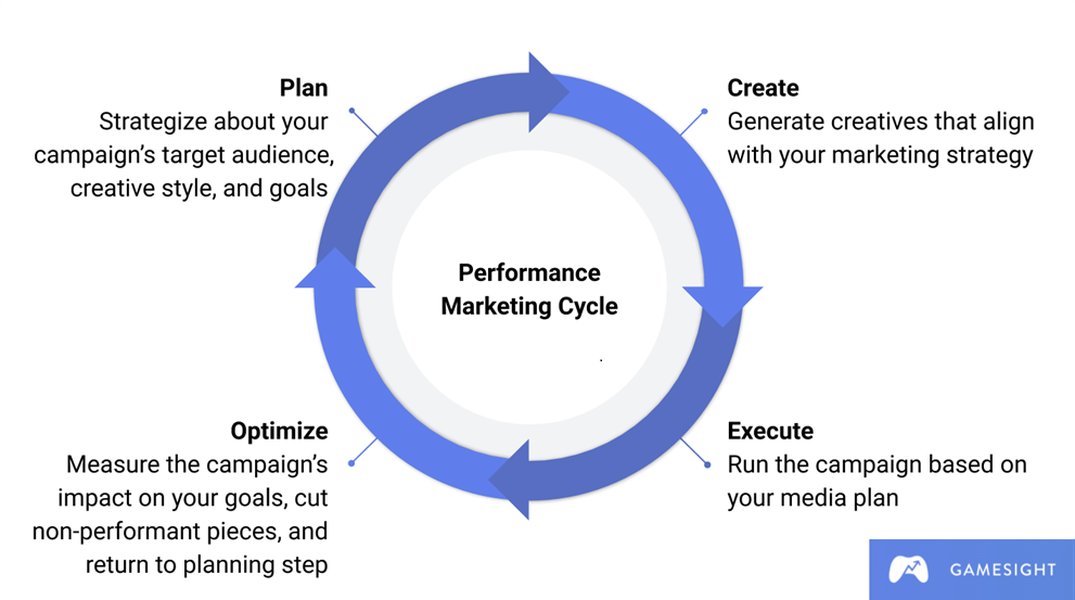
The iterative cycle of performance marketing emphasizes continuous tracking and optimization.
Key Players in the Performance Marketing Ecosystem
Performance marketing typically involves collaboration between several parties:
- Advertisers (or Merchants/Retailers): Businesses seeking to promote their products or services and achieve specific actions.
- Publishers (or Affiliates/Partners): Website owners, influencers, bloggers, app developers, or other entities that promote the advertiser's offerings on their platforms.
- Networks and Platforms: Intermediaries like affiliate networks (e.g., Commission Junction, Rakuten Advertising) or advertising platforms (e.g., Google Ads, Meta Ads) that connect advertisers and publishers, provide tracking technology, handle payments, and facilitate campaign management.
- Affiliate Managers / Outsourced Program Management (OPMs): Individuals or agencies responsible for managing an advertiser's affiliate program, including recruitment, relationship management, strategy, and optimization.
Popular Channels and Types of Performance Marketing
Performance marketing strategies can be implemented across a variety of digital channels:
- Affiliate Marketing: Partnering with affiliates who earn commissions for driving sales or leads through unique tracking links.
- Paid Search Marketing (PPC/SEM): Running ads on search engines like Google or Bing, typically paying per click (CPC) for users searching relevant keywords.
- Social Media Advertising: Utilizing platforms like Facebook, Instagram, LinkedIn, TikTok, etc., to run targeted ad campaigns, often paying based on clicks, leads, or conversions.
- Display Advertising: Placing visual ads (banners, videos) on websites within ad networks, often using performance-based models like CPA or CPC, sometimes involving programmatic buying.
- Native Advertising: Ads designed to blend seamlessly with the surrounding content on a platform (e.g., sponsored articles, promoted listings), often measured by engagement or conversions.
- Performance-Based Email Marketing: Sending targeted emails designed to drive specific actions like purchases or sign-ups, with success measured by conversion rates.

Performance marketing encompasses diverse channels tailored to specific goals.
Visualizing Performance Marketing Components
To better understand how the different elements of performance marketing connect, the mindmap below illustrates the core concept branching out into its key channels, benefits, metrics, stakeholders, and the operational process involved. It provides a holistic view of this results-driven strategy.
Pay for Results"] id2["Key Channels"] id2a["Affiliate Marketing"] id2b["Paid Search (PPC/SEM)"] id2c["Social Media Ads"] id2d["Display Advertising"] id2e["Native Advertising"] id2f["Email Marketing"] id3["Major Benefits"] id3a["Cost-Effective"] id3b["Measurable ROI"] id3c["Data-Driven Optimization"] id3d["Scalability"] id3e["Targeted Reach"] id4["Essential Metrics (KPIs)"] id4a["CPA (Cost Per Acquisition)"] id4b["CPL (Cost Per Lead)"] id4c["CPC (Cost Per Click)"] id4d["CTR (Click-Through Rate)"] id4e["Conversion Rate"] id4f["ROI (Return on Investment)"] id4g["MER (Marketing Efficiency Ratio)"] id5["Key Stakeholders"] id5a["Advertisers / Merchants"] id5b["Publishers / Affiliates"] id5c["Networks / Platforms"] id5d["Managers / Agencies"] id6["Operational Process"] id6a["Set Goals"] id6b["Select Channels"] id6c["Track Actions"] id6d["Attribute Results"] id6e["Pay for Performance"] id6f["Analyze & Optimize"]
Measuring Success: Key Performance Indicators (KPIs)
The measurability of performance marketing is one of its greatest strengths. Success is gauged using specific KPIs that reflect campaign effectiveness and efficiency. Tracking these metrics allows for informed decision-making and continuous improvement. Here are some of the most common KPIs:
| KPI | Description | Relevance |
|---|---|---|
| CPA (Cost Per Acquisition/Action) | The average cost incurred for each desired action (e.g., sale, completed form). | Directly measures the cost-effectiveness of achieving the primary conversion goal. |
| CPL (Cost Per Lead) | The average cost incurred for generating one qualified lead. | Crucial for businesses focused on lead generation for their sales funnel. |
| CPC (Cost Per Click) | The cost paid each time a user clicks on an advertisement. | Measures the cost of driving traffic to a landing page or website. |
| CTR (Click-Through Rate) | The percentage of impressions that result in a click (\( \text{Clicks} / \text{Impressions} \times 100\% \)). | Indicates ad relevance and effectiveness at capturing user attention. |
| Conversion Rate (CVR) | The percentage of users who complete the desired action after clicking the ad (\( \text{Conversions} / \text{Clicks} \times 100\% \)). | Measures how effectively the landing page and offer convert traffic. |
| ROI (Return on Investment) | The profit generated from the campaign relative to its cost (\( [(\text{Revenue} - \text{Cost}) / \text{Cost}] \times 100\% \)). | The ultimate measure of profitability for the marketing spend. |
| MER (Marketing Efficiency Ratio) | Total revenue divided by total marketing spend (\( \text{Total Revenue} / \text{Total Marketing Spend} \)). Also known as Blended ROAS. | Provides a high-level view of overall marketing efficiency across channels. |
Assessing Channel Effectiveness: A Comparative View
Different performance marketing channels excel in different areas. The radar chart below offers a hypothetical comparison of popular channels based on key attributes relevant to performance marketers. These scores represent general tendencies rather than definitive data, as actual performance varies greatly based on industry, execution, and target audience. Factors considered include ROI potential, scalability, targeting precision, cost efficiency (where a higher score means better efficiency), and the relative simplicity of tracking results.
Benefits of Embracing Performance Marketing
Adopting a performance marketing approach offers numerous advantages for businesses:
- Cost-Effectiveness & Reduced Risk: Paying only for actual results minimizes wasted ad spend and lowers the financial risk associated with advertising campaigns.
- Measurability & Accountability: Every dollar spent can be tracked and attributed to specific outcomes, providing clear ROI calculations and holding marketing efforts accountable.
- Data-Driven Insights & Optimization: The wealth of performance data generated allows for continuous learning and refinement of strategies, leading to better targeting, creative, and overall campaign effectiveness.
- Scalability: Successful campaigns can often be scaled effectively by increasing budgets on high-performing channels or expanding partnerships.
- Targeted Reach: Digital platforms used in performance marketing offer sophisticated targeting options, allowing advertisers to reach specific audience segments more precisely.
- Transparency: Provides clear visibility into where the marketing budget is going and what results it's generating.
Challenges and Considerations
Despite its benefits, performance marketing also presents certain challenges:
- Potential Short-Term Focus: An overemphasis on immediate conversions might sometimes neglect longer-term brand building activities.
- Competition and Costs: Popular and high-performing channels can become competitive, driving up costs (e.g., CPC bids).
- Tracking Complexity & Privacy Concerns: Accurate tracking can be complex, involving multiple technologies. Furthermore, evolving privacy regulations (like restrictions on third-party cookies) require careful navigation and adaptation of tracking methods.
- Quality Control: Especially in affiliate marketing, advertisers need to monitor partner activities to ensure brand safety and prevent fraudulent practices.
Real-World Success Stories
Numerous companies have leveraged performance marketing effectively. For instance, early pioneers like Amazon built vast affiliate networks. Subscription services like Spotify and Dollar Shave Club have used targeted social media ads and influencer collaborations paid on a performance basis to acquire users rapidly. Travel companies like Airbnb utilized referral programs (a form of affiliate marketing) to fuel exponential growth. These examples demonstrate the power of tying marketing spend directly to acquisition and conversion goals across various industries.
Learn More About Performance Marketing
For a deeper dive into the concepts and metrics discussed, the following video provides a helpful overview of performance marketing, explaining its core ideas and relevance in today's digital landscape:
This video explores digital marketing metrics and KPIs, which are fundamental to understanding and executing successful performance marketing campaigns.
Frequently Asked Questions (FAQ)
How is performance marketing different from digital marketing?
Digital marketing is a broad umbrella term encompassing all marketing efforts that use electronic devices or the internet. Performance marketing is a *subset* of digital marketing that specifically focuses on strategies where payment is directly tied to measurable actions or results (like clicks, leads, or sales).
Is performance marketing suitable for small businesses?
Yes, absolutely. Because it's results-driven and often involves paying only when specific actions occur, it can be very cost-effective for small businesses with limited budgets. It allows them to ensure their marketing spend directly contributes to tangible outcomes like sales or leads, making it easier to manage ROI.
What are the most common payment models in performance marketing?
The most common models are Cost Per Acquisition (CPA) or Cost Per Sale (CPS), where payment is made for each sale; Cost Per Lead (CPL), paying for each qualified lead; and Cost Per Click (CPC), paying for each click on an ad. The choice depends on the specific campaign goals.
What tools are typically used to track performance marketing campaigns?
A variety of tools are used, including analytics platforms (like Google Analytics), ad platform reporting dashboards (Google Ads, Meta Ads Manager), affiliate network platforms, specialized tracking and attribution software (like Impact.com, PartnerStack, Voluum), Customer Relationship Management (CRM) systems, and tag management solutions (like Google Tag Manager).
Does performance marketing replace brand marketing?
No, they are generally complementary. Brand marketing builds awareness and long-term value, creating an audience that performance marketing can then convert into customers. A balanced strategy often involves both approaches working together to build a sustainable business.
Recommended Further Exploration
- Explore advanced performance marketing strategies for e-commerce.
- Compare the effectiveness of different performance marketing channels.
- Understand the role of affiliate networks in performance marketing.
- Learn about the latest tools and technologies used for tracking performance marketing campaigns.
References

Last updated May 4, 2025