

- Gerunds exhibit a unique dual nature: while they function as nouns in a sentence, their verb-derived origin allows them to retain certain verbal characteristics.
- Adverbs are the primary modifiers for the verbal aspect of a gerund, providing information about how, when, where, or to what extent the action occurs.
- Adjectives can modify gerunds when emphasizing their noun-like qualities, particularly when the gerund is functioning as a standalone noun or within a possessive construction.
Understanding how gerunds are modified is crucial for achieving grammatical precision and clarity in English. Gerunds, which are verb forms ending in "-ing" that function as nouns, present a fascinating linguistic paradox. Their inherent "verbness" allows them to take adverbial modifiers, much like a verb, while their role as a noun means they can also be modified by adjectives. This dual nature can often lead to confusion, but by dissecting their function within a sentence, we can determine the appropriate type of modifier.
The Curious Case of the Gerund: A Blended Identity
A gerund is a verbal that ends in "-ing" and acts as a noun. This means it can occupy any position in a sentence that a noun typically would, such as a subject, direct object, subject complement, or object of a preposition. For example, in "Swimming is good exercise," "swimming" acts as the subject of the sentence. Similarly, in "She enjoys reading," "reading" serves as the direct object of the verb "enjoys."
Despite their noun function, gerunds retain some characteristics of verbs. They can express action or a state of being, have grammatical categories of voice and tense, and can even take direct objects and complements, forming what is known as a gerund phrase. This blend of verbal and nominal properties is what makes their modification unique and, at times, perplexing.
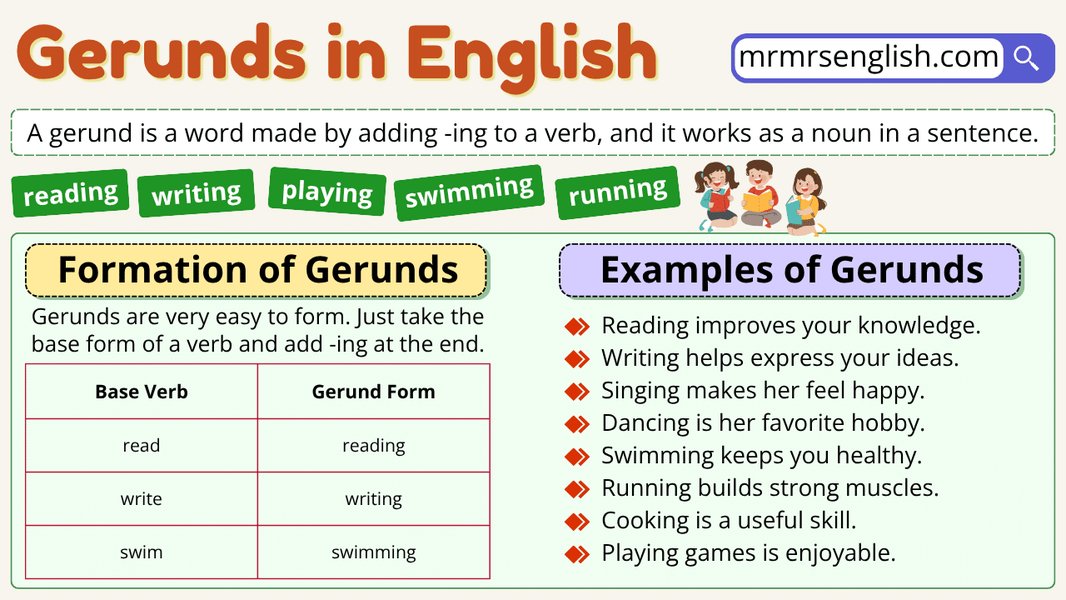
Visual representation of gerunds in English with examples.
The Verbal Side: Adverbs Step In
Because gerunds originate from verbs, they can be modified by adverbs. Adverbs describe how, when, where, or to what extent an action is performed. When an adverb modifies a gerund, it emphasizes the action or process that the gerund represents.
Adverbs Modifying Gerunds: Illustrative Examples
- "Quickly finishing the assignment impressed the teacher." Here, "quickly" (an adverb) modifies "finishing" (the gerund), indicating the manner in which the assignment was finished.
- "Working diligently from home allows for more flexibility." "Diligently" modifies "working," describing the quality of the work.
- "Regularly visiting the hospital ensures continuous care." "Regularly" modifies "visiting," indicating the frequency of the action.
This adverbial modification highlights the gerund's verb-like ability to convey action and its associated circumstances. The adverb directly describes the action implied by the gerund.
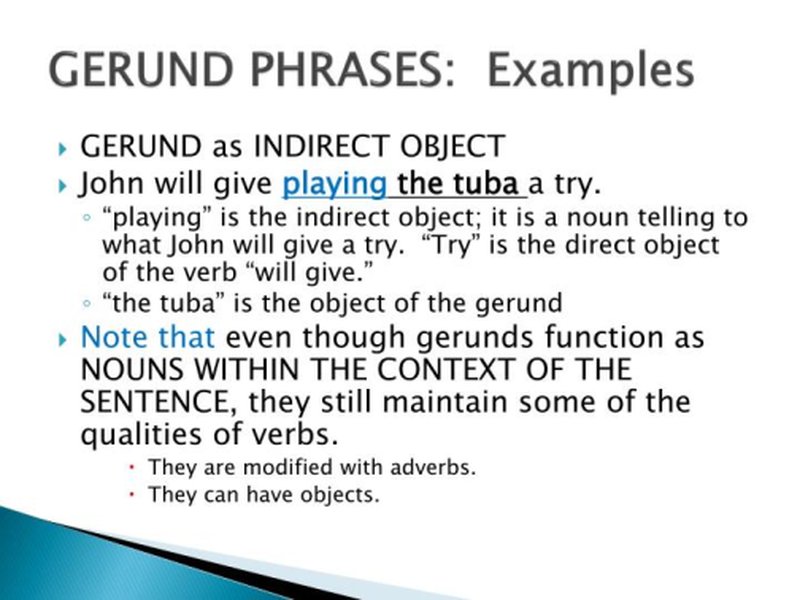
Examples of gerund phrases modified by adverbs.
The Nominal Aspect: Where Adjectives Play a Role
When a gerund functions more strongly as a noun, it can be modified by adjectives. Adjectives describe or provide more information about nouns, answering questions like "which one?" "what kind?" or "how many?" This typically occurs when the gerund is treated more as a conceptual entity rather than an ongoing action.
Adjectives Modifying Gerunds: Contextual Examples
- "Her persistent questioning revealed the truth." In this case, "persistent" (an adjective) modifies "questioning" (the gerund), describing the characteristic of the act of questioning.
- "Continual monitoring is essential for data security." "Continual" modifies "monitoring," indicating the type of monitoring.
It's important to note that when an adjective modifies an -ing word, it often emphasizes the noun-like quality, sometimes even hinting that the -ing word might be functioning as a verbal noun rather than a true gerund in certain contexts. The distinction can be subtle and is often debated among grammarians.
The Possessive Case: A Special Adjectival Modification
One clear instance where a gerund is modified in an adjective-like manner is when a noun or pronoun precedes it in the possessive case. Because gerunds function as nouns, if a noun or pronoun precedes a gerund, it must be in the possessive case to modify the gerund effectively.
Possessive Modifiers with Gerunds: Key Instances
- "I appreciate your coming to the event." Here, "your" (a possessive pronoun) modifies "coming," indicating whose coming is appreciated.
- "John's singing was impressive." "John's" (a possessive noun) modifies "singing," clarifying whose singing is being discussed.
This possessive construction is a strong indicator of the gerund acting purely in its nominal capacity.
The Nuance of Gerund Phrases
A gerund phrase is a group of words consisting of a gerund and any modifiers, objects, or complements associated with it. The entire phrase functions as a noun within the sentence. Just like a single gerund, a gerund phrase can be modified.
For instance, in "Eating blackberries without washing them will make you ill," the entire phrase "eating blackberries without washing them" is the subject. Within this phrase, "without washing them" acts as an adverbial modifier to the gerund "eating." This demonstrates how modifiers can be internal to the gerund phrase, describing the action of the gerund itself, or external, modifying the entire phrase.
Differentiating Gerund Phrases from Participial Phrases
It's crucial to distinguish gerund phrases from participial phrases, as both begin with an "-ing" word. The key difference lies in their function: a gerund phrase always acts as a noun, while a participial phrase functions as an adjective, modifying a noun or pronoun. For example, "Running quickly, he caught the bus" contains a participial phrase ("running quickly") modifying "he," while "Running quickly is exhilarating" uses "running quickly" as a gerund phrase functioning as the subject.
This mindmap illustrates the various ways gerunds and gerund phrases can be modified, highlighting their dual verbal and nominal characteristics and the types of modifiers associated with each aspect.
The Great Debate: Adjective or Adverb?
The question of whether a gerund should be modified by an adjective or an adverb is a classic point of contention in grammar. The confusion arises because gerunds, despite acting as nouns, are derived from verbs and thus retain some verbal properties. The consensus, however, leans towards adverbial modification when emphasizing the action of the gerund, and adjectival modification when emphasizing its noun-like quality, particularly in possessive constructions.
| Modifier Type | When to Use | Example | Rationale |
|---|---|---|---|
| Adverb | When the gerund's verbal (action) aspect is emphasized. | "Rapidly speaking can lead to misunderstandings." | "Rapidly" describes how the speaking occurs, focusing on the action. |
| Adjective | When the gerund's nominal (noun-like) aspect is emphasized, often in a more static or descriptive sense. | "Her quick thinking saved the day." | "Quick" describes the type of thinking, treating "thinking" more like a characteristic noun. |
| Possessive Noun/Pronoun | When indicating ownership or agency related to the gerund. | "We celebrated their winning the championship." | "Their" indicates whose winning is being celebrated, functioning as a possessive adjective. |
| Prepositional Phrase | To add further context or detail (can function adverbially or adjectivally within a gerund phrase). | "Walking in the park is relaxing." | "In the park" modifies "walking," specifying where the walking happens. |
This table summarizes the different types of modifiers for gerunds and the contexts in which they are most appropriately used.
The Role of Context in Gerund Modification
Ultimately, the choice between an adverbial or adjectival modifier for a gerund often boils down to the specific nuance you wish to convey. If the focus is on the action itself and how it is performed, an adverb is generally preferred. If the gerund is functioning more as a static concept or is part of a possessive construction, an adjective is more appropriate.
Grammarly and Purdue OWL both emphasize that gerunds retain verbal qualities, allowing for adverbial modification, while also functioning as nouns, making them susceptible to adjectival modification in certain contexts. The key is to consider what aspect of the gerund—its action or its noun-like identity—you are intending to describe.
FAQ: Frequently Asked Questions About Gerunds and Their Modifiers
What is a gerund?
Can a gerund be modified by an adverb?
Can a gerund be modified by an adjective?
What is a gerund phrase?
How can I tell the difference between a gerund and a present participle?
Conclusion: The Dynamic Nature of Gerunds
The modification of gerunds encapsulates the dynamic nature of English grammar. While fundamentally functioning as nouns, their verbal lineage grants them a unique flexibility, allowing for both adverbial and adjectival modification. The context in which a gerund is used dictates the appropriate modifier, with adverbs typically describing the action and adjectives detailing the noun-like quality or defining the possessive relationship. Mastering this distinction enhances both the precision and expressiveness of one's writing.
Recommended Further Exploration
- How to distinguish gerunds from present participles?
- What are the various grammatical functions of gerund phrases in sentences?
- When should the possessive case be used with gerunds?
- What is the difference between gerunds and verbal nouns?