
Understanding the Sum of Two and Two
A Fundamental Concept in Arithmetic
Key Insights
- Direct Addition: The expression "2 + 2" represents a basic addition operation.
- Arithmetic Foundation: Addition is one of the four fundamental arithmetic operations.
- Result: The sum of 2 and 2 is consistently 4.
The Core of the Query: Simple Addition
The query "whats 2+2" asks for the result of a fundamental arithmetic operation: addition. In mathematics, addition is the process of combining two or more numbers or quantities to find their total sum. The symbol used to denote addition is the plus sign (+).
When we encounter the expression \(2 + 2\), it instructs us to combine a quantity of 2 with another quantity of 2. This is a basic concept typically introduced early in mathematics education.
Arithmetic: The Foundation
Arithmetic is the oldest and most elementary branch of mathematics. It deals with the study of numbers and the traditional operations performed on them. These fundamental operations include:
- Addition (+)
- Subtraction (-)
- Multiplication (×)
- Division (÷)
The expression \(2 + 2\) falls squarely within the domain of arithmetic, specifically the operation of addition.
The Role of Addition
Addition is a core concept in arithmetic. It is the process of finding the total number of items when two or more groups are combined. For example, if you have 2 apples and you are given 2 more apples, you can use addition to find the total number of apples you now have. This can be represented as \(2 \text{ apples} + 2 \text{ apples} = 4 \text{ apples}\).
Visualizing Addition with a Number Line
One way to visualize addition is by using a number line. To find the sum of 2 and 2 using a number line, you start at the position representing the first number (2). Then, you move to the right by a number of units equal to the second number (2). The position you land on is the sum. Starting at 2 and moving 2 units to the right brings you to 4.
Calculating 2 + 2
The calculation of \(2 + 2\) is a straightforward application of the addition operation. When we add 2 to 2, we are combining two sets, each containing two units. The total number of units in the combined set is four.
This can be illustrated with objects:
-
Imagine you have two objects, like two balls.
-
Now, imagine you get two more objects, another two balls.
-
If you put all the balls together, you will have a total of four balls.
Mathematically, this is represented as:
\[ 2 + 2 = 4 \]This result is a fundamental arithmetic fact that is universally accepted in standard mathematics.
Confirmation from Various Sources
Numerous resources and educational materials confirm that the sum of 2 and 2 is 4. This basic addition fact is a cornerstone of learning arithmetic and is presented as a foundational concept in various educational contexts.
Common Arithmetic Operations
While the query specifically asks about addition, it's helpful to understand the context of other basic arithmetic operations. Here is a table summarizing the four fundamental operations:
| Operation | Symbol | Description | Example |
|---|---|---|---|
| Addition | + | Combining quantities to find a total sum. | \(2 + 2 = 4\) |
| Subtraction | - | Finding the difference between two quantities. | \(5 - 3 = 2\) |
| Multiplication | × or * | Repeated addition of a quantity. | \(2 \times 3 = 6\) (which is \(3 + 3\)) |
| Division | ÷ or / | Splitting a quantity into equal parts. | \(6 \div 2 = 3\) (splitting 6 into 2 equal parts) |
Understanding these operations is crucial for tackling more complex mathematical problems.
Exploring Basic Addition Visually
Visual aids can be very effective in understanding basic addition. Here's an image that represents the concept of combining two groups of two to get a total of four:
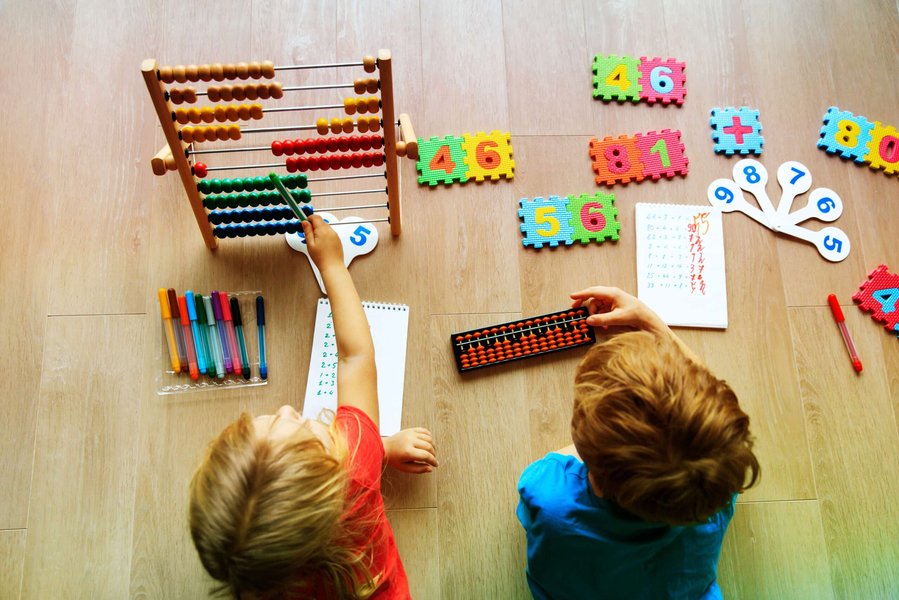
Children engaged in learning basic math concepts, which often involves visual aids for addition.
Using concrete objects or visual representations helps solidify the understanding that combining two units with another two units results in a total of four units.
The Significance of Basic Arithmetic
While \(2 + 2 = 4\) is a very simple calculation, mastering basic arithmetic is fundamental to understanding more advanced mathematical concepts. A strong foundation in addition, subtraction, multiplication, and division is essential for success in algebra, calculus, and various scientific fields.
Basic arithmetic skills are also vital in everyday life, from managing personal finances and calculating change to understanding measurements and interpreting data.
Arithmetic in Daily Life
We use arithmetic constantly without even realizing it. Calculating the cost of groceries, figuring out how much time you have left before an appointment, or dividing a pizza among friends all involve basic arithmetic operations. The ability to quickly and accurately perform these calculations is a valuable skill.
FAQs
Is there any other answer to 2 + 2?
In standard arithmetic within the decimal number system, the sum of 2 and 2 is always 4. While some philosophical or abstract contexts might explore alternative mathematical systems, for typical arithmetic problems, 2 + 2 equals 4.
How is addition taught to young children?
Addition is often taught to young children using concrete objects, counting on fingers, number lines, and simple word problems. The goal is to help them understand the concept of combining quantities.
Why is basic addition important?
Basic addition is a foundational skill for all subsequent mathematical learning. It helps develop number sense and is a prerequisite for understanding more complex operations and mathematical concepts.
Further Exploration of Addition
For those interested in learning more about addition and basic arithmetic, there are many resources available. Here is a video that provides a basic introduction to addition:
This video offers a basic introduction to the concept of addition.
Understanding the fundamental operation of addition is a crucial first step in mastering mathematics.
References
Last updated May 17, 2025