
Earth's Next Ice Age: When Does the Deep Freeze Return?
Unraveling the natural cycles and human impact on our planet's glacial future.
The question of when Earth might next plunge into an ice age fascinates many. It involves understanding vast geological timescales, intricate orbital mechanics, and, increasingly, the profound impact of human civilization on the planet's climate system. While Earth naturally cycles between glacial periods (ice ages) and warmer interglacial periods, predicting the exact timing of the next deep freeze isn't straightforward.
Highlights: The Frozen Forecast
- Natural Timing: Based on Earth's orbital cycles (Milankovitch cycles), the planet would naturally be heading towards conditions suitable for the start of the next ice age in approximately 10,000 to 11,000 years.
- Human Intervention: Anthropogenic greenhouse gas emissions are significantly warming the planet, disrupting natural cycles and likely delaying the next ice age by tens of thousands, possibly over 100,000 years, or potentially preventing it altogether within current emission scenarios.
- No Imminent Threat: Despite speculation, there is no credible scientific evidence supporting claims of an impending "mini ice age" or a near-term onset of major glaciation. Current climate trends are dominated by human-caused warming.
Earth's Natural Climate Rhythms: The Milankovitch Clock
For the last ~2.5 million years (the Quaternary Period), Earth's climate has oscillated between long ice ages and shorter, warmer interglacial periods like the one we live in now, the Holocene. This epoch began roughly 11,700 years ago after the retreat of massive ice sheets from the Last Glacial Maximum (LGM).
These long-term climate shifts are primarily orchestrated by subtle, predictable variations in Earth's orbit around the Sun, known as Milankovitch cycles.
Understanding Milankovitch Cycles
The Key Orbital Variations
Three main orbital parameters interact to influence the amount and distribution of solar radiation (insolation) reaching Earth, particularly in the Northern Hemisphere where large ice sheets tend to form:
- Eccentricity: The shape of Earth's orbit around the Sun varies from nearly circular to more elliptical over cycles of about 100,000 and 413,000 years. Higher eccentricity means greater variation in solar energy received throughout the year.
- Obliquity (Axial Tilt): The angle of Earth's axial tilt changes between about 22.1° and 24.5° over a cycle of roughly 41,000 years. A greater tilt leads to more extreme seasons (hotter summers, colder winters), while a lesser tilt promotes milder seasons, which can allow snow to persist through summer at high latitudes, building up ice sheets.
- Precession: This refers to the wobble of Earth's rotational axis, like a spinning top, which changes the timing of the seasons relative to Earth's position in its orbit (perihelion and aphelion). This cycle takes about 26,000 years. It affects whether summer in a hemisphere occurs when Earth is closest to or farthest from the Sun.
When these cycles align to reduce summer sunlight in the Northern Hemisphere, snow and ice can survive the warmer months, gradually accumulating over millennia to form vast continental ice sheets, triggering an ice age.
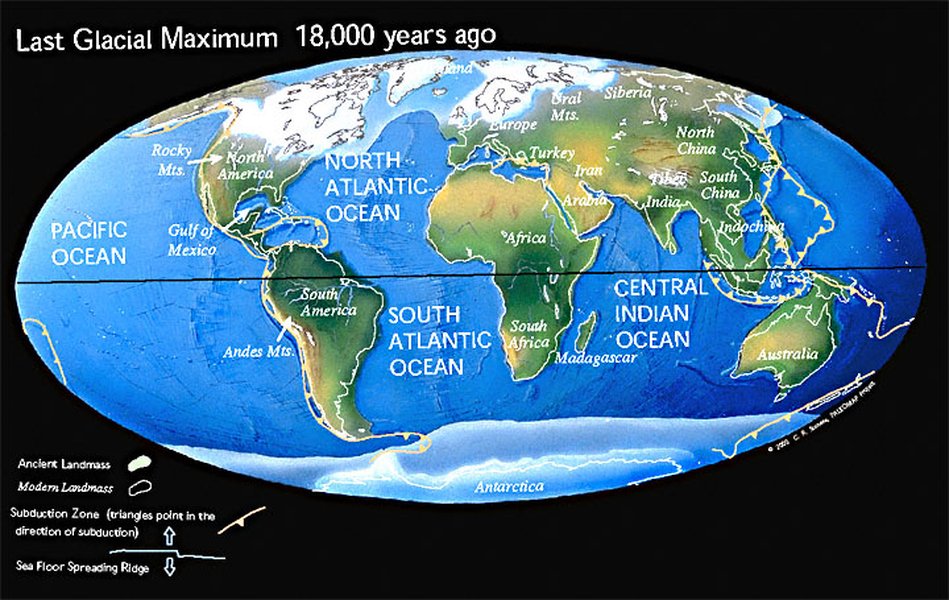
Map depicting approximate ice coverage and coastlines during the Last Glacial Maximum, around 20,000 years ago.
The Geological Clock and Future Glaciation
By analyzing geological records like ice cores and deep-sea sediments, scientists can reconstruct past climate changes and correlate them with calculated Milankovitch cycles. Recent research, including studies from institutions like UC Santa Barbara and Cardiff University, analyzing patterns over the last 900,000 years, has reinforced the link between orbital forcing and glacial cycles.
These studies converge on the prediction that, based purely on natural orbital mechanics, the current Holocene interglacial period is relatively stable, and the conditions required to initiate the next major glaciation are expected to align in approximately 10,000 to 11,000 years.
Mindmap: Ice Age Drivers and Timing
This mindmap illustrates the key factors influencing Earth's glacial cycles and the predicted timeline for the next ice age based on natural patterns versus human influence.
(e.g., Albedo)"] id2["Geological Context"] id2a["Quaternary Period
(~2.5 million years)"] id2b["Glacial / Interglacial Periods"] id2c["Current: Holocene Interglacial
(Started ~11,700 yrs ago)"] id3["Timing of Next Ice Age"] id3a["Natural Prediction"] id3a1["Based on Orbital Cycles"] id3a2["~10,000 - 11,000 years from now"] id3b["Human Impact"] id3b1["Greenhouse Gas Emissions"] id3b2["Atmospheric Warming"] id3b3["Significant Delay
(Tens of thousands
to >100,000 yrs)"] id3b4["Potential Prevention"]
The Human Factor: A Spanner in the Orbital Works
While Milankovitch cycles set the natural tempo for ice ages, human activities since the Industrial Revolution have introduced a powerful new variable into the climate equation: greenhouse gases.
Greenhouse Gases vs. Natural Cooling
The concentration of carbon dioxide (CO2) and other heat-trapping gases in the atmosphere has risen dramatically due to the burning of fossil fuels, deforestation, and industrial processes. These gases create a warming effect that counteracts the subtle cooling trends induced by orbital variations that would normally nudge the planet towards glaciation.
Current atmospheric CO2 levels are far higher than they have been during previous interglacial periods over the past 800,000 years or more. This unprecedented level of greenhouse gases means the planet retains significantly more heat, overwhelming the natural mechanisms that initiate ice ages.
Delaying the Inevitable Freeze?
Climate models and studies analyzing the impact of current and projected greenhouse gas levels suggest that the onset of the next ice age has been substantially postponed. Estimates vary depending on future emission scenarios, but many scientists suggest the delay could be on the order of:
- At least 50,000 years: Several studies propose that even if emissions were drastically reduced now, the existing CO2 levels are sufficient to postpone the next glaciation for this long.
- Potentially 100,000 years or more: If emissions continue at high rates, the warming effect could suppress ice age conditions for an even longer duration, effectively skipping at least one natural glacial cycle.
- Indefinite Suppression: Some research indicates that under sustained high-emission scenarios, the conditions necessary for large-scale ice sheet formation might not occur for the foreseeable future, essentially averting the next ice age entirely as long as greenhouse gas concentrations remain elevated.
This human-induced warming is now considered the dominant factor controlling Earth's near-term and potentially long-term climate trajectory, overriding the natural Milankovitch pacemaker.
Relative Influence on Current Climate
The following chart illustrates the estimated relative influence of different factors on Earth's current climate trajectory. It highlights how anthropogenic greenhouse gas levels are currently exerting a much stronger warming influence than the long-term cooling trend from natural cycles or short-term variations like solar activity.
This chart visually represents the current dominance of human-caused warming (via greenhouse gases) over the natural long-term cooling trend associated with Milankovitch cycles, as well as other shorter-term natural influences.
What Would an Ice Age Look Like?
While likely delayed or averted for the foreseeable future due to human influence, contemplating a future ice age helps understand Earth's climate potential.
A Fundamentally Colder World
The defining characteristic of an ice age is a significant drop in global average temperatures, allowing vast sheets of ice, potentially kilometers thick, to cover large parts of the continents, primarily in the Northern Hemisphere (North America, Europe, Asia).
Global Transformations
The onset of glaciation would trigger profound changes across the globe:
- Sea Level Drop: As vast amounts of water become locked up in continental ice sheets, global sea levels would fall dramatically, potentially by 100 meters or more, exposing continental shelves and connecting landmasses currently separated by water (like Alaska and Siberia).
- Landscape Reshaping: Advancing glaciers act like giant bulldozers, carving valleys, creating lakes, grinding down mountains, and depositing massive amounts of sediment (moraines, drumlins), radically altering landscapes.
- Ecosystem Shifts: Plant and animal species would be forced to migrate towards the equator, adapt to colder conditions, or face extinction. Tundra and boreal forests would expand significantly.
- Challenges for Civilization: Areas currently supporting large populations and extensive agriculture would become uninhabitable under ice or permafrost. Infrastructure would be destroyed or buried. Freshwater resources would shift dramatically.
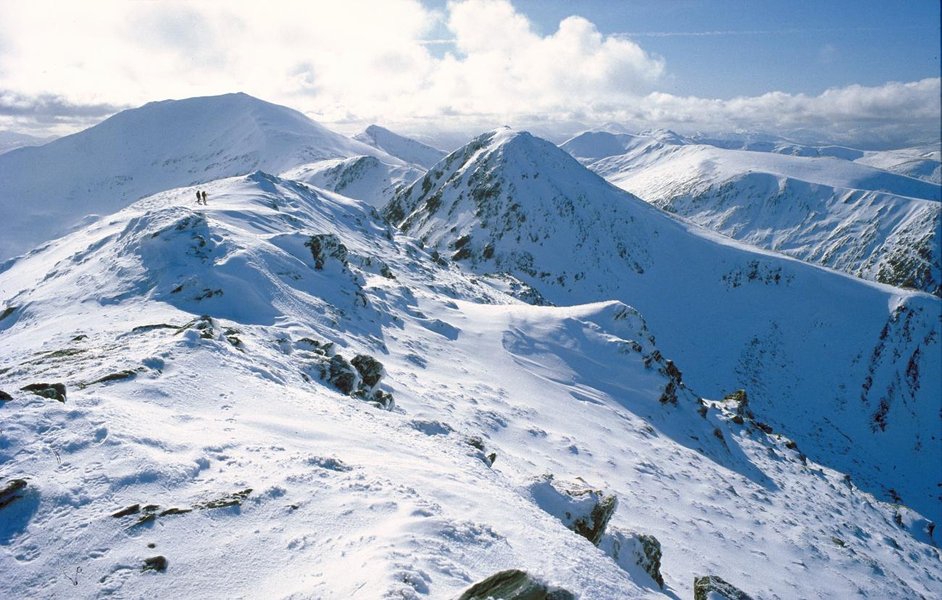
Glaciers dramatically reshape landscapes, carving U-shaped valleys and leaving behind distinct geological features.
Debunking Common Myths
Discussions about ice ages sometimes involve misunderstandings or sensationalized claims.
The "Mini Ice Age" Myth
Claims occasionally surface suggesting an imminent "mini ice age," often linked to periods of lower solar activity (like a Grand Solar Minimum). However, mainstream climate science refutes this. While prolonged periods of low solar activity can have a minor cooling effect, it is vastly outweighed by the warming impact of anthropogenic greenhouse gases. Organizations like NASA have explicitly stated that even a significant solar minimum would only offset a few years of human-caused warming, and it would not trigger an ice age or even a "mini ice age." Ice ages are driven by long-term orbital cycles, not short-term variations in solar output.
Educational Perspective: Understanding the Cycles
For a clear explanation of ice age cycles and their drivers, this video provides valuable insights into the science behind these long-term climate shifts.
This TED-Ed video explains the mechanisms behind ice ages, including Milankovitch cycles, and touches upon the potential timing based on natural patterns.
Summary Table: Ice Age Timing Factors
This table summarizes the key factors influencing the timing of the next ice age:
| Factor | Description | Influence on Next Ice Age Timing |
|---|---|---|
| Natural Cycles (Milankovitch) | Long-term variations in Earth's orbit and tilt affecting solar radiation distribution. | Predicts conditions suitable for onset in ~10,000 - 11,000 years without external interference. Primary natural driver. |
| Anthropogenic Greenhouse Gases | Heat-trapping gases (CO2, methane, etc.) released by human activities. | Causes significant global warming, counteracting natural cooling trends. Expected to delay onset by 50,000 - 100,000+ years or prevent it indefinitely. Currently the dominant factor. |
| Solar Activity Variations | Short-term changes in the Sun's energy output (e.g., sunspot cycles, solar minimums). | Minor influence compared to orbital cycles and greenhouse gases. Cannot trigger or prevent an ice age. Insufficient to cause a "mini ice age." |
| Predicted Natural Timing | When the next ice age *would* likely begin based solely on orbital cycles. | Approximately 10,000 - 11,000 years from now. |
| Predicted Actual Timing (Factoring Humans) | When the next ice age is *now expected* given human impact. | Delayed by at least 50,000 years, potentially much longer or indefinitely suppressed. |
| Likelihood of Near-Term Ice Age (Next Century) | Probability of an ice age starting within decades. | Effectively zero. Climate trends point strongly towards continued warming. |
Frequently Asked Questions
What are Milankovitch cycles?
How long do ice ages typically last?
How do scientists know about past ice ages?
Could climate change actually *cause* an ice age?
Are we currently in an ice age?
Recommended
- What are Milankovitch cycles and how do they affect climate?
- How does human activity influence long-term climate cycles?
- What was the Earth like during the Last Glacial Maximum?
- Differences between glacial and interglacial periods?
References
Last updated April 28, 2025