
Billiards at the White House: A Presidential Pastime
Uncovering the History and Location of Pool Tables in the Executive Mansion
- A Storied Tradition: Billiards has been a recreational staple in the White House since the early 19th century, with presidents using it for relaxation and diversion.
- Dynamic Locations: Pool tables have occupied various rooms over time, including the modern-day Map Room, Vermeil Room, and currently, a dedicated Game Room on the third floor.
- Presidential Preference: While some presidents actively engaged with the pool table, its presence has at times sparked public debate regarding the use of taxpayer funds for leisure.
The White House, the iconic residence of the President of the United States, is not merely a center for political activity but also a home with various amenities designed for the First Family's recreation and relaxation. Among these amenities, the presence of a pool table has a long and interesting history, reflecting both presidential preferences and evolving public perceptions of leisure within the Executive Mansion.
A Legacy of Leisure: The White House and Billiards
Indeed, there is a pool table in the White House, and its history stretches back nearly two centuries. Billiards has served as a consistent source of diversion for many presidents and their families, offering a break from the immense pressures of their roles.
Early Beginnings: John Quincy Adams and Public Scrutiny
The tradition of billiards in the White House began with John Quincy Adams, who in 1828 became the first president to install a billiard table. This acquisition, however, was not without controversy. Adams faced significant criticism for using public funds to purchase what some considered "gambling furniture" for the "President’s Palace." The cost of the table, cues, and balls, amounting to $61, was initially billed to the government, leading to public outrage and becoming a point of attack by supporters of Andrew Jackson during the 1828 presidential election campaign. This early instance highlights the delicate balance between a president's personal comfort and public accountability for expenditures within the White House.
An artistic rendering of a billiard room, possibly within the White House, showcasing a pool table from an earlier era.
Evolution of Location and Usage
Over the decades, the pool table has moved to different locations within the White House, adapting to changing layouts and the needs of various administrations. Initially, billiard tables were housed in rooms that are now known by different names. For example, the Billiard Room, located on the southwest end of the Ground Floor Corridor, is now known as the Map Room. The Vermeil Room has also, at times, housed a pool table. These early placements suggest a more fluid approach to room designation, where spaces were repurposed based on the First Family's activities.
The Game Room: A Dedicated Space Since 1970
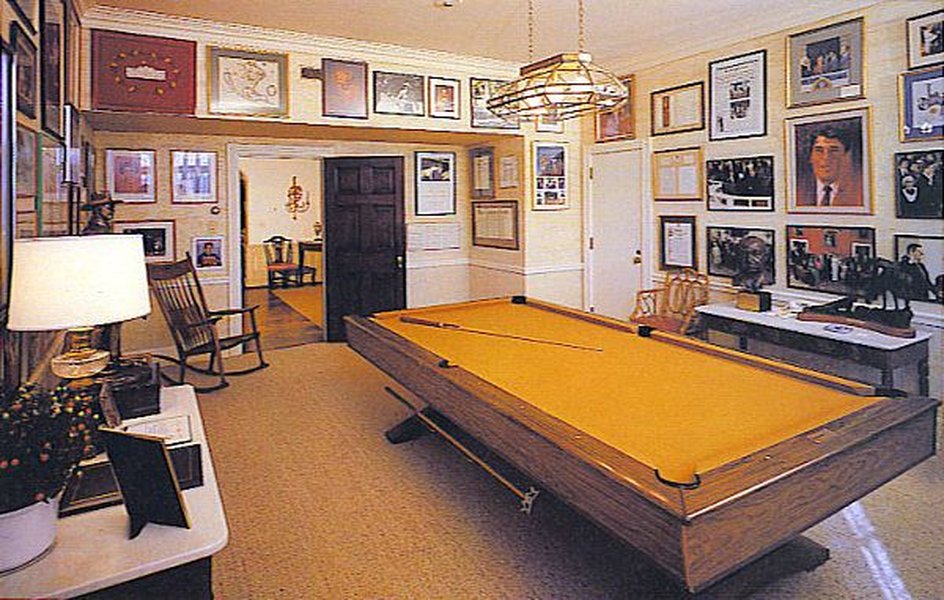
A significant change occurred in 1970 when a dedicated game room, equipped with billiard and ping-pong tables, was constructed on the third floor of the White House. This establishment of a permanent recreational space underscores a more institutionalized approach to providing leisure facilities for the First Family. The game room on the third floor remains the primary location for the pool table today, a fixture at least since the George H.W. Bush era.
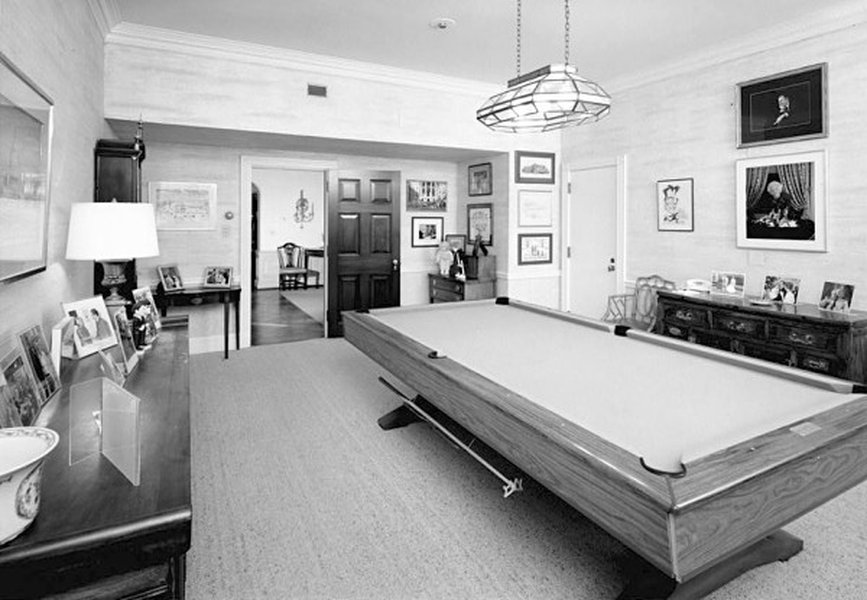
The White House Game Room in 1992, featuring a pool table and television, indicative of its purpose as a recreational area.
Presidential Engagement with Billiards
While the physical presence of a pool table is confirmed, the degree to which presidents have personally engaged with it has varied. Abraham Lincoln was reportedly a "billiards addict," describing the game as a "health inspiring, scientific game." This highlights how some presidents viewed billiards not just as a pastime but as a mental and physical exercise.
President Reagan was also known to use the White House pool table, with anecdotes suggesting he would "hustle unsuspecting employees." This illustrates the more informal and social aspect of the pool table's use, fostering a relaxed environment within the otherwise formal setting of the White House. More recently, there's a record of President Obama playing pool on the campaign trail, though his engagement with the White House table specifically is less highlighted in public sources.
Recreational Amenities at the White House: Beyond Billiards
The pool table is just one of several recreational facilities available to the First Family, designed to provide opportunities for stress relief, exercise, and family time. These amenities underscore the White House's dual role as both a workplace and a private residence.
A Spectrum of Sporting Facilities
In addition to the billiard table, the White House boasts an array of facilities that cater to various interests:
- Ping-Pong Tables: Often located alongside the pool table in the Game Room, ping-pong offers another popular indoor recreational activity.
- Swimming Pools: The White House has a notable history with swimming pools. An indoor pool was constructed in 1933 for President Franklin D. Roosevelt's polio therapy. This space was later converted into the White House Press Briefing Room by President Nixon in 1970. Subsequently, an outdoor pool was installed on the South Lawn in 1975 during Gerald Ford's presidency, who was an avid swimmer.
- Bowling Alley: Richard Nixon, who preferred bowling to swimming, had a bowling alley installed in the White House.
- Tennis Court: Originally built in 1902 and moved in 1909, a tennis court is available for outdoor recreation.
- Putting Green: A putting green was moved outside the Oval Office in 1995 by Bill Clinton, providing a convenient option for golf enthusiasts.
- Other Recreational Spaces: The White House also includes a Solarium, a music room (where Bill Clinton could play his saxophone), and a workout room, demonstrating a comprehensive approach to the First Family's well-being.
White House Recreational Facilities: A Comparative Analysis
To better understand the relative importance and accessibility of the various recreational facilities within the White House, we can consider factors such as historical significance, frequency of use by presidents, public perception, and privacy. The radar chart below offers an opinionated analysis of these aspects for key White House amenities.
This radar chart illustrates a subjective assessment of several key recreational facilities in the White House. The "Historical Significance" axis reflects how long and prominently the amenity has been part of White House history. "Presidential Usage (Perceived)" gauges the general impression of how frequently presidents might use or have used the facility. "Public Awareness" indicates how well-known the amenity is to the general public. "Privacy Level" refers to how secluded or private the usage of the facility typically is. Finally, "Accessibility (Internal)" represents how easily accessible the amenity is to the First Family and authorized personnel within the White House complex. The pool table consistently scores high in internal accessibility and privacy, reflecting its placement in a less public area and its role as a personal recreational tool.
The White House: A Blend of Official and Personal Spaces
The existence and evolution of recreational spaces like the Game Room and its pool table underscore the White House's unique function as both a seat of immense power and a private home. The ability to engage in leisure activities, even simple ones like billiards, provides vital respite and a sense of normalcy for the First Family amidst their demanding public roles.
A Look Inside the White House's Recreational Spaces
The White House, with its 132 rooms, 35 bathrooms, and 28 fireplaces, is a vast and complex structure. While public tours typically focus on the State Floor rooms, many areas, particularly in the private residence on the second and third floors, remain largely out of public sight. The Game Room is one such space, providing a secluded area for relaxation.
For a deeper dive into the less-seen rooms of the White House and the amenities available to the First Family, consider watching the following video:
A video exploring various secret and private rooms within the White House, including recreational facilities.
This video offers a glimpse into some of the lesser-known areas of the White House, including the game room, home cinema, and outdoor pool. It provides valuable visual context for understanding the scope of recreational amenities available to the First Family, highlighting how these spaces contribute to a more balanced life for those living under constant public scrutiny.
Key White House Rooms and Their Evolution
The table below summarizes some key rooms in the White House, focusing on their current or historical uses related to recreation and other significant functions.
| Room Name (Current) | Historical/Recreational Use | Location | Key Features/Notes |
|---|---|---|---|
| Game Room | Current location of pool and ping-pong tables (since 1970). | Third Floor | Dedicated recreational space; includes a lavatory. |
| Map Room | Formerly the Billiard Room. | Ground Floor Corridor | Used for mapping during WWII; once housed a pool table. |
| Vermeil Room | Occasionally housed a pool table. | Ground Floor | Houses a collection of gilded silver tableware. |
| Press Briefing Room | Constructed over the indoor swimming pool (1970). | West Wing | Main media briefing area. |
| Outdoor Swimming Pool | Installed by Gerald Ford (1975) for recreation. | South Lawn (near West Wing) | Replaced earlier indoor pool. |
| Bowling Alley | Installed during Nixon administration. | Undisclosed/Private | Preference for Nixon. |
| Tennis Court | Moved in 1909 to accommodate West Wing expansion. | West Side of South Lawn | Outdoor athletic facility. |
| Putting Green | Moved outside the Oval Office by Bill Clinton (1995). | Near Oval Office | For golf enthusiasts. |
| Solarium | Used for relaxation; historically a place for significant family discussions. | Third Floor | Offers views and a space for winding down. |
| Music Room | Sitting room converted by Hillary Clinton for Bill Clinton's saxophone playing. | Third Floor | Personalized recreational space. |
This table illustrates the diverse functions of White House rooms and how some spaces have been adapted over time to serve the recreational needs of the First Family. The presence of these amenities highlights the personal aspect of the presidential residence, providing a necessary counterpoint to its formal public role.
Frequently Asked Questions (FAQ)
Does the White House currently have a pool table?
Who was the first president to install a pool table in the White House?
Where have pool tables been located in the White House historically?
What other recreational facilities are available in the White House?
Why is there a pool table in the White House?
Conclusion
The presence of a pool table in the White House is a long-standing tradition, dating back to John Quincy Adams. While its initial installation sparked public debate, it has since become a standard amenity within the Executive Residence. Currently located in the dedicated Game Room on the third floor, the pool table, along with other recreational facilities like swimming pools, bowling alleys, and tennis courts, underscores the White House's dual nature as both a powerful seat of government and a private home. These spaces provide essential avenues for relaxation, stress relief, and family activities for the presidents and their families, offering a necessary balance to the demanding responsibilities of their office.
Recommended Searches
- Explore the complete history of recreational facilities in the White House.
- Discover which U.S. presidents were known for their love of billiards in the Executive Mansion.
- Learn more about the specific features and activities available in the White House Game Room.
- Understand past public reactions to presidential spending on leisure activities at the White House.