
The Dual Heat Crisis: Earth's Natural Warmth & Human-Accelerated Warming
Understanding both Earth's natural thermal dynamics and our unprecedented climate emergency
- Earth maintains warmth through natural processes like the greenhouse effect, which traps solar energy by capturing heat through atmospheric gases.
- Human activities have dramatically increased greenhouse gas concentrations by 50% since pre-industrial times, causing global temperatures to rise by over 1°C.
- The 2020s are on track to be the hottest decade in recorded history, with warming accelerating despite international climate agreements.
Understanding Earth's Temperature: Two Distinct Heating Systems
Earth's temperature is regulated by two fundamentally different heating systems: internal heat generation and the atmospheric greenhouse effect. While Earth's internal heat maintains core temperatures of around 5,000°C-6,000°C, the greenhouse effect governs surface temperatures that make our planet habitable.
The current climate crisis involves human amplification of the greenhouse effect, causing surface temperatures to rise at unprecedented rates. This has resulted in a global average temperature increase of approximately 1.1°C above pre-industrial levels, with the rate of warming more than doubling since 1981.
This radar chart illustrates the dramatic shifts in Earth's climate system between pre-industrial times and today, highlighting how various climate indicators have worsened. Note especially the substantial increase in greenhouse gas contributions and the corresponding decreases in our infrastructure's resilience to climate impacts.
Earth's Natural Heating: Why Our Planet Is Inherently Warm
Earth maintains its internal heat through several natural mechanisms that have been active for billions of years:
Internal Heat Sources
Earth's core temperature hovers around 5,000-6,000°C due to three primary factors:
Primordial Heat Retention
When Earth formed approximately 4.5 billion years ago, violent collisions between cosmic materials generated enormous heat. This initial heat has been slowly dissipating for billions of years but remains significant within Earth's core and mantle.
Gravitational Compression
As the young Earth formed, gravitational forces pulled material toward the center, creating pressure that generated additional heat. The sinking of denser materials (primarily iron and nickel) to form the core created friction, contributing to Earth's internal temperature.
Radioactive Decay
Unstable radioactive elements like uranium, thorium, and potassium within Earth's mantle and crust decay over time, releasing energy that continues to heat our planet. This ongoing process supplies approximately 50% of Earth's internal heat energy.
These natural heating mechanisms drive critical planetary processes, including plate tectonics, volcanic activity, and the geomagnetic field that protects us from harmful solar radiation.
The Natural Greenhouse Effect
The greenhouse effect is a natural phenomenon essential for life on Earth:
- Without it, Earth's average surface temperature would be approximately -18°C rather than the current +15°C
- Naturally occurring greenhouse gases (water vapor, carbon dioxide, methane, nitrous oxide) trap heat in the atmosphere
- These gases allow sunlight to pass through but absorb and re-emit infrared radiation from Earth's surface
- This natural process has maintained Earth's habitability throughout geological history
Human-Accelerated Warming: Why Earth Is Getting Hotter
The current climate crisis is primarily driven by human activities that have significantly enhanced the greenhouse effect beyond its natural state. Since the Industrial Revolution, several key factors have contributed to this accelerated warming:
Rising Greenhouse Gas Concentrations
Human activities have dramatically increased the concentration of greenhouse gases in the atmosphere, intensifying the natural greenhouse effect:
| Greenhouse Gas | Primary Human Sources | Pre-Industrial Level | Current Level (2025) | Warming Potential |
|---|---|---|---|---|
| Carbon Dioxide (CO₂) | Fossil fuel combustion, deforestation, cement production | 280 ppm | ~420 ppm | 1× (reference) |
| Methane (CH₄) | Livestock, rice cultivation, landfills, fossil fuel extraction | 700 ppb | ~1,900 ppb | 28-36× (over 100 years) |
| Nitrous Oxide (N₂O) | Agricultural fertilizers, industrial processes, combustion | 270 ppb | ~335 ppb | 265-298× (over 100 years) |
| Fluorinated Gases | Refrigerants, industrial processes, aluminum production | Negligible | Varies by compound | Up to 23,000× (over 100 years) |
Key Drivers of Human-Caused Warming
Fossil Fuel Combustion
Burning coal, oil, and natural gas for energy production, transportation, and industrial processes releases massive amounts of CO₂. This accounts for approximately 75% of the human-caused increase in greenhouse gas emissions since the pre-industrial era.
Deforestation and Land Use Changes
Forests act as carbon sinks, absorbing CO₂ from the atmosphere. Deforestation not only releases stored carbon but also reduces Earth's capacity to absorb future emissions. Agricultural expansion, particularly for livestock, contributes significantly to both deforestation and methane emissions.
Industrial Processes
Manufacturing, particularly of cement, steel, and chemicals, releases significant amounts of CO₂ and other greenhouse gases. These industries account for approximately 21% of global greenhouse gas emissions.
Agriculture and Food Production
Agricultural activities contribute about 11% of global greenhouse gas emissions, primarily through livestock production (methane from enteric fermentation and manure management), rice cultivation, and nitrogen-based fertilizers (releasing nitrous oxide).
Climate Feedback Mechanisms: Amplifiers of Warming
Several natural feedback mechanisms amplify the initial warming caused by increased greenhouse gas concentrations:
This mindmap illustrates how various feedback mechanisms in Earth's climate system can amplify initial warming from greenhouse gases. These feedbacks help explain why climate change can accelerate even if emissions plateau, making rapid emissions reductions more urgent.
Observed and Projected Temperature Changes
The global climate has already warmed considerably, with clear evidence of human influence:
- Global average temperature has increased by approximately 1.1°C since the pre-industrial era (1850-1900)
- The decade from 2013-2023 was the warmest on record
- The rate of warming has more than doubled since 1981, with global temperatures rising by ~0.2°C per decade
- 2024 was reported as the hottest year in recorded history, continuing a trend of record-breaking years
If current emission trends continue, projections indicate:
- Global temperatures could rise by 2.7°C to 3.1°C by 2100 (relative to pre-industrial levels)
- Inhospitably hot regions could expand from 0.8% of Earth's land surface to 19% by 2070
- Daily high and low temperatures could increase by at least 5°F in most areas by mid-century
- Parts of the US Gulf Coast and desert Southwest may become too hot for human survival without significant adaptation
This video explains climate change and global warming in simple terms, highlighting how rising greenhouse gas concentrations are the biggest driver of global warming and how this impacts our planet's systems.
Visual Evidence of Earth's Warming
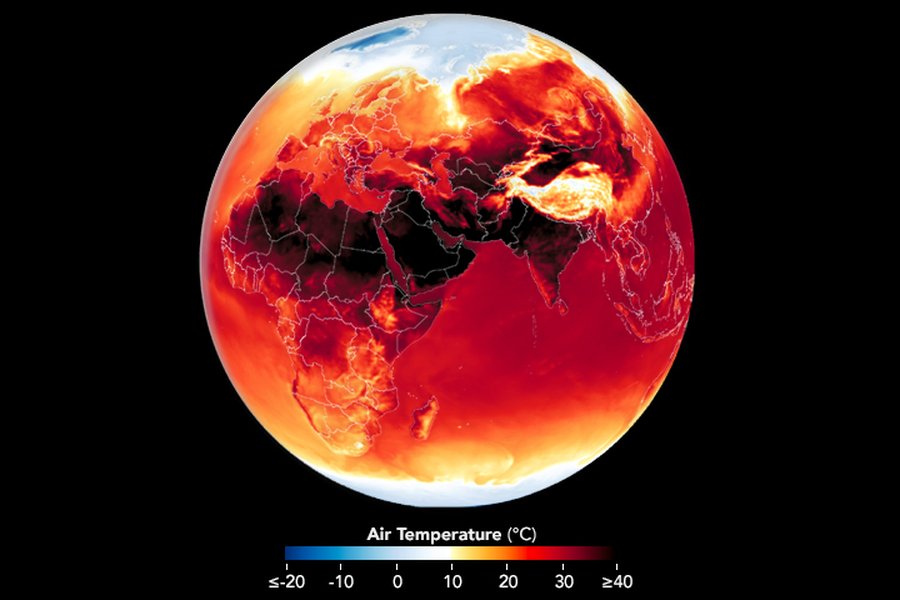
NASA visualization showing global temperature anomalies, with areas in red experiencing temperatures far above normal

Graph showing the rise in global average temperature over time relative to the 1961-1990 average

Melting glaciers due to global warming have been shifting Earth's poles since 1995
Consequences of Earth's Rising Temperature
The warming of Earth is already having far-reaching impacts across the globe:
Extreme Weather Events
Higher temperatures are fueling more frequent and intense weather extremes. Heat waves are becoming longer and more severe, while warming oceans intensify hurricanes and typhoons. In 2024, we've already seen unprecedented heat waves across multiple continents.
Rising Sea Levels
Global sea levels have risen by about 20 cm since 1900, with the rate accelerating. This is caused by thermal expansion of ocean water and melting ice from glaciers and ice sheets. Projections suggest sea levels could rise by 30-100 cm by 2100 depending on emissions scenarios.
Disruption of Ecosystems
Rising temperatures are disrupting ecosystems worldwide. Species are shifting their ranges toward the poles and higher elevations, with those unable to adapt facing extinction. Coral reefs are experiencing mass bleaching events due to marine heat waves.
Human Health Impacts
Heat-related illnesses and deaths are increasing globally. Warming also expands the range of disease vectors like mosquitoes and ticks, increasing the spread of diseases such as malaria, dengue fever, and Lyme disease.
Frequently Asked Questions
References
- Causes of Climate Change - NASA Science
- Global Warming 101 - Natural Resources Defense Council
- Causes and Effects of Climate Change - United Nations
- Causes of Climate Change - European Commission
- Heat Waves and Climate Change - Center for Climate and Energy Solutions
- Why Earth Is Warming - Center for Science Education
- Global Warming - Encyclopedia Britannica
- Causes of Global Warming - WWF Australia
- Climate Change and Extreme Weather - Environmental Defense Fund
Recommended Explorations
Last updated April 6, 2025