
The Science Behind Our Azure Canopy: Why the Sky Displays Its Brilliant Blue
Discover how light physics, atmospheric particles, and human perception combine to create Earth's iconic blue dome
Key Insights About Our Blue Sky
- Rayleigh Scattering: Shorter wavelength blue light is scattered more effectively by atmospheric molecules than longer wavelength colors like red and orange.
- Atmospheric Composition: Nitrogen and oxygen molecules in our atmosphere are the perfect size to interact with and scatter blue light wavelengths.
- Visual Perception: While violet has an even shorter wavelength, our eyes are more sensitive to blue light, and the sun emits more blue than violet light, creating our blue sky perception.
Understanding Rayleigh Scattering: The Blue Sky Phenomenon
The blue color that blankets our sky is the result of a physical process known as Rayleigh scattering, named after British physicist Lord Rayleigh who first described it in the late 19th century. When sunlight—which appears white but contains all colors of the visible spectrum—enters Earth's atmosphere, it encounters gas molecules primarily consisting of nitrogen and oxygen.
These atmospheric molecules are significantly smaller than the wavelengths of visible light. When sunlight interacts with these molecules, an interesting physical phenomenon occurs: the shorter wavelengths of light are scattered more efficiently than longer wavelengths. The degree of scattering is inversely proportional to the fourth power of the wavelength (λ-4), which means blue light (wavelength around 450-495 nanometers) scatters approximately 10 times more than red light (620-750 nanometers).
The Physics of Light in Our Atmosphere
Sunlight contains the entire spectrum of visible light—from red and orange (longer wavelengths) to blue and violet (shorter wavelengths). As this light travels through space, it moves in a straight line until it enters Earth's atmosphere. Upon interaction with atmospheric molecules, the light waves are absorbed and then re-emitted in different directions, creating what we perceive as scattering.
This scattering process distributes blue light in all directions throughout the atmosphere, which is why the sky appears blue from every angle during daylight hours. When you look up at the sky, you're seeing this scattered blue light reaching your eyes from all parts of the atmosphere in your field of view.
Why Blue Dominates Over Violet
An interesting question arises: since violet light has an even shorter wavelength than blue light (380-450 nanometers), why doesn't the sky appear violet? The answer involves three key factors:
- The sun emits more blue light than violet light in its spectrum
- Human eyes are more sensitive to blue wavelengths than to violet
- The combined effect of all wavelengths being scattered (including some green and red) creates a blue-dominant mixture
Our visual perception system ultimately interprets this scattered light as a blue sky, though the exact shade can vary depending on atmospheric conditions, viewing angle, and time of day.
Color Changes: From Dawn to Dusk
The dramatic color shifts we observe during sunrise and sunset provide further evidence of Rayleigh scattering at work. During these times, sunlight must travel through a much longer path through the atmosphere to reach our eyes. This extended journey causes even more blue light to be scattered away from our line of sight.
What remains are the longer wavelengths—reds, oranges, and yellows—that can penetrate the thicker atmospheric layer with less scattering. This is why sunrises and sunsets often display spectacular reddish-orange hues. The scattered blue light is still present but directed away from our direct view of the sun.
Factors Affecting Sky Color Variation
Several factors can influence the exact shade and intensity of the sky's blue appearance:
- Atmospheric conditions: Humidity, dust, pollution, and other particles affect scattering
- Altitude: Higher elevations have less atmosphere above, resulting in a darker blue
- Viewing angle: The sky appears lighter near the horizon and darker overhead
- Time of day: The changing angle of sunlight affects color intensity
- Geographic location: Differences in atmospheric composition and pollution levels
Blue Skies Beyond Earth
Interestingly, not all planetary bodies with atmospheres have blue skies. Mars, for instance, has a thin atmosphere that creates a butterscotch-colored sky, occasionally appearing bluish near the sunset. This difference occurs because Mars' atmosphere contains suspended dust particles rather than primarily nitrogen and oxygen molecules.
Visualizing Rayleigh Scattering Intensity
The following radar chart illustrates the relative scattering intensity of different light wavelengths in Earth's atmosphere. Notice how the scattering effectiveness dramatically increases as wavelengths get shorter, with blue and violet experiencing the most significant scattering effects.
This visualization demonstrates why we perceive a blue sky: blue light experiences much more scattering than other colors, our eyes are highly sensitive to blue wavelengths, and the sun emits significant blue light energy. The combination of these factors creates our perception of a blue sky.
The Sky Color System: A Mind Map
Let's explore the interconnected factors that contribute to our perception of a blue sky through this mind map. This visualization helps illustrate how various physical, atmospheric, and perceptual elements work together to create the blue sky phenomenon we observe daily.
This mind map demonstrates the complex interplay of factors that result in our blue sky. From the fundamental properties of light to the specific composition of our atmosphere, along with our human visual perception system, these elements combine to create the characteristic blue dome above us.
Sky Blue: The Science Explained
This educational video provides an excellent explanation of why the sky appears blue and not another color like purple, green or orange. It breaks down how the Sun's light reaches Earth and interacts with our atmosphere, making complex physics concepts accessible. The video explores Rayleigh scattering in a visual way that helps clarify how different wavelengths of light interact with atmospheric particles.
Visual Exploration of Atmospheric Perspective
The blue color of the sky also creates what artists call "atmospheric perspective." Objects in the distance appear increasingly blue and less distinct because of the same Rayleigh scattering that makes our sky blue. These images demonstrate this phenomenon and how the scattering of blue light affects our perception of distance in landscapes.

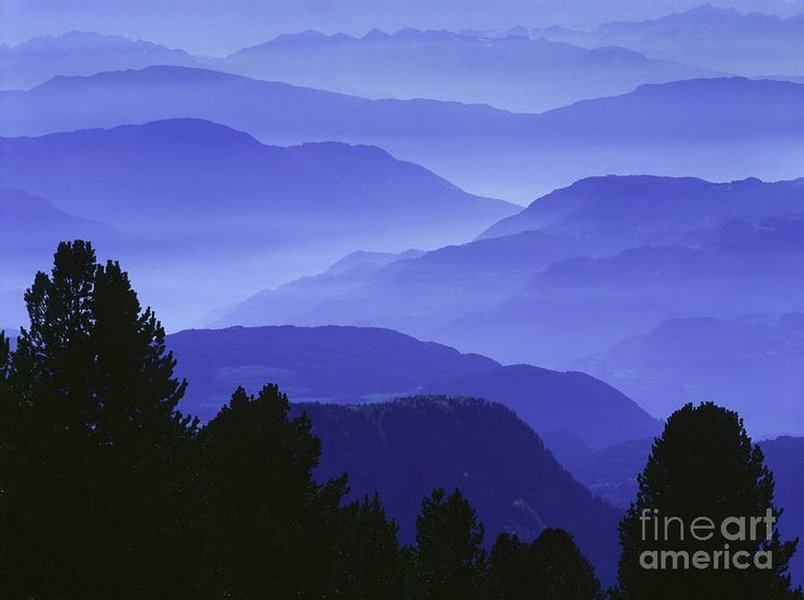
Notice how in these landscapes, distant mountains and objects appear more blue and less distinct. This is caused by the same Rayleigh scattering that makes our sky blue. The greater the distance, the more air the light must travel through, creating increased blue scattering and the characteristic blue haze we associate with distant objects.
Light Scattering and Sky Color Comparison
| Color | Wavelength Range (nm) | Scattering Intensity | Visibility in Sky | Conditions for Prominence |
|---|---|---|---|---|
| Violet | 380-450 | Highest | Limited | Rarely dominant due to human eye sensitivity |
| Blue | 450-495 | Very High | Dominant | Normal daytime viewing |
| Green | 495-570 | Moderate | Minimal | Special atmospheric conditions |
| Yellow | 570-590 | Low | Sunset/sunrise | Low sun angle, more atmosphere |
| Orange | 590-620 | Very Low | Sunset/sunrise | Low sun angle, more atmosphere |
| Red | 620-750 | Lowest | Sunset/sunrise | Low sun angle, dust, pollution |
This table illustrates how different wavelengths of light interact with our atmosphere and the conditions under which we observe various colors in the sky. Blue dominates our daytime viewing experience due to the perfect combination of scattering intensity, human visual sensitivity, and solar output levels.
Frequently Asked Questions About Our Blue Sky
References
- Why Is the Sky Blue? - NASA Space Place
- Why is the sky blue? - Scientific American
- Why Is the Sky Blue? - Encyclopedia Britannica
- Why is the sky blue? - Royal Observatory Greenwich
- Why Is the Sky Blue? - NOAA SciJinks
- Why is the sky blue? - Met Office
- Why is the sky blue? - Live Science
Recommended Explorations
Last updated April 4, 2025