
Unraveling the Mystery: The Science Behind Wind's Whistling Tune
Explore how air, objects, and fluid dynamics combine to create the distinctive sounds of whistling wind.
Key Insights into Wind's Whistling Melody
- Wind Requires Interaction: Wind itself is silent; whistling occurs only when moving air encounters objects, causing vibrations and pressure changes.
- Primary Mechanisms: Key phenomena like vortex shedding (Aeolian tones), Helmholtz resonance, and friction are responsible for generating audible whistling sounds.
- Influencing Factors: Wind speed, the size and shape of objects, and the presence of narrow spaces significantly determine the pitch and intensity of the whistling.
The familiar whistling sound of the wind is not an inherent quality of moving air itself, but rather a fascinating acoustic phenomenon that arises from the intricate interaction between wind and its environment. When air flows past or through objects, it sets off a series of physical processes—including vibrations, friction, and localized pressure changes—that culminate in the generation of sound waves. These sound waves, when within our audible range, are perceived as whistling.
The Fundamental Principle: Wind's Interaction with Obstacles
Wind, as a flow of air molecules, is silent in a vacuum. It only becomes audible when it encounters an obstruction, such as a building, a tree, a wire, or even a tiny crack. This interaction disrupts the smooth flow of air, causing the air molecules and the objects themselves to vibrate. These vibrations then create pressure waves that propagate through the air, reaching our ears as sound.
The Role of Object Characteristics
The type of sound produced—whether a whistle, hum, howl, or roar—is heavily influenced by the characteristics of the object the wind interacts with. Factors such as the object's shape, size, material, and the presence of any openings or gaps are crucial in determining the specific acoustic signature of the wind.
Key Mechanisms Behind Wind Whistling
Several distinct physical mechanisms contribute to the creation of whistling sounds from the wind:
1. Vortex Shedding (Aeolian Tones)
One of the most significant mechanisms is **vortex shedding**, also known as the generation of Aeolian tones. This fluid dynamics effect occurs when wind flows over or around an elongated or cylindrical object, such as a wire, power line, or railing. As the air passes, it detaches from the object in a regular, alternating pattern, forming swirling masses of air called vortices (or eddies) on opposite sides. This periodic shedding of vortices creates rapid fluctuations in air pressure around the object. These pressure changes, in turn, cause the object and the surrounding air to vibrate at a specific frequency, producing a distinct, often musical, whistling tone. The frequency (and thus the pitch) of the sound is directly proportional to the wind speed and inversely proportional to the object's diameter.
2. Helmholtz Resonance
Helmholtz resonance occurs when wind blows across an opening of a cavity or enclosed space, such as a crack in a window, a gap around a door, or even a vent. As the air passes over the opening, it causes the air inside and around the opening to compress and decompress rhythmically. This oscillation of air acts like a spring-mass system, resonating at a specific frequency determined by the volume of the cavity and the size of the opening. This phenomenon is similar to blowing across the top of a bottle to create a musical note, and it often results in a distinct, high-pitched whistling sound.
3. Friction and Turbulence
When wind moves across surfaces, it generates friction. This friction creates disturbances in the air, leading to the generation of sound waves. Stronger winds cause greater friction, resulting in louder sounds, which can manifest as whistling or swooshing noises. Additionally, the uneven or swirling airflows known as **turbulence** also contribute to wind sounds. Turbulent eddies and rapid, chaotic fluctuations in air pressure can cause nearby objects or the air itself to vibrate, producing audible noises, including whistling or howling. This is particularly noticeable when wind blows through dense foliage like treetops.
Factors Influencing the Whistling Sound
The characteristics of the whistling sound—its pitch, loudness, and duration—are shaped by several environmental and physical factors:
Wind Speed
A fundamental factor is wind speed. Generally, faster wind speeds lead to more rapid vibrations and more intense pressure fluctuations. This results in higher-pitched and louder whistling sounds. A gentle breeze might produce a soft hum, while a strong gale can create a sharp, piercing whistle.
Size and Shape of Objects
The dimensions and geometry of the object or opening that the wind interacts with play a critical role. Narrower gaps, smaller objects, or sharper edges tend to produce higher-pitched and clearer whistling sounds. For instance, the diameter of a wire or the width of a crack directly influences the frequency of the sound generated by vortex shedding or Helmholtz resonance.
Natural Resonant Frequencies
If the wind excites vibrations that match the natural resonant frequency of a structure or an air cavity, the whistling sound can be significantly amplified. This aeroacoustic resonance can lead to particularly strong and sometimes disturbing noises, especially in architectural contexts like poorly designed balconies or facade components.
Environmental Context
The surrounding environment also influences the prevalence and character of whistling wind. Urban settings with numerous buildings, narrow alleys, and specific architectural features (like balconies or facade elements) can create constrained airflow pathways that amplify whistling sounds. Natural environments, such as forests, also produce whistling as wind is forced through gaps between branches and leaves.
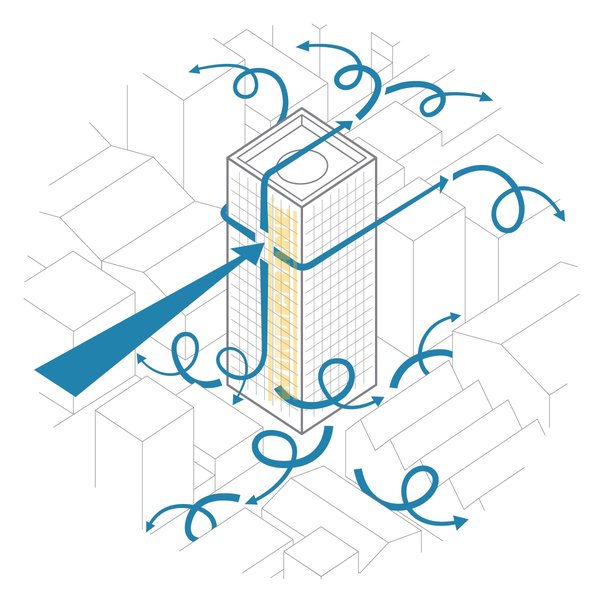
Wind interacting with urban structures creates complex airflow patterns.
Common Examples of Wind Whistling in Everyday Life
Wind whistling is an omnipresent phenomenon, observable in numerous daily scenarios:
| Location/Object | Contributing Factors | Typical Sound/Effect |
|---|---|---|
| Around Homes (Windows, Doors, Vents) | Gaps in weather stripping, misaligned seals, Helmholtz resonance in cavities. | High-pitched, often consistent whistling, especially noticeable indoors. |
| Vehicles (Windshields, Doors, Sunroofs) | Worn weather stripping, misaligned door seals, issues with windshield installation. | Persistent whistling or gushing noises at higher speeds, can be distracting. |
| Infrastructure (Power Lines, Railings, Bridges) | Vortex shedding (Aeolian tones) due to wind passing over cylindrical or thin objects. | Humming, whistling, or musical tones, as seen with bridge cables. |
| Natural Elements (Trees, Grass, Mountains) | Friction of wind over surfaces, air forced through narrow spaces between foliage. | Soft rustling, humming, or subtle whistling through branches and leaves. |
| Architectural Features (Balconies, Facades, Vents) | Aeroacoustic resonance, specific geometries interacting with wind. | Loud whistling or screaming sounds, especially if not considered in design. |
Visualizing Wind Whistling Characteristics
To better understand the multifaceted nature of wind whistling, we can visualize the relative impact of various factors on its prominence and characteristics. This radar chart illustrates how different elements contribute to the perceived intensity and pitch of wind whistling.
As depicted, factors like "Presence of Gaps" and "Object Geometry" have a strong influence on the pitch, often leading to higher-frequency sounds, while "Wind Speed" is a primary driver of overall whistling intensity. "Resonance Potential" highlights how structural features can amplify sounds when their natural frequencies align with wind-induced vibrations. This chart provides a simplified, opinionated view of these complex interactions.
Understanding Wind Sounds: A Practical Application
The study of why wind whistles is not just an academic exercise; it has practical implications. For instance, in architectural design, understanding aeroacoustics helps engineers and architects design buildings that minimize unwanted wind noise. Similarly, automotive manufacturers consider these principles to reduce wind noise inside vehicles, enhancing driver and passenger comfort. This knowledge also informs solutions for home maintenance, such as identifying and sealing gaps around windows and doors to prevent irritating whistling sounds.
This video provides practical tips on how to address wind whistling noises in a car, highlighting common issues like worn weather stripping and misaligned seals that contribute to the phenomenon. It underscores how understanding the underlying causes of wind noise can lead to effective solutions.
Frequently Asked Questions (FAQ)
Why doesn't wind make sound in an open, empty space?
What is the Aeolian effect?
Can buildings cause wind to whistle?
Does higher wind speed always mean louder whistling?
Conclusion
The whistling of the wind is a complex yet captivating symphony of physics, arising from the dynamic interplay between moving air and the myriad objects it encounters. From the subtle hum of a gentle breeze through leaves to the piercing shriek around urban structures, each sound is a testament to the principles of fluid dynamics, vibration, and acoustics. Understanding these mechanisms—vortex shedding, Helmholtz resonance, and friction—not only demystifies this common auditory experience but also provides valuable insights for design, engineering, and even everyday problem-solving.
Recommended Searches
- How to mitigate wind noise in buildings
- Physics of Aeolian harp
- Understanding vortex shedding and its applications
- How weather stripping reduces wind noise
Referenced Search Results
 acousticengineering.wordpress.com