
The Science Behind Widex's Dual Approach: How Music and Speech Programs Transform Your Hearing Experience
Discover why Widex hearing aids use fundamentally different settings to optimize both musical enjoyment and speech comprehension
Key Highlights
- Sound Processing Differences: Music programs minimize compression and noise reduction to preserve natural sound dynamics, while speech programs emphasize clarity through directional microphones and speech enhancement.
- Frequency Response Adjustments: Speech programs boost mid-range frequencies (500 Hz - 4 kHz) critical for understanding conversation, whereas music programs maintain a more balanced frequency response across the entire spectrum.
- Feedback Management: Music programs typically reduce feedback suppression to avoid distorting complex sounds, while speech programs employ aggressive feedback control to enhance clarity in conversational settings.
Understanding the Fundamental Differences
Widex hearing aids incorporate specialized programs for both music and speech that differ significantly in their approach to sound processing. These differences aren't merely cosmetic—they reflect the distinct acoustic characteristics and cognitive processing requirements of music versus speech. While speech programs prioritize intelligibility and clarity in conversational settings, music programs focus on preserving the rich, dynamic, and nuanced qualities that make music enjoyable.
The sophisticated technology behind Widex hearing aids allows them to adapt to different listening environments by adjusting multiple parameters simultaneously. This means the device functions fundamentally differently when you're enjoying a symphony versus when you're engaged in conversation at a restaurant.
Core Sound Processing and Algorithmic Differences
| Parameter | Speech Program Settings | Music Program Settings |
|---|---|---|
| Compression | Higher compression ratios to balance soft and loud speech elements | Lower compression to preserve dynamic range and natural variations in volume |
| Noise Reduction | Aggressive noise filtering to isolate speech from background sounds | Minimal noise reduction to preserve musical nuances often mistaken as "noise" |
| Frequency Response | Enhanced mid-frequencies (500 Hz - 4 kHz) where consonants reside | Flatter, wider frequency response to reproduce full musical spectrum |
| Directionality | Strong directional focus toward speaker (typically forward-facing) | Omnidirectional setting to capture the full spatial qualities of music |
| Attack/Release Times | Faster to respond to rapid speech transitions | Slower to maintain natural sound envelopes in musical passages |
Maximum Input Level and Sound Handling
Widex hearing aids, particularly the DREAM series, offer a high maximum input level of up to 113 dB SPL. This feature is especially important for music programs as it prevents distortion during loud musical passages that often exceed typical conversation volumes. Speech programs typically operate with more conservative input ceiling limits since conversational speech rarely exceeds 85-90 dB SPL, even in noisy environments.
Music programs in Widex devices are engineered to handle the unpredictable intensity variations in music without compression artifacts that can make music sound unnatural. This results in a more authentic reproduction of dynamics, from the softest violin note to the impact of orchestral crescendos.
Technical Implementation in Widex MOMENT Series
The Widex MOMENT series represents the company's most advanced approach to handling these different sound environments. Unlike some competitors, the MOMENT 440 music program doesn't invert sound polarity, which helps preserve the natural soundstage and instrumental timbres. This makes these devices particularly suitable for audiophiles and music enthusiasts who require high-fidelity sound reproduction.
The Science of Sound Processing Differences
This radar chart illustrates the comparative settings across different parameters for speech, music, and universal programs in Widex hearing aids. Note how speech programs prioritize directional focus and noise reduction, while music programs emphasize dynamic range and balanced frequency response. The universal program serves as a middle ground for everyday situations.
Equalization and Frequency Response Differences
One of the most significant differences between music and speech programs lies in their equalization approaches. Speech programs in Widex hearing aids emphasize the frequency range most critical for understanding spoken language—typically 500 Hz to 4 kHz. This is where consonant sounds that provide speech intelligibility reside.
In contrast, music programs implement a more neutral equalization curve that preserves the natural balance between low, mid, and high frequencies. This approach ensures that both the fundamental tones of bass instruments and the overtones of high-register instruments are reproduced accurately without artificial boosting or attenuation.
Widex's Unique Approach to Sound Classes
Widex's proprietary Sound Class Technology enhances these differences by automatically classifying incoming sounds and applying the appropriate processing strategy. When the system detects music, it can automatically switch to settings that preserve musical detail and tonal quality. For speech, it prioritizes settings that enhance intelligibility and reduce listening effort.
Feedback Management Strategies
Feedback management represents another area of significant difference between speech and music programs. Speech programs typically employ aggressive feedback suppression algorithms that can quickly identify and neutralize potential feedback loops before they become audible whistling sounds.
Music programs take a more conservative approach to feedback management, as aggressive suppression can sometimes mistake musical elements (especially sustained high notes from instruments like flutes or violins) for feedback. The music program in Widex hearing aids adjusts the feedback suppression algorithm to be less interventionist, preserving the integrity of musical sounds while still providing protection against uncomfortable feedback.
Program Selection and Automatic Adaptation
This mindmap illustrates the hierarchical organization of different programs in Widex hearing aids and their associated features. The speech and music programs contain fundamentally different sub-features optimized for their specific use cases.
User Control and Customization
The level of user control also differs between speech and music programs. Speech programs often rely more heavily on automatic adjustments, with the hearing aid making moment-to-moment decisions about directionality, noise reduction, and other parameters based on the acoustic environment.
Music programs typically offer users more manual control options, allowing for personalized adjustments to create the optimal listening experience. For instance, some Widex models let users adjust equalization settings or choose between different music presets tailored for various music types (classical, jazz, rock, etc.) through the Widex MOMENT smartphone app.
Automatic Program Selection
Widex hearing aids can intelligently detect when you're listening to music versus speech and automatically switch to the appropriate program. This is particularly useful when streaming audio content, as the hearing aid can recognize the audio characteristics and apply the optimal settings without requiring manual program changes.
Real-World Performance and User Experience
This video explores the music capabilities of Widex Moment hearing aids, highlighting their exceptional sound quality for music listening. The reviewer demonstrates how these hearing aids maintain natural tonal qualities and dynamics, making them suitable for all-day music and podcast listening. The video provides valuable real-world perspective on how the music program settings translate to actual listening experience.
User Feedback on Program Differences
User experiences with Widex hearing aids consistently highlight the noticeable differences between speech and music programs. Many users report that the transition between programs provides an immediate and substantial improvement in listening comfort and sound quality for the specific listening environment.
Musicians and audiophiles with hearing loss particularly appreciate the music program's ability to preserve dynamic range and tonal balance, while those who prioritize communication value the speech program's enhanced clarity and background noise reduction.
Case Study: The Musician's Experience
Professional and amateur musicians with hearing loss have provided especially valuable feedback on Widex music programs. Many report that competing hearing aid brands often struggle with music reproduction, either compressing dynamic range too aggressively or applying excessive noise reduction that removes subtle musical details.
Widex's approach in their music program settings has earned praise for maintaining the integrity of musical performances while still providing the necessary amplification for hearing-impaired users. The high-frequency boost option in music programs has proven particularly valuable for musicians who need to hear overtones and harmonics clearly.
Frequently Asked Questions
Images: Visualizing Widex Hearing Aid Technology
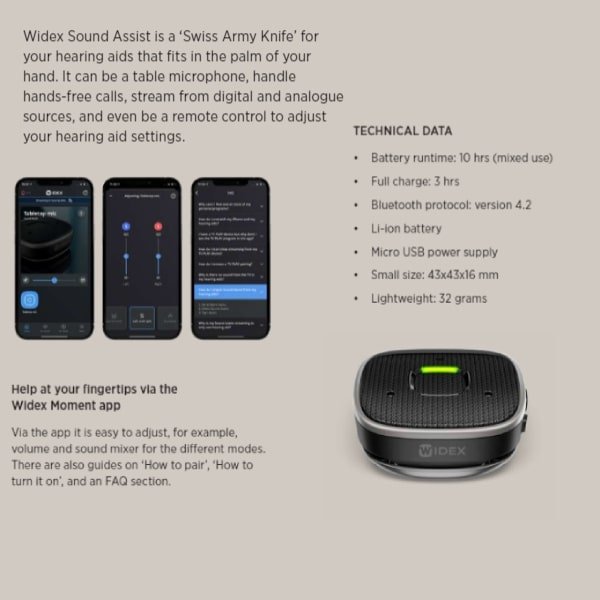
The Widex Sound Assist accessory enhances both speech and music listening experiences by providing additional streaming capabilities and remote microphone functionality.

The Widex Moment hearing aids feature PureSound technology with ZeroDelay processing, significantly enhancing music program performance by reducing distortion and preserving natural sound quality.
References
- Widex PureSound and ZeroDelay Technology - Widex Professional
- Hearing Aids and Music: A Tricky Combination - Widex Professional
- Widex Sound Class Technology - HearSource
- Two Months With Widex's Moment 440 mRIC R D Hearing Aids - AnalogPlanet
- Get Connected, Go Beyond with Widex - AudiologyOnline
- Why You Can Benefit From Using Other Hearing Aid Programs - Widex
- Programming Hearing Aids for Listening - AudiologyOnline
Recommended Topics
Last updated April 5, 2025