
Analyzing the Inequality 0 < x² - y² ≤ 5
A Detailed Exploration of Solving and Graphing Compound Inequalities
Key Highlights
- Factorization Insight: The expression x² - y² can be factored as (x - y)(x + y), simplifying the inequality into a product form that reveals critical boundary lines.
- Regional Solution: The inequality defines a specific region in the xy-plane bounded by hyperbolas, excluding the line x = y and constrained within x² - y² = 5.
- Practical Applications: Understanding this inequality aids in fields like optimization and geometry, where differences of squares often appear in constraints and equations.
Understanding the Inequality
The inequality 0 < x² - y² ≤ 5 is a compound inequality that combines two conditions: x² - y² must be greater than 0 and less than or equal to 5. This expression involves a difference of squares, which is a fundamental algebraic concept. The difference of squares formula, x² - y² = (x - y)(x + y), allows us to rewrite and analyze the inequality more effectively. By factoring, we can break down the problem into cases based on the signs of the factors, making it easier to solve and visualize.
This inequality represents a region in the two-dimensional plane where the difference between x squared and y squared falls within a specific range. It excludes points where x² - y² is zero or negative, and caps the difference at 5. Such inequalities are common in mathematics, particularly in calculus, algebra, and geometry, where they help define feasible regions for optimization problems or describe conic sections.
Rewriting the Inequality Using Difference of Squares
To begin solving 0 < x² - y² ≤ 5, apply the difference of squares formula. This gives us 0 < (x - y)(x + y) ≤ 5. The compound nature means we must satisfy both 0 < (x - y)(x + y) and (x - y)(x + y) ≤ 5 simultaneously.
First, consider the inequality (x - y)(x + y) > 0. This product is positive when both factors are positive or both are negative:
- Both positive: x - y > 0 and x + y > 0, which simplifies to x > y and x > -y.
- Both negative: x - y < 0 and x + y < 0, which simplifies to x < y and x < -y.
The boundary case (x - y)(x + y) = 0 occurs when x = y or x = -y, but since the inequality is strict (> 0), these lines are excluded from the solution set.
Next, address the upper bound (x - y)(x + y) ≤ 5, or x² - y² ≤ 5. This can be rewritten as y² ≥ x² - 5 or y² ≤ x² + 5, but it's often more insightful to consider the equality x² - y² = 5, which represents a hyperbola. The solution to x² - y² ≤ 5 includes all points inside and on this hyperbola.
Case Analysis for (x - y)(x + y) > 0
To solve (x - y)(x + y) > 0, identify the regions where the product is positive. The lines x = y and x = -y divide the plane into four regions:
- Region where x > y and x > -y: This is above the line x = -y and to the right of x = y in the first and second quadrants.
- Region where x < y and x < -y: This is below the line x = -y and to the left of x = y, primarily in the third quadrant.
Test points in each region to confirm. For example, in the first quadrant (x > 0, y > 0), if x > y, the product is positive; if x < y, it's negative. Similarly, in other quadrants, the signs change based on the relative positions.
Incorporating the Upper Bound
Now intersect this with x² - y² ≤ 5. The hyperbola x² - y² = 5 opens horizontally, with vertices at (√5, 0) and (-√5, 0). The inequality x² - y² ≤ 5 shades the region between the branches of this hyperbola, including the hyperbola itself.
Combining both parts, the solution set is where (x - y)(x + y) > 0 and x² - y² ≤ 5. This excludes the lines x = y and x = -y and is constrained within the hyperbola.
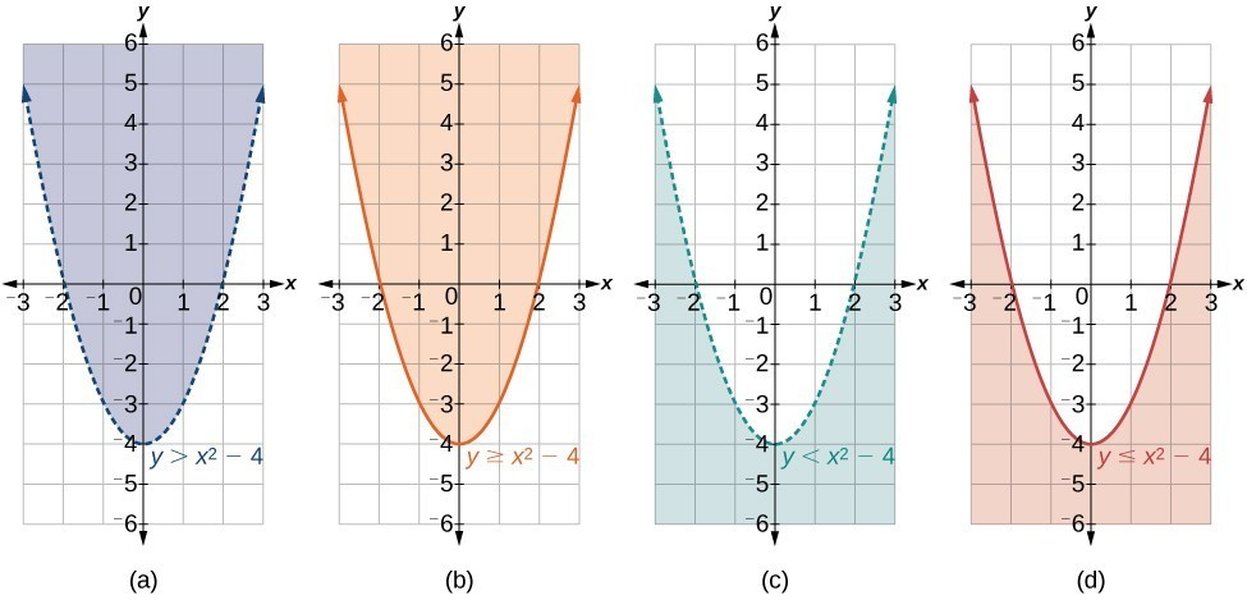
Image Description: This image shows a hyperbola similar to x² - y² = c, illustrating the boundary for inequalities like x² - y² ≤ 5. It helps visualize the region where the difference of squares is constrained, directly complementing the discussion on graphing the inequality.
Solving the Inequality Step by Step
To solve 0 < x² - y² ≤ 5 comprehensively, consider the two inequalities separately and then find their intersection. This approach ensures a thorough understanding and avoids errors common in multivariable inequalities.
Solving x² - y² > 0
The inequality x² - y² > 0 is equivalent to (x - y)(x + y) > 0. As a product, it is positive when the factors have the same sign:
- Case 1: x - y > 0 and x + y > 0 → x > y and x > -y. This describes regions where x is greater than both y and -y, which for x ≥ 0 is simply x > y, and for x < 0, it requires y < x < -y (but since x < 0, -y must be positive, so y < 0).
- Case 2: x - y < 0 and x + y < 0 → x < y and x < -y. This is symmetric and occurs when both x and y are negative, with x less than y and less than -y.
The critical lines x = y and x = -y are asymptotes or boundaries. Since the inequality is strict, points on these lines are not included.
Solving x² - y² ≤ 5
The inequality x² - y² ≤ 5 can be rearranged as y² ≥ x² - 5. This means for each x, y must satisfy |y| ≥ √(x² - 5) when x² - 5 ≥ 0 (i.e., |x| ≥ √5), and for |x| < √5, the inequality holds for all y since x² - 5 < 0 implies y² ≥ a negative number is always true for real y. However, combined with the first part, we must restrict to where x² - y² > 0.
Consider the equality x² - y² = 5, which is a hyperbola. The region x² - y² ≤ 5 lies between the two branches. Intersecting with x² - y² > 0 narrows this down.
Intersection of Both Conditions
The full solution set is where both inequalities hold. For instance:
-
When x > y and x > -y, and x² - y² ≤ 5.
-
When x < y and x < -y, and x² - y² ≤ 5.
Numerically, test points. For example, at (2, 1): x² - y² = 4 - 1 = 3, which is greater than 0 and less than or equal to 5, so it satisfies. At (3, 2): x² - y² = 9 - 4 = 5, which is equal to 5 and (x - y)(x + y) = (1)(5) > 0, so included. At (1, 1): x² - y² = 0, not greater than 0, so excluded.
Boundary and Critical Points
The boundaries are x² - y² = 0 (excluded) and x² - y² = 5 (included). Critical points occur where the expressions change, such as at x = ±√5, y = 0, but must satisfy the sign conditions.
| x | y | x² - y² | Satisfies 0 < x² - y² ≤ 5? |
|---|---|---|---|
| 2 | 1 | 3 | Yes |
| 3 | 2 | 5 | Yes |
| 1 | 1 | 0 | No |
| 4 | 1 | 15 | No |
| -2 | -3 | 4 - 9 = -5 | No |
This table summarizes test points to verify the inequality, helping to understand where the conditions hold and fail. It directly supports the case analysis by providing concrete examples.
The embedded video demonstrates how to factor the difference of squares, a key step in solving this inequality. It is relevant because x² - y² is factored into (x - y)(x + y), which is central to understanding the sign changes and boundaries. This visual aid provides a deeper context by showing algebraic techniques that apply directly to this problem.
Graphing the Inequality
Graphing 0 < x² - y² ≤ 5 in the xy-plane reveals a region bounded by hyperbolas. The equation x² - y² = 0 corresponds to the lines x = y and x = -y, but since it's strictly greater than 0, these lines are not part of the solution. The curve x² - y² = 5 is a hyperbola, and the inequality includes the area inside it where the difference is positive.
To graph, first sketch x² - y² = 5, which has asymptotes y = x and y = -x. The region where x² - y² > 0 is outside the lines y = x and y = -x in certain quadrants, intersected with the hyperbola constraint. This results in two unbounded regions symmetric about the origin, excluding the asymptotes.
Interpreting the Graph
The graph consists of parts where |x| > |y| in magnitude but constrained by the hyperbola. For large |x|, y can vary, but must satisfy the inequalities. This visualization is crucial for understanding the feasible set in applications like linear programming or conic sections.
Examples in Context
Consider real-world scenarios, such as in physics where differences of squares might represent energy differences or in engineering for constraint optimization. For instance, if x and y represent dimensions, this inequality could define allowable pairs where a difference is positive and bounded.
Frequently Asked Questions
What does x² - y² represent?
x² - y² is the difference of squares, which factors into (x - y)(x + y). It often appears in algebraic manipulations and can represent differences in squared quantities, such as areas or distances in geometry.
How do I solve inequalities like this one?
Start by factoring if possible, then analyze the signs of the factors or consider the equality to find boundaries. Test intervals or use graphing to visualize the solution set.
What are common mistakes when dealing with such inequalities?
A common error is forgetting to exclude equality when the inequality is strict, or mishandling the compound nature by not intersecting both conditions. Always check boundary points and test regions carefully.
Can this inequality be extended to more variables?
Yes, similar principles apply to higher dimensions, but it becomes more complex, often involving multiple inequalities or surfaces in 3D space.
References
Last updated May 10, 2025