
Understanding Yrast States in Nuclear Physics
Exploring the Minimum Energy States for a Given Angular Momentum
Key Highlights
- Yrast states represent the minimum energy for a nucleus at a specific angular momentum. Think of it as the "lowest possible energy configuration" for a nucleus spinning at a certain rate.
- These states are crucial for understanding nuclear structure and reactions. Studying yrast states helps physicists learn about the forces within the nucleus and how nuclei behave under stress, like high spin.
- The term "yrast" has Swedish origins, meaning "whirlingest" or "dizziest". This etymology aptly describes the concept of a nucleus with significant angular momentum.
In the realm of nuclear physics, the term "yrast" holds a specific and significant meaning. It refers to the state of a nucleus that possesses the minimum possible energy for a given value of angular momentum. Imagine a spinning top; as it spins faster (higher angular momentum), its energy increases. Similarly, a nucleus can have different energy levels depending on how fast it is "spinning" or, more accurately, its angular momentum. The yrast states represent the lowest energy pathway a nucleus can take as its angular momentum increases.
This concept is fundamental to understanding nuclear structure and dynamics, particularly in the study of nuclei at high spins. When nuclei are formed in nuclear reactions, they often possess a significant amount of excitation energy and angular momentum. As these highly excited nuclei de-excite, they tend to shed their energy and angular momentum by emitting particles (like neutrons or protons) and gamma rays. The decay often proceeds down towards the yrast line, the sequence of yrast states, as this represents the most energetically favorable path for a given angular momentum.
The Definition and Origin of "Yrast"
What Exactly is a Yrast State?
Formally, a yrast state is the nuclear state with the lowest energy for a given total angular momentum \( J \). As the angular momentum \( J \) of a nucleus increases, the minimum possible energy generally also increases. The sequence of these minimum energy states for increasing angular momentum forms the "yrast band" or "yrast line" in a nuclear energy level diagram.
Etymology of the Term
The word "yrast" originates from the Swedish language. It is the superlative form of the adjective "yr", which can be translated as "dizzy" or "whirling". Thus, "yrast" literally means "dizziest" or "most whirling". This etymology provides an intuitive link to the concept of angular momentum and rotation in nuclear physics. The term was introduced into nuclear physics to describe these states of minimum energy at high angular momentum, effectively the most "whirling" states that are also the most energetically stable for that amount of whirl.
Nuclear Structure and Yrast States
The Interplay of Energy and Angular Momentum
The structure of yrast states is intimately connected to the underlying nuclear forces and the arrangement of protons and neutrons within the nucleus. As a nucleus gains angular momentum, it experiences centrifugal and Coriolis forces, which can significantly influence its shape and internal structure. The nucleus will reconfigure itself to minimize its energy for this increased rotation, leading to specific arrangements of nucleons and collective rotations of the nucleus as a whole.
Investigating Yrast Structures
Experimental studies of yrast structures typically involve populating high-spin states in nuclei through nuclear reactions, such as heavy-ion induced fusion-evaporation or fission. The subsequent de-excitation of these nuclei is observed by detecting the emitted gamma rays using sophisticated detector arrays. By analyzing the energies, intensities, and time correlations of these gamma rays, physicists can reconstruct the sequence of energy levels and determine the spins and parities of the yrast states.
Theoretical models, such as the Interacting Boson Model (IBM) and cranked shell model calculations, are used to interpret the experimental data and provide insights into the nature of yrast states. These models aim to describe the collective and single-particle excitations that contribute to the observed yrast structures.
Below is an image depicting nuclear energy levels, which provides a visual context for understanding how yrast states fit within the broader scheme of nuclear excitation.
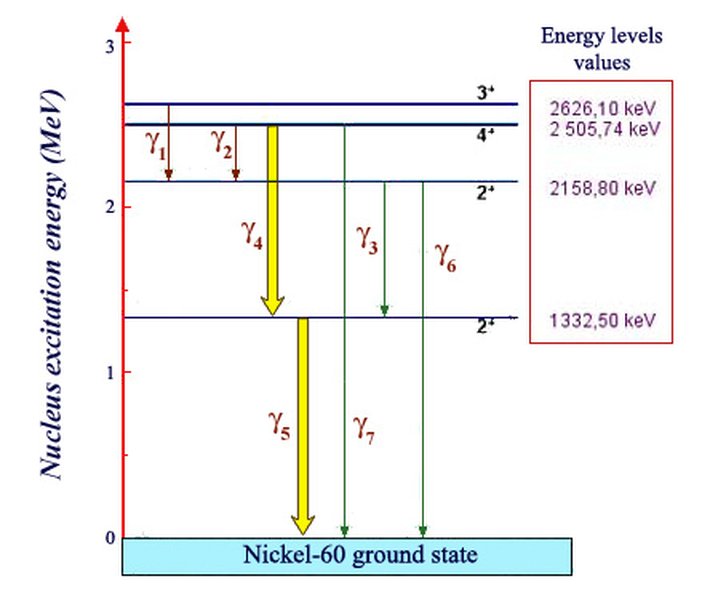
Illustration of Nuclear Energy Levels
Phenomena Associated with Yrast States
Backbending
One of the most fascinating phenomena observed in yrast bands is "backbending". This occurs when the moment of inertia of the nucleus, which is a measure of its resistance to changes in rotation, suddenly increases at a certain angular momentum. This increase is often attributed to the alignment of the angular momentum of a pair of nucleons (typically neutrons or protons) with the rotational axis of the nucleus. This alignment provides a more energetically favorable way for the nucleus to carry angular momentum, leading to a deviation from the expected smooth increase in yrast energy with spin.
Yrast Traps
In some cases, a nucleus can get "trapped" in a high-spin yrast state if there are no available lower-energy states with spins that allow for rapid gamma-ray transitions. This can occur if there is a large difference in angular momentum between a high-spin yrast state and the next available lower-lying states. Such states are known as "yrast traps" and can have relatively long lifetimes compared to other excited states.
For example, the isomer Tantalum-180m is a well-known example of an effectively stable nucleus due to its high-spin yrast state.
Shape Changes Along the Yrast Line
As the angular momentum of a nucleus increases, its shape can evolve. Many nuclei that are nearly spherical in their ground state become deformed (ラグビーボールのような形) at higher spins. This shape change is often driven by the need to minimize the rotational energy. Studying the properties of yrast states provides valuable information about how nuclear shapes change with increasing angular momentum.
Experimental Techniques and Theoretical Approaches
Populating Yrast States
To study yrast states, nuclear physicists employ various experimental techniques to create nuclei with high angular momentum. Heavy-ion fusion-evaporation reactions are a common method. In these reactions, a beam of heavy ions is directed at a target nucleus. When a projectile nucleus fuses with a target nucleus, a compound nucleus is formed with high excitation energy and angular momentum. This compound nucleus then de-excites by evaporating particles and emitting gamma rays.
Fission reactions can also populate yrast structures in the resulting fission fragments.
Detecting Gamma Rays
The gamma rays emitted during the de-excitation process carry information about the energies and spins of the nuclear states. High-resolution gamma-ray detector arrays, such as those using High Purity Germanium (HPGe) detectors, are used to measure the energies and intensities of these gamma rays. Coincidence measurements, where multiple gamma rays are detected in time correlation, are crucial for constructing the level schemes and identifying the yrast bands.
Below is an image relevant to the experimental setup for detecting nuclear emissions.
Equipment used in Nuclear Physics Experiments
Theoretical Models
Interpreting the experimental data requires theoretical models that can describe the behavior of nuclei at high spins. Some commonly used models include:
-
Interacting Boson Model (IBM): This model treats the nucleus as a system of interacting bosons, which represent pairs of nucleons. It has been successful in describing the collective properties of nuclei, including rotational and vibrational bands.
-
Cranked Shell Model: This model considers the motion of individual nucleons in a rotating potential. It can describe both collective and single-particle excitations and is particularly useful for understanding phenomena like backbending.
-
Total Routhian Surface (TRS) calculations: These calculations can predict the equilibrium shape of a nucleus as a function of angular momentum and deformation.
Yrast States vs. Nonyrast States
Understanding the Distinction
While yrast states represent the minimum energy for a given angular momentum, nuclei can also exist in "nonyrast" states. Nonyrast states are excited states that have higher energy than the yrast state for the same angular momentum. These states can involve different types of excitations, such as vibrations, different single-particle configurations, or combinations of both.
The decay of highly excited nuclei often involves transitions between both yrast and nonyrast states as the nucleus seeks to reach lower energy configurations. Studying both yrast and nonyrast states provides a more complete picture of the nuclear structure at various excitation energies and angular momenta.
Applications and Significance
Deciding Nuclear Reactions
The structure of yrast levels plays a crucial role in deciding the course and outcome of many nuclear reactions. The available decay paths for a compound nucleus are heavily influenced by the energies and spins of the yrast and near-yrast states. Understanding these pathways is essential for predicting the residues produced in nuclear reactions and for studying the synthesis of new elements and isotopes.
Astrophysical Implications
Yrast states can also have implications in astrophysical environments, such as in the rapid neutron capture process (r-process) that occurs in supernovae and neutron star mergers. The lifetimes and decay properties of nuclei involved in the r-process can be influenced by the presence of yrast traps and the structure of high-spin states, affecting the abundances of the elements synthesized.
Illustrative Example of Yrast Data
Examining a Specific Nucleus
To further illustrate the concept of yrast states, let's consider a simplified example of how yrast energies might be presented for a hypothetical nucleus. This table shows the minimum energy for a few different angular momentum values.
| Angular Momentum (J) | Yrast Energy (MeV) |
|---|---|
| 0 | 0.0 |
| 2 | 0.5 |
| 4 | 1.2 |
| 6 | 2.1 |
| 8 | 3.2 |
This table demonstrates the general trend of increasing yrast energy with increasing angular momentum. Real nuclear data is much more complex, involving many more energy levels and transitions.
Further Exploration: Video on Yeast (Not Yrast)
Clarifying a Common Confusion
It is important to note that "yrast" in nuclear physics is distinct from "yeast," the single-celled fungus used in baking and fermentation. While the words sound similar, they refer to completely different concepts in entirely different fields. To avoid confusion, here is a video explaining what yeast is.
Understanding Yeast: A Single-Celled Fungus
This video provides a basic introduction to yeast, explaining its biological nature and its role in processes like baking. This is unrelated to the nuclear physics concept of yrast states, but included to differentiate the terms due to potential phonetic similarity.
Frequently Asked Questions About Yrast States
What is the primary characteristic of a yrast state?
The primary characteristic of a yrast state is that it represents the nuclear state with the minimum possible energy for a given total angular momentum.
How are yrast states populated in experiments?
Yrast states are typically populated in nuclear reactions that create nuclei with high excitation energy and angular momentum, such as heavy-ion fusion-evaporation reactions or fission.
What is "backbending" in the context of yrast bands?
Backbending is a phenomenon in yrast bands where the moment of inertia of the nucleus suddenly increases at a certain angular momentum, often due to the alignment of nucleon pairs.
What is an "yrast trap"?
An yrast trap is a high-spin yrast state with a relatively long lifetime because there are no available lower-energy states with suitable spins for rapid gamma-ray transitions.
Why is studying yrast states important?
Studying yrast states is important for understanding nuclear structure, the behavior of nuclei at high spins, nuclear reactions, and astrophysical processes.
References
Last updated May 6, 2025