
A 20,000 mAh power bank and a 5,000 mAh phone do not automatically make four charges. The labels can describe charge at different battery voltages, and energy is lost between the power bank’s cells and the phone’s battery. Compare watt-hours first, then state which losses your estimate includes.
This guide separates three things that are often mixed together: a battery’s stored energy, energy delivered at a USB port, and energy actually added to a phone. The calculations and diagram below are original worked examples, not measurements of a power bank Ithy tested.
mAh measures charge; Wh measures energy
For a label using the battery’s nominal voltage, the useful conversion is Wh = mAh ÷ 1,000 × V. A hypothetical 20,000 mAh bank specified at 3.7 V therefore represents 74 Wh. A hypothetical 5,000 mAh phone battery specified at 3.85 V represents 19.25 Wh. Even before losses, their energy ratio is 74 ÷ 19.25, about 3.84, rather than exactly four.
Use the voltage stated for the capacity label, not whichever voltage happens to appear beside the USB output. Nominal voltage is a specification convention, not a claim that battery voltage stays fixed throughout discharge. If the manufacturer already supplies Wh, use that figure instead of reconstructing it with an assumed 3.7 V.
Two 20,000 mAh labels can mean different energy
Anker’s capacity explanation illustrates 20,000 mAh at 3.7 V as 74 Wh. The official NITECORE NB20000 Gen3 specification, checked October 24, 2026, instead lists 20,000 mAh at 3.6 V, or 72 Wh. Neither voltage should be silently substituted for the other.
That NITECORE page separately gives rated output of 10,100 mAh at 5 V under its stated typical 3 A condition. Converting that output label gives 50.5 Wh. It describes a different boundary from the 72 Wh cell figure. The ratio is about 70.1% at that declared condition; it is not an Ithy measurement, a universal efficiency, or a prediction for another load or model revision.
A smaller output mAh figure does not all represent lost energy
Imagine converting the example bank’s 74 Wh with no losses at all. The equivalent output charge changes with voltage:
| Output voltage | Equivalent output charge | Energy |
|---|---|---|
| 5 V | 14,800 mAh | 74 Wh |
| 9 V | About 8,222 mAh | 74 Wh |
| 20 V | 3,700 mAh | 74 Wh |
The smaller mAh numbers in this ideal table result from changing the voltage used for the comparison. Real conversion losses reduce the delivered Wh as well. Do not subtract 14,800 from 20,000 and call the difference an efficiency loss: those charge figures refer to different voltages.
One complete worked charging estimate
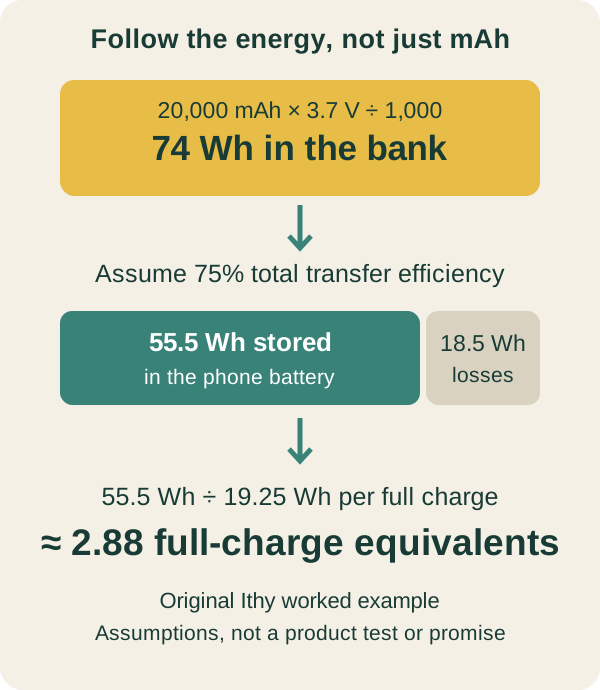
Take the hypothetical 74 Wh bank and 19.25 Wh phone battery above. Assume, solely for this example, that 75% of the bank’s labeled energy ends up stored in the phone after all transfer losses. Then:
- Energy added to the phone batteries: 74 × 0.75 = 55.5 Wh.
- Equivalent full charges: 55.5 ÷ 19.25 = about 2.88.
- In this simplified budget, that is two complete empty-to-full charges, with energy remaining for part of another.
Changing the assumption changes the answer. At 65%, the same budget gives about 2.50 equivalent full charges; at 85%, about 3.27. These are sensitivity scenarios, not a measured typical range or a confidence interval. Temperature, battery condition, charging method, output load and device activity can change the actual result.
If the phone also consumes 3 Wh during a charging session, and that consumption has not already been included in the 75% assumption, only 52.5 Wh remains for storage: about 2.73 full-charge equivalents. Count a loss or operating load once. Applying a second blanket efficiency discount to an already end-to-end measured result would double-count losses.
A top-up is not a full charge
Charging from 30% to 80% spans half the displayed battery range. In a deliberately simplified linear energy model, it needs half the energy of an empty-to-full charge, so 2.88 full-charge equivalents would represent about 5.77 such top-ups. A real percentage indicator is an estimate, and battery aging changes usable capacity. Record the actual starting and finishing percentages when comparing claims.
Also distinguish W from Wh. A 30 W output rating describes a power capability, not a 30 Wh energy store. Compatible USB Power Delivery implementations negotiate power capabilities. A larger maximum wattage does not by itself establish more stored energy or more phone charges.
What to check on your own power bank
- Find the exact model, cell Wh or nominal-voltage capacity, and any separate rated output figure.
- Check the output rating’s voltage, load and other test conditions. Compare Wh at the same boundary.
- Find the phone battery’s specified energy where available; do not assume every 5,000 mAh battery has the same Wh.
- Separate wired and wireless results, partial top-ups and full charges, and idle versus actively used phones.
- If using a suitable USB energy meter, record its position and measured Wh. Output at the bank’s port is not energy stored in the phone; intervening losses and phone activity remain.
A low charge count alone does not prove either a fault or honest labeling. Check model-specific documentation and test conditions before drawing that conclusion. For how energy reaches the port, read how a power bank’s cells, charger and converter work. For connector compatibility, see USB-C charging, data and display capabilities.
Reproduce the arithmetic
Download the standard-library Python example or its six-row illustrative CSV. It uses exact decimal inputs for two bank sizes and three assumed total-transfer efficiencies, with a 19.25 Wh hypothetical phone battery. The files perform no network request and contain no measured customer or product data.
Primary sources and scope
- Anker: capacity labels, voltage conversion and charging losses.
- NITECORE: NB20000 Gen3 cell and rated output specifications. Model-specific published figures, not independent testing.
- USB-IF: USB Power Delivery.
Sources checked October 24, 2026. No purchase recommendation, teardown or universal charge-count claim is made.