
Unraveling the Christmas Eve Fury: The 2018 Mount Etna Eruption Explained
A complex interplay of subterranean forces led to a significant flank eruption and seismic events, reshaping Sicily's landscape.
- Shallow Dyke Intrusion: The primary trigger for the eruption was a rapid, shallow intrusion of magma, creating immense overpressurization within the volcano.
- Seismic Swarm and Flank Instability: Preceding the eruption, intense seismic activity indicated magma movement, exacerbated by the gravitational instability of Etna's southeastern flank.
- Widespread Impact: The eruption produced lava flows, ash plumes that disrupted air traffic, and a powerful magnitude 4.9 earthquake causing damage and injuries in nearby towns.
The 2018 eruption of Mount Etna, which commenced dramatically on Christmas Eve, December 24, was a pivotal event in the volcano's recent history. It wasn't merely a sudden outburst but the culmination of months of subterranean unrest, involving intricate magmatic processes, ground deformation, and seismic activity. This flank eruption, a notable departure from Etna's more common summit activity, provided volcanologists with a unique opportunity to study the complex interplay of forces that drive such powerful natural phenomena.
The Precursor Symphony: Months of Unrest Leading to the Eruption
Mount Etna, Europe's largest and most active volcano, constantly undergoes periods of internal change. The 2018 eruption was not an isolated incident but rather the climax of several months of escalating activity. Volcanologists had been closely monitoring signs of increasing pressure within the volcanic edifice, raising concerns about potential lateral eruptions and even prompting discussions about evacuation plans for the lower flanks.
Early Warning Signs and Subterranean Dynamics
The volcano exhibited a range of precursor activities throughout 2018, signaling a significant buildup of internal energy:
- Strombolian Explosions: Earlier in the year, particularly in June and July, observers noted intermittent Strombolian explosions from the Southeast Crater (SEC). These relatively localized bursts ejected ash and volcanic material, indicative of rising magma.
- Lava Flows: By late August and again in late November, lava flows emanated from the New South-East Crater (NSEC), suggesting a shift towards more effusive activity and continuous magma supply.
- Deep Seismic Swarm: On November 20, a significant seismic swarm, comprising over 40 events with hypocenters ranging from 15 to 27 kilometers deep, affected Etna's western flank. This deep seismicity coincided with a small, short-lived lava flow from the NSEC, hinting at deeper magmatic movements.
Ground Deformation and Pressure Buildup
Crucially, geodetic measurements consistently revealed significant inflation of the volcano's southeastern flank. This ground deformation, particularly pronounced since September 2018, was a direct consequence of magma intrusions at shallow depths—estimated between 1 and 6 kilometers below the surface. The swelling of the volcano indicated an intense overpressurization of magma reservoirs, forcing the volcanic edifice to expand.
Moreover, subtle changes in gravity and gas emissions were detected, further corroborating the ascent of magma and the escalating pressure within Etna's intricate plumbing system. These observations provided critical insights into the internal state of the volcano, allowing scientists to anticipate a potential eruption.
The Christmas Eve Commencement: A Lateral Flank Eruption
The immediate trigger for the December 2018 eruption was a major seismic swarm that began affecting the southeastern belt of Etna between December 23 and 24. This intense seismic activity was a direct consequence of a shallow dyke intrusion—a process where magma forces its way upwards through existing fractures in the rock, creating new pathways for eruption.
The Opening of the Fissure and Initial Activity
At approximately 9:30 AM on Christmas Eve, December 24, 2018, a new eruptive fissure, extending about 2 kilometers in length, dramatically opened on the southeastern flank of the volcano. This was a classic flank eruption, distinct from typical summit eruptions, where magma exploits weaknesses on the volcano's side rather than emerging directly from the main craters.
The eruption immediately produced significant Strombolian explosive activity. This activity is characterized by moderate bursts of lava bombs, incandescent fragments, and ash clouds, which, while spectacular, did not form a sustained, towering eruption column. Lava flows rapidly emerged from the fissure, primarily directed towards the Valle del Bove, a large horseshoe-shaped caldera on the volcano’s eastern side, which effectively channeled the flows and mitigated some of the immediate risks to populated areas.
An active lava flow during the 2018 Mount Etna eruption, highlighting the effusive nature of the event.
The Seismic Aftershock: A Powerful Earthquake
The eruption was accompanied by continuous, intense seismicity. Just two days later, on December 26, 2018, at 02:19 UTC, a particularly strong earthquake with a magnitude of 4.9 (ML 4.8) struck the southeastern flank of Etna. This shallow earthquake, originating at less than 1 kilometer deep near Pisano and 5 kilometers northwest of Acireale, caused severe damage to buildings and roads in several towns and villages, resulting in approximately 10 injuries and displacing over 1,100 people. This earthquake was not merely a coincidental event but a direct consequence of the volcanic unrest, as the movement of magma and the volcano's structural instability contributed to significant ground shaking.
The Mechanisms at Play: Why the Eruption Occurred
The 2018 eruption was a testament to the complex geological processes that govern Mount Etna's behavior. Scientific analyses have pinpointed several key factors that contributed to the event.
Overpressurization and Dyke Intrusion
The most critical factor was the rapid intrusion of magmatic dykes into the southeastern flank. A substantial buildup of magma and volcanic gases generated immense stress within the volcano, finally forcing the magma out through newly formed or exploited fractures on the southeastern flank. This process of extreme overpressurization allowed for the fast and forceful intrusion of magma.
The magma ascent involved a bicomponent magma mixing, as revealed by geochemical studies of the eruption products. One type was more primitive and affected by shallower crustal contamination, while the other was more evolved and representative of Etna's typical magma. This mixing likely played a role in triggering the eruptive phase.
Structural Flank Instability
Mount Etna’s southeastern flank is known to be gravitationally unstable and is slowly sliding towards the Mediterranean Sea. This inherent structural weakness was exploited by the ascending dyke, facilitating the lateral escape of magma. The instability of the flank, coupled with the internal pressure, created optimal conditions for a flank eruption rather than a summit one.
Impacts and the Lingering Aftermath
The 2018 eruption had immediate and noticeable impacts on the surrounding region and beyond.
Airspace Disruptions
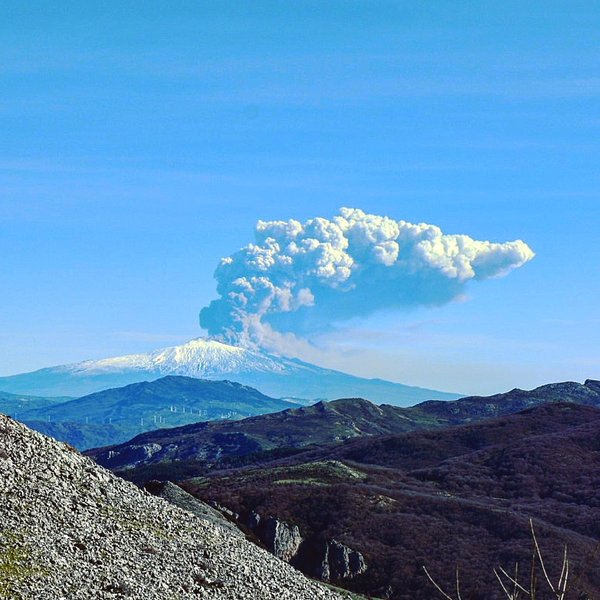
The ash clouds generated by the explosive activity rose high enough to disrupt regional airspace, leading to the temporary closure of Catania Airport. This caused significant travel disruptions during a peak holiday season, underscoring the broader logistical challenges posed by volcanic eruptions.

A large ash plume rising from Mount Etna, demonstrating the aerial impact of the eruption.
Damage to Infrastructure and Communities
The magnitude 4.9 earthquake on December 26 was particularly destructive. Towns like Viagrande, Aci Bonaccorsi, and Acireale suffered significant structural damage, including cracked buildings and compromised infrastructure. While no fatalities were reported, the event caused injuries and necessitated the displacement of many residents.
A New Eruptive Phase
Despite initial fears of a catastrophic lateral eruption, the 2018 event ultimately acted as a pressure release valve. It marked the beginning of a prolonged phase of eruptive activity for Etna, spanning from 2019 to 2021, characterized by repeated paroxysms, spectacular lava fountains, and ash columns. This "payment in installments" released the accumulated magma and energy gradually, making the 2018 Christmas eruption a starting point for a new decade of specific eruptive behaviors.
Understanding Etna's Volcanic Behavior
To further understand the dynamics of the 2018 eruption and its place in Etna's overall activity, a comprehensive assessment of various volcanic characteristics is insightful. This radar chart presents an opinionated analysis of how the 2018 event scored across key parameters compared to a typical Etna eruption.
This radar chart illustrates that the 2018 Christmas Eve eruption was characterized by unusually high seismic intensity and ground deformation compared to a typical Etna summit eruption, indicative of the significant internal pressure buildup and dyke intrusion. While lava flow volume was moderate, the ash plume height and socio-economic impact were notably elevated due to its nature as a flank eruption and the accompanying earthquake. The duration of the primary eruptive phase was relatively short, but it initiated a multi-year period of heightened activity.
The Event's Place in Etna's History
Mount Etna, with a documented history of eruptions dating back to 1500 BCE, is constantly transforming. Its height, currently around 3,403 meters (as of September 2024), varies due to eruptions and collapses. The 2018 event, though not the largest in Etna's history, is significant because it showcased the complex interplay of magmatic and structural factors that drive flank eruptions in hazardous ways. It provided valuable data on how internal pressures and gravitational forces interact to trigger volcanic activity.
The following mindmap visually organizes the key aspects of the 2018 Mount Etna eruption, from its underlying causes to its immediate and prolonged effects.
This mindmap effectively illustrates the multifaceted nature of the 2018 Mount Etna eruption, from the deep-seated geological causes to its far-reaching consequences. It highlights how precursor activities, such as seismic swarms and ground deformation, signaled the impending event, which was primarily driven by a shallow dyke intrusion and the inherent instability of the volcano's flank. The mindmap also clearly delineates the specific eruptive events, including the Christmas Eve fissure opening and the subsequent powerful earthquake, and their significant impacts on both human activity and the volcano's long-term behavior.
Detailed Timeline of Events
To provide a clearer chronological understanding, the table below summarizes the key events leading up to, during, and immediately after the 2018 Mount Etna eruption.
| Date/Period | Event Description | Significance |
|---|---|---|
| Early-Mid 2018 | Intermittent Strombolian explosions from Southeast Crater (SEC). | Routine activity, indicative of magma rising through conduits. |
| Late August 2018 | Lava flows observed from New Southeast Crater (NSEC). | Shift towards more effusive activity. |
| September 2018 onwards | Pronounced ground deformation on the southeastern flank due to magma intrusions. | Signs of increasing overpressurization at shallow depths (1-6 km). |
| November 20, 2018 | Seismic swarm (40+ events, 15-27 km deep) on western flank, coinciding with small NSEC lava flow. | Deep magma movements and initial pressure release. |
| Late November 2018 | Another lava flow episode from NSEC. | Continued magma supply and pressure buildup. |
| December 23-24, 2018 | Major seismic swarm affecting the southeastern belt. | Direct precursor to the flank eruption, indicating dyke intrusion. |
| December 24, 2018 (9:30 AM) | Lateral eruptive fissure (approx. 2 km long) opens on southeastern flank (3100m, extending to 2400m). | Commencement of the main flank eruption; ash, gas, and lava flows into Valle del Bove. |
| December 24, 2018 onwards | Intense Strombolian activity and ash clouds. | Explosive phase of eruption, leading to airspace closure. |
| December 26, 2018 (02:19 UTC) | Magnitude 4.9 (ML 4.8) shallow earthquake strikes southeastern flank (near Pisano, 5km NW Acireale). | Significant seismic event causing widespread damage and injuries. |
| 2019-2021 | Prolonged phase of eruptive activity, including repeated paroxysms and lava fountains. | Long-term consequence of the 2018 pressure release. |
Visualizing the Eruption
The 2018 Mount Etna eruption captivated global attention, with many capturing its dramatic displays. The following video offers a vivid glimpse into the powerful forces at play during this significant event.
This video titled "Etna erupts on Christmas Eve 2018: huge lava flow travels..." directly shows footage from the event. It effectively visualizes the lava flows and ash plumes emanating from the newly opened fissures, providing a direct visual representation of the eruptive activity that occurred. It helps contextualize the descriptions of the lateral eruption and the scale of the phenomena witnessed during that period, complementing the scientific explanations with raw footage of nature's power.
Frequently Asked Questions (FAQ)
What is a flank eruption?
How often does Mount Etna erupt?
What is a dyke intrusion in volcanology?
How was the 2018 eruption linked to the earthquake on December 26?
Did the 2018 eruption cause widespread damage?
Conclusion
The 2018 Mount Etna eruption stands as a significant case study in modern volcanology, illustrating the complex interplay of internal magmatic forces and external structural weaknesses. Triggered by a shallow dyke intrusion and exacerbated by pre-existing flank instability, the Christmas Eve event evolved from a period of escalating unrest into a powerful lateral eruption. Its immediate impacts, including extensive seismic activity, lava flows, and ash plumes, directly affected local communities and air travel. Furthermore, the eruption marked the beginning of a new, prolonged phase of energetic activity for Etna, reinforcing the importance of continuous, multi-disciplinary monitoring to understand and mitigate the hazards posed by this dynamic volcano.
Recommended Further Queries
- How has Mount Etna's activity changed since 2018?
- What are the primary methods for monitoring active volcanoes like Etna?
- How do flank eruptions differ from summit eruptions at Mount Etna?
- What are the long-term geological impacts of major eruptions on volcanic structures?