
Unlocking the Power of Abstract Decision Trees for Code Generation
Deep insights into leveraging abstract models and real-world datasets for superior code generation
Key Highlights
- Abstract Decision Trees in Code: Discover how decision trees can be abstracted for reasoning over code and integrated into advanced models.
- SWE-Bench and Real-World Datasets: Learn about high-quality, I/O-focused programming datasets that mirror real-world software challenges.
- Model Training & Evaluation: Explore strategies for training a 70B parameter code generation model with robust, diverse data.
Deep Research Overview
The goal for the upcoming April focus is to build an exemplary coding model that leverages abstract decision trees integrated with real-world software development datasets, including SWE-bench. This approach combines an abstract representation of code logic and decision-making processes using decision trees with high-quality, real-world programming datasets designed for input/output (I/O) problem-solving. This synthesis not only emphasizes the algorithm's interpretability and performance but also ensures practicality when applied to software engineering challenges.
Abstract Decision Trees in Code
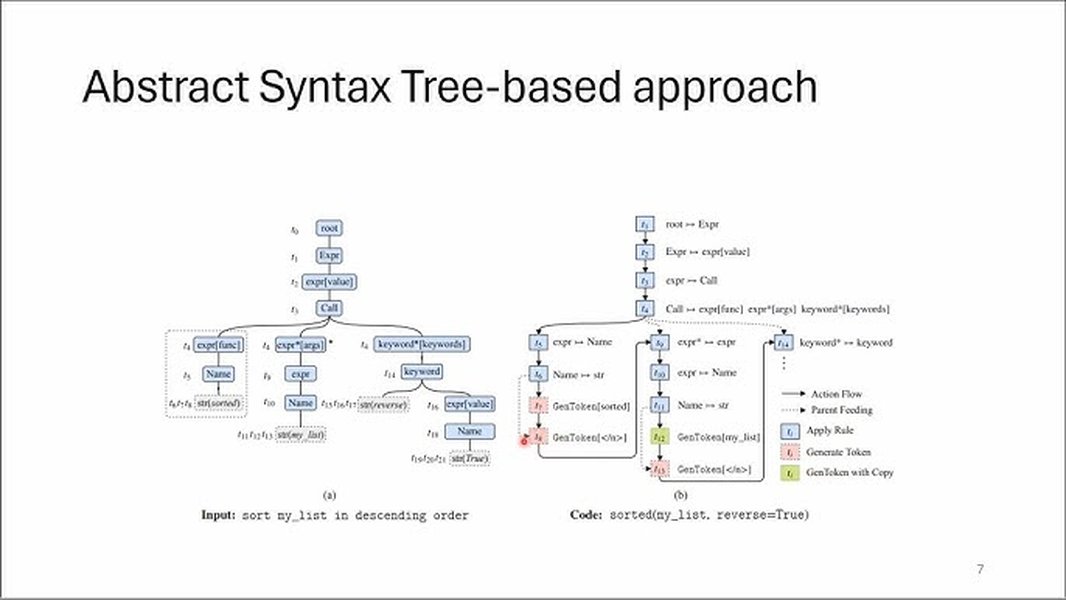
Abstract decision trees are a conceptual framework that represents decision-making processes in code. At their core, they treat the development process as a tree-like structure:
Core Structure
In the abstract decision tree model:
- Internal Nodes: Are representative of the testing of conditions or features in the code (e.g., testing variable states, function outputs, or control flow decisions).
- Branches: Extend from each node, representing the decisions or paths taken based on the outcomes of the tests.
- Leaf Nodes: Provide final predictions or outcomes, such as suggestions for code completions, corrections, or optimizations.
This abstraction enables us to create models that not only replicate human-like reasoning over code but also operate efficiently in making predictions about code behavior and structure. By abstracting the intricacies of code into decision-making pathways, the model can learn from multiple code examples and apply learned rules to new code, thus allowing for a robust and interpretable code generation process.
Probabilistic Modeling and Training
Integrating abstract decision trees into a probabilistic framework allows the model to capture uncertainties and varied coding patterns. By leveraging large-scale codebases, the system can:
- Learn abstract representations of code syntax and semantics.
- Utilize algorithms inspired by traditional decision tree learning (ID3, ID3+, E13) but adapted to code structures.
- Integrate probabilistic outcomes to not only predict probable code completions but also to suggest improvements and repairs.
For instance, research has demonstrated that using decision tree models can significantly improve code prediction accuracy, paving the way for training models with up to 70 billion parameters. These massive models require extensive and diverse datasets to capture the complexities of real-world software development.
Programming SWE-Bench Datasets and Real-World Software Development Data
Understanding SWE-Bench
SWE-Bench datasets are curated specifically to reflect the challenges of real-world software engineering:
- Dataset Composition: Typically include thousands of issue and pull request pairs extracted from popular repositories. This ensures that the dataset encapsulates common errors, feature requests, and I/O challenges encountered in everyday development.
- I/O Problems Focus: The datasets contain diverse examples of input/output problems that can be used to simulate practical coding scenarios. These include error handling, data validation, and user interaction challenges.
- Real-World Relevance: The emphasis is on practical problems rather than theoretical or competition-only challenges, ensuring that models trained on this data are robust and versatile.
Training a code generation model using SWE-Bench datasets provides several distinct advantages:
- It improves the model’s ability to generalize across different coding styles and paradigms.
- It enhances the understanding of realistic programming challenges, thereby improving the practical utility of the generated code.
- It delivers predictive insights that are directly applicable to live software development environments.
Real-World Software Development Programming Datasets
Alongside SWE-Bench, other programming datasets provide further depth:
- Diverse Sources: GitHub repositories, open-source projects, and curated real-world issues/pull requests offer data that is reflective of modern development practices.
- Annotated Data: Careful annotation of datasets ensures clear representation of problems, solutions, and the causal relationships between code and its outcomes.
- High-Quality Annotations: Indicators such as bug fixes, feature enhancements, and code refactorings provide useful context to build models not solely based on syntax but also on semantic understanding of code changes.
Model Training and Evaluation Strategy
Training a 70B Parameter Code Generation Model
The approach to training an advanced coding model involves leveraging a combination of abstract decision tree reasoning and robust, real-world datasets. The core strategy includes:
Data Integration
The training data should be carefully aggregated from:
- SWE-Bench datasets to account for real-world issue and pull request pairs.
- Additional datasets that capture a broad range of programming paradigms and I/O challenges.
- Continually updated real-world codebases that can provide the latest trends and best practices in software engineering.
By combining these sources, data diversity will drive the model to learn nuanced coding patterns and decision-making strategies vital for effective code generation.
Model Architecture and Learning Algorithm
The model will integrate layers inspired by transformer-based architectures with dedicated modules for abstract decision tree reasoning. The abstract decision trees facilitate:
- Conditional Decision Making: Modules that predict branching and decisions based on the current code context.
- Probabilistic Predictions: Incorporating strategies from probabilistic model learning to assign likelihoods to possible code completions or corrections.
- Interpretability: Maintenance of a tree-structured decision path enhances the interpretability of the generated results, a unique advantage over monolithic black-box models.
The combination of these strategies will create a model specifically tuned for generating high-quality code that is not merely syntactically correct but contextually appropriate for real-world applications.
Evaluation Metrics
Model performance should be evaluated using the following metrics:
- Accuracy & Precision: Measuring how often the generated code meets the requirements specified in input data.
- Responsiveness to I/O Challenges: Evaluating the model on its ability to handle real-world input and output variations effectively.
- Generalizability: Ensuring that the model performs consistently across diverse programming tasks, projects, and coding styles.
- Interpretability: Assessing the clarity and usefulness of the decisions made by the model as explained by its abstract decision tree paths.
Visualizing the Research Strategy
Radar Chart Representation
The following radar chart represents our multi-dimensional approach to building this coding model. The key axes include model performance, data quality, decision-making interpretability, training scalability, and real-world application readiness.
Mindmap of the Research Strategy
The mindmap below illustrates the conceptual framework that integrates abstract decision trees with SWE-Bench and real-world datasets, driving the training of a 70B parameter code generation model.
Supplementary Video Resource
To further enhance understanding of abstract decision trees and decision-making in code, please watch the video below which delves into core principles of decision tree implementation and their abstract applications in software engineering:
Comprehensive Data Table: Key Elements in Our Strategy
The table below outlines the core elements we are focusing on, their key attributes, and their relevance to building a state-of-the-art code generation model:
| Focus Area | Description | Key Benefits |
|---|---|---|
| Abstract Decision Trees |
Model abstract decision-making via tree structures representing code logic. Utilizes probabilistic modeling for prediction. |
Enhanced interpretability, Clear decision paths, Robust integration into code generation. |
| SWE-Bench Datasets |
Real-world dataset combining issue and pull request pairs from high-quality repositories. Focus on I/O problems and practical coding challenges. |
Validates model performance, Provides diverse and annotated examples, Improves generalizability. |
| Real-World Codebases |
Aggregated from open-source projects and live software development environments. Focus on contemporary coding standards and practices. |
Ensures practical relevance, Enhances model adaptability, Reflects latest industry trends. |
| 70B Parameter Model |
A large-scale transformer-based architecture integrated with abstract reasoning. Trained using diverse and real-world examples. |
Superior predictive performance, Greater contextual awareness, Scalability and robustness. |
Frequently Asked Questions (FAQ)
What are abstract decision trees in the context of code generation?
Abstract decision trees represent a high-level model where decisions in code are arranged in a tree structure. Each node represents a decision point based on code features, while branches guide the evolution of the code logic, culminating in outcomes at the leaves. This framework enables models to learn not only syntactical elements but also contextual decision-making processes in software development.
How do SWE-Bench datasets improve model training for real-world challenges?
SWE-Bench datasets consist of real-world issue and pull request pairs, emphasizing I/O problems and practical coding challenges. This high-quality, annotated data helps the model learn from actual software development scenarios, improving its generalizability and predictive accuracy in live coding environments.
What makes a 70B parameter model unique for code generation?
A 70B parameter model leverages an enormous capacity to capture intricate patterns in code. Combined with abstract decision tree reasoning, it is capable of producing highly context-aware and precise code suggestions. The large-scale nature of the model ensures that it can adapt to diverse coding scenarios and handle complex decision-making processes inherent in real-world software development.
References
- Decision Tree Introduction - GeeksforGeeks
- Probabilistic Models of Code - ETH Zurich Publications
- Decision Tree Implementation in Python - GeeksforGeeks
- Decision Tree Algorithm Overview - Analytics Vidhya
- SWE-Bench+: Enhanced Coding Benchmark for LLMs - arXiv
Recommended Further Queries
Last updated April 1, 2025