
Unveiling the Secrets of Flawless Financial Records: A Deep Dive into Error Rectification
Mastering the art of identifying and correcting accounting mistakes for pristine financial reporting.
In the meticulous world of accounting, precision is paramount. However, human fallibility and the complexity of financial transactions mean errors can, and do, occur. "Rectification of Errors" is the systematic process of identifying these inaccuracies and making the necessary corrections to ensure that financial records present a true and fair view of an entity's financial position and performance. This module explores the critical aspects of this process, from understanding its fundamental meaning to applying practical correction techniques.
Essential Insights: Key Takeaways
- Accuracy is Non-Negotiable: Rectification ensures financial statements are reliable, forming a trustworthy basis for decision-making by stakeholders.
- Diverse Error Types: Errors vary from simple omissions to complex misapplications of accounting principles, each requiring a specific approach for correction.
- Systematic Correction: The process involves identifying the error, understanding its impact, and applying correcting journal entries, sometimes utilizing a suspense account.
Understanding Rectification of Errors: Meaning and Definition
Rectification of errors in accounting refers to the formal procedure of identifying, analyzing, and correcting mistakes made during the recording, classifying, or summarizing of financial transactions. These errors can creep in at various stages of the accounting cycle, such as when journalizing transactions, posting them to ledger accounts, balancing accounts, or even when preparing the trial balance and final financial statements.
Definition: Several sources define rectification of errors as "the process of revising mistakes and making amendments to the accounting records." The core purpose is to amend these mistakes so that the financial statements accurately reflect the true financial health and operational results of a business. This is not merely about fixing numbers; it's about upholding the integrity and reliability of the entire accounting system.
Identifying common accounting errors is the first step towards rectification.
The Imperative: Why We Need Rectification of Errors
The need for rectifying errors is multifaceted and critical for the sound financial management and reporting of any organization. Uncorrected errors can have significant repercussions:
Ensuring Accuracy of Financial Statements
The primary goal of accounting is to provide accurate financial information. Errors, regardless of their size or nature, can distort the true picture of a company's profitability, assets, liabilities, and equity. Rectification ensures that the Profit & Loss Account and Balance Sheet present correct and reliable figures.
Facilitating Reliable Decision-Making
Management, investors, creditors, and other stakeholders rely on financial statements to make informed economic decisions. If these statements are riddled with errors, the decisions based upon them can be flawed, potentially leading to financial loss or missed opportunities.
Upholding Legal and Regulatory Compliance
Accurate accounting records are often a legal requirement. Regulatory bodies and tax authorities demand precise financial reporting. Failure to rectify errors can lead to non-compliance, penalties, and legal challenges. Audits also rely on the accuracy of these records.
Maintaining Stakeholder Trust
Transparency and accuracy in financial reporting build and maintain the trust of shareholders, lenders, employees, and the public. Errors, especially if perceived as intentional or due to negligence, can erode this trust.
Preventing Compounding Issues
An uncorrected error in one accounting period can carry over and affect subsequent periods, making future financial analysis even more complex and unreliable. Timely rectification prevents this snowball effect.
The Aims: Objectives of Rectification of Errors
The process of rectifying errors is guided by several key objectives:
- Presenting a True and Fair View: To ensure that the financial statements (Balance Sheet, Income Statement, Cash Flow Statement) accurately reflect the financial position, performance, and cash flows of the entity.
- Ensuring Accuracy and Reliability: To correct the accounting records so that they are free from material misstatements, thereby enhancing their reliability.
- Compliance with Accounting Standards: To align the financial records with Generally Accepted Accounting Principles (GAAP) or International Financial Reporting Standards (IFRS), and other relevant legal stipulations.
- Facilitating Correct Financial Analysis: To provide a sound basis for management analysis, budgeting, forecasting, and strategic planning.
- Maintaining Integrity of the Accounting System: To uphold the robustness and credibility of the internal control systems and the overall accounting framework.
- Correct Determination of Profit or Loss: To accurately ascertain the operational results for an accounting period, ensuring that revenues and expenses are correctly matched and reported.
Classifying Mistakes: Types of Accounting Errors
Accounting errors can be broadly categorized based on their nature and their impact on the agreement of the trial balance. Understanding these types is crucial for effective rectification.
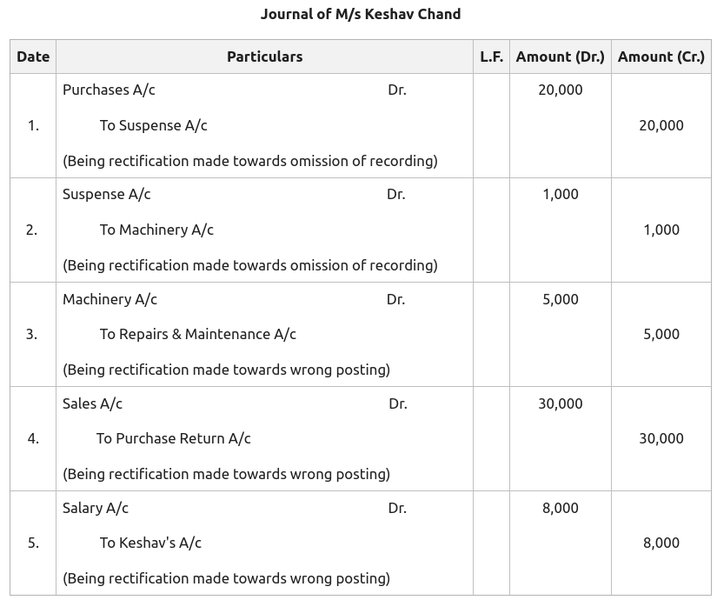
Errors can be detected at various stages, including trial balance preparation.
Errors That Do Not Affect the Trial Balance (Two-Sided Errors)
These errors are often more insidious because the trial balance will still agree (total debits equal total credits), potentially masking the mistake. They typically affect two or more accounts.
1. Errors of Omission (Complete Omission)
This occurs when a transaction is entirely missed and not recorded in the books of accounts at all. For example, failing to record a cash sale or a purchase on credit.
2. Errors of Commission
These errors arise due to incorrect recording of a transaction, such as posting to the wrong account (but of the correct class, e.g., another expense account instead of the correct one), wrong amount in the correct accounts on both debit and credit sides, or errors in subsidiary books that are correctly posted. For example, recording a Rs. 550 sale as Rs. 505 in both the customer's account and the sales account.
3. Errors of Principle
These occur when a transaction is recorded in fundamental violation of accounting principles. This often involves misclassifying an item between capital and revenue. For instance, treating the purchase of a fixed asset (capital expenditure) as a regular expense (revenue expenditure), or vice versa. While the debit and credit amounts are correct, the accounts used are inappropriate from a classification perspective.
4. Compensating Errors
These are two or more independent errors that coincidentally cancel out each other's effect on the trial balance. For example, an over-debit in one account by Rs. 100 is compensated by an over-credit in another account by Rs. 100, or an under-debit in one account is offset by an under-credit in another.
Errors That Affect the Trial Balance (One-Sided Errors or Errors Leading to Disagreement)
These errors cause the total of debits and total of credits in the trial balance to disagree, signaling that something is amiss.
1. Errors of Omission (Partial Omission)
This happens when one aspect of a transaction is recorded, but the other is not. For example, a cash sale is debited to the Cash account, but the corresponding credit to the Sales account is omitted.
2. Errors of Posting
These include:
- Posting to the wrong side of an account (e.g., debiting an account that should have been credited).
- Posting the wrong amount to one side of the entry.
- Omitting to post an amount from a subsidiary book to a ledger account.
3. Errors of Casting (Totaling)
These are mistakes made in totaling subsidiary books or balancing ledger accounts. For example, the Sales Day Book is undercast (totaled less) or overcast (totaled more).
4. Errors in Carrying Forward
Mistakes made when carrying a balance from one page or period to another.
Visualizing the Impact of Rectification
The rectification of errors significantly enhances various aspects of financial integrity and business operations. The radar chart below illustrates the perceived positive impact of effective error rectification across several key dimensions for businesses of different sizes. The scores (ranging from 4 to 10, where 10 is the highest positive impact) reflect the increasing importance and benefit as business complexity grows.
As illustrated, the benefits of robust error rectification processes, such as enhanced accuracy and stakeholder confidence, become increasingly vital as organizations scale and their financial structures become more complex.
The Correction Toolkit: Simple Journal Entries for Rectification
The most common method for rectifying errors is by passing rectifying journal entries. The nature of the entry depends on the type of error and when it is discovered. The goal is to nullify the effect of the wrong entry and simultaneously record the correct effect.
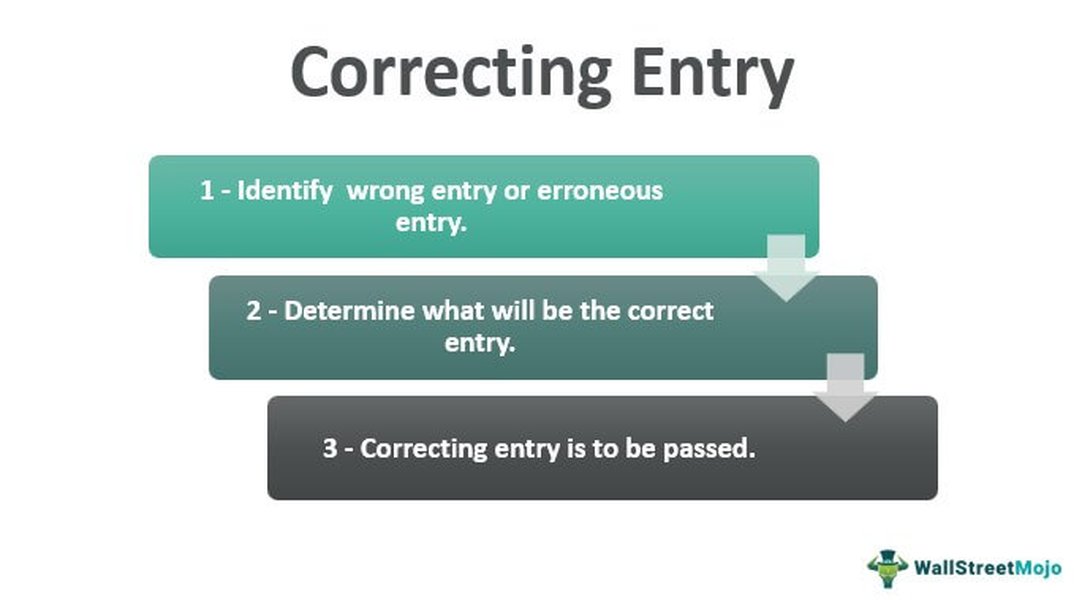
Correcting entries restore accuracy to the financial records.
Examples of Rectifying Journal Entries
Example 1: Error of Principle - Capital Expenditure Treated as Revenue Expenditure
Error: Rs. 5,000 paid for the installation of new machinery was wrongly debited to the Wages Account instead of the Machinery Account.
Analysis: Wages Account (revenue expense) was incorrectly debited. Machinery Account (capital asset) should have been debited. The effect on Wages A/c needs to be reversed (credited), and Machinery A/c needs to be correctly debited.
Rectifying Entry:
Machinery A/c       Dr.   5,000
  To Wages A/c              5,000
(Being wages paid for machinery installation, wrongly debited to Wages A/c, now rectified)
Example 2: Error of Complete Omission
Error: Credit sales of Rs. 2,000 to Mr. John were not recorded in the books.
Analysis: Both the debit to Mr. John's A/c (Debtor) and the credit to Sales A/c were omitted.
Rectifying Entry:
Mr. John's A/c      Dr.   2,000
  To Sales A/c              2,000
(Being credit sales to Mr. John, previously omitted, now recorded)
Example 3: Error of Commission - Posting to Wrong Account (Correct Side and Amount)
Error: Rs. 1,000 paid for Rent was wrongly debited to the Salaries Account.
Analysis: Salaries A/c was incorrectly debited. Rent A/c should have been debited. The debit in Salaries A/c needs to be reversed (credited), and Rent A/c needs to be correctly debited.
Rectifying Entry:
Rent A/c            Dr.   1,000
  To Salaries A/c           1,000
(Being rent paid, wrongly debited to Salaries A/c, now rectified)
Example 4: Error Affecting Trial Balance - One-Sided Error (Corrected using Suspense Account if Trial Balance was forced)
Error: The Sales Day Book was undercast (totaled less) by Rs. 500. This means the Sales Account was credited with Rs. 500 less.
Analysis: Sales Account needs to be credited by an additional Rs. 500. If a Suspense Account was opened to balance the trial balance due to this error, it would have a debit balance of Rs. 500. The rectification will credit Sales A/c and debit Suspense A/c.
Rectifying Entry (assuming Suspense Account was used):
Suspense A/c        Dr.     500
  To Sales A/c                500
(Being correction of undercasting of Sales Day Book)
If the error is found before closing the books and before preparing the trial balance, or if no suspense account was used, a direct correction might be made, or for one-sided errors, a note is made, and the specific account (Sales A/c here) is credited appropriately. The use of a Suspense Account typically occurs when the trial balance doesn't agree, and the difference is temporarily parked in this account until errors are located.
Summary Table: Error Types and Rectification Approach
This table summarizes common error types and their typical rectification paths:
| Type of Error | Description | Impact on Trial Balance | Typical Rectification |
|---|---|---|---|
| Error of Complete Omission | Transaction entirely unrecorded | No effect (both debit and credit missing) | Pass the original journal entry |
| Error of Principle | Violation of accounting principles (e.g., capital vs. revenue) | No effect (amounts correct, accounts wrong) | Journal entry to transfer amount from wrong account to correct account |
| Error of Commission (Wrong Account) | Correct amount, correct side, but wrong account of similar nature | No effect | Journal entry to debit correct account and credit wrong account (or vice-versa) |
| Compensating Errors | Two or more errors that offset each other | No effect | Separate journal entries for each error |
| Error of Partial Omission | One aspect of a transaction unrecorded | Affects agreement (one-sided) | Complete the missing part of the entry; may involve Suspense A/c if trial balance was forced |
| Error in Casting/Totaling | Incorrect total in a subsidiary book or ledger account | Affects agreement (one-sided) | Adjust the affected account; may involve Suspense A/c |
| Error of Posting (Wrong Amount - One Side) | Correct account, correct side, but wrong amount posted for one aspect | Affects agreement (one-sided) | Adjust the affected account for the difference; may involve Suspense A/c |
Mapping the Concepts: Rectification of Errors Mindmap
This mindmap provides a visual summary of the core concepts discussed within the rectification of errors, offering a quick overview of its key components and relationships.
Systematic correction of
accounting mistakes"] id2["Need for Rectification"] id2a["Accuracy of Financials"] id2b["Reliable Decision-Making"] id2c["Legal & Regulatory Compliance"] id2d["Stakeholder Trust"] id3["Objectives"] id3a["True & Fair View"] id3b["Accuracy & Reliability"] id3c["Compliance with Standards"] id3d["Integrity of Accounting System"] id4["Types of Errors"] id4a["Errors Not Affecting Trial Balance"] id4a1["Complete Omission"] id4a2["Commission (e.g., wrong account)"] id4a3["Principle (Capital vs. Revenue)"] id4a4["Compensating Errors"] id4b["Errors Affecting Trial Balance"] id4b1["Partial Omission"] id4b2["Posting Errors (wrong side/amount)"] id4b3["Casting Errors (totaling)"] id4b4["Carrying Forward Errors"] id5["Rectification Methods"] id5a["Journal Entries"] id5b["Suspense Account (for TB differences)"]
The mindmap above encapsulates the definition, necessity, goals, classifications of errors, and common methods employed in their rectification, illustrating the comprehensive nature of this accounting process.
Visual Learning: Understanding Error Rectification through Video
For a dynamic explanation of error rectification, including various types of errors, illustrative examples, and the application of journal entries, the following video provides valuable insights. It covers fundamental concepts that are key to mastering this topic.
This video delves into the practical aspects of identifying and correcting different accounting errors, reinforcing the principles discussed and demonstrating how rectifying journal entries are constructed and applied.
Frequently Asked Questions (FAQs)
What is a suspense account and when is it used in error rectification?
A suspense account is a temporary account used in accounting to record discrepancies in the trial balance. When the total debits do not equal the total credits in a trial balance, the difference is placed in a suspense account to make the trial balance agree provisionally. This allows for the preparation of financial statements while investigation into the cause of the difference is ongoing. Once the specific errors that caused the imbalance are identified, rectifying journal entries are passed, and the suspense account is cleared (its balance becomes zero).
Can errors be rectified if they are discovered in a subsequent accounting period?
Yes, errors discovered in a subsequent accounting period, after the books for the period in which the error occurred have been closed, are known as "prior period errors." These are typically corrected by restating the comparative figures for the prior period in the current year's financial statements and adjusting the opening balance of retained earnings. The specific accounting treatment depends on the materiality of the error and the applicable accounting standards (e.g., IAS 8 or local GAAP).
What is the difference between an error of principle and an error of commission?
An error of principle occurs when a transaction is recorded without adhering to fundamental accounting principles. This usually involves incorrect classification between capital and revenue items (e.g., treating a purchase of machinery as a repair expense). The trial balance will still agree because the debit and credit amounts are correctly recorded, but in the wrong category of accounts. An error of commission involves an incorrect recording in terms of amount, account, or posting, but not necessarily a violation of a fundamental principle. Examples include posting to the wrong personal account (e.g., debiting customer A instead of customer B), or recording the correct transaction with the wrong amount in both accounts. Some errors of commission may not affect the trial balance agreement (if debit equals credit but for wrong accounts/amounts), while others might (if only one side is posted incorrectly).
How does rectification of errors impact the final financial statements?
Rectification of errors directly impacts the accuracy and fairness of the financial statements. If errors are not rectified, the Balance Sheet might show incorrect values for assets, liabilities, or equity, and the Income Statement might report an inaccurate profit or loss. For example, if an expense is understated, profits will be overstated. Rectification ensures that all figures presented in the financial statements are correct, leading to a true and fair view of the company's financial position and performance, which is crucial for all stakeholders.
Recommended Further Exploration
- How does the use of a suspense account facilitate the preparation of financial statements when errors are present?
- What are the implications of unrectified errors of principle on a company's reported profits and asset values?
- Explore the detailed steps for rectifying errors discovered after the finalization of accounts for a previous period.
- How can businesses implement internal controls to minimize the occurrence of accounting errors in the first place?
References
Last updated May 8, 2025