
Unlock Efficiency: How AI is Revolutionizing BIM Information Management on Large Projects
Leverage intelligent automation to streamline workflows, enhance accuracy, and optimize outcomes in complex construction environments.
Key Highlights
- Automated Model Creation & Updates: AI significantly speeds up the generation and maintenance of BIM models using data from laser scans, drones, and point clouds, integrating updates seamlessly.
- Intelligent Clash Detection & Resolution: AI algorithms automatically identify conflicts within complex BIM models, often suggesting solutions, thereby reducing costly rework during construction.
- Streamlined Documentation & Data Management: AI automates the creation of schedules, quantity takeoffs, reports, and other documentation directly from BIM data, ensuring consistency and freeing up valuable human resources.
The Synergy Between AI and BIM
Building Information Modeling (BIM) provides a digital foundation for construction projects, managing vast amounts of data related to design, construction, and operation. Artificial Intelligence (AI) acts as a powerful catalyst, enhancing BIM's capabilities by automating complex information management tasks. On large construction projects, where data volume and complexity are immense, integrating AI into BIM workflows is no longer a futuristic concept but a present-day necessity for maintaining a competitive edge. AI analyzes patterns, predicts outcomes, and automates repetitive processes, transforming BIM from a static database into a dynamic, intelligent system.
Automating Core BIM Processes with AI
AI offers numerous avenues to automate critical aspects of BIM information management, leading to significant improvements in efficiency, accuracy, and project coordination.
Intelligent Model Creation and Updates
AI-Powered Scan-to-BIM
Manually creating detailed BIM models from existing conditions or complex designs can be incredibly time-consuming. AI accelerates this through Scan-to-BIM processes. By processing vast datasets from laser scans, drone imagery, and point clouds, AI algorithms can automatically generate accurate, semantically rich 3D BIM models. This includes incorporating geo-metadata and GPS information, significantly reducing manual modeling effort and speeding up the creation of as-built documentation.
Dynamic Model Management
Maintaining model accuracy throughout the project lifecycle is crucial. AI, often working with scripting tools like Dynamo and the Revit API, automates the integration of various data inputs and updates into the central BIM model. This ensures the model remains current, reflecting changes and incorporating data from different disciplines, thereby minimizing human error and enhancing overall model fidelity.
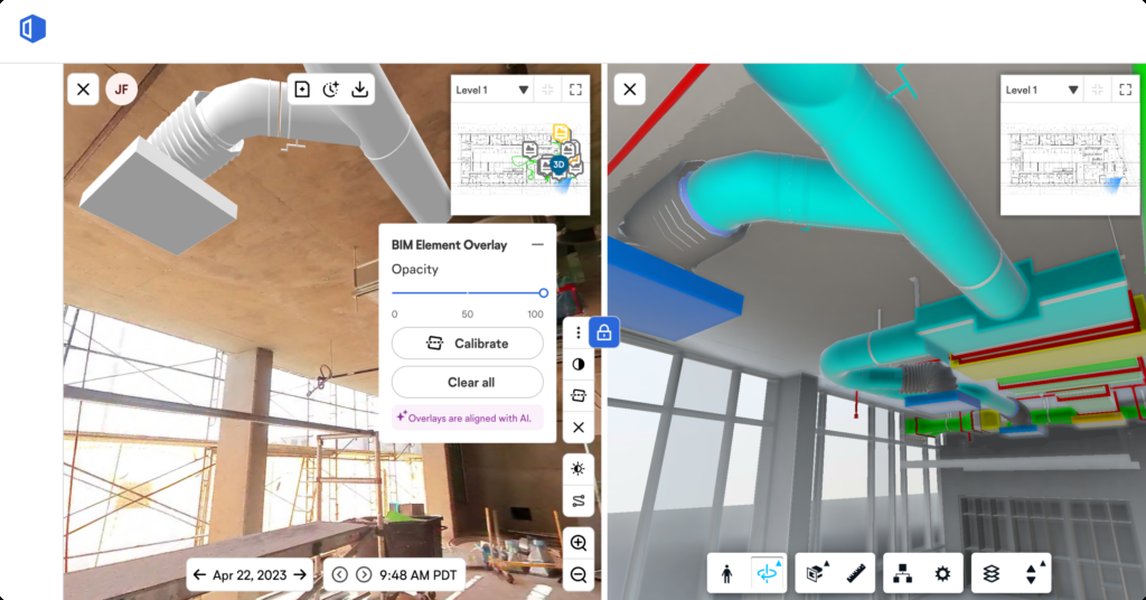
AI assists in overlaying real-world site data onto BIM models for enhanced visualization and accuracy.
Streamlined Documentation and Data Management
Automated Generation of Construction Documents
Generating schedules, material quantity takeoffs, specifications, and reports is a fundamental, yet often tedious, part of BIM management. AI automates these documentation tasks by extracting relevant information directly from the BIM model. AI tools can recognize patterns, classify elements, and produce accurate, standardized documents, reducing administrative workload significantly (potentially by 25-30% in some workflows) and freeing up project teams to focus on critical decision-making.
Ensuring Data Integrity and Standardization
On large projects with multiple teams, maintaining data consistency is challenging. AI algorithms can automatically validate BIM data against project standards, specifications, and regulatory requirements. They detect inconsistencies, missing information, or non-standard entries, flagging issues early to prevent downstream problems. This automated quality control ensures data reliability across disciplines.
Proactive Clash Detection and Resolution
Identifying Conflicts Efficiently
Manually identifying clashes between different systems (e.g., structural, MEP) in complex BIM models is laborious and error-prone. AI excels at automated clash detection, rapidly scanning models to pinpoint conflicts like overlapping pipes, ducts intersecting beams, or insufficient clearances. Rule-based AI systems can significantly reduce manual review time.
Towards Automated Conflict Resolution
Beyond simple detection, advanced AI systems are emerging that not only identify clashes but also suggest potential resolutions based on predefined rules, building codes, or learned patterns from previous projects. This further streamlines the coordination process, preventing costly rework during the construction phase.
Accurate Quantity Takeoffs and Cost Estimation
Precise cost estimation hinges on accurate material quantities. AI automates the quantity takeoff process by extracting element data directly from the BIM model. This provides real-time, accurate material calculations essential for budgeting and procurement. When combined with predictive analytics analyzing material price trends and historical data, AI helps optimize resource allocation, minimize waste, and maintain budget control.
Optimized Construction Planning and Scheduling
Developing efficient construction schedules for large projects is complex. AI analyzes BIM data, project constraints, resource availability, and historical performance data to generate optimized construction sequences and schedules. It can simulate different scenarios, identify potential bottlenecks, and predict the impact of delays (e.g., due to weather or supply chain issues), allowing for proactive adjustments and more realistic project timelines.
Facilitating Lifecycle Management and Operations
COBie Data Automation
Handover to facility management (FM) requires structured data. AI can automate the extraction and formatting of COBie (Construction-Operations Building Information Exchange) data from the final BIM model. This provides facility managers with the necessary information in a readily usable format, streamlining the transition from construction to operation.
Digital Twins and Predictive Maintenance
AI-integrated BIM models form the basis of digital twins. By linking the BIM model with data from IoT sensors installed in the building, AI can monitor real-time operational performance. This enables predictive maintenance, where AI algorithms forecast potential equipment failures or system inefficiencies, allowing for proactive intervention before problems escalate, thus optimizing building performance and reducing long-term operational costs.
Advanced AI Applications in BIM
Beyond automating routine tasks, AI introduces more sophisticated capabilities into the BIM workflow.
Generative Design for Enhanced Options
Generative design utilizes AI algorithms to explore numerous design possibilities automatically based on predefined goals and constraints (e.g., cost, materials, energy performance, spatial requirements). AI can generate and evaluate thousands of design options, presenting project teams with optimized solutions that might not have been conceived through traditional methods. This accelerates the early design phases and fosters innovation.
Predictive Analytics for Risk Mitigation
Large construction projects are inherently risky. AI leverages machine learning models trained on historical project data, real-time site information, and external factors (like weather forecasts or economic indicators) to predict potential risks. This includes forecasting schedule delays, anticipating cost overruns, predicting potential safety hazards, or identifying risks of equipment failure. Early identification allows project managers to implement mitigation strategies proactively.
Visualizing AI's Impact on BIM Management Tasks
The integration of AI provides varying levels of automation and enhancement across different facets of BIM information management. This radar chart offers a qualitative assessment of AI's current impact and potential in key areas, considering factors like efficiency gains, accuracy improvements, and the maturity of available AI solutions.
As shown, areas like Clash Detection and Model Creation see significant benefits from mature AI solutions, while areas like predictive Scheduling and Facility Management automation are rapidly evolving.
Mapping AI's Role in the BIM Ecosystem
This mindmap illustrates the interconnected nature of AI applications within the broader BIM information management landscape for large construction projects. It highlights how various AI techniques contribute to automating processes, enabling advanced capabilities, and ultimately driving project success.
(Large Projects)"] id1["Automated Processes"] id1a["Model Creation & Updates
(Scan-to-BIM, API Integration)"] id1b["Clash Detection & Resolution"] id1c["Documentation Generation
(Schedules, Reports, QTOs)"] id1d["Data Validation & Standardization"] id1e["Scheduling & Sequencing"] id1f["Lifecycle Data Management
(COBie, FM Handover)"] id2["Advanced Applications"] id2a["Generative Design"] id2b["Predictive Analytics
(Risk, Cost, Schedule)"] id2c["Digital Twins & IoT Integration"] id3["Enabling Technologies"] id3a["Machine Learning Algorithms"] id3b["Natural Language Processing (NLP)"] id3c["Computer Vision (for Scans/Images)"] id3d["Cloud Computing Platforms"] id3e["APIs & Interoperability"] id4["Key Benefits"] id4a["Increased Efficiency & Speed"] id4b["Improved Accuracy & Quality"] id4c["Reduced Costs & Waste"] id4d["Enhanced Collaboration"] id4e["Better Decision Making"] id4f["Improved Safety & Risk Management"]
The mindmap emphasizes how core automation tasks like model creation and clash detection form the foundation, while advanced applications like generative design and predictive analytics build upon this, supported by underlying AI technologies and ultimately delivering substantial benefits.
Summary of AI Automation in BIM
The following table summarizes key areas where AI automates BIM information management, outlining the specific tasks and the primary benefits achieved, particularly relevant for large-scale construction projects.
| AI Application Area | Specific Automation Task | Key Benefit(s) |
|---|---|---|
| Model Creation & Updating | Processing scans/point clouds (Scan-to-BIM), integrating data via APIs (e.g., Dynamo). | Faster model generation, improved as-built accuracy, reduced manual modeling time. |
| Clash Detection | Automated identification of geometric and rule-based conflicts between model elements. | Early issue identification, reduced rework during construction, improved coordination. |
| Documentation | Generating schedules, quantity takeoffs, specifications, reports directly from BIM data. | Reduced administrative effort, consistency in documentation, faster reporting. |
| Quantity Takeoff & Costing | Extracting material quantities automatically, potentially linking to cost databases/prediction models. | Accurate budgeting, optimized procurement, reduced material waste. |
| Scheduling & Planning | Analyzing dependencies and constraints to generate optimized construction sequences. | More realistic timelines, identification of potential bottlenecks, efficient resource allocation. |
| Facility Management | Automated extraction and formatting of COBie data, linking BIM to IoT for Digital Twins. | Streamlined handover, optimized building operations, predictive maintenance capabilities. |
| Risk Assessment | Using predictive analytics on historical and real-time data to forecast delays, cost overruns, or safety issues. | Proactive risk mitigation, improved project predictability, enhanced safety. |
Implementing AI for BIM Automation
Strategic Steps for Integration
Successfully implementing AI requires a structured approach:
- Identify High-Value Targets: Assess current BIM workflows to pinpoint repetitive, time-consuming, or error-prone tasks where automation offers the most significant return (e.g., clash detection, documentation, quantity takeoffs).
- Integrate Data Sources: Ensure seamless data flow between different sources (laser scanners, drones, IoT sensors, GIS) and the BIM environment. Establish robust data pipelines.
- Adopt Cloud-Based Platforms: Utilize cloud platforms for BIM and AI processing. This facilitates real-time collaboration, scalability, and access to powerful computing resources needed for AI algorithms.
- Train and Validate Models: If using machine learning, leverage historical project data to train models for tasks like risk prediction or scheduling optimization. Crucially, validate AI outputs against project requirements and potentially combine with human quality assurance.
- Standardize Processes: Implement clear protocols for how AI tools are used and how data is managed to ensure consistency across the project team.
- Foster Skills and Adaptation: Train project teams on how to use new AI-powered tools effectively and understand their outputs and limitations.
- Monitor and Iterate: Continuously track the performance of AI automation tools and refine processes based on feedback and results.
Leveraging AI-Enhanced Tools and Platforms
Many existing BIM software providers (like Autodesk with Revit and BIM 360) are incorporating AI features. Additionally, specialized AI platforms and plugins are emerging that integrate with standard BIM tools. Selecting the right combination of software depends on the specific automation goals and the existing technology stack of the project team. APIs play a crucial role in connecting different systems (e.g., linking BIM software to AI platforms like TensorFlow or cloud AI services).
Exploring AI and BIM Transformation Further
The integration of AI into BIM is rapidly evolving. This video provides insights into how these technologies are combining to revolutionize project design, delivery, and management within the Architecture, Engineering, and Construction (AEC) industry.
The video discusses the practical applications and future potential of combining AI and BIM, highlighting how this synergy drives efficiency, improves collaboration, and leads to smarter project outcomes, aligning with the automation strategies discussed.
Frequently Asked Questions (FAQ)
What are the main benefits of using AI for BIM information management?
The primary benefits include significantly increased efficiency by automating repetitive tasks, improved accuracy by reducing human error, substantial cost and time savings through optimized planning and resource allocation, enhanced collaboration via centralized and validated data, and better lifecycle management leading to improved building operations post-construction.
Is AI automation in BIM only useful for new construction projects?
No, AI-driven BIM automation is also highly valuable for renovation and retrofit projects. AI-powered Scan-to-BIM, for example, is particularly useful for creating accurate models of existing structures where original documentation might be missing or outdated. AI can also assist in analyzing existing conditions and planning interventions.
What skills does my team need to implement AI in BIM workflows?
While deep AI expertise isn't required for all team members, a general understanding of AI capabilities and limitations is beneficial. Key skills include proficiency in BIM software, understanding data management principles, familiarity with scripting tools (like Dynamo) if customization is needed, and the ability to critically evaluate and utilize the outputs from AI tools. Data analysis skills are increasingly valuable.
Are there challenges or limitations to using AI for BIM automation?
Yes, challenges include the initial cost of software and implementation, the need for high-quality, standardized data to train and run AI models effectively, ensuring interoperability between different software platforms, managing data privacy and security concerns, and the need for skilled personnel to oversee and validate AI-driven processes. Over-reliance on automation without critical human oversight can also be a risk.
Recommended
- What are the best AI-powered BIM software tools available in 2025?
- How does AI-driven generative design work within BIM?
- What are the data requirements for effective AI implementation in construction projects?
- Compare the impact of AI on BIM versus traditional CAD workflows.
References
Last updated May 5, 2025