
Navigating the Modern Office: Productivity, Presence, and the AI Elephant in the Room
A Visual Exploration of AI's Impact on Professional Workspaces
In today's dynamic professional landscape, the integration of artificial intelligence (AI) tools like ChatGPT is reshaping how individuals work and interact within office environments. This evolution presents both unprecedented opportunities for efficiency and subtle shifts in workflow dynamics. The concept of a "giant elephant in the room" often refers to an obvious but unaddressed issue, and in the context of AI, it aptly symbolizes the pervasive, yet sometimes understated, influence of these powerful technologies on daily tasks and strategic decisions. As a 30-something professional navigates their laptop in a business casual setting, they represent a generation actively embracing and adapting to these transformative tools. This scenario highlights the ongoing dialogue about how human ingenuity and AI collaboration will define the future of work.
Key Insights into the AI-Augmented Workspace
- Seamless Integration and Productivity Gains: AI tools like ChatGPT are becoming increasingly integral to daily workflows, from drafting communications to analyzing data, significantly boosting productivity for professionals across various sectors.
- Evolving Professional Roles: The rise of AI necessitates a re-evaluation of traditional job functions, encouraging professionals to focus on higher-order tasks, critical thinking, and strategic oversight while AI handles repetitive or data-intensive processes.
- The Unseen Influence of AI: Despite their powerful capabilities, AI tools often operate in the background, becoming an "elephant in the room"—a significant, undeniable presence that profoundly impacts work without always being explicitly acknowledged or discussed.
The Professional in the AI Era
The image of a 30-something professional working on a laptop in a business casual setting encapsulates the contemporary work environment. This demographic is often at the forefront of technology adoption, comfortable with digital tools, and keen on leveraging innovations to enhance their output. Business casual attire signifies a modern, adaptable, and less rigid corporate culture, mirroring the flexibility and evolving nature of work facilitated by technology. The laptop, as a central tool, symbolizes connectivity, remote work capabilities, and the digital nature of most modern professional tasks.
A professional man working on a laptop, symbolizing modern office productivity.
In this context, the professional isn't just performing tasks; they are interacting with an ecosystem of digital tools, including AI. This interaction transforms their workflow, allowing for quicker analysis, more refined content creation, and streamlined communication. The continuous evolution of these tools means that staying updated and adaptable is crucial for career progression and effectiveness.
Daily Interactions with AI
Many professionals now regularly interact with AI, often without explicit thought. From predictive text in emails to advanced search algorithms, AI is embedded in countless applications. ChatGPT, specifically, offers capabilities such as:
- Content Generation: Drafting emails, reports, marketing copy, and creative content.
- Information Synthesis: Summarizing lengthy documents or articles, extracting key insights from large datasets.
- Brainstorming and Ideation: Serving as a collaborative partner for generating new ideas or problem-solving approaches.
- Coding Assistance: Helping with debugging, generating code snippets, or understanding complex programming concepts.
These functionalities allow professionals to delegate mundane or time-consuming tasks to AI, freeing up their time for more strategic, creative, and interpersonal activities. The shift is not about replacing human intelligence but augmenting it, enabling professionals to achieve more with less effort and in less time.
The Giant AI Elephant: ChatGPT's Presence
The "giant cartoon elephant with 'Chat GPT' painted on its side" serves as a powerful metaphor for the profound, yet often unacknowledged, impact of AI in the workplace. An elephant in the room is something obvious that everyone knows about but no one talks about. Similarly, while AI tools like ChatGPT are widely used, their full implications—from job displacement to ethical considerations and the need for new skills—are not always openly discussed or fully grasped.
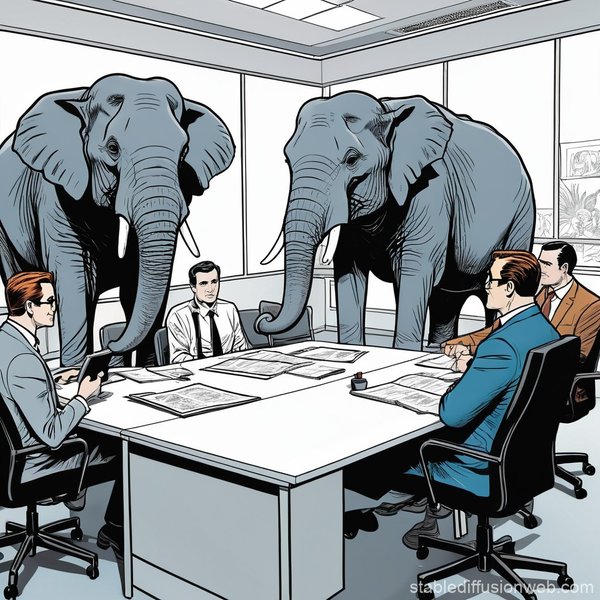
A giant elephant metaphorically representing AI's large presence in a modern office.
This "elephant" is not a threat but a symbol of the significant transformation underway. Its cartoonish depiction suggests a friendly, accessible, yet immense force. The "Chat GPT" branding makes it clear that this AI is a specific, recognizable entity that is rapidly becoming indispensable in many professional environments.
Understanding the AI's Impact
The presence of this "elephant" prompts a deeper look into AI's multifaceted influence:
Productivity Paradox
While AI tools undeniably boost individual productivity, their widespread adoption can create a "productivity paradox." The sheer volume of content and analysis that AI can generate might overwhelm existing systems or human capacities to process it. Companies must adapt their workflows and communication channels to effectively manage the increased output.
Skill Evolution
The demand for new skills in the workforce is a direct consequence of AI's integration. Professionals need to develop "prompt engineering" skills to effectively communicate with AI, critical thinking to evaluate AI-generated content, and ethical awareness to navigate potential biases or misuses of AI. Rather than fearing job displacement, the focus shifts to upskilling and reskilling.
Data Security and Privacy Concerns
The use of AI, especially large language models like ChatGPT, raises critical questions about data security and privacy. Inputting sensitive company information into public AI models can pose risks. Organizations must establish clear guidelines and invest in secure AI solutions to protect proprietary data.
Ethical Considerations
Beyond data, the ethical implications of AI are vast. This includes issues of algorithmic bias, intellectual property, and the potential for AI to be used for malicious purposes. The "elephant" reminds us that these ethical dilemmas must be openly discussed and addressed through policy and responsible AI development.
The Symbiosis of Human and Artificial Intelligence
The scene depicts a harmonious, albeit complex, relationship between human and artificial intelligence. The professional is actively engaged with their laptop, implying a direct interaction with AI, where the human provides the direction and judgment, and the AI executes the heavy lifting or provides raw material.
A cartoon businessman illustrating active engagement with a laptop.
This synergy is crucial for maximizing the benefits of AI while mitigating its risks. It’s not about replacing humans with machines but about empowering humans with advanced tools. The future of work will likely involve increasingly sophisticated AI assistants that work alongside professionals, augmenting their capabilities rather than supplanting them.
Measuring the Impact of AI in the Workplace
To further illustrate the multifaceted impact of AI, consider a radar chart demonstrating perceived strengths and challenges. This chart is based on conceptual analysis rather than empirical data, reflecting general observations about AI integration.
This radar chart visually represents the perceived strengths and challenges associated with AI integration in the workplace. It shows that while AI offers significant boosts in productivity and innovation, it also introduces challenges related to skill evolution, data security, and ethical considerations. The "Future Potential" dataset suggests an even greater leap in productivity and innovation, indicating that as AI matures, its positive impacts are expected to amplify, while some challenges might remain or evolve.
The Ongoing Dialogue
The concept of the "elephant in the room" further emphasizes that the conversation around AI's role in the workplace is ongoing and critical. Companies and individuals need to engage in open discussions about:
- How AI tools are being used.
- Their benefits and potential downsides.
- The training and resources needed to adapt.
- The development of ethical guidelines for AI use.
Ignoring the "elephant" can lead to missed opportunities for growth, unaddressed risks, and a workforce unprepared for the future. Proactive engagement with AI's implications is essential for a successful transition to an AI-augmented professional landscape.
The Transformative Role of AI in Workflows
AI's integration into the professional office extends beyond individual tasks, influencing entire workflows and organizational structures. The shift is from merely automating repetitive tasks to fundamentally redesigning how work gets done.
| Business Function | Traditional Approach | AI-Augmented Approach | Key Benefits |
|---|---|---|---|
| Content Creation | Manual drafting, research, and editing. | AI-assisted drafting, summarization, and content optimization. | Increased speed, reduced errors, improved consistency. |
| Data Analysis | Manual data collection, spreadsheet analysis, basic visualization. | Automated data extraction, advanced predictive modeling, real-time dashboards. | Deeper insights, faster decision-making, identification of hidden patterns. |
| Customer Service | Human-only interactions, limited availability. | AI-powered chatbots for routine queries, human agents for complex issues. | 24/7 availability, faster response times, reduced operational costs. |
| Software Development | Manual coding, debugging, and testing. | AI code generation, intelligent error detection, automated testing frameworks. | Accelerated development cycles, higher code quality, reduced human error. |
| Strategic Planning | Reliance on historical data, expert opinions. | AI-driven market analysis, trend forecasting, scenario simulation. | More informed strategies, proactive risk management, identification of new opportunities. |
This table illustrates how AI is not just a tool but a catalyst for systemic change across various business functions. Each area sees a significant leap in efficiency, accuracy, and strategic capability when augmented by AI. This comprehensive integration means that the "elephant" isn't just present; it's actively contributing to the foundation of modern business operations.
Embracing the Future of Work with AI
The vision of a professional working diligently with the omnipresent AI "elephant" symbolizes a future where human ingenuity and artificial intelligence are inextricably linked. The success of this partnership hinges on continuous learning, ethical considerations, and a proactive approach to managing technological advancements.
As professionals, adapting to these changes means not just learning how to use AI tools but understanding their capabilities, limitations, and the broader implications for one's role and industry. Organizations, in turn, must foster an environment that encourages AI literacy, supports experimentation, and establishes clear guidelines for responsible AI use.
The true power of AI like ChatGPT isn't just in its ability to generate text or analyze data, but in its potential to unlock new forms of human creativity, problem-solving, and efficiency, ultimately leading to a more dynamic and productive professional world.
Frequently Asked Questions
What does the "AI elephant in the room" symbolize?
How is AI, like ChatGPT, transforming daily work for professionals?
What new skills are necessary for professionals in an AI-augmented workspace?
What are the main challenges of integrating AI into the office?
Conclusion
The presence of a giant AI elephant, specifically labeled "Chat GPT," behind a professional at their laptop vividly illustrates the profound and evolving role of artificial intelligence in contemporary office environments. This powerful metaphor highlights not only the immense capabilities AI brings to productivity and innovation but also the critical need for open dialogue and strategic adaptation. As AI tools become increasingly integrated into daily workflows, professionals and organizations must proactively address the ethical considerations, data security implications, and the necessity for continuous skill development. Embracing this transformative technology with awareness and foresight will be key to harnessing its full potential, fostering a more dynamic, efficient, and intelligently augmented future of work.
Recommended Further Exploration
- How AI is reshaping future job roles and career paths.
- Ethical considerations in AI development and deployment.
- Best practices for integrating AI tools in corporate environments.
- Impact of large language models on creativity and innovation.