
Unlocking the Power of Visual Understanding and Creation
Exploring the Capabilities of AI in Image Analysis and Manipulation
Highlights
- Image Recognition and Object Identification: AI can analyze images to identify and classify objects using advanced computer vision techniques and machine learning models.
- Image Manipulation and Drawing: While current AI excels at generating images and applying effects, directly drawing specific elements at precise angles within a user-provided image is generally beyond the current capabilities of readily available tools.
- Forex Chart Analysis: AI can be trained to recognize candlestick patterns and identify potential support and resistance zones on Forex charts, aiding in technical analysis.
AI's Eye: Identifying Objects in Images
As an AI assistant, my core function is to process and generate text based on the data I was trained on. However, the broader field of Artificial Intelligence has made significant strides in visual understanding. This is primarily achieved through a discipline known as computer vision.
Computer vision allows machines to "see" and interpret the visual world. One of the key applications within computer vision is object detection and image recognition. These technologies enable AI systems to analyze an image and identify the various objects present within it.
How Object Identification Works
The process of object identification in images typically involves several steps:
Analyzing Visual Data
AI models, often based on deep learning and neural networks, are trained on massive datasets of images. During training, the models learn to recognize patterns, shapes, textures, and colors associated with different objects.
Comparing and Ranking
When an image is provided to an AI system capable of object detection, it analyzes the pixel data. It compares the features it detects in the image to the patterns it learned during training. Based on similarity and relevance, it can then identify and often label the objects it recognizes. Google Lens, for example, compares objects in a picture to other images and ranks them based on similarity and relevance.
Localization and Classification
Object detection goes a step further than just identification; it also involves localization, which means drawing bounding boxes around the detected objects to show their precise location within the image. Simultaneously, the AI performs classification, assigning a label or category to each detected object (e.g., "dog," "car," "tree").
Several platforms and tools offer object detection and image recognition capabilities. These range from large-scale cloud-based services like Google Cloud Vision AI, Amazon Rekognition, and Microsoft Azure AI Custom Vision to more specialized tools and open-source libraries.

An illustration of support and resistance lines on a financial chart.
Adding Elements: AI and Image Manipulation
When it comes to drawing or adding specific elements to an existing image, like drawing a line at a particular angle on a Forex chart, the capability depends heavily on the specific AI tool or platform being used. While AI is powerful in image generation and applying filters or general enhancements, precise and user-directed drawing tasks at specific coordinates or angles are not a standard feature of most general-purpose AI assistants or image recognition tools.
Current AI Capabilities in Image Manipulation
AI excels in tasks such as:
Generative AI for Images
Creating entirely new images based on text prompts or existing styles.
Image Editing and Enhancement
Applying filters, adjusting colors, removing backgrounds, or even generating missing parts of an image (inpainting).
Object Removal or Addition (with less precision)
Some advanced tools can attempt to remove or add objects, but precisely controlling their placement, angle, and interaction with the existing image at a detailed level is challenging for AI without explicit user input through a graphical interface.
Tools for Drawing on Images
For tasks requiring precise drawing, traditional image editing software or online drawing tools are more suitable. These tools provide users with brushes, shapes, lines, and the ability to control their placement, size, color, and angle manually or with specific input values. Examples of such tools include:
- Adobe Photoshop (professional software)
- GIMP (free and open-source)
- Krita (free and open-source painting program)
- Online editors like Pixlr, Canva, and LunaPic which offer drawing tools.
- Specialized apps for drawing on pictures like DrawPad or Annotate.
While some of these tools may incorporate AI features for other purposes (like object recognition or automatic enhancements), the act of drawing a precise line at a specific angle on a given image is typically a manual or feature-driven process within the software, rather than something an AI would perform based on a natural language instruction like "draw a line at a 45-degree angle from this point."
Analyzing Forex Charts with AI
The analysis of financial charts, such as Forex charts, is a domain where AI and machine learning are increasingly being applied. AI can be trained to identify patterns and indicators that are relevant to traders.
Identifying Candlesticks and Patterns
Candlestick patterns are visual representations of price movements over a specific period and are a fundamental part of technical analysis in Forex trading. AI can be trained to recognize these patterns by analyzing the shape, size, and color of the candlesticks, as well as their position relative to each other.
Some common candlestick patterns AI can be trained to identify include:
-
Doji
-
Hammer and Hanging Man
-
Engulfing Patterns (Bullish and Bearish)
-
Morning and Evening Stars
-
Piercing Pattern and Dark Cloud Cover
-
Marubozu
By analyzing sequences of candlesticks, AI can confirm the presence of these patterns and potentially provide insights into future price movements based on historical data associated with these patterns.
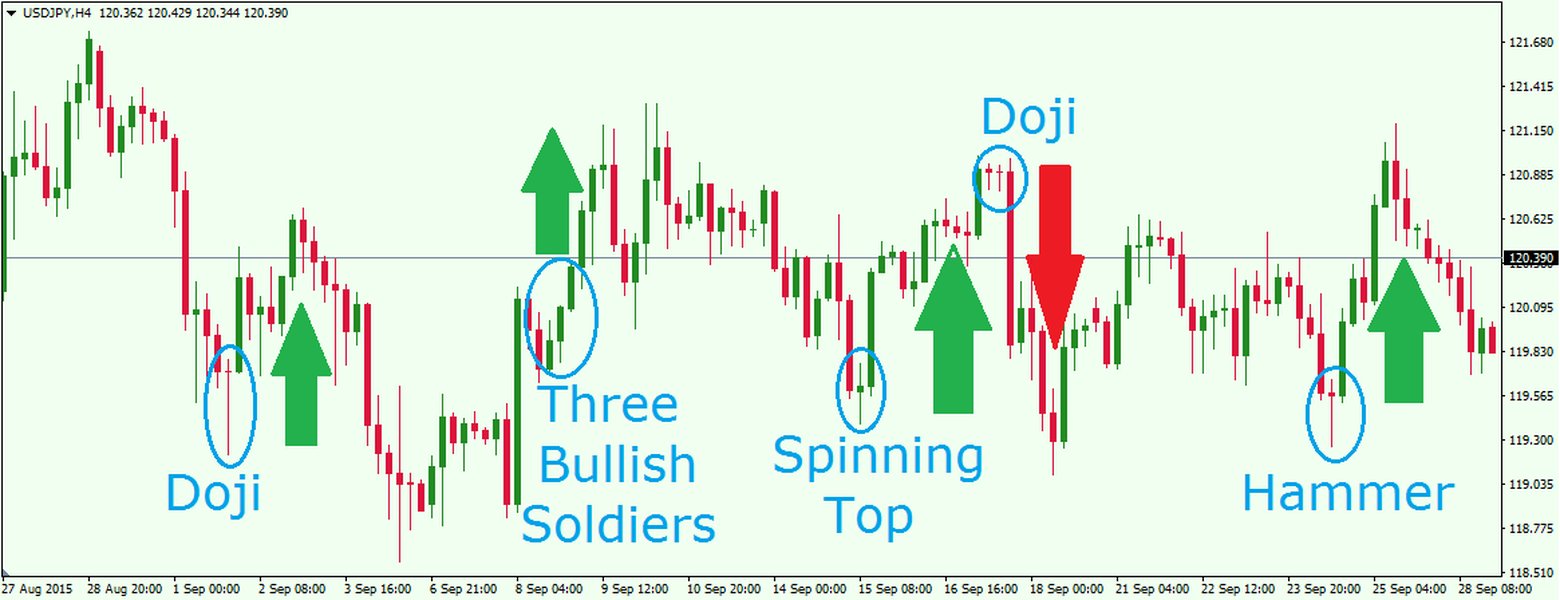
Various candlestick patterns illustrated on a Forex chart.
Identifying Support and Resistance Zones
Support and resistance zones are key levels on a price chart where the price has historically shown a tendency to pause or reverse its direction. AI can be used to identify these zones by analyzing historical price data and identifying areas where the price has repeatedly bounced off a certain level (support) or struggled to break above a certain level (resistance).
AI algorithms can employ various techniques to identify these zones, including:
Analyzing Price Action
Identifying points where the price has made significant turns.
Using Statistical Methods
Applying statistical analysis to identify price levels with high trading volume or repeated interactions.
Machine Learning Models
Training models to recognize the visual and numerical characteristics of support and resistance levels based on historical data.
While AI can assist in identifying these patterns and zones, it's important to remember that Forex trading involves inherent risks, and AI analysis should be used as a tool to support decision-making, not as a guaranteed predictor of future market movements.
Summary of AI Capabilities
To summarize the capabilities discussed in relation to your query:
| Capability | AI's Ability | Explanation |
|---|---|---|
| Identify objects in an image | Yes (through computer vision) | AI models trained on large datasets can recognize and classify objects in images using techniques like object detection and image recognition. |
| Draw or add specific elements (e.g., a line at a particular angle) in an image | Limited (not a standard feature of most general AI) | While AI excels at image generation and general editing, precise, user-directed drawing at specific coordinates/angles is typically handled by traditional image editing software. |
| Identify key support and resistance zones on a Forex chart | Yes (through trained models) | AI can analyze historical price data and chart patterns to identify potential support and resistance levels. |
| Identify different candlesticks on a Forex chart | Yes (through pattern recognition) | AI can be trained to recognize the visual characteristics of various candlestick types. |
| Confirm candlestick patterns on a Forex chart | Yes (through pattern analysis) | AI can analyze sequences of candlesticks to confirm the presence of known trading patterns. |
Frequently Asked Questions
What is the difference between image recognition and object detection?
Image recognition typically refers to identifying the content of an entire image (e.g., "this is a picture of a dog"). Object detection goes further by identifying specific objects within the image and indicating their location, often with bounding boxes (e.g., "there is a dog in the top left corner").
Can AI generate entirely new images?
Yes, generative AI models like GANs (Generative Adversarial Networks) and diffusion models are capable of creating novel images based on text descriptions or other inputs.
How accurate is AI in analyzing financial charts?
AI can be a powerful tool for analyzing financial charts by identifying patterns and trends. However, the accuracy of AI analysis depends on the quality and quantity of the training data, the complexity of the market, and the specific algorithms used. Market conditions can change rapidly, and past performance is not indicative of future results. AI analysis should be used as one of many tools in a comprehensive trading strategy.
Are there free tools available for image recognition or drawing on images?
Yes, there are many free tools available. For image recognition, some online demos or limited-use APIs might be available from providers. For drawing on images, free software like GIMP and Krita, as well as online editors like Pixlr and Canva, offer robust drawing functionalities.
References
 aws.amazon.com
Last updated May 5, 2025