
Unveiling "AI Ne E": A Deep Dive into Artificial Intelligence in 2025
Exploring the rapid advancements, pivotal applications, and critical ethical considerations shaping the future of AI.
The query "ai ne e" appears to be a phonetic or abbreviated inquiry into "AI," or Artificial Intelligence. As a multilingual AI assistant, I understand this as a request for a comprehensive overview of AI, its current state, and its implications as of June 2025. Artificial Intelligence fundamentally refers to computer systems engineered to exhibit human-like cognitive abilities, enabling them to learn, understand, reason, problem-solve, process language, and even perceive. This expansive field integrates various sub-disciplines, including robotics, natural language processing, image recognition, machine learning, deep learning, and genetic algorithms.
Key Insights into AI's Evolution in 2025
- Generative AI (GenAI) Revolution: GenAI is at the forefront of innovation, capable of producing novel content across various modalities, significantly transforming industries from content creation to gaming and business operations.
- Ethical AI Imperative: As AI becomes more pervasive, crucial ethical concerns surrounding privacy, bias, accountability, and job displacement necessitate robust frameworks and responsible development practices.
- Widespread Application & Integration: AI technologies are deeply embedded across nearly every sector, enhancing efficiency, fostering innovation, and supporting decision-making in healthcare, finance, automotive, and creative industries.
AI systems are designed to learn from data, continuously improving their performance over time, solving complex problems, and making informed decisions. The transformative impact of AI is evident across diverse sectors, ushering in unprecedented levels of efficiency, fostering groundbreaking innovations, and providing powerful decision-making support. However, this rapid evolution also brings forth significant responsibilities, particularly concerning ethical deployment, privacy protection, and cybersecurity.
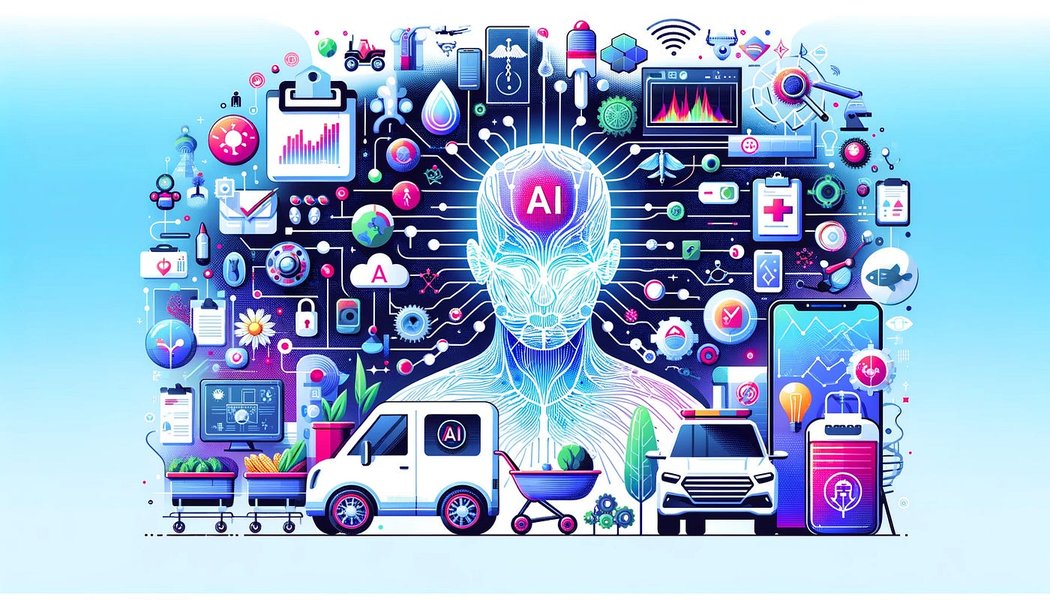
AI's transformative impact is increasingly visible across diverse industries and daily life.
Generative AI: Crafting the Future of Content and Beyond
Unlocking New Creative and Business Frontiers
One of the most significant advancements in AI as of June 2025 is the rapid expansion of Generative AI (GenAI). This branch of AI possesses the remarkable ability to create entirely new content, including text, code, images, audio, and video, by learning intricate patterns from vast datasets. GenAI tools are fundamentally reshaping creative processes, reducing manual effort, and opening up a myriad of possibilities across industries, from sophisticated content creation to advanced gaming and business operations. Over 80% of companies are projected to integrate GenAI into their operations by the end of 2025.
Text and Code Generation
Tools like OpenAI's ChatGPT, Google's Gemini, and Claude demonstrate exceptional capabilities in natural language understanding and generation. These tools are invaluable for tasks such as drafting emails, generating comprehensive reports, automating customer service interactions, and providing sophisticated coding assistance. In January 2025, ChatGPT introduced "Operators," enabling AI agents to autonomously handle online tasks, including ordering groceries and processing ticket purchases. Google AI Studio and NotebookLM further facilitate the development of multimodal generative AI models, encompassing text, video, and audio generation.
Image and Video Generation
AI tools are making remarkable strides in producing high-quality visual content. Adobe Firefly, for instance, allows users to generate design-ready assets such as text effects and vector art seamlessly within Adobe workflows. Other specialized tools focus on creating realistic AI avatars, enhancing video quality, and performing video translation. While AI excels at generating short clips and B-roll footage, the creation of complete, high-quality, long-form videos remains an active area of ongoing development.
Audio Generation and Productivity Applications
Platforms like ElevenLabs are at the forefront of creating lifelike speech synthesis and advanced voice cloning. NotebookLM can generate podcast-style conversations from uploaded content, showcasing AI's versatility in audio production. Beyond creative applications, AI productivity tools are designed to streamline various aspects of work. Examples include Jasper AI and Anyword for marketing content, Buffer AI Assistant for brainstorming, and Salesforce's integrated AI tools for automating customer journeys and sales pipelines. AI is also being leveraged for technical skill assessments in hiring and for optimizing development workflows with AI coding assistants like Qodo.
A comparative analysis of AI's strengths across different applications and ethical considerations. This radar chart visualizes the perceived maturity and impact of various AI aspects in 2025, offering a nuanced perspective on their development status and societal readiness.
Ethical Considerations in AI: Navigating the Complex Landscape
Addressing the Challenges of Responsible AI Development and Deployment
As AI technology continues its rapid advance, it brings forth complex and evolving ethical dilemmas that demand careful consideration and proactive solutions. Ensuring responsible AI development and deployment is paramount to harnessing its benefits while mitigating potential harms. Key ethical concerns include:
Privacy and Surveillance
AI systems often necessitate access to vast quantities of sensitive data, raising significant concerns about individual privacy and the potential for misuse in surveillance applications. Data transfer and ownership, especially when involving third-party vendors, further complicate privacy issues, necessitating robust data governance frameworks.
Bias and Discrimination
The performance of AI systems is inherently tied to the quality and characteristics of their training data. Biased or poorly designed algorithms can lead to inaccuracies, discriminatory outcomes, and the reinforcement of existing societal biases. Ensuring fairness, mitigating bias in AI algorithms, and promoting inclusivity in data collection are critical ethical imperatives.

AI's ethical considerations extend to critical sectors like healthcare, where responsible implementation is vital for patient safety and data privacy.
Accountability and Transparency
Establishing clear lines of accountability and liability for AI-related issues is essential. The inherent opacity of many machine learning algorithms, often referred to as "black boxes," can make them challenging to control, monitor, and correct, leading to a lack of transparency and interpretability regarding their decision-making processes.
Job Displacement and Societal Impact
Automation driven by AI can lead to job displacement and potentially exacerbate economic inequality. Addressing the broader societal impact of automation, ensuring a just transition for affected workers, and fostering reskilling initiatives are crucial ethical considerations. While some roles may be radically transformed, not all will be entirely eliminated; rather, the nature of work will evolve.
Patient Safety and Informed Consent (in Healthcare)
In the medical field, ethical concerns specific to AI include patient safety, the potential for AI to displace human expertise, and ensuring informed consent regarding the use of patient data and AI-generated diagnoses. Physicians ultimately retain responsibility for interpreting diagnostic results and ensuring safe patient care delivery.
Cybersecurity and Misinformation
AI-driven systems, particularly those handling sensitive data, present attractive targets for cyberattacks, raising significant cybersecurity concerns. Furthermore, AI's capacity for generating realistic content raises the risk of misinformation campaigns and psychological manipulation, highlighting the potential for AI to be weaponized for malicious purposes.
Addressing these ethical issues requires a concerted effort involving thoughtful consideration, the development of robust regulatory frameworks, and an unwavering commitment to responsible AI development and deployment. The goal is to maximize AI's transformative potential while safeguarding human values and societal well-being.
The Pervasive Reach of AI: Real-World Applications in 2025
Transforming Industries and Daily Life with Intelligent Systems
As of 2025, Artificial Intelligence technologies are extensively integrated across virtually every sector, fundamentally redefining how industries operate and innovate. AI's core ability to process vast amounts of data and derive actionable insights has made it an indispensable tool for enhancing efficiency, driving innovation, and enabling more accurate decision-making.
This mindmap illustrates the diverse and expanding real-world applications of AI across various sectors in 2025, highlighting its pervasive influence.
Here's a detailed overview of AI's pervasive applications:
| Sector | Key AI Applications in 2025 | Impact and Benefits |
|---|---|---|
| Healthcare | Disease diagnosis (e.g., cancer detection), treatment planning, medical image analysis, drug discovery, personalized medicine, diabetes management (IBM & Roche). Neuralink's clinical trials. | Improved diagnostic accuracy, accelerated drug development, tailored patient care, enhanced health outcomes. |
| Education | Personalized learning paths, virtual tutors, automated assessment, content curation, interactive learning environments. | Adaptive learning experiences, increased student engagement, optimized educational resources. |
| Commerce & Marketing | Customer behavior analysis, automated content generation, chatbots for customer service, personalized recommendations, predictive analytics for sales. | Enhanced customer experience, streamlined marketing efforts, increased sales efficiency. |
| Finance | Risk assessment, fraud detection, algorithmic trading, credit scoring, personalized financial advice. | Reduced financial crime, optimized investment strategies, more informed lending decisions. |
| Automotive | Autonomous driving technologies, predictive maintenance for vehicles, optimized traffic management, supply chain logistics. | Improved road safety, reduced congestion, increased efficiency in transportation. |
| Creative Industries | Automated generation of text, images, video, and music (Generative AI). AI avatars, video translation. | Boosted creativity, accelerated content production, new forms of digital art and entertainment. |
| Research & Development | Accelerated scientific discovery, identification of new materials (e.g., concrete ingredients by MIT), connectomics (mapping the human brain). | Faster breakthroughs in science and technology, development of sustainable solutions. |
| Productivity & Business | AI assistants (e.g., OpenAI's "Operator" for online tasks), automated workflows, coding assistants, sentiment analysis, HR technical skill assessments. | Increased operational efficiency, reduced manual labor, better strategic decision-making. |
| Government & Public Sector | FDA's agency-wide AI tool for performance optimization, AI-based weather models for accurate forecasts, smart city initiatives. | Improved public services, enhanced disaster preparedness, optimized resource allocation. |
AI's fundamental importance stems from its ability to significantly boost efficiency by performing repetitive tasks quickly and without error, drive innovation through the creation of novel products and services, and support more accurate decision-making by analyzing vast datasets. Furthermore, AI makes expertise-requiring tasks more accessible to a broader audience.
Latest AI News and Breakthroughs (June 2025)
A Snapshot of AI's Dynamic Evolution
As of June 2025, the AI landscape continues to be marked by rapid innovation and significant developments across various fronts. These breakthroughs are not only pushing the boundaries of what AI can do but also integrating these capabilities into practical, real-world applications.
Key Highlights and Advancements
- OpenAI's "Operator": This new AI assistant is designed to handle a range of online tasks, such as ordering groceries and processing ticket purchases, signifying AI's growing integration into daily personal and professional life.
- Healthcare Collaborations: IBM and Roche are leveraging AI to forecast blood sugar levels for diabetes management, showcasing AI's transformative potential in patient care through predictive insights. The FDA has also launched an agency-wide AI tool to optimize its performance, aiming to improve public health services.
- Sustainable Materials Science: MIT researchers have successfully employed machine learning to identify new ingredients for concrete production, highlighting AI's role in developing sustainable solutions for critical industries.
- Neurotechnology Investments: Elon Musk's Neuralink has secured substantial funding, reaching $650 million, to support ongoing clinical trials in neurotechnology, underscoring significant investment in AI-driven brain-computer interfaces.
- Cloud AI Tools: Major cloud providers like Google Cloud and Amazon Web Services (AWS) are expanding their generative AI offerings. Google Cloud provides low-cost options for text and code generation via Vertex AI, while AWS offers Amazon Bedrock and SageMaker for building and scaling generative AI applications.
These developments underscore AI's increasing sophistication and its ability to address complex challenges across diverse domains, from personalized services to scientific discovery and large-scale industrial applications. The ongoing advancements reflect a dynamic field poised for even greater impact.
This video, titled "AI News: 22 Advancements That Happened This Week!", provides a concise and engaging overview of recent developments in the AI landscape. It highlights a multitude of breakthroughs and innovations, offering a quick yet comprehensive update on the dynamic progress within the field of Artificial Intelligence. The video's focus on weekly advancements perfectly complements the rapid pace of AI evolution discussed in this response, showcasing practical examples and demonstrating the tangible impact of these technologies.
Frequently Asked Questions about AI
What is the core definition of AI?
How is Generative AI different from other AI?
What are the main ethical concerns surrounding AI?
Where is AI most commonly used in 2025?
Conclusion: The Intelligent Horizon
Artificial Intelligence stands as one of the most profound technological advancements of our era, fundamentally transforming nearly every facet of our lives. From revolutionizing industries like healthcare, finance, and automotive to powering creative endeavors and enhancing daily productivity, AI's applications are vast and growing. The emergence of Generative AI, with its capacity to create novel content, marks a new frontier, pushing the boundaries of creativity and efficiency. However, alongside these incredible opportunities come significant responsibilities, particularly in navigating complex ethical challenges such as privacy, bias, transparency, and the societal impact on employment. The ongoing advancements in AI, coupled with a concerted global effort towards responsible development and robust governance, will be crucial in shaping a future where intelligent systems serve humanity's best interests, unlocking unprecedented potential while upholding core human values.
Recommended Further Exploration
- What are the emerging trends and future directions for Generative AI in the next decade?
- How are global entities developing policies and governance frameworks for AI ethics and safety?
- What is the projected impact of AI on global labor markets and the future of work?
- What are the latest breakthroughs and applications of AI in personalized medicine and healthcare?
Referenced Search Results
 aws.amazon.com