
Unlocking the Power of Your Voice: A Deep Dive into AI Voice Cloning
Explore how artificial intelligence is revolutionizing audio content creation by replicating human voices with remarkable precision.
Key Insights into AI Voice Cloning
- Rapid Replication: Modern AI voice cloning tools can replicate a voice with startling accuracy, often requiring as little as 15 to 30 seconds of audio, making the process incredibly fast and efficient.
- Versatile Applications: From generating audiobooks and podcasts to creating personalized brand messages and multilingual content, AI voice cloning is transforming various industries by offering cost-effective and scalable audio solutions.
- Ethical Considerations and Quality: While the technology offers immense potential, responsible use is crucial, including obtaining consent for voice cloning. The best tools prioritize natural-sounding output, capturing nuances, emotions, and accents to ensure the cloned voice is virtually indistinguishable from the original.
AI voice cloning represents a groundbreaking advancement in artificial intelligence, enabling the creation of synthetic voices that closely mimic the tone, style, and unique characteristics of a human voice. This sophisticated technology analyzes audio samples to learn the intricate patterns of a speaker's voice, then applies this understanding to generate new speech from text or even convert one voice into another. The capabilities of AI voice cloning have expanded rapidly, offering practical applications across numerous sectors, from enhancing content creation to providing innovative solutions for accessibility and entertainment.
The Core Mechanism of AI Voice Cloning
How AI Learns and Replicates Human Speech
At its heart, AI voice cloning relies on advanced deep learning models that process existing audio to build a comprehensive understanding of a speaker's vocal identity. This involves analyzing a multitude of factors, including pitch, timbre, rhythm, intonation, and even subtle emotional nuances. The goal is not merely to mimic words but to replicate the very essence of how a person speaks.
Understanding the Process: From Sample to Synthesis
The typical process for AI voice cloning involves several key steps:
- Audio Input: Users provide an audio sample of the voice they wish to clone. The length of this sample can vary significantly depending on the tool and desired fidelity, ranging from a mere 15-30 seconds for "instant" cloning to several minutes or even hours for "professional" or high-fidelity clones. Clean audio, free from background noise, music, or interruptions, yields the best results.
- Feature Extraction: AI algorithms analyze the audio input, extracting distinct vocal features and patterns. This is where the AI learns the unique acoustic fingerprint of the voice.
- Model Training: Using these extracted features, a machine learning model is trained to generate speech that emulates the original voice. More extensive and diverse training data generally leads to more accurate and natural-sounding clones.
- Text-to-Speech (TTS) Conversion: Once the voice model is created, users can input any written text. The AI then synthesizes this text into spoken audio, using the cloned voice. Many advanced tools also allow for real-time speech-to-speech conversion or adjustments to emotion and pacing.
The speed and accuracy of these processes have improved dramatically. Platforms like Speechify, Vocloner, VEED.IO, and ElevenLabs highlight the ability to clone voices in seconds or minutes, making the technology highly accessible for various projects.
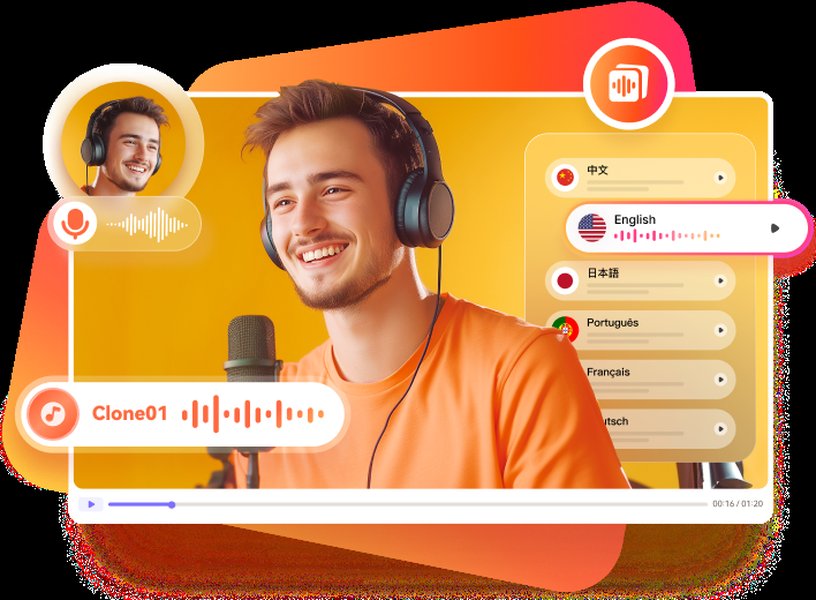
The seamless transformation from human voice input to digital clone via AI technology.
Diverse Applications of AI Voice Cloning
Revolutionizing Industries with Synthetic Speech
AI voice cloning is not merely a technological marvel; it's a versatile tool that offers significant benefits across a broad spectrum of applications. Its ability to create high-quality, consistent, and customizable audio content opens up new possibilities for creators, businesses, and individuals alike.
Enhancing Content Creation
- Audiobooks and Podcasts: Content creators can generate entire audiobooks or podcast episodes in their own cloned voice, saving immense time and resources typically spent on manual recording. This allows for consistent narration without the need for repetitive studio sessions.
- Voiceovers and Narrations: For videos, presentations, and e-learning modules, AI voice cloning provides a quick and cost-effective way to produce professional voiceovers. This is particularly useful for creators who want to maintain a consistent brand voice across their content.
- Character Voices: In animation, video games, and interactive media, AI voice cloning can generate expressive character voices, maintaining consistent vocalizations for various roles and scenarios.
Business and Marketing Innovations
- Personalized Customer Experiences: Companies can leverage cloned voices to create branded voice assistants or personalized messages for customers, enhancing engagement and brand recognition.
- Advertisement Production: Voice cloning enables businesses to generate countless advertisement pieces using a consistent brand ambassador's voice, even for a single recording, allowing for rapid iteration and localization.
- Multilingual Content: A significant advantage of many AI voice cloning tools is their support for multiple languages. Users can clone their voice and then have it speak in various languages, such as Spanish, French, German, or Hindi, breaking down language barriers for global audiences.
AI voice cloning streamlines dubbing and localization, offering global content reach.
Accessibility and Personal Use
- Assisted Communication: For individuals with speech impediments or those who have lost their voice, AI voice cloning can help create a synthetic voice that retains their original vocal identity, aiding communication.
- Archiving Voices: The technology allows for the digital preservation of voices, enabling loved ones to "hear" familiar voices, for instance, reading stories or poems.
Leading AI Voice Cloning Tools in 2025
Comparing Features and Capabilities
The market for AI voice cloning tools is dynamic and competitive, with various platforms offering unique features, pricing models, and levels of voice quality. Here's an overview of some prominent options:
| Tool Name | Key Features | Voice Cloning Speed/Requirements | Notable Use Cases | Languages Supported |
|---|---|---|---|---|
| ElevenLabs | Advanced voice cloning, real-time speech synthesis, emotional depth, multi-language support. Offers "Instant" and "Professional" cloning. | Few seconds (Instant) to minutes (Professional) of audio. | Audiobooks, digital animation, storytelling, business interactions. | 29-32 languages. |
| Speechify | Human-like cadence, high-quality synthetic voices, cross-device compatibility. | Around 30 seconds of voice sample. | Audiobooks, content creation, presentations, training. | 28+ languages (e.g., English, German, Polish, Italian, French). |
| Descript | Integrated audio/video editor, "Overdub" feature for voice cloning, accurate transcription. | Requires recording a sample statement. | Podcasting, video creation, general audio/video editing. | Not explicitly listed, but generally supports common languages. |
| PlayHT | High-quality, expressive voice clones, maintains accents and nuances, robust API. | As little as 30 seconds for high quality clones; hours for high fidelity. | Content creators, teams, multilingual content, podcasts. | 40+ languages. |
| Vidnoz AI | Studio-quality voice clones, adjustable emotions and speed, online recording/uploading. | Seconds for cloning and generation. | Various content creation, marketing materials. | Multiple languages (e.g., English, Spanish, French, Portuguese). |
| Resemble AI | Realistic AI voice generator, real-time speech-to-speech and text-to-speech, adjustable emotions and tone. | Not specified, but focuses on real-time creation. | Hollywood productions, AI agents, personalized messages, games. | Multiple languages. |
| Vocloner | Fast and efficient, instant cloning, simple and cost-effective, daily character limit for free tier. | Just seconds. | Quick experimentation, cost-effective voice generation. | Multiple languages (maintains natural tone). |
| Uberduck | Free voice cloning, high accuracy (95% similarity), text-to-speech, voice conversion. | Seconds. | Content creation, audiobooks, voiceovers, singing, rapping. | Not explicitly listed, but implies broad language support. |
| Wondershare Virbo | Ultra-realistic sound quality, custom voice profiles, narrative avatar videos, text-to-speech. | 50-90 seconds of clear speech (for best quality). | Marketing, business, education, content creation. | Any language. |
When selecting a tool, key considerations include the required audio sample length, the fidelity and naturalness of the cloned voice, the range of languages supported, and whether it offers features like emotional control or integration with other content creation workflows.
Ethical Considerations and Responsible Use
Navigating the Implications of Voice Cloning Technology
While AI voice cloning offers incredible opportunities, it also presents significant ethical challenges. The ability to replicate someone's voice carries the potential for misuse, including deepfakes, scams, and unauthorized impersonation. Therefore, responsible use and strong ethical guidelines are paramount.
Addressing Misuse and Ensuring Consent
- Consent Mechanisms: Reputable voice cloning platforms often implement consent mechanisms, such as requiring users to record a specific consent statement or verifying identity before cloning a voice. This helps prevent unauthorized replication, especially for public figures or copyrighted voices.
- Security Protocols: Protecting voice data is crucial. Platforms like ElevenLabs emphasize security protocols and proprietary Voice Captcha mechanisms to ensure data protection.
- Legal and Copyright Implications: Using AI voice cloning to mimic public figures, celebrities, or copyrighted characters without explicit permission can lead to legal repercussions. Understanding and adhering to copyright and intellectual property laws is essential for ethical deployment of this technology.

AI voice cloning: A powerful tool with ethical considerations that demand responsible use.
The development of voice cloning technology is still in its early stages, with continuous improvements in quality and naturalness. As the technology evolves, so too must the frameworks for its ethical application, ensuring that its benefits are harnessed while mitigating potential risks.
The Technical Landscape: Charting Voice Cloning Capabilities
A Comparative Analysis of AI Voice Cloning Tool Strengths
To further illustrate the diverse strengths of various AI voice cloning tools, the following radar chart provides a conceptual comparison across several key performance indicators. These indicators reflect aspects critical to users, such as the naturalness of the cloned voice, the speed of cloning, multilingual capabilities, emotional range, and overall ease of use. Please note that the data points in this chart are opinion-based analyses derived from the provided sources and represent relative strengths rather than precise empirical measurements.
This radar chart visually represents how different AI voice cloning tools might compare in key areas. For instance, ElevenLabs generally scores high on naturalness and emotional range due to its advanced models, while tools like Vocloner or Uberduck might excel in speed and cost-effectiveness, especially for quick, free applications. Multilingual support is a growing area, with many platforms striving for broader language capabilities. Fidelity with minimal audio input highlights how quickly a tool can generate a convincing clone from a short sample. Understanding these distinctions helps users choose the best tool for their specific needs.
A Practical Demonstration: Cloning Your Voice with AI
Witnessing the Speed and Simplicity of Voice Replication
To truly grasp the capabilities of AI voice cloning, observing the process in action can be incredibly insightful. The following video demonstrates how easily a voice can be cloned using a popular AI tool, highlighting the minimal audio input required and the rapid generation of new speech.
A video demonstration showcasing the process of AI voice cloning and its impressive results.
This video provides a clear example of the user-friendly interfaces common in modern voice cloning software. It underscores the "instant" nature of many of these tools, demonstrating how quickly one can move from uploading an audio sample to generating new, synthesized speech in the cloned voice. Such demonstrations are crucial for demystifying the technology and highlighting its practical accessibility for content creators and businesses.
Frequently Asked Questions about AI Voice Cloning
What is AI voice cloning?
How much audio is needed to clone a voice?
Is AI voice cloning free?
Can AI voice cloning replicate emotions?
What are the ethical concerns surrounding voice cloning?
Conclusion: The Future Resonates with Cloned Voices
AI voice cloning stands as a testament to the remarkable progress in artificial intelligence, offering unparalleled capabilities for synthesizing human speech with incredible accuracy and versatility. From simplifying content creation for podcasters and filmmakers to enabling new forms of personalized customer engagement and supporting accessibility initiatives, the applications are vast and continuously expanding. While the technology holds immense promise, it equally demands a commitment to ethical deployment, ensuring that its power is wielded responsibly and with respect for individual consent and intellectual property. As AI continues to evolve, the ability to clone voices will undoubtedly become more refined, seamless, and integrated into our daily digital interactions, reshaping how we create, communicate, and experience audio in the modern world.
Recommended Further Exploration
- What are the ethical implications and safeguards in AI voice cloning technology?
- How can content creators leverage AI voice cloning to enhance their productions?
- What are the upcoming trends and advancements in synthetic speech and AI voice generation?
- How is AI voice cloning being used to improve accessibility for individuals with speech impediments?