
Unveiling the Intellectual Tapestry: Groundbreaking Theories from Ancient India
Exploring profound ideas in philosophy, governance, science, and consciousness that shaped a civilization and influenced the world.
Ancient India was a fertile ground for intellectual exploration, giving rise to a diverse array of sophisticated theories across numerous fields. From the intricate systems of philosophy and the pragmatic principles of statecraft to pioneering scientific concepts, these ancient theories offer a fascinating glimpse into the intellectual heritage of the subcontinent. They reveal a deep engagement with fundamental questions about reality, knowledge, society, and the cosmos, often predating similar developments elsewhere in the world.
Highlights of Ancient Indian Theoretical Contributions
- Diverse Philosophical Schools: Ancient India nurtured multiple schools of thought (Darśanas), both orthodox (accepting Vedic authority) and unorthodox, exploring metaphysics, epistemology, logic, and ethics with remarkable depth.
- Pioneering Scientific Concepts: Theories like atomism (Paramāṇu-vāda) proposed by Kanada and advancements in mathematics and astronomy, including the concept of zero and early heliocentric ideas, highlight significant scientific ingenuity.
- Sophisticated Political Thought: Thinkers debated various theories on the origin and nature of the state, including Divine Right, Social Contract, and Organic theories, alongside developing detailed principles of governance (Dandaniti) and statecraft (Arthashastra).
The Spectrum of Ancient Indian Philosophy (Darśana)
Ancient Indian philosophy, known as Darśana (meaning 'vision' or 'viewpoint'), represents a rich tapestry of intellectual traditions developed over centuries. These schools grappled with profound questions concerning existence, reality, consciousness, knowledge, and the ultimate goals of human life. They are traditionally classified into two broad categories: orthodox (āstika), which accept the authority of the Vedas, and unorthodox (nāstika), which do not.
Orthodox Schools (Āstika) - Accepting Vedic Authority
Six major schools fall under this category, often grouped into pairs based on their metaphysical similarities:
- Nyāya: Focused primarily on logic and epistemology (the theory of knowledge). It developed systematic methods for determining valid knowledge (pramāṇa), identifying four key sources: perception (Pratyaksha), inference (Anumana), comparison (Upamana), and testimony (Shabda). Nyāya aimed to eliminate suffering through logical reasoning and achieving true knowledge.
- Vaisheshika: Known for its metaphysical framework, particularly its early atomic theory (Paramāṇu-vāda). Founded by the sage Kanada, it proposed that the physical universe is composed of eternal, indivisible atoms (paramāṇu) of earth, water, fire, and air, along with ether (akasha), time, space, soul (atman), and mind (manas). It aimed to understand reality by categorizing all existing things.
- Samkhya: A dualistic philosophy theorizing two fundamental, eternal realities: Purusha (consciousness, the self, spirit) and Prakriti (primordial matter, nature, energy). It posits that the universe evolves through the interaction of these two principles and aims to achieve liberation (moksha) by understanding the distinction between Purusha and Prakriti.
- Yoga: Closely associated with Samkhya metaphysics, Yoga focuses on the practical path to liberation through discipline, meditation, and control of the mind and body. Patanjali's Yoga Sutras codified these practices, outlining the eight limbs (Ashtanga Yoga) as a means to attain self-realization and union with the divine or ultimate reality.
- Mimamsa (or Pūrva Mimamsa): Primarily concerned with the exegesis (interpretation) of the Vedas, focusing on understanding the correct performance of Vedic rituals (yajnas) as the path to dharma and liberation. It emphasized the eternal and authoritative nature of the Vedas and developed principles of hermeneutics (interpretation theory).
- Vedanta (or Uttara Mimamsa): Based on the philosophical teachings of the Upanishads (the concluding parts of the Vedas). Vedanta explores the nature of Brahman (the ultimate reality) and Atman (the individual self or soul), and their relationship. Various sub-schools emerged, including Advaita (non-dualism), Vishishtadvaita (qualified non-dualism), and Dvaita (dualism), offering different interpretations of these core concepts.
The following table summarizes the core focus of these six orthodox schools:
| School | Founder (Traditional) | Core Focus | Key Concepts |
|---|---|---|---|
| Nyāya | Gautama | Logic, Epistemology | Pramāṇa (means of knowledge), Valid Reasoning |
| Vaisheshika | Kanada | Metaphysics, Atomism | Paramāṇu (atoms), Padārtha (categories of reality) |
| Samkhya | Kapila | Dualism, Cosmology | Purusha (consciousness), Prakriti (matter), Gunas (qualities) |
| Yoga | Patanjali | Mind Control, Meditation, Liberation | Ashtanga Yoga (eight limbs), Samādhi (concentration) |
| Mimamsa | Jaimini | Vedic Exegesis, Rituals, Dharma | Apauruşeyatva (impersonal origin of Vedas), Karma |
| Vedanta | Badarayana (Vyasa) | Nature of Reality (Brahman), Self (Atman) | Brahman, Atman, Maya (illusion), Moksha (liberation) |
Unorthodox Schools (Nāstika) - Rejecting Vedic Authority
These schools developed independently and often challenged Brahmanical orthodoxy:
- Buddhism: Founded by Siddhartha Gautama (the Buddha), it centers on the Four Noble Truths and the Eightfold Path to end suffering (dukkha). Key theories include Anatman (no-self), Anicca (impermanence), Dependent Origination (Pratītyasamutpāda), and the concept of Nirvana (liberation from the cycle of rebirth).
- Jainism: Traditionally traced to Rishabhanatha and consolidated by Mahavira, Jainism emphasizes Ahimsa (non-violence), Anekāntavāda (many-sidedness or multiplicity of viewpoints), Aparigraha (non-attachment), and the eternal nature of the soul (jiva). It prescribes rigorous asceticism to purify the soul and attain liberation.
- Charvaka (Lokayata): A materialistic and skeptical school that rejected supernaturalism, scripture, karma, and rebirth. It held that perception is the only valid source of knowledge and that pleasure is the ultimate goal of life. Much of its original literature is lost, known primarily through critiques by other schools.
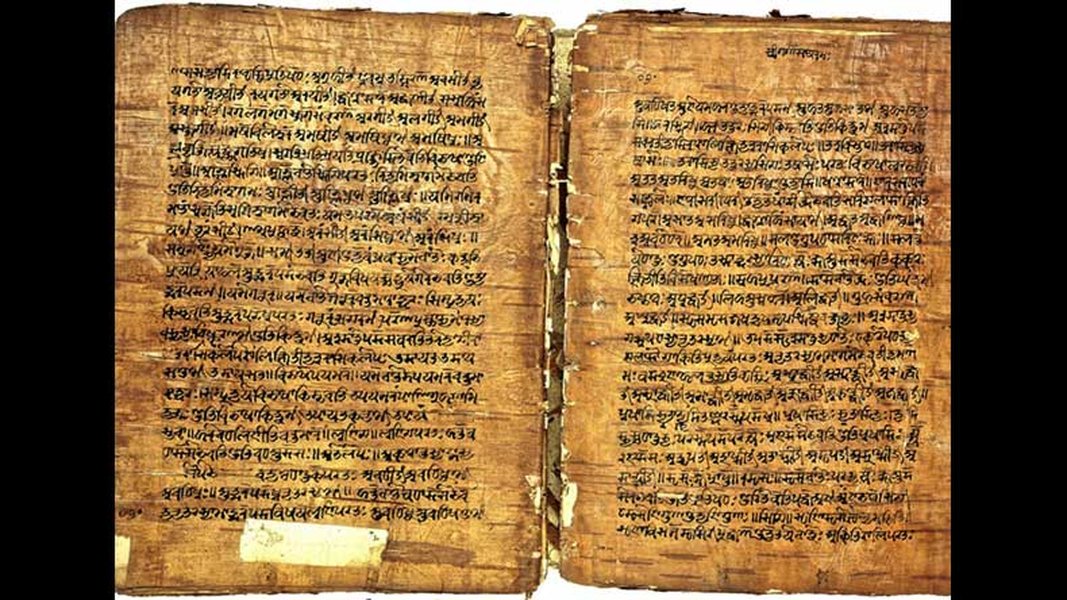
An ancient manuscript depicting yoga practices, reflecting the deep integration of philosophy and physical/mental discipline in systems like Yoga.
Theories of State and Governance
Ancient Indian thinkers devoted considerable attention to political philosophy, exploring the origins, nature, and functions of the state and kingship. This branch of knowledge, often termed Dandaniti (science of government) or Rajadharma (duties of a king), produced several influential theories.
Origins of the State
Several theories attempted to explain the emergence of political authority:
The Divine Origin Theory
Rooted in Vedic literature and prominent in Brahmanical texts like the Manusmriti, this theory posited that kingship was divinely ordained. Rulers were seen as appointed by the gods (like Indra or Vishnu) or possessed divine qualities to maintain cosmic and social order (dharma). The king's primary duty was protection, particularly of Brahmins and the varna system, and enforcing laws derived from sacred texts.
The Social Contract Theory
Contrasting with divine ordination, this theory suggested that the state arose from a mutual agreement among people. Texts like the Śāntiparva of the Mahabharata and Kautilya's Arthashastra describe a pre-state condition of anarchy or chaos, termed Mātsyanyāya ("the law of the fish," where the strong prey on the weak). To escape this, people collectively chose or agreed upon a ruler (like the mythical Manu), granting him authority and resources (taxes) in exchange for protection and justice. This theory emphasized societal consent and the ruler's accountability to the community.
The Organic/Evolutionary Theory
This perspective viewed the state as a natural development, evolving gradually from simpler social units like the family and tribe into more complex political structures. As societies grew and agriculture developed, the need for coordination, defense, and regulation led organically to the formation of states and kingship, integrating various societal elements (like varna and guilds) into a cohesive whole.
Statecraft and the Ideal State (Saptanga Theory)
Beyond origins, ancient texts elaborated on the components and functions of a well-run state. Kautilya's Arthashastra is a seminal work in this regard, outlining practical principles of governance, administration, diplomacy, espionage, and warfare. A key concept is the Saptanga Theory, which describes the state as an organism comprising seven essential limbs or elements (angas):
- Svamin (The Sovereign): The king or ruler, who should be virtuous, wise, and proactive.
- Amatya (The Ministers): The council of advisors and administrators responsible for assisting the king and running departments.
- Janapada (The Territory and People): The land, resources, and population, which should be fertile and loyal.
- Durga (The Fort): Fortified structures crucial for defense and security.
- Kosha (The Treasury): Financial resources necessary for administration, defense, and welfare.
- Danda (The Army/Force): Military strength essential for protection and maintaining order.
- Mitra (The Allies): Friendly states crucial for diplomatic strength and security.
This theory emphasized the interdependence of these elements for the stability and prosperity of the state, always centered around the ultimate goal of upholding Dharma and ensuring the welfare (Yogakshema) of the people.
Pioneering Scientific and Mathematical Theories
Ancient India witnessed remarkable advancements in various scientific and mathematical fields, developing theories and techniques that often predated similar discoveries elsewhere and laid foundations for modern science.
Atomic Theory (Paramāṇu-vāda)
One of the most striking scientific contributions was the development of an atomic theory by the sage Kanada, founder of the Vaisheshika school of philosophy (around the 6th to 2nd century BCE). In his Vaisheshika Sutra, Kanada proposed:
- The physical world is composed of fundamental, indivisible particles called paramāṇu (atoms).
- These atoms are eternal and possess specific characteristics.
- There are different types of atoms corresponding to the elements: earth (prithvi), water (ap), fire (tejas), and air (vayu). Ether (akasha) was considered non-atomic.
- Atoms combine in specific ways (dyads, triads) to form molecules and, ultimately, all observable matter.
- The properties of substances arise from the types and combinations of atoms composing them.
This ancient theory, though intertwined with metaphysical concepts, represents one of the earliest systematic attempts to explain the nature of matter based on fundamental constituents, centuries before John Dalton.
This video explores the Vaisheshika Sutras and the sophisticated Atomic Theory developed in ancient India by Rishi Kanada.
Mathematics and Astronomy
Ancient Indian mathematicians and astronomers made profound contributions:
- The Concept of Zero (Shunya): Perhaps the most significant mathematical contribution was the development of the concept of zero not just as a placeholder but as a number in its own right, along with the decimal place-value system. This revolutionized calculation and algebra.
- Approximation of Pi (π): Scholars like Aryabhata (5th century CE) calculated a remarkably accurate value for π (approximated as 3.1416).
- Algebra and Trigonometry: Brahmagupta (7th century CE) established rules for operating with zero and negative numbers and provided solutions for quadratic equations. Trigonometric concepts, including sine (jya) and cosine (kojya), were also developed.
- Astronomical Models: Aryabhata proposed theories suggesting that the Earth rotates on its axis and revolves around the Sun (heliocentrism), challenging prevailing geocentric models. He also provided accurate calculations for the length of the solar year and methods for predicting eclipses.

The Bakhshali Manuscript, dating back potentially as early as the 3rd century CE, contains the oldest known written examples of the symbol for zero.
Insights into Cognition and Consciousness
Beyond external reality, ancient Indian thought delved deep into the nature of the mind, cognition, and consciousness, primarily within philosophical systems like Samkhya and Yoga.
Samkhya-Yoga Theories of Mind
The Samkhya-Yoga tradition provided detailed models of the mind and its functions:
- Components of the Mind (Antahkarana): They conceptualized the mind not as a single entity but as comprising different functions: Manas (lower mind, processing sensory input), Ahamkara (ego, sense of 'I-ness'), and Buddhi (intellect, discrimination, decision-making).
- Theory of Perception: Perception was understood as a process involving the senses (indriyas), Manas, Ahamkara, and Buddhi, ultimately illuminated by Purusha (consciousness).
- States of Consciousness: These systems explored various states of consciousness, including waking, dreaming, deep sleep, and the transcendental state (turiya or samadhi) achieved through yogic practices.
- The Gunas: Prakriti (matter/nature) was seen as composed of three fundamental qualities or forces (gunas) - Sattva (purity, harmony, light), Rajas (activity, passion, dynamism), and Tamas (inertia, darkness, ignorance). The interplay of these gunas shapes the mind and experiences.
These ancient psychological theories, often derived empirically through introspection and meditation, offer frameworks for understanding cognition, emotion, and altered states that are increasingly being explored in modern consciousness studies and psychology, particularly in relation to mindfulness and meditation research.
Mapping the Landscape of Ancient Indian Theories
The vast intellectual output of ancient India can be visualized through the interconnectedness of its major theoretical domains. The mindmap below provides a simplified overview, linking core areas like philosophy, science, and political thought to their key concepts and schools.
This mindmap illustrates the breadth and depth of theoretical inquiry in ancient India, showing how different fields often intersected, particularly through shared philosophical underpinnings like the concept of Dharma.
Comparative Influence of Theoretical Domains
Assessing the relative prominence or influence of these diverse theoretical domains within ancient Indian thought itself is complex. However, we can conceptualize their perceived development and impact using a radar chart. This chart subjectively represents the estimated sophistication and reach of key areas based on the available historical and textual evidence. Note that this is an interpretative visualization, not based on quantitative data.
This chart suggests that while areas like metaphysics, ethics, and philosophy of consciousness reached high levels of sophistication and had profound lasting influence, practical sciences and political theory were also highly developed and integral to the intellectual landscape of ancient India.
Frequently Asked Questions (FAQ)
What is the difference between Āstika and Nāstika schools?
The main difference lies in their acceptance of the authority of the Vedas, the foundational scriptures of Hinduism. Āstika (orthodox) schools (Nyaya, Vaisheshika, Samkhya, Yoga, Mimamsa, Vedanta) accept the Vedas as a valid source of knowledge. Nāstika (unorthodox or heterodox) schools (Buddhism, Jainism, Charvaka) reject the ultimate authority of the Vedas.
Who was Kautilya and what is the Arthashastra?
Kautilya, also known as Chanakya or Vishnugupta (traditionally dated around the 4th century BCE), was an influential scholar, teacher, and advisor, most famously associated with the Mauryan emperor Chandragupta Maurya. The Arthashastra is an ancient Indian treatise attributed to him, covering statecraft, economic policy, military strategy, and political duties. It is renowned for its pragmatic and sometimes ruthless approach to governance and provides detailed theories on administration, law, diplomacy, and the structure of the state (like the Saptanga theory).
What exactly is the Paramāṇu (atomic) theory of Kanada?
The Paramāṇu-vāda, primarily developed by Kanada in the Vaisheshika school, is one of the earliest known atomic theories. It posits that all physical substances are ultimately composed of eternal, indivisible, and indestructible particles called paramāṇu (atoms). These atoms were thought to exist for the four fundamental elements (earth, water, fire, air) and possess unique qualities. They were believed to combine in specific configurations (like dyads and triads) to form all composite objects in the universe. While differing significantly from modern atomic theory in its details and metaphysical context, it represents a remarkable early attempt to explain matter based on discrete, fundamental particles.
How did ancient Indian theories influence the world?
Ancient Indian theories had a significant impact both within Asia and beyond. Philosophical and religious ideas, particularly Buddhism, spread widely across East and Southeast Asia. Mathematical concepts, including the decimal system and zero, were transmitted to the Arab world and subsequently to Europe, fundamentally transforming mathematics and science globally. Astronomical knowledge and techniques were also shared, influencing Islamic astronomy. Ayurvedic medical concepts and practices also spread. Furthermore, the depth of Indian philosophical inquiry, especially concerning consciousness and metaphysics, continues to interest scholars worldwide.
Recommended Further Exploration
- How did the Social Contract theory in ancient India compare to later Western versions?
- Can you provide a detailed explanation of the Saptanga theory from Kautilya's Arthashastra?
- What were the key similarities and differences between Vaisheshika atomism and ancient Greek atomism?
- Explore the concept of Pramanas (valid sources of knowledge) within the Nyaya school of Indian philosophy.
References

 explorewithakm.wordpress.com

Last updated May 3, 2025