
Unveiling the Legacy of the Ashoka Pillars: Pillars of Dharma and Imperial Decree
Ancient Indian Monuments of Morality and Mauryan Might
The Ashoka Pillars, standing as silent sentinels across the Indian subcontinent, are remarkable testaments to the vision and legacy of Emperor Ashoka the Great, the third ruler of the Mauryan Empire. Erected primarily during his reign from approximately 268 to 232 BCE, these monolithic columns were more than mere architectural feats; they were powerful instruments for disseminating Ashoka's moral code, known as Dharma, and marking significant locations related to Buddhism and his imperial authority.
These pillars are among the earliest substantial stone sculptural monuments in India and represent a pivotal shift in Indian art and architecture, moving from perishable materials like wood to durable stone. Their existence provides crucial physical evidence of the Buddhist faith during this early period and offers invaluable insights into the Mauryan civilization, its administrative structure, and its embrace of Buddhist principles following Ashoka's transformative experience after the Kalinga War.
Key Insights into the Ashoka Pillars
- Dissemination of Dharma: The primary purpose of the pillars was to propagate Ashoka's edicts, which promoted a code of morality, peace, and compassion based on Buddhist teachings.
- Buddhist Significance: Many pillars were strategically placed at sites important to Buddhist history, including the Buddha's birthplace and places of pilgrimage, serving as tangible markers of faith.
- Architectural and Artistic Innovation: The monolithic nature, high polish, and sophisticated animal capitals of the pillars showcase the advanced craftsmanship and artistic skill of the Mauryan period.
The Genesis of the Pillars: Ashoka's Transformation and the Spread of Dharma
The history of the Ashoka Pillars is deeply intertwined with the personal journey of Emperor Ashoka. Initially a fierce warrior known for his conquests, Ashoka underwent a profound transformation after witnessing the immense suffering and bloodshed of the Kalinga War. This experience filled him with remorse and led him to embrace Buddhism, with its emphasis on non-violence and compassion. His conversion marked a turning point not only in his life but also in the direction of the Mauryan Empire.
Inspired by Buddhist teachings, Ashoka resolved to rule according to the principles of Dharma. He sought to promote a just and ethical society, and the pillars became a primary means of communicating these ideals to his vast empire. By erecting pillars in prominent locations, including religious sites, trade routes, and provincial centers, Ashoka aimed to reach a wide audience and encourage his subjects to adopt a more moral and peaceful way of life.
The inscriptions on the pillars, known as the Edicts of Ashoka, served as public pronouncements of his policies and beliefs. These edicts covered a wide range of topics, including the importance of respecting elders, practicing tolerance towards all religions, caring for the welfare of his subjects, and abstaining from violence.
Construction and Craftsmanship: Engineering Marvels of the Mauryan Era
The construction of the Ashoka Pillars was a remarkable feat of engineering and artistry for their time. These monolithic columns, typically standing between 40 and 50 feet tall, were often quarried from distant locations, such as Mathura and Chunar in northern India, and transported to their final destinations. The sheer scale and weight of these stones, some weighing around 50 tons, highlight the logistical capabilities of the Mauryan Empire.
The pillars were generally fashioned from a single piece of sandstone for the shaft, with a separately carved capital placed on top. A distinctive feature of the Ashokan pillars is their remarkable polish, which gave them a lustrous appearance and has survived through centuries. This high level of finish is not commonly found in later Indian monuments, leading some scholars to suggest possible influence from Achaemenid Persian or Hellenistic artistic traditions, although the overall form and symbolism are distinctly Indian.
Components of an Ashoka Pillar
A typical Ashoka Pillar consists of several key components:
- Shaft: The tall, monolithic column, usually tapering slightly towards the top.
- Abacus: A square or circular platform atop the shaft, often decorated with friezes of animals or floral motifs.
- Capital: The crowning element of the pillar, typically featuring one or more animal sculptures.
- Crowning Animal: The sculpted animal figure(s) at the very top, often lions, bulls, elephants, or horses, each carrying symbolic significance within Buddhism and Indian culture.
Symbolism in the Capitals
The animal capitals are perhaps the most recognizable feature of the Ashoka Pillars, each imbued with rich symbolism:
-
Lion: A powerful symbol of royalty, leadership, and the Buddha himself, who was born into the Shakya (lion) clan. The most famous example is the four-lion capital from Sarnath, which is now the National Emblem of India.
-
Bull: Represents the zodiac sign under which the Buddha was born.
-
Elephant: Symbolizes the Buddha's descent from heaven.
-
Horse: Represents the Buddha's departure from his palace.
The abacus often features a depiction of the Dharma Chakra (wheel of Dharma), symbolizing the Buddha's first sermon and the turning of the wheel of righteousness.
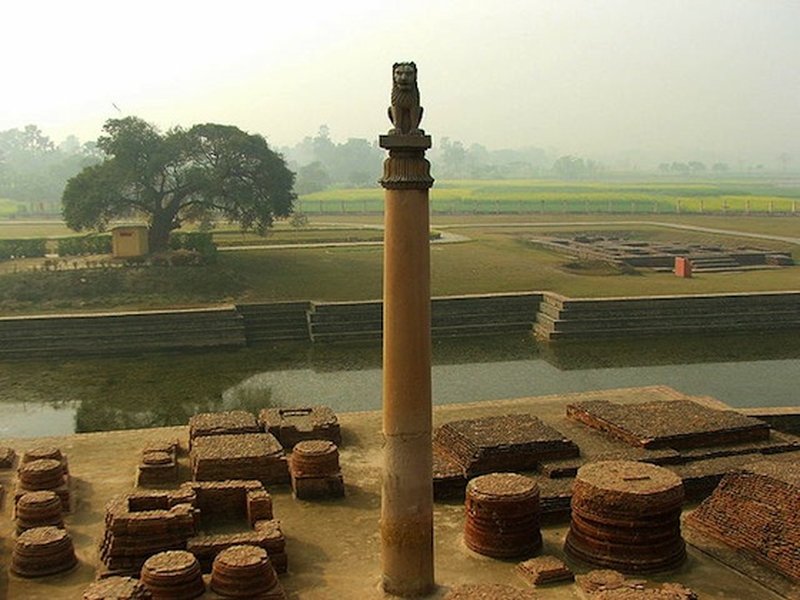
Illustration depicting an Ashoka Pillar with its distinct components, including the lion capital.
Locations and Notable Pillars
The Ashoka Pillars were strategically erected across the vast Mauryan Empire, which encompassed much of the Indian subcontinent and parts of modern-day Afghanistan and Nepal. Their placement at key locations ensured that Ashoka's message reached a wide and diverse population.

Map illustrating the geographical spread of Ashoka's edicts and pillars across the Mauryan Empire.
While many pillars were erected, only around 20 of the original pillars survive today, many in fragmented states. Some were moved from their original locations in later centuries. Here are some of the most notable Ashoka Pillars and their locations:
Sarnath Pillar
Located at Sarnath, near Varanasi, this pillar is arguably the most famous. It marks the site where the Buddha delivered his first sermon, setting in motion the wheel of Dharma. The Lion Capital of Ashoka from this pillar, with its four back-to-back lions, is a masterpiece of Mauryan art and serves as India's national emblem.
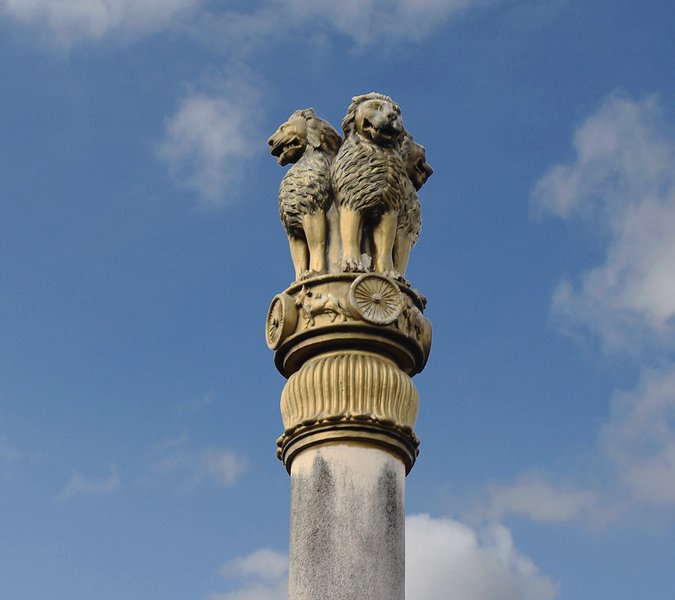
The iconic Lion Capital of Ashoka from the Sarnath pillar, now housed in the Sarnath Museum.
Lauriya Nandangarh Pillar
Situated in Bihar, this intact pillar features six Ashokan edicts and is topped with a single lion capital. It stands as a well-preserved example of Ashokan architecture and inscription.
Allahabad Pillar
Now located within the Allahabad Fort, this pillar was originally erected at Kaushambi and later moved. It bears not only Ashokan inscriptions but also later inscriptions from the Gupta period and the Mughal era, reflecting its continued significance through different historical periods.
Lumbini Pillar
Found in Lumbini, Nepal, the birthplace of the Buddha, this pillar commemorates Ashoka's pilgrimage to the sacred site. Although its capital is missing, the inscription on this pillar provides crucial historical evidence confirming Lumbini as the Buddha's birthplace.
Topra Kalan and Meerut Pillars
These two pillars were famously moved to Delhi by the Sultan Firuz Shah Tughlaq in the 14th century. They contain significant Ashokan edicts and highlight the later historical interest in these ancient monuments.
Other notable pillar locations include Rampurva (known for its bull and lion capitals), Sanchi (near the Great Stupa), and Nigali Sagar (in Nepal, near Lumbini). The distribution of these pillars provides a geographical outline of the Mauryan Empire under Ashoka's rule.
The Edicts of Ashoka: Messages of Morality and Governance
The inscriptions on the Ashoka Pillars, along with those found on rocks and cave walls, form the collection known as the Edicts of Ashoka. These edicts, written in various Prakrit dialects using the Brahmi script (and in some frontier areas, Aramaic and Greek), are the primary source of information about Ashoka's reign, his conversion to Buddhism, and his efforts to establish a just and compassionate state.
The edicts are broadly categorized into Major Rock Edicts, Minor Rock Edicts, and Pillar Edicts. The Pillar Edicts are particularly detailed and extensive, often focusing on Ashoka's administrative policies, his understanding of Dharma, and his instructions to his officials.
The content of the edicts reflects Ashoka's commitment to the welfare of his subjects, irrespective of their religious beliefs. He promoted religious tolerance, social harmony, and ethical conduct. The edicts provide valuable insights into the social and religious conditions of the Mauryan period and Ashoka's unique approach to governance, which blended imperial authority with moral persuasion.
Themes in the Pillar Edicts
The Major Pillar Edicts, found on several of the surviving pillars, elaborate on various aspects of Ashoka's Dharma:
| Edict Number | Key Themes |
|---|---|
| Pillar Edict I | Ashoka's principle of protection and welfare for his subjects. |
| Pillar Edict II | Definition of Dharma as compassion, liberality, truthfulness, purity, gentleness, and goodness. |
| Pillar Edict III | Prohibition of certain animal sacrifices and the importance of self-control and purity of thought. |
| Pillar Edict IV | Duties of the Rajukas (provincial administrators) and their role in dispensing justice and promoting welfare. |
| Pillar Edict V | Appointment of Dhamma Mahamatras (officials for the spread of Dharma) and their activities. |
| Pillar Edict VI | Ashoka's desire to be accessible to his officials at all times to discuss matters of welfare. |
| Pillar Edict VII | Summary of Ashoka's efforts to promote Dharma and create a harmonious society. |
These edicts demonstrate Ashoka's active role in shaping the moral and ethical landscape of his empire, utilizing the pillars as a direct channel of communication with his people.
Legacy and Significance
The Ashoka Pillars hold immense historical, cultural, and artistic significance. They are among the earliest examples of monumental stone sculpture in India and provide tangible links to the Mauryan Empire and the reign of one of its most influential rulers. The inscriptions on the pillars are invaluable primary sources for understanding the history of ancient India, the early spread of Buddhism, and the administrative policies of the Mauryan state.
Beyond their historical importance, the Ashoka Pillars are celebrated for their artistic merit. The skill demonstrated in carving and polishing these monolithic structures, as well as the naturalistic depiction of the animal capitals, reflects a high level of artistic achievement. The Lion Capital of Sarnath, in particular, is recognized globally as a symbol of India's rich ancient heritage and its embrace of the values of strength, courage, and unity, as represented by the lions, and the principles of righteousness, as symbolized by the Dharma Chakra.
The pillars also stand as a testament to Ashoka's enduring legacy as a ruler who sought to govern with compassion and promote a universal moral code. His concept of Dharma, as articulated in the edicts, has had a lasting influence on Indian thought and continues to resonate as an ideal of ethical leadership and social responsibility.
This video provides an overview of Ashoka's Pillar Edicts, explaining their historical context and significance as primary sources for understanding his reign and the spread of Buddhism.
FAQ about Ashoka Pillars
What was the main purpose of the Ashoka Pillars?
The main purpose was to spread Emperor Ashoka's edicts, which promoted his moral code (Dharma) based on Buddhist principles, and to mark significant locations, particularly those related to Buddhism.
How many Ashoka Pillars are there?
While many pillars were originally erected, only around 20 of them survive today, some in fragments. The exact original number is unknown.
What is the significance of the animal capitals on the pillars?
The animal capitals, such as lions, bulls, elephants, and horses, carry symbolic meanings related to Buddhism and royalty. The lion, for instance, symbolizes the Buddha and royalty, while the Dharma Chakra on the abacus represents the Buddha's first sermon.
What are the Edicts of Ashoka?
The Edicts of Ashoka are the inscriptions found on the pillars, as well as on rocks and cave walls. They contain Ashoka's pronouncements on Dharma, his administrative policies, and his efforts to promote the welfare of his subjects.
Why is the Sarnath Pillar particularly famous?
The Sarnath Pillar is famous because it marks the site of the Buddha's first sermon, and its Lion Capital is a significant artistic achievement that has been adopted as the National Emblem of India.
References
Last updated May 2, 2025