
Quiz on the Structure of the Atom
Explore atomic theory and subatomic particles with this comprehensive quiz
Highlights
- Comprehensive coverage: Questions on subatomic particles, atomic number, mass number, and electron configuration.
- Engaging formats: Multiple-choice, short answer, fill in the blanks, and true or false questions.
- Concept reinforcement: Detailed answers and explanations to deepen understanding of atomic structure.
Introduction
The atom is the fundamental building block of matter, and understanding its structure is essential in the study of chemistry. This quiz covers key concepts including the identification of subatomic particles, interpretation of atomic numbers and mass numbers, and an understanding of historical atomic models. The questions are designed to cater to a range of learners, from those beginning their study of chemistry to those who wish to deepen their conceptual understanding of atomic structure.
Quiz Sections
Section 1: Multiple-Choice Questions
Question 1
Which of the following options best describes an atom?
- A) A molecule composed of several atoms
- B) The smallest unit of matter that retains chemical properties
- C) A subatomic particle
- D) A group of protons only
Answer: B
Question 2
What are the three primary subatomic particles found in an atom?
- A) Protons, electrons, and photons
- B) Protons, neutrons, and electrons
- C) Electrons, neutrons, and neutrinos
- D) Quarks, electrons, and protons
Answer: B
Question 3
Which part of an atom contains protons and neutrons?
- A) The electron cloud
- B) The nucleus
- C) Outer orbitals
- D) Inter-electronic space
Answer: B
Question 4
Which subatomic particle carries a positive charge?
- A) Electron
- B) Neutron
- C) Proton
- D) Positron
Answer: C
Question 5
What determines the atomic number of an element?
- A) Total number of electrons
- B) Total number of protons
- C) Total number of neutrons
- D) Sum of protons and neutrons
Answer: B
Question 6
The mass number of an atom is the sum of:
- A) Protons only
- B) Neutrons only
- C) Protons and neutrons
- D) Protons, neutrons, and electrons
Answer: C
Question 7
Which model of the atom describes electrons moving in fixed orbits around the nucleus?
- A) Dalton's model
- B) Rutherford’s model
- C) Bohr’s model
- D) Quantum mechanical model
Answer: C
Section 2: Short Answer Questions
Question 8
Describe the structure of an atom, including the location and roles of protons, neutrons, and electrons.
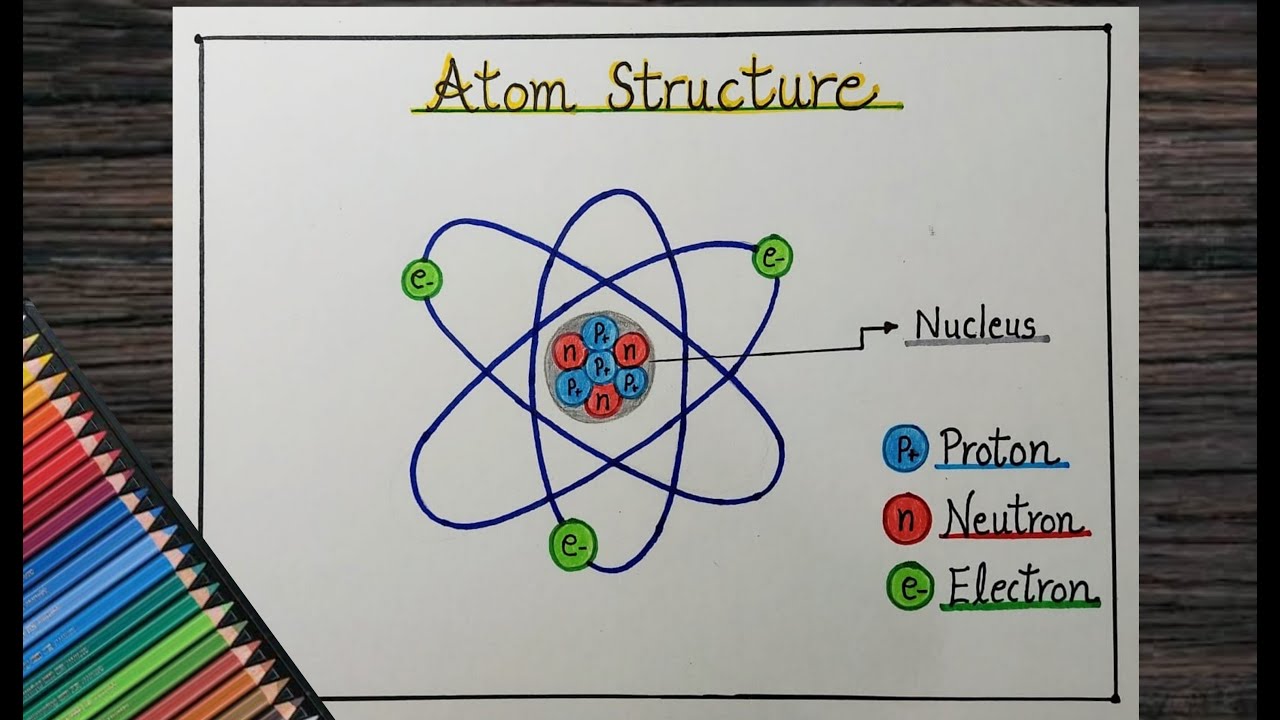
Answer Example: An atom consists of a central nucleus that contains positively charged protons and neutral neutrons, while electrons, which carry a negative charge, orbit the nucleus. This configuration dictates the atom’s mass and chemical behavior, with the nucleus accounting for nearly all of the atom’s mass and the electrons determining its reactivity.
Question 9
Explain the difference between atomic number and mass number. Give an example involving a common element.
Answer Example: The atomic number is the number of protons in an atom's nucleus and uniquely defines an element, while the mass number is the sum of protons and neutrons, reflecting an atom's mass. For instance, carbon-12 has an atomic number of 6 (6 protons) and a mass number of 12, meaning it also has 6 neutrons.
Section 3: Fill in the Blanks
Question 10
Fill in the blanks below:
- The atomic number of an element is equal to the number of __________ in its nucleus.
- The mass number of an atom is the sum of its __________ and __________.
- Electrons are found in the __________ or __________ of an atom.
Answers: 1. protons, 2. protons; neutrons, 3. electron shells; orbitals
Section 4: True or False
Question 11
State whether the following statements are True or False:
- A) An atom's mass is primarily contributed by its electrons. (False)
- B) The nucleus of an atom contains most of its mass. (True)
- C) Atoms of the same element always have the same mass number. (False)
- D) The electron configuration of an atom determines its chemical properties. (True)
Additional Concepts
Subatomic Particle Details
The quiz is designed to highlight essential details about subatomic particles:
- Protons: Positively charged particles located within the nucleus, determining the atomic number and influencing chemical behavior.
- Neutrons: Uncharged particles also found in the nucleus, contributing to the mass of the atom and playing a role in the stability of the nucleus.
- Electrons: Negatively charged particles orbiting the nucleus in defined energy levels or orbitals, largely responsible for bonding behavior between atoms.
Historical Atomic Models
Understanding the structure of the atom has evolved over time. Early models such as J.J. Thomson's "plum pudding" model gave way to Rutherford's nuclear model after his gold foil experiment, which then evolved into Niels Bohr's model featuring fixed electron orbitals. Today’s quantum mechanical model describes electrons in terms of probabilities and electron clouds rather than fixed orbits.
Atomic Structure Quiz Overview Table
| Section | Question Type | Key Concepts Addressed |
|---|---|---|
| Section 1 | Multiple-Choice | Definition of an atom, subatomic particles, atomic number, mass number, Bohr model |
| Section 2 | Short Answer | Atomic structure explanation, differentiation between atomic number and mass number |
| Section 3 | Fill in the Blanks | Subatomic particle roles, electron distribution |
| Section 4 | True or False | Key atomic properties, experimental evidence and particle contributions |
Detailed Explanations and Concepts
Properties of Subatomic Particles
Understanding the distinct properties of protons, neutrons, and electrons is essential to grasping atomic structure:
Protons
Protons have a positive charge and reside in the nucleus where they contribute significantly to the atomic mass and determine the chemical identity of an element through the atomic number. A higher number of protons corresponds to a different element on the periodic table.
Neutrons
Neutrons, which have no charge, are also housed in the nucleus and play a vital role in stabilizing the atom. Variations in the number of neutrons in atoms of the same element result in different isotopes with varying mass numbers.
Electrons
Electrons are light, negatively charged particles that orbit the nucleus in energy levels. Their arrangement dictates the electron configuration of an element, which in turn determines chemical properties and bonding behavior. The quantum mechanical model provides a more accurate description of electron locations and behaviors compared to fixed orbit models.
Historical Experiments and Models
Several groundbreaking experiments paved the way for current understandings of atomic structure:
Thomson’s Experiment
J.J. Thomson's cathode ray experiments led to the discovery of the electron, establishing that atoms contained smaller particles. His "plum pudding" model proposed that electrons were embedded in a positively charged substance; however, this model was later refined.
Rutherford’s Gold Foil Experiment
Ernest Rutherford’s gold foil experiment revealed that atoms have a small, dense, positively charged nucleus. This discovery marked a significant departure from previous models and set the stage for the Bohr model, which further refined the understanding of electron orbits.
Bohr’s Model and Beyond
Niels Bohr introduced the concept of quantized orbitals in his atomic model, where electrons inhabit fixed orbits with specific energy levels. Although the Bohr model successfully explained certain aspects of atomic behavior, modern quantum theory has replaced it with models that describe electron positions as probability distributions or clouds.
References
- Atomic Structure Quiz Questions and Answers - Online Exam Maker
- Atomic Structure Quiz - ProProfs
- Chemistry Atomic Structure - Texas A&M University
- Atomic Structure Quiz - Education Quizzes
- Atomic Structure Quiz - ThoughtCo
Recommended Further Exploration
Last updated March 20, 2025