
Unpacking "Attention Is All You Need": The Paper That Revolutionized AI Language Models
Discover how a groundbreaking idea replaced complex structures with a simpler, more powerful mechanism, transforming how machines understand language.
The world of Artificial Intelligence, especially in how computers understand and generate human language, experienced a seismic shift in 2017. This change was largely sparked by a research paper that introduced a novel architecture called the Transformer. This model proposed a departure from then-dominant approaches, suggesting that a concept called "attention" could, on its own, handle the intricate task of language processing more effectively and efficiently. Let's delve into this pivotal work.
Key Insights at a Glance
- A New Architecture is Born: The paper introduces the Transformer, a model that relies entirely on "attention mechanisms" and abandons the previously standard recurrent or convolutional layers for sequence-to-sequence tasks.
- Parallel Power: Unlike its predecessors that processed words one by one, the Transformer can process all words in a sequence simultaneously, leading to significantly faster training times and the ability to train on much larger datasets.
- Setting New Standards: The Transformer model achieved state-of-the-art results on machine translation tasks while requiring less computation to train, fundamentally changing the trajectory of natural language processing research.
Document Overview: "Attention Is All You Need"
Title of the Document
Attention Is All You Need
Authors and Date
Authored by Ashish Vaswani, Noam Shazeer, Niki Parmar, Jakob Uszkoreit, Llion Jones, Aidan N. Gomez, Łukasz Kaiser, and Illia Polosukhin. The paper was initially submitted to arXiv on June 12, 2017.
A Short Summary
This paper introduces the Transformer, a novel network architecture for sequence transduction tasks like machine translation. It notably dispenses with recurrence and convolutions, relying entirely on an "attention mechanism" to draw global dependencies between input and output. The Transformer allows for significantly more parallelization, enabling training on larger datasets and achieving state-of-the-art results in translation quality while being more computationally efficient and requiring less training time than existing approaches. Its core components include multi-head self-attention and positional encodings within an encoder-decoder framework.
Deconstructing the Transformer: Main Points Explained
The paper's core contribution is the Transformer architecture. Here are its fundamental ideas presented simply:
-
Moving Beyond Sequential Processing: Traditional models like Recurrent Neural Networks (RNNs) processed words in a sentence one after another. This sequential nature made it hard to parallelize computations and capture long-range dependencies effectively. Convolutional Neural Networks (CNNs) offered some parallelism but struggled with dependencies between distant words.
-
The "Attention" Revolution: The Transformer's central idea is that "attention mechanisms" alone, without recurrence or standard convolutions, are sufficient for high-quality sequence modeling. Attention allows the model to weigh the importance of different words in the input sequence when producing each word in the output sequence.
-
Self-Attention – Understanding Context: A key component is "self-attention," where the model relates different positions of a single sequence to compute a representation of that sequence. For instance, when translating a sentence, self-attention helps the model understand how different words within that sentence relate to each other (e.g., what a pronoun refers to).
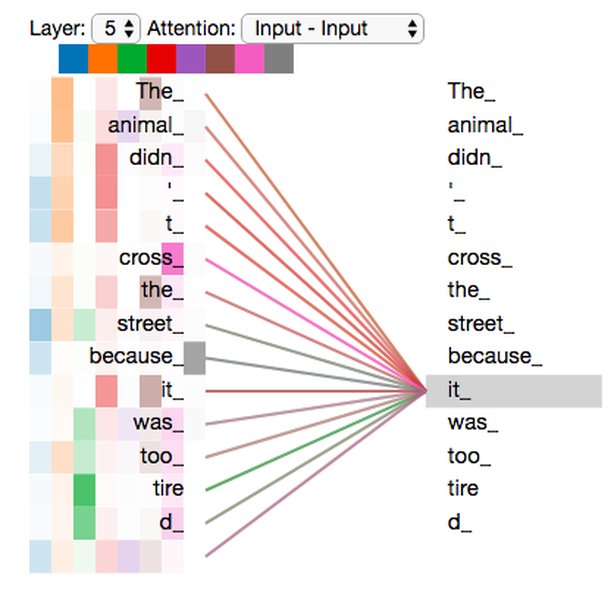
Visual representation of how self-attention might weigh the importance of other words when processing the word "it".
-
Multi-Head Attention – Diverse Perspectives: Instead of just one attention mechanism, the Transformer uses "multi-head attention." This means it runs the attention process multiple times in parallel, with each "head" learning to focus on different types of relationships or different parts of the sequence. It's like having multiple experts look at the sentence from different angles and then combining their insights.
-
Positional Encoding – Remembering Word Order: Since the self-attention mechanism itself doesn't inherently consider the order of words (it sees all words at once), the Transformer adds "positional encodings" to its input. These are special vectors that give the model information about the position of each word in the sequence.
-
Encoder-Decoder Architecture: The Transformer maintains the popular encoder-decoder structure.
- The Encoder processes the input sequence (e.g., a sentence in German) and builds a rich representation of it. It consists of a stack of identical layers, each having a multi-head self-attention mechanism and a simple feed-forward neural network.
- The Decoder takes this representation and generates the output sequence (e.g., the translated sentence in English), word by word. It also has a stack of layers, which include self-attention, attention over the encoder's output, and a feed-forward network.
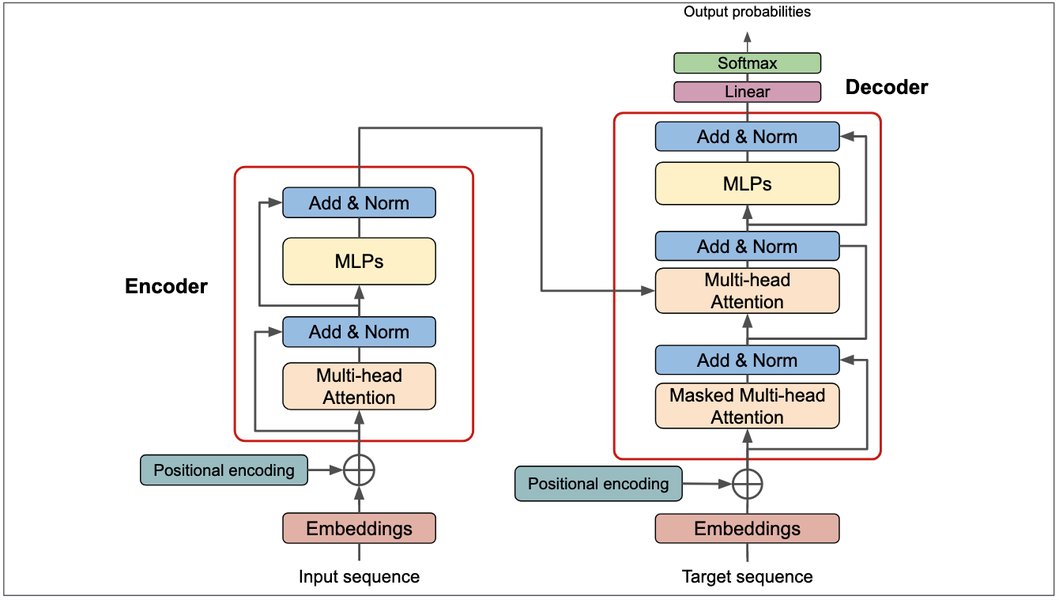
Overall architecture of the Transformer model, showing the encoder (left) and decoder (right) stacks.
-
Superior Parallelization and Efficiency: Because it doesn't rely on processing words one by one, many computations within the Transformer can be done in parallel. This dramatically speeds up training, especially on modern hardware like GPUs, and allowed the model to be trained on much larger datasets than previously feasible.
-
Achieving New Performance Benchmarks: The paper demonstrated that the Transformer could achieve better results (measured by BLEU scores) on standard machine translation tasks (WMT 2014 English-to-German and English-to-French) compared to existing, more complex models, and often with significantly less training time.
Performance and Efficiency Insights
The paper substantiated its claims with strong empirical results. The Transformer model not only introduced a novel architecture but also demonstrated its practical advantages in terms of performance and training efficiency. Below is a summary of some key statistics and figures reported, showcasing its capabilities, particularly in machine translation.
| Metric/Task | Reported Result for Transformer | Comparison Point (Previous Best/Typical) |
|---|---|---|
| WMT 2014 English-to-German Translation (BLEU score) | 28.4 (new state-of-the-art) | Previous SOTA was around 27.3 (ensemble) or lower for single models. |
| WMT 2014 English-to-French Translation (BLEU score) | 41.8 (new state-of-the-art for an ensemble of big models) | Previous SOTA was around 40.4 (ensemble). Single big Transformer model achieved 41.0. |
| Training Cost (Big Model - WMT En-Fr) | 3.5 days on 8 NVIDIA P100 GPUs | Significantly less than many competitive models based on recurrent or convolutional layers. |
| Training Cost (Base Model - WMT En-De) | 12 hours on a single NVIDIA K80 GPU (for a smaller setup) | Demonstrates feasibility even on less powerful hardware for base configurations. |
| Model Parameters (Base Model) | Approx. 65 million parameters | Comparable to or less than many deep recurrent models. |
| Model Parameters (Big Model) | Approx. 213 million parameters (for configuration transformer_vaswani_wmt_en_de_big) |
A large model, but its efficiency allowed it to be trained effectively. |
| Parallelism (Sequential Operations) | O(1) - Constant number of sequential operations | RNNs require O(n) sequential operations (where n is sequence length). |
| Maximum Path Length (for long-range dependencies) | O(1) - Constant path length | RNNs have O(n) path length, making long-range dependencies harder to learn. |
Note: BLEU (Bilingual Evaluation Understudy) is a score for comparing a candidate translation to one or more reference translations. Higher scores are better. Training costs and parameters can vary based on specific configurations and tasks.
Understanding Key Concepts: A Glossary
To better grasp the paper's contributions, here are some important terms explained in plain language:
- Sequence Transduction Models: These are models that transform an input sequence into an output sequence. Examples include translating a sentence from one language to another, or converting speech to text.
- Recurrent Neural Networks (RNNs): Neural networks designed to work with sequences. They process inputs one element at a time, maintaining an internal "memory" (state) that captures information about past elements. LSTMs and GRUs are advanced types of RNNs.
- Convolutional Neural Networks (CNNs): Neural networks that typically apply filters to input data to extract features. While famous for image processing, they can also be adapted for sequence data by applying 1D convolutions.
- Attention Mechanism: A technique that allows a model to selectively focus on certain parts of the input when producing an output. It assigns "attention weights" to different input elements, indicating their relevance.
- Self-Attention (Intra-Attention): An attention mechanism that relates different positions of a single sequence to compute a representation of the sequence. It helps the model understand the context and dependencies within the same sentence.
- Multi-Head Attention: An extension of self-attention where the attention mechanism is run multiple times in parallel with different, learned linear projections of queries, keys, and values. This allows the model to jointly attend to information from different representation subspaces at different positions.
- Positional Encoding: Since the Transformer's attention mechanism doesn't inherently process data in order, positional encodings are added to the input embeddings to provide the model with information about the relative or absolute position of tokens in the sequence.
- Encoder: The part of the Transformer model that processes the input sequence and maps it into a continuous representation (a set of vectors) that captures its meaning and context.
- Decoder: The part of the Transformer model that takes the encoder's output and generates the output sequence, one element at a time, using attention to focus on relevant parts of the input.
- BLEU Score (Bilingual Evaluation Understudy): A metric used to evaluate the quality of machine-generated text, especially in machine translation. It measures how similar the machine's output is to a set of high-quality human reference translations. Higher scores generally indicate better translation quality.
Visualizing the Transformer's Core Ideas
The Transformer architecture, while powerful, is built upon several interconnected concepts. The mindmap below illustrates the key components and principles introduced in the "Attention Is All You Need" paper, providing a hierarchical view of how they fit together.
(Transformer Architecture)"] id1["Core Problem: Sequence Transduction"] id1a["e.g., Machine Translation"] id1b["Limitations of RNNs/CNNs"] id1b1["Sequential Computation (RNNs)"] id1b2["Long Path Lengths (RNNs/CNNs)"] id1b3["Limited Parallelism"] id2["Key Innovation: Attention Mechanism"] id2a["Self-Attention"] id2a1["Queries, Keys, Values"] id2a2["Scaled Dot-Product Attention"] id2b["Multi-Head Attention"] id2b1["Parallel Attention Layers"] id2b2["Diverse Representations"] id2c["Replaces Recurrence/Convolution"] id3["Transformer Model Components"] id3a["Encoder"] id3a1["Input Embedding"] id3a2["Positional Encoding"] id3a3["Stack of N Identical Layers"] id3a3i["Multi-Head Self-Attention"] id3a3ii["Position-wise Feed-Forward Networks"] id3a3iii["Add & Norm (Residual Connections & Layer Norm)"] id3b["Decoder"] id3b1["Output Embedding (Shifted Right)"] id3b2["Positional Encoding"] id3b3["Stack of N Identical Layers"] id3b3i["Masked Multi-Head Self-Attention"] id3b3ii["Multi-Head Attention (Encoder-Decoder)"] id3b3iii["Position-wise Feed-Forward Networks"] id3b3iv["Add & Norm"] id3c["Final Linear Layer & Softmax"] id4["Advantages"] id4a["High Parallelizability"] id4b["Reduced Training Time"] id4c["Superior Performance (SOTA on WMT)"] id4d["Constant Path Length for Dependencies (O(1))"] id5["Implications"] id5a["Foundation for Modern LLMs (BERT, GPT, etc.)"] id5b["Shift in NLP Research Paradigm"]
This mindmap shows how the central idea of using attention mechanisms, particularly multi-head self-attention, forms the backbone of both the encoder and decoder components. The architecture is designed for parallelism and efficiency, leading to significant performance gains and paving the way for many subsequent advancements in AI.
Underlying Assumptions and Context
The researchers made several implicit and explicit assumptions when developing the Transformer model:
- Attention Suffices: The most fundamental assumption is that attention mechanisms, particularly self-attention, are powerful enough to capture dependencies in sequential data without needing explicit recurrent connections (like in RNNs) or hierarchical feature extraction through local receptive fields (like in CNNs). They posited that "attention is all you need."
- Global Dependencies are Key: The model assumes that the ability to directly model relationships between any two positions in a sequence, regardless of their distance, is crucial for understanding and transduction. Self-attention provides this capability with a constant number of operations (in terms of path length).
- Parallelization as a Primary Goal: A significant motivation was to overcome the sequential computation bottleneck of RNNs. The design heavily favors parallelizable computations, assuming that this will lead to faster training and the ability to use larger datasets and models.
- Positional Information is Additive: The model assumes that information about word order, which is lost by the permutation-invariant nature of basic self-attention, can be effectively re-introduced by adding or concatenating positional encodings to the input embeddings.
- Sufficient Data and Compute: Like many deep learning models, the Transformer assumes the availability of large datasets for training and sufficient computational resources (GPUs) to handle its architecture, which can be parameter-heavy.
- Effectiveness of Layer Normalization and Residual Connections: The design incorporates these standard deep learning techniques, assuming they are effective for training deep stacks of Transformer layers.
Model Architecture Comparison: Transformer vs. Predecessors
To better understand the Transformer's impact, it's helpful to compare its characteristics to the then-dominant sequence modeling architectures like Recurrent Neural Networks (RNNs, including LSTMs/GRUs) and Convolutional Neural Networks (CNNs) adapted for sequence tasks. The radar chart below provides a visual comparison across key attributes relevant in 2017. A higher score generally indicates a more favorable characteristic.
This chart highlights the Transformer's strengths: high parallelism, excellent long-range dependency resolution due to its O(1) path length (meaning information can travel between any two points in constant time through attention), efficient training on large datasets, and superior performance on tasks like translation at the time of its publication. RNNs, while decent at capturing sequential information, suffer from limited parallelism and difficulties with very long dependencies (O(n) path length). CNNs offer good parallelism but typically have a more limited receptive field for capturing long-range context unless many layers or dilations are used (path length O(log n) or O(n/k)).
Evolving the Paradigm: Improving and Challenging the Thinking
Avenues for Improvement (from a 2017 perspective and beyond)
Even revolutionary ideas have room for growth. Potential areas for enhancing the Transformer concept include:
- Computational Efficiency for Extremely Long Sequences: The self-attention mechanism has a computational complexity quadratic in sequence length (\(O(n^2 \cdot d)\)). While efficient for typical sentence lengths, this becomes a bottleneck for very long documents or other long sequences. Much research since has focused on "Efficient Transformers" (e.g., Sparse Attention, Linear Attention).
- Interpretability and Explainability: While attention weights offer some insight into model decisions, fully understanding why a Transformer makes a specific prediction can still be challenging. Enhancing explainability remains an active research area.
- Handling of Rare Words or Out-of-Vocabulary (OOV) Terms: While subword tokenization (like Byte Pair Encoding, BPE) helps, extremely rare or novel words can still pose challenges.
- Reducing Data Hunger: Transformers, especially large ones, typically require vast amounts of data to train effectively. Improving sample efficiency is an ongoing goal.
- Architectural Refinements: Exploring different ways to combine attention with other mechanisms, or modifying the layer structure (e.g., layer normalization placement, types of feed-forward networks) continues to yield incremental improvements.
Challenges to the Original "Attention Is All You Need" Thinking
While immensely influential, the "attention is all you need" mantra has also faced scrutiny and evolution:
- Quadratic Complexity: As mentioned, the \(O(n^2)\) complexity of self-attention is a significant practical limitation for very long sequences, leading to a plethora of research into more efficient attention variants or alternative architectures.
- Loss of Inductive Bias: RNNs possess a natural sequential inductive bias (processing step-by-step) which can be beneficial for certain tasks or with smaller datasets. Transformers, being less biased, might require more data to learn similar patterns. Positional encodings are a way to re-inject some of this, but they are not as inherently sequential.
- Is Attention *Truly* All You Need?: Subsequent research has explored combining Transformers with convolutional layers (e.g., ConvNeXt, CoAtNet) or re-evaluating recurrence. More recently, architectures like State Space Models (SSMs, e.g., Mamba) have emerged, claiming to match or exceed Transformer performance on some tasks with linear complexity in sequence length, challenging the idea that attention is the *only* powerful mechanism needed.
- Positional Encoding Limitations: While effective, the original sinusoidal positional encodings or learned embeddings might not be optimal for all tasks or sequence lengths. Research into relative positional encodings and other alternatives continues.
Despite these challenges and ongoing evolution, the core principles introduced in "Attention Is All You Need" remain foundational to most modern large language models and have spurred an incredible wave of innovation in AI.
Video Deep Dive: Understanding the Transformer Model
For those who prefer a visual and auditory explanation, the following video provides a comprehensive breakdown of the Transformer model's architecture, including its layers like Multi-Head Self-Attention and Positional Encoding. It explains the matrix operations and the flow of data through the encoder and decoder, which can be very helpful for demystifying the concepts presented in the "Attention Is All You Need" paper.
This video delves into the mechanics of how queries, keys, and values interact in the attention mechanism, how multiple attention heads provide diverse perspectives, and how the encoder and decoder stacks work together to perform tasks like machine translation. It complements the textual explanations by illustrating the dynamic processes within the Transformer.
Frequently Asked Questions (FAQ)
What is a "sequence transduction model" in simple terms?
Think of it like a translator. A sequence transduction model takes an input sequence (like a sentence in one language) and transforms, or "transduces," it into an output sequence (like the same sentence in another language). Other examples include converting a sequence of speech sounds into a sequence of text words (speech recognition) or summarizing a long document (a sequence of words) into a shorter one.
Why was the "Attention Is All You Need" paper so revolutionary?
Before this paper, most advanced language models relied on recurrent neural networks (RNNs) or convolutional neural networks (CNNs). These had limitations, especially in processing long sentences and in how quickly they could be trained (RNNs processed words one by one). This paper showed that a simpler architecture based purely on "attention mechanisms" could not only match but outperform these complex models, and crucially, it could be trained much faster due to its high parallelizability. This opened the door to training much larger and more capable AI models, like GPT and BERT.
What are the main advantages of the Transformer model?
The main advantages are:
- Parallelism: It can process all words in a sentence at the same time, unlike RNNs that process word by word. This drastically speeds up training.
- Handling Long-Range Dependencies: It's better at understanding relationships between words that are far apart in a sentence because attention can directly connect any two words.
- Performance: It achieved state-of-the-art results on many language tasks, particularly machine translation, when it was introduced.
- Scalability: Its architecture is well-suited for training very large models on massive datasets, which has been key to recent AI advancements.
Are Transformers still the best, or have they been surpassed?
Transformers are still the dominant architecture for large language models (LLMs) like ChatGPT, Claude, and Gemini. However, research is continuous. There's a lot of work on "Efficient Transformers" to address the quadratic complexity of attention for very long sequences. Also, new architectures like State Space Models (SSMs, e.g., Mamba) are emerging that show promise in matching or exceeding Transformer performance on some benchmarks with better efficiency for long contexts. So, while Transformers are foundational and still leading, the field is dynamic, and the "best" architecture can evolve.
How does "attention" work in simple terms?
Imagine you're reading a sentence and trying to understand the meaning of a specific word, say a pronoun like "it." To understand what "it" refers to, you'd naturally pay more "attention" to some other words in the sentence (like a previously mentioned noun) than to others. The attention mechanism in AI works similarly. For each word it processes or generates, it looks at all the words in the input (or the words generated so far) and assigns an "importance score" or "attention weight" to each of them. Words that are more relevant get higher scores. The model then uses these scores to create a weighted sum of the information from those words, effectively focusing on the most pertinent context. "Self-attention" means it does this within the same sentence to understand internal relationships.
Recommended Further Exploration
If you're intrigued by the concepts in "Attention Is All You Need," you might find these related queries useful for deeper insights:
- How do modern Large Language Models like GPT build upon the Transformer architecture?
- What are the main differences between self-attention and traditional attention mechanisms?
- Explain the role of positional encoding in Transformer models in more detail.
- What are some of the efficient Transformer variants designed to handle long sequences?
References
Last updated May 14, 2025