
Unlocking AI's Potential: The Revolutionary Impact of Transformers
Discover how these groundbreaking neural networks have reshaped artificial intelligence, from language understanding to creative generation.
Key Highlights of Transformer AI
- Parallel Processing Power: Unlike older sequential models, transformers process entire data sequences simultaneously, dramatically accelerating training and enhancing efficiency for large datasets.
- Advanced Contextual Understanding: The core "self-attention" mechanism allows transformers to weigh the importance of different parts of input data, enabling sophisticated comprehension of relationships and nuances, crucial for tasks like natural language understanding.
- Versatility Across AI Domains: Originally designed for natural language processing, transformers have expanded their influence across computer vision, speech recognition, robotics, and multimodal learning, driving state-of-the-art performance in diverse applications.
Understanding Transformers in Artificial Intelligence
A Deep Dive into the Architecture That Changed AI
Transformers are a pivotal deep learning architecture that has fundamentally revolutionized artificial intelligence. Introduced in a seminal 2017 paper titled "Attention Is All You Need" by Google researchers, their initial purpose was to enhance machine translation. However, their unique design has since propelled them into widespread applications across virtually every domain of AI.
At their core, transformers are distinguished by their reliance on a mechanism called "self-attention" and their capability for parallel processing. This contrasts sharply with previous neural network architectures like Recurrent Neural Networks (RNNs) and Long Short-Term Memory (LSTM) networks, which processed data sequentially, token by token. Transformers, on the other hand, can process entire sequences of data concurrently. This parallelization is a game-changer, enabling them to handle vast datasets with greater efficiency and to effectively model long-range dependencies within the data.
The Ingenuity of Self-Attention
The self-attention mechanism is the cornerstone of the transformer architecture. It empowers the model to dynamically assess the relevance of different segments within the input data to one another. For instance, when processing a sentence, self-attention allows the transformer to identify and weigh the relationships between distant words, providing a nuanced understanding of context and meaning. This leads to more coherent and accurate outputs, even when dealing with complex or lengthy data sequences.
The radar chart above illustrates the comparative strengths of Transformer models against older architectures like RNNs and LSTMs across several key performance indicators. It highlights how transformers significantly excel in parallel processing, handling long-range dependencies, and achieving higher accuracy and contextual understanding, making them a more scalable and versatile solution for modern AI challenges. The data points represent conceptual performance scores, showcasing the relative advancements transformers bring to the field of deep learning.
Core Architectural Components
A typical transformer model comprises an encoder-decoder structure, though some applications might only use the encoder or decoder parts. Key components include:
- Self-attention mechanism: As described, this allows the model to focus on various parts of the input sequence simultaneously, capturing intricate contextual relationships.
- Multi-head attention: This extends self-attention by running several attention mechanisms in parallel. Each "head" can learn to focus on different aspects of the input, enabling the model to jointly attend to information from different representation subspaces, leading to a richer understanding.
- Encoder-decoder architecture: Stacked encoder layers process and encode the input data, while decoder layers generate the output sequence based on the encoded information and previously generated tokens.
- Positional Encoding: Since parallel processing removes the inherent sequential order, positional encodings are added to the input embeddings to inject information about the relative or absolute position of tokens in the sequence.
- Residual connections and layer normalization: These are crucial for stable training, especially in deep networks, by helping to maintain stable gradient flows and improve convergence.
How Transformers Have Revolutionized AI Performance
Transforming Capabilities Across Diverse AI Applications
The introduction of transformers has led to monumental improvements in AI performance across a multitude of domains, addressing many limitations of previous architectures.
Efficiency and Speed through Parallel Processing
One of the most significant advancements brought by transformers is their computational efficiency. By eliminating the sequential processing bottleneck inherent in RNNs and LSTMs, transformers allow for the simultaneous processing of an entire input sequence. This parallelization drastically reduces training times, making it feasible to train models on vastly larger datasets and tackle more complex problems that were previously computationally intractable.
of Sequences"] id1_2["Reduced Training Times"] id1_3["Scalability to Large Datasets"] id2["Superior Accuracy & Context"] id2_1["Self-Attention Mechanism"] id2_2["Long-Range Dependency Handling"] id2_3["Human-Like Output Generation"] id3["Broadened Application Scope"] id3_1["Natural Language Processing (NLP)"] id3_1_1["LLMs (GPT, BERT, LLaMA)"] id3_1_2["Machine Translation"] id3_1_3["Text Generation & Summarization"] id3_1_4["Sentiment Analysis"] id3_2["Computer Vision (CV)"] id3_2_1["Vision Transformers (ViT)"] id3_2_2["Image/Video Generation (DALL-E, Sora)"] id3_3["Speech Recognition & Audio Generation"] id3_4["Robotics"] id3_5["Multimodal Learning"] id3_6["Reinforcement Learning (RL)"] id4["Overcoming Previous Limitations"] id4_1["Elimination of Vanishing Gradients"] id4_2["No Long-Term Memory Loss (RNN/LSTM issues)"]
This mindmap visually summarizes the profound impact of transformers on AI performance. It highlights their core advantages in efficiency, accuracy, and broad applicability across various modalities, demonstrating how they have addressed inherent limitations of prior architectures and fueled the rapid advancements seen in modern AI.
Unparalleled Accuracy and Contextual Understanding
The attention mechanisms within transformers enable them to learn deep contextual relationships within data. This capability translates into significantly higher accuracy in tasks that demand nuanced understanding, such as machine translation, question answering, and text summarization. Models powered by transformers produce outputs that are remarkably human-like and contextually relevant, a major leap forward from earlier models.
Expansion into New Modalities and Generative AI
While born from NLP, transformers quickly demonstrated their versatility. Since 2020, they have been successfully adapted to fields beyond text:
- Computer Vision: Vision Transformers (ViT) analyze image data by breaking it into "tokens" and applying self-attention. This has led to breakthroughs in image recognition and the development of sophisticated image and video generation models like DALL-E, Stable Diffusion, and Sora, which leverage transformers to create high-fidelity content from text prompts.
- Speech Recognition and Audio Generation: Transformers improve the accuracy and fluency of speech-to-text and text-to-speech systems.
- Robotics and Reinforcement Learning: Advanced robotics research and reinforcement learning leverage transformers to process sequences of actions and observations more effectively, leading to more intelligent agent behaviors and efficient decision-making.
- Multimodal Learning: Their architecture facilitates the integration of information from different data types (e.g., text and images), fostering models that can understand and generate content across modalities.
Transformers are the foundational technology for the current wave of generative AI, powering prominent models like OpenAI's GPT series (including ChatGPT), Google's BERT and Gemini, and Meta's LLaMA. These models excel at generating text, images, and other forms of data with unprecedented coherence and creativity.
"Transformer Neural Networks, ChatGPT's foundation, Clearly Explained" - This video offers an accessible explanation of how transformer neural networks operate, highlighting their crucial role as the backbone for cutting-edge AI technologies such as ChatGPT and Google Translate. It provides a visual and intuitive understanding of the attention mechanism, which is central to the transformer's ability to process and understand sequential data effectively.
The video above delves into the mechanics of transformer neural networks, the very architecture that underpins the most advanced AI applications we use today, like ChatGPT and Google Translate. It's an excellent resource for visualizing how components such as multi-head attention enable these models to process information in a parallel and context-aware manner, far exceeding the capabilities of previous sequential models. Understanding this mechanism is key to appreciating the profound impact transformers have had on the AI landscape, leading to more natural and intelligent interactions with machines.
Overcoming Limitations of Previous Architectures
Transformers effectively resolved critical issues that plagued older architectures, such as the vanishing gradient problem and long-term memory loss in RNNs and LSTMs. By eliminating recurrence and relying entirely on attention, transformers can maintain strong connections between distant elements in a sequence, capturing long-range dependencies without information degradation. This has enabled the development of much deeper and more capable AI models.
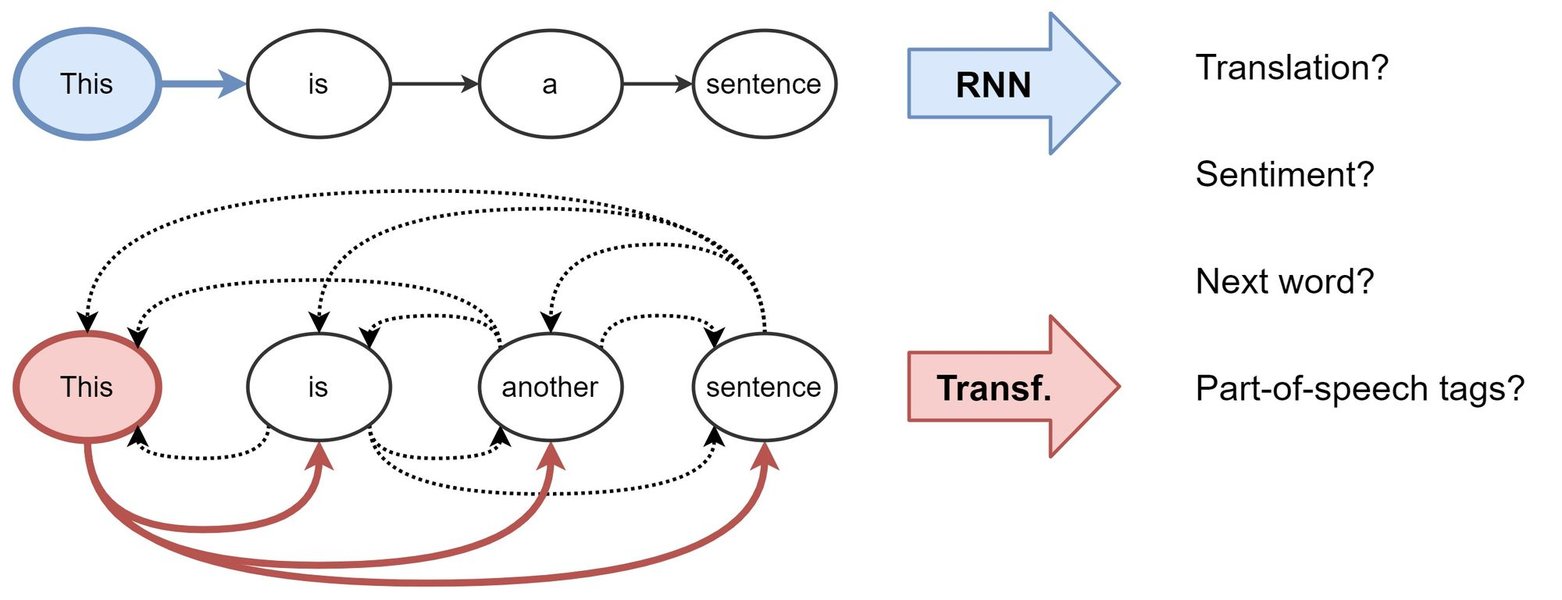
A visual comparison illustrating the architectural differences between recurrent neural networks (RNNs) and transformer models, highlighting the parallel processing capability of transformers.
The widespread success of transformers has not only led to a "unification of AI methodology" but has also spurred immense investment and innovation in the field, making them indispensable to virtually every major AI product and research initiative currently making headlines.
Comparative Analysis: Transformers vs. Predecessors
To better understand the advancements brought by transformers, it's useful to compare their key characteristics with those of older architectures like RNNs and LSTMs.
| Feature | Recurrent Neural Networks (RNNs) / LSTMs | Transformers |
|---|---|---|
| Processing Method | Sequential (token by token) | Parallel (entire sequence simultaneously) |
| Long-Range Dependencies | Struggles due to vanishing/exploding gradients and memory decay; limited by sequence length. | Effectively models long-range dependencies through self-attention, no inherent sequence length limitation. |
| Computational Efficiency | Slower training, especially for long sequences, due to sequential nature. | Significantly faster training and inference due to parallelization. |
| Contextual Understanding | Relies on hidden states; less dynamic and global context. | Dynamic and global context derived from weighted relationships across the entire sequence. |
| Scalability | Limited scalability with increasing sequence length and dataset size. | Highly scalable, enabling the creation of larger, more powerful models. |
| Primary Mechanism | Recurrence, gating mechanisms (for LSTMs) | Self-attention (primarily), feed-forward networks, positional encoding. |
This table highlights the fundamental architectural differences and the resulting performance advantages that transformers hold over their predecessors, particularly in handling large-scale data and complex contextual relationships.
Frequently Asked Questions (FAQ)
What does "GPT" in ChatGPT stand for?
Were transformers the first models to use attention mechanisms?
What is a "token" in the context of transformers?
Conclusion
Transformers have undeniably reshaped the landscape of artificial intelligence. Their innovative architecture, particularly the self-attention mechanism and parallel processing capabilities, has addressed critical limitations of earlier models, leading to unprecedented improvements in efficiency, accuracy, and versatility. From powering sophisticated natural language models and revolutionizing computer vision to enhancing robotics and multimodal AI, transformers are the cornerstone of the current AI revolution. Their continued evolution promises even more remarkable breakthroughs as AI systems become increasingly intelligent and capable.
Recommended Further Exploration
- How do Large Language Models (LLMs) work under the hood?
- What are the future trends in AI model architectures?
- Explore the impact of generative AI on creative industries.
- What are the challenges and solutions in training massive AI models?
