
Unleashing Adaptive Intelligence: A Deep Dive into Bandit-Based Learning
Mastering uncertainty and optimizing decisions through the exploration-exploitation balance.
Key Insights into Bandit-Based Learning
- Foundation of Adaptive Decision-Making: Bandit-based learning, rooted in the Multi-Armed Bandit (MAB) problem, is a fundamental framework in machine learning and reinforcement learning, designed for optimal decision-making under uncertainty, particularly when immediate feedback is crucial.
- Balancing Exploration and Exploitation: At its core lies the exploration-exploitation dilemma—the critical need to balance gathering new information about options (exploration) with leveraging the best-known options to maximize current rewards (exploitation).
- Pervasive Real-World Applications: From personalizing online advertising and content recommendations to optimizing clinical trials and dynamic pricing strategies, bandit algorithms offer efficient, adaptive solutions in diverse, data-driven environments where rapid learning and minimal regret are paramount.
Decoding the Multi-Armed Bandit Problem
Bandit-based learning is primarily conceptualized through the "Multi-Armed Bandit" (MAB) problem, a classic scenario that vividly illustrates decision-making under uncertainty. Imagine a gambler faced with multiple slot machines, each an "arm," offering unknown probabilities of reward. The gambler's objective is to maximize their total winnings over a series of pulls. The inherent challenge is to decide which arm to pull at any given moment without full knowledge of its long-term payoff. This analogy underscores the core dilemma at the heart of all bandit problems: the exploration-exploitation trade-off.
The Exploration-Exploitation Imperative
The central tension in bandit problems is balancing two competing goals:
- Exploration: This involves trying out different arms, including those with less historical data, to gather more information about their true reward distributions. Exploration is crucial for discovering potentially superior options that might currently appear suboptimal due to limited trials.
- Exploitation: This entails choosing the arm that is currently believed to have the highest expected reward based on the information gathered so far. Exploitation aims to maximize immediate gains by leveraging known high-performing options.
An effective bandit algorithm must intelligently navigate this trade-off to maximize cumulative rewards over time, minimizing "regret"—the difference between the total reward obtained and the reward that would have been achieved had the optimal arm been chosen consistently from the start.

Visual representation of the exploration-exploitation dilemma.
Categories of Bandit Problems
Bandit problems evolve in complexity, catering to various real-world scenarios:
Stochastic Multi-Armed Bandits
In this foundational setting, rewards from each arm are drawn from a fixed but unknown probability distribution. The goal is to identify the arm with the highest average reward. Algorithms are designed to learn these distributions efficiently over time.
Adversarial Multi-Armed Bandits
Unlike stochastic bandits, here the rewards are not fixed but may be determined by an "adversary" aiming to minimize the agent's total gains. This requires more robust algorithms that can adapt to non-stationary or even maliciously chosen reward sequences.
Contextual Bandits
A significant extension, contextual bandits incorporate additional "contextual information" or features (e.g., user demographics, time of day, historical interactions) before an arm is chosen. The reward probabilities for an arm now depend on this observed context, allowing for highly personalized decision-making. This variant bridges the gap between classical MABs and full reinforcement learning by enabling context-dependent optimal actions.
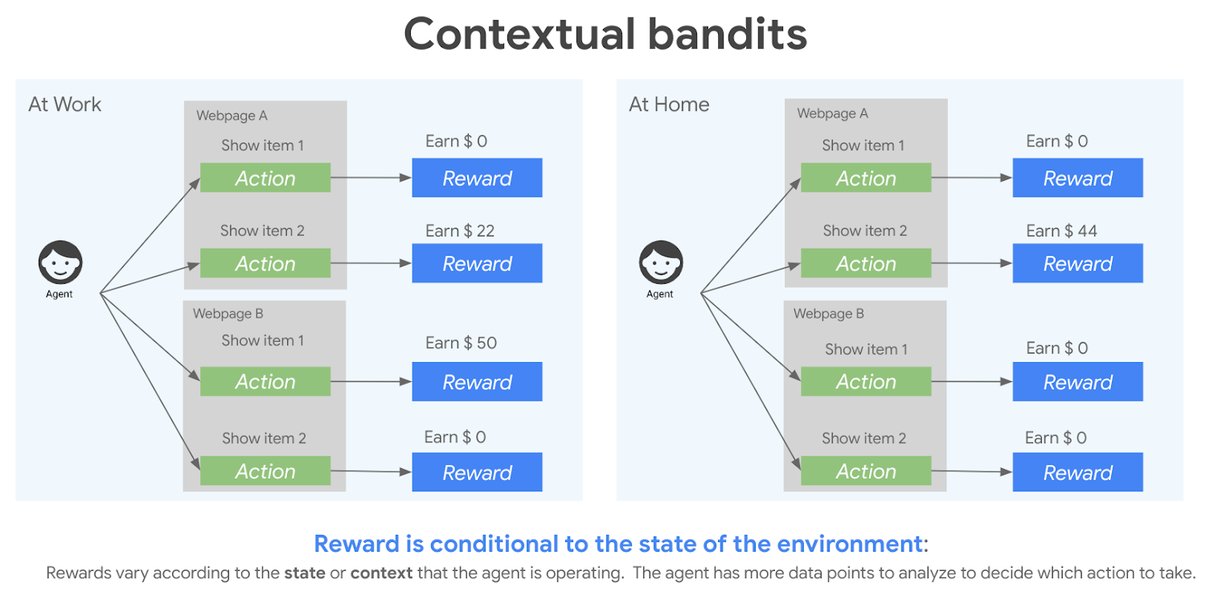
An illustration of a contextual bandit problem, where decisions are influenced by user context.
Key Algorithms Driving Bandit Solutions
Numerous algorithms have been developed to tackle the exploration-exploitation trade-off within bandit problems, each with distinct mechanisms for balancing the two objectives:
Epsilon-Greedy Strategy
One of the simplest strategies, Epsilon-Greedy, involves a probabilistic approach. With a small probability \( \epsilon \) (epsilon), the algorithm chooses a random arm (exploration) to gather new information. For the rest of the time, with probability \( 1 - \epsilon \), it exploits the arm currently believed to have the highest average reward. Variations include epsilon-first (pure exploration then pure exploitation) and epsilon-decreasing (gradually reducing \( \epsilon \) over time to transition from more exploration to more exploitation).
Upper Confidence Bound (UCB) Algorithms
UCB algorithms are deterministic and select arms by considering both their estimated reward and the uncertainty of that estimate. They are optimistic in the face of uncertainty, choosing arms that have a high estimated reward or those that have been pulled less frequently (thus having higher uncertainty). The core idea is to select the arm \( a \) that maximizes the upper bound of its expected reward, typically given by the formula:
\[ A_t = \arg\max_{a \in \mathcal{A}} \left( \hat{Q}_t(a) + c \sqrt{\frac{\ln t}{N_t(a)}} \right) \]
Where:
- \( \hat{Q}_t(a) \) is the estimated average reward of arm \( a \) at time \( t \).
- \( N_t(a) \) is the number of times arm \( a \) has been pulled up to time \( t \).
- \( t \) is the current time step.
- \( c \) is a confidence parameter that balances exploration and exploitation.
Thompson Sampling (Bayesian Bandits)
This Bayesian approach selects an arm based on the probability that it is the optimal arm. It maintains a posterior probability distribution over the reward of each arm. In each round, it samples a potential mean reward for each arm from its posterior distribution and then selects the arm with the highest sampled mean. This probabilistic matching strategy naturally balances exploration (by sampling from uncertain distributions) and exploitation (by favoring arms likely to be best).
Gradient Bandit Algorithms
Instead of estimating action values directly, gradient bandit algorithms learn a numerical "preference" for each action. These preferences are then used, often via a softmax distribution, to determine the probability of selecting each arm. Gradient descent (or ascent) is applied to update these preferences to maximize the overall reward. This method is particularly useful when the goal is to maximize a performance metric directly or in scenarios with a large number of actions.
Bandit Algorithms vs. Traditional Reinforcement Learning
Bandit problems are often considered a simplified, foundational case of reinforcement learning (RL). While both aim to maximize cumulative rewards through interaction with an environment, a key distinction lies in the concept of "state."
In standard bandit problems, the environment is stateless. Actions (pulling an arm) provide immediate rewards but do not influence the future state of the environment or the reward distributions of other arms. This contrasts with full RL problems, where an agent's actions can change the environment's state, leading to sequential decision-making over multiple states and requiring long-term planning and value function estimation (e.g., Q-learning, SARSA).
The simplicity of bandit problems makes them an ideal starting point for understanding the exploration-exploitation dilemma before delving into the complexities of full RL, which involve state transitions, larger state-action spaces, and delayed rewards.
Applications of Bandit-Based Learning in the Real World
The practical utility of bandit algorithms is extensive, spanning various industries and use cases where adaptive decision-making under uncertainty is critical. Their ability to learn from partial feedback and minimize regret makes them invaluable in online and dynamic environments.
Online Advertising and Content Recommendation
Bandit algorithms are widely used to optimize online advertising campaigns. They dynamically select which ad to display to a user to maximize click-through rates or conversions, balancing showing proven ads with exploring new ones. Similarly, in content recommendation systems (e.g., for news articles, videos, or products), contextual bandits personalize suggestions based on user attributes and real-time behavior, leading to improved user engagement and satisfaction. Companies like Netflix, Lyft, and Yahoo leverage contextual bandits for these purposes.
A/B Testing and Adaptive Experimentation
Bandit algorithms offer a "smarter" alternative to traditional A/B testing. Instead of fixed traffic splits, bandits continuously allocate more traffic to better-performing variations (e.g., website layouts, product features) and reduce exposure to underperforming ones. This adaptive allocation accelerates the learning process, reduces the "cost" of experimentation by minimizing exposure to suboptimal options, and allows for faster deployment of optimal solutions.
Healthcare and Clinical Trials
In clinical trials, bandit algorithms can adaptively allocate patients to different treatment arms. This allows researchers to quickly identify more effective treatments and assign more patients to them, improving ethical outcomes and making trials more efficient. They help in determining optimal patient treatment plans by learning from initial responses.
Dynamic Pricing
E-commerce platforms and service providers utilize bandit algorithms for dynamic pricing. By testing various price points and observing customer responses, these algorithms can swiftly and accurately measure demand elasticity, pinpointing the optimal price to maximize revenue in real-time.
Other Notable Applications
- Finance: Dynamically adjusting investment portfolios based on asset performance to achieve higher returns while managing risks.
- Education: Adapting educational content and strategies to individual learner needs, optimizing learning paths.
- Robotics and Autonomous Systems: For real-time decision-making, control, and resource allocation in uncertain environments.
- Large Language Models (LLMs): Recently, bandit algorithms are being explored for fine-tuning LLMs, particularly when reward feedback is limited or expensive to obtain.
- Speech and Natural Language Processing: Addressing exploration-exploitation trade-offs in real-world systems with data uncertainty, such as optimizing dialogue systems.
Performance Evaluation of Bandit Algorithms
Evaluating bandit algorithms involves understanding their efficiency in learning and minimizing regret. Here’s a radar chart illustrating the general strengths of different bandit algorithms across key performance criteria:
This radar chart provides a comparative overview of how different bandit algorithms generally perform across various metrics crucial for practical application. For instance, Epsilon-Greedy is highly praised for its ease of implementation, while UCB and Thompson Sampling typically offer stronger theoretical guarantees regarding regret minimization. Contextual bandits excel in handling high-dimensional context information, which is vital for personalization.
The Foundational Role in AI and Machine Learning
Bandit-based learning serves as a crucial stepping stone in the broader field of artificial intelligence and machine learning. Its focus on the exploration-exploitation dilemma provides a simplified yet profound framework for understanding how agents can learn optimal behaviors in uncertain environments. The principles derived from bandit problems are applicable across various subfields, from online learning to decision theory, emphasizing the adaptive nature of intelligent systems.
Mindmap of Bandit-Based Learning Concepts
This mindmap illustrates the interconnectedness of key concepts, algorithms, and applications within the realm of bandit-based learning, highlighting its comprehensive nature:
The mindmap above visually organizes the core components of bandit-based learning, showing how the central MAB problem branches into different types, algorithms, and a wide array of applications, all while being a fundamental aspect of reinforcement learning.
A Deeper Look: How Multi-Armed Bandits Optimize Experiments in Real-Time
This video explains how Multi-Armed Bandits optimize experiments in real-time.
This video from Amplitude offers an insightful perspective on how Multi-Armed Bandits (MABs) revolutionize experimentation, particularly for short-lived content like news headlines. It emphasizes that MABs provide a "smarter" and more efficient alternative to traditional A/B testing by continuously and adaptively allocating traffic to better-performing variants. Unlike A/B tests that require fixed traffic splits and a pre-determined duration, MABs learn and adapt in real-time, reducing exposure to underperforming options and accelerating the identification of optimal solutions. This dynamic approach minimizes the "cost of exploration" and allows businesses to make data-driven decisions much faster, directly impacting user engagement and revenue. The video highlights how the algorithm handles the statistical complexity, making it accessible even without deep statistical expertise, demonstrating the practical and business-oriented benefits of integrating bandit algorithms into modern experimentation platforms.
Comparative Analysis of Bandit Algorithms
Understanding the nuances of various bandit algorithms is crucial for selecting the most appropriate one for a given application. The table below provides a comparative overview, highlighting their primary characteristics and suitability for different scenarios.
| Algorithm | Core Mechanism | Exploration Strategy | Exploitation Strategy | Key Advantages | Key Limitations | Best Suited For |
|---|---|---|---|---|---|---|
| Epsilon-Greedy | Random exploration with a fixed probability, otherwise greedy choice. | Random selection with probability ε. | Always chooses the arm with the highest estimated reward. | Simple to understand and implement; good baseline performance. | Suboptimal exploration (can waste pulls on bad arms); fixed ε might not be ideal over time. | Simple scenarios, initial testing, or when exploration costs are low. |
| Upper Confidence Bound (UCB) | Optimistic selection based on estimated reward plus an uncertainty bonus. | Prioritizes arms with high uncertainty or fewer pulls. | Chooses the arm with the highest upper confidence bound. | Strong theoretical guarantees; balances exploration and exploitation deterministically. | Assumes stationary rewards; sensitive to the confidence parameter 'c'. | Stochastic bandit problems with stationary reward distributions. |
| Thompson Sampling | Probabilistic selection based on posterior belief of arm optimality. | Samples from posterior distributions, naturally balancing exploration. | Selects the arm with the highest sampled reward. | Excellent empirical performance; flexible with non-stationary rewards; intuitive Bayesian approach. | Can be computationally more intensive for complex reward distributions; requires maintaining posteriors. | Online advertising, content recommendation, and applications with non-stationary or complex rewards. |
| Gradient Bandits | Learns preferences for actions using gradient ascent. | Probabilistic action selection based on learned preferences (softmax). | Favors actions with higher learned preferences. | Does not require estimating action values directly; effective for continuous action spaces. | Can be sensitive to learning rate; may require careful tuning. | Scenarios where maximizing a performance metric directly is preferred, or complex action spaces. |
| Contextual Bandits (e.g., LinUCB) | Incorporates context (features) to inform arm selection. | Exploration is guided by contextual information and uncertainty. | Chooses best arm for a specific context using a learned policy. | Enables personalization; learns optimal actions for specific situations; highly adaptable. | Requires relevant contextual features; more complex to model and implement than standard bandits. | Personalized recommendation systems, adaptive experimentation, dynamic pricing. |
This table summarizes how each algorithm addresses the exploration-exploitation trade-off and highlights their suitability for various applications. The choice of algorithm often depends on factors such as the nature of the reward distributions (stochastic vs. adversarial), the availability of contextual information, computational constraints, and the desired balance between simplicity and performance.
Frequently Asked Questions (FAQ)
What is the primary goal of bandit-based learning?
How does bandit-based learning differ from full reinforcement learning?
What is the "regret" in bandit problems?
Can bandit algorithms handle changing reward distributions?
What makes contextual bandits powerful for personalization?
Conclusion
Bandit-based learning stands as a robust and adaptive framework within the fields of machine learning and reinforcement learning, offering elegant solutions to the fundamental dilemma of exploration versus exploitation. By providing a structured approach to sequential decision-making under uncertainty, these algorithms have moved beyond theoretical constructs to become indispensable tools in optimizing real-world applications. From dynamically adjusting prices and personalizing content recommendations to streamlining clinical trials and enhancing online advertising, bandit algorithms enable systems to learn and adapt efficiently with minimal regret. Their continued evolution, particularly with advancements like contextual bandits, underscores their enduring relevance and growing impact across diverse data-driven environments, solidifying their role as a cornerstone of modern adaptive intelligence.
Recommended Further Exploration
- How do deep reinforcement learning approaches build upon or differ from bandit algorithms?
- In what ways can Bayesian optimization techniques enhance multi-armed bandit strategies?
- What are the ethical implications and considerations when using bandit algorithms in adaptive clinical trials?
- What are the challenges and best practices for deploying bandit algorithms in production systems for real-time decision-making?