
Rewriting the Code of Life: How Base Editing Offers Unprecedented Genetic Precision
Explore the revolutionary technology that precisely edits single DNA letters, transforming medicine and beyond.
Highlights
- Unmatched Precision: Base editing modifies single DNA or RNA bases (letters) directly, without cutting the DNA double helix like traditional CRISPR-Cas9, reducing unintended errors.
- Targeted Disease Correction: This technology holds immense promise for treating genetic diseases caused by single-letter mutations (point mutations), potentially correcting conditions like sickle cell anemia and high cholesterol at their source.
- Versatile Applications: Beyond medicine, base editing is being applied in agriculture to enhance crop traits and in research to precisely study gene function.
Unlocking Precision: The Core Principles of Base Editing
What is Base Editing?
Base editing represents a significant leap forward in genome editing. Unlike earlier technologies like CRISPR-Cas9, which act like molecular scissors cutting both strands of the DNA double helix to enable changes, base editing functions more like a pencil with an eraser. It allows scientists to make precise, targeted changes to individual DNA or RNA 'letters' or bases (A, C, G, T/U) without inducing potentially harmful double-strand breaks (DSBs). This avoidance of DSBs is crucial because the cellular repair mechanisms triggered by DSBs can lead to unwanted insertions, deletions (indels), or larger chromosomal rearrangements.
Developed as an evolution of the CRISPR system, base editing harnesses the targeting ability of CRISPR but replaces the cutting function with a chemical modification process, offering a potentially safer and more precise way to correct certain types of genetic defects.
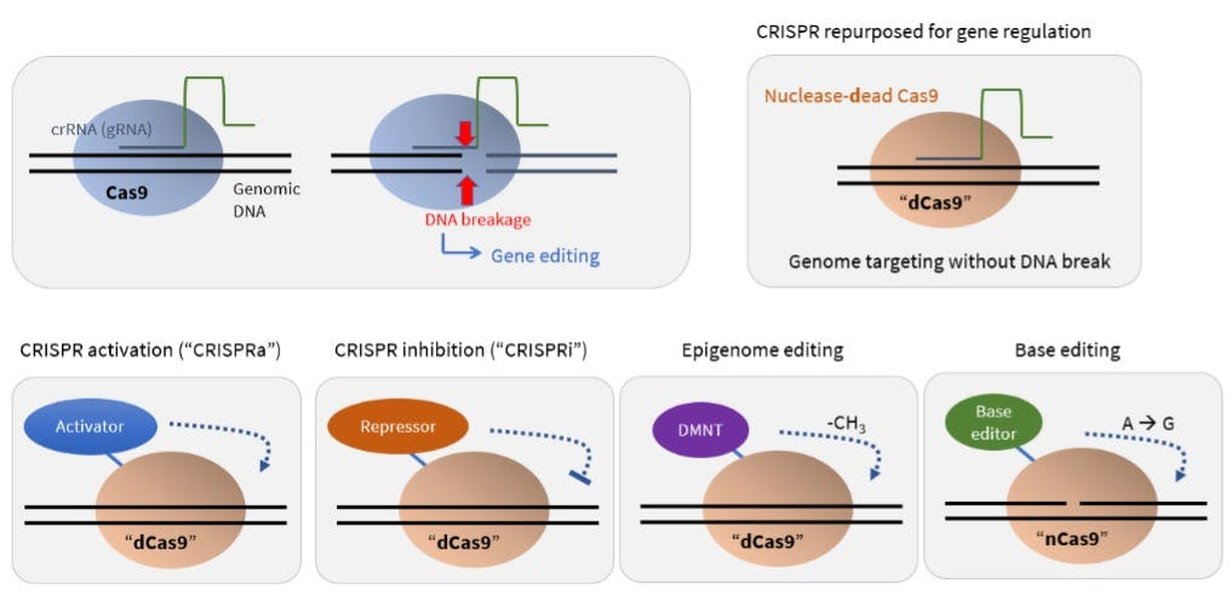
Visual representation comparing traditional CRISPR-Cas9 gene editing (which cuts DNA) with base editing (which chemically modifies a single base).
The Molecular Machinery: How Base Editors Work
Base editors are sophisticated molecular machines constructed by fusing two key components:
- A DNA-Targeting Module: This is typically a modified version of the Cas9 protein (or a related protein like Cas12) derived from the CRISPR system. Critically, this Cas protein is engineered to be 'catalytically impaired' – meaning it can no longer cut both DNA strands. It might be a 'nickase' (nCas9), cutting only one strand, or a 'dead' Cas9 (dCas9), which binds to the DNA target but doesn't cut at all. Its primary role is to locate the specific target DNA sequence guided by a companion molecule called the guide RNA (gRNA).
- A Base-Modifying Enzyme: Fused to the Cas9 variant is an enzyme, specifically a deaminase, capable of chemically converting one type of DNA base into another. For instance, a cytidine deaminase can convert cytosine (C) into uracil (U), which the cell then treats as thymine (T). An adenine deaminase converts adenine (A) into inosine (I), which the cell treats as guanine (G).
The process unfolds as follows:
- Targeting: The gRNA directs the base editor complex to the desired location in the genome.
- Binding & Unwinding: The Cas9 component binds to the DNA and unwinds the double helix near the target site, creating a small bubble or 'R-loop' where one strand is temporarily single-stranded.
- Deamination: The deaminase enzyme gains access to the exposed single-stranded DNA within this R-loop and chemically modifies the target base (e.g., C to U or A to I).
- Repair/Replication: Cellular DNA repair mechanisms or DNA replication processes then recognize the modified base (U or I) and typically replace the base on the opposing strand to match it, completing the base pair conversion (e.g., C•G becomes T•A, or A•T becomes G•C).
To enhance efficiency and prevent the cell from immediately undoing the edit, base editors often include additional components, such as a Uracil Glycosylase Inhibitor (UGI), which prevents the removal of the uracil (U) created by CBEs before the desired T•A pair is established.
Key Features: Precision Without the Break
Avoiding Double-Strand Breaks (DSBs)
The defining feature and major advantage of base editing is its ability to make precise changes without cutting the DNA backbone entirely. This significantly reduces the risk of unpredictable indels and larger genomic alterations often associated with DSB-dependent editing methods.
The Editing Window
Base editing doesn't occur randomly; the deaminase enzyme typically modifies bases within a specific range or "editing window" on the exposed single-stranded DNA loop. This window is usually located a certain distance upstream from the Protospacer Adjacent Motif (PAM) sequence – a short DNA sequence required for the Cas9 protein to bind effectively. The typical editing window might span nucleotides 4-8 or positions 12-16 relative to the PAM, depending on the specific editor design. While this provides specificity, it also means that not every base in a gene is easily targetable, and sometimes "bystander" bases within the window might be unintentionally edited alongside the target base.
PAM Requirement
Like standard CRISPR-Cas9, base editors generally require a PAM sequence adjacent to the target DNA sequence for binding. This requirement restricts the number of sites in the genome that can be targeted. However, ongoing research has led to the development of Cas9 variants with altered or relaxed PAM requirements, significantly expanding the range of potential target sites for base editing.
A Spectrum of Editors: Tailoring the Change
Base editing technology is not monolithic; different types of editors have been developed to perform specific base conversions, expanding the scope of possible genetic modifications.
Cytosine Base Editors (CBEs): The C-to-T Conversion
CBEs were among the first base editors developed. They utilize a cytidine deaminase (like APOBEC1) fused to a Cas9 nickase or dCas9. These enzymes target a cytosine (C) within the editing window and convert it to uracil (U). During subsequent DNA replication or repair, this U is treated as thymine (T), resulting in a stable C•G base pair being converted to a T•A base pair. This C-to-T transition (or G-to-A on the complementary strand) is highly relevant for correcting many pathogenic point mutations.
Adenine Base Editors (ABEs): The A-to-G Swap
ABEs achieve the conversion of adenine (A) to guanine (G). They employ an engineered adenine deaminase (derived from tRNA Adenosine Deaminase, TadA) fused to a Cas9 variant. The deaminase converts the target adenine (A) to inosine (I). Inosine is interpreted as guanine (G) by the cell's replication machinery, leading to the conversion of an A•T base pair to a G•C base pair. ABEs are crucial because A-to-G (or T-to-C) mutations are also responsible for a large fraction of human genetic disorders.
Expanding the Toolkit: Advanced Base and Prime Editors
Research continues to push the boundaries of base editing:
- Guanine Base Editors (gGBEs): Newer systems are being developed to enable conversions involving guanine, such as G-to-C or G-to-T changes (transversions), which are more challenging chemically. Some approaches use DNA glycosylase enzymes.
- RNA Base Editors: Adapting the principles to target RNA instead of DNA allows for temporary, reversible edits to gene transcripts, offering applications in modulating gene expression without permanently altering the genome. These often use deaminase enzymes like ADAR.
- Prime Editors (PEs): Considered a "search-and-replace" technology, prime editing is an even more versatile system. It uses a Cas9 nickase fused to a reverse transcriptase enzyme and a special prime editing guide RNA (pegRNA). The pegRNA not only targets the editor but also contains the template for the desired edit. Prime editing can perform all 12 possible base-to-base conversions, as well as small insertions and deletions, without requiring DSBs or donor DNA templates, significantly broadening the scope of precise genome editing.
Visualizing the Base Editing Landscape
This mindmap provides a visual overview of base editing technology, outlining its core components, the different editor types, its diverse applications, and the key challenges researchers are working to overcome. It helps conceptualize how these elements interconnect within this powerful field of genome engineering.
Revolutionizing Fields: Applications of Base Editing
The precision and safety profile of base editing have opened doors to a wide range of applications, from treating devastating genetic disorders to improving global food security.
Transforming Healthcare: Treating Genetic Diseases
A major driving force behind base editing research is its potential to correct single-nucleotide variants (SNVs) or point mutations, which are responsible for approximately half of all known pathogenic human genetic variants.
Correcting Monogenic Disorders
Diseases caused by a single incorrect DNA letter are prime candidates for base editing therapy. Clinical trials and preclinical studies are underway for conditions such as:
- Sickle Cell Disease: Base editing aims to correct the specific mutation in the beta-globin gene (HBB) responsible for the disease or to reactivate fetal hemoglobin production. The first human patient received base editing therapy for sickle cell disease in a clinical trial.
- Familial Hypercholesterolemia: Base editors targeting genes like PCSK9 or ANGPTL3 have shown promise in lowering LDL ("bad") cholesterol and triglyceride levels in preclinical models and early human trials, potentially offering a one-time, permanent treatment.
- Other Inherited Conditions: Research is exploring base editing for Tay-Sachs disease, hereditary tyrosinemia, cystic fibrosis, and many other monogenic disorders.
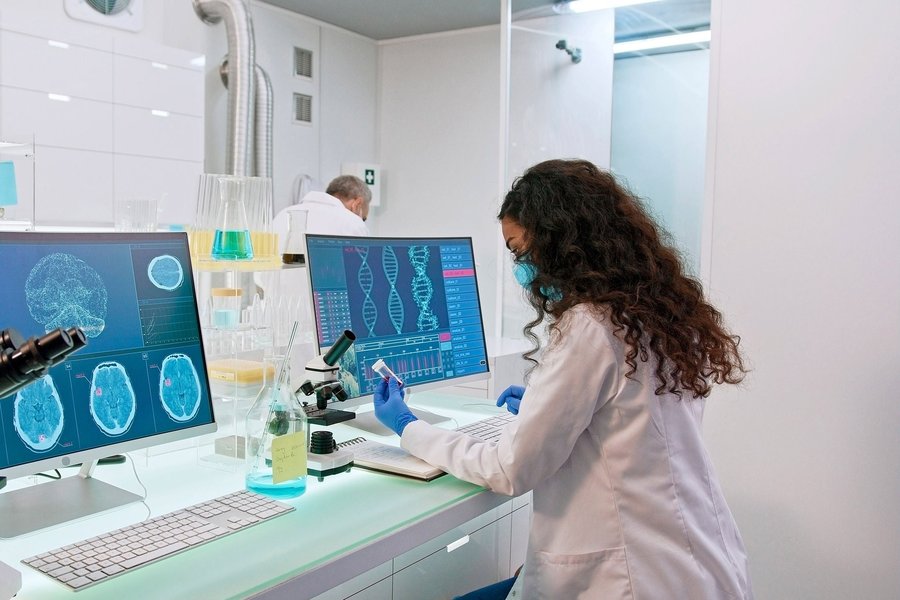
Researchers are actively developing base editing therapies in advanced laboratory settings.
Therapeutic Strategies: In Vivo vs. Ex Vivo
Base editing therapies can be delivered in two main ways:
- In Vivo: The base editing machinery (often packaged in viral vectors like AAV or non-viral carriers like lipid nanoparticles) is delivered directly into the patient's body to edit cells within specific tissues or organs (e.g., liver, eye, muscle).
- Ex Vivo: Cells are removed from the patient (e.g., hematopoietic stem cells from bone marrow), edited in the laboratory using base editors, and then infused back into the patient. This approach is common for blood disorders and CAR-T cell cancer therapies, allowing for quality control before reinfusion.
Advancing Agriculture: Engineering Better Crops
Base editing is proving to be a powerful tool for crop improvement. By precisely introducing or correcting single nucleotide polymorphisms (SNPs) known to influence key agronomic traits, scientists can accelerate the development of crops with desirable characteristics without the random mutations associated with traditional breeding or the DSBs from standard CRISPR.
Targeted Trait Enhancement
Applications in agriculture include:
- Developing crops with enhanced resistance to pests, diseases, and environmental stresses (like drought or salinity).
- Improving nutritional value (e.g., increased vitamins, healthier oils).
- Boosting yield and optimizing growth characteristics.
- Removing undesirable traits or allergens.
The precision of base editing aligns well with the goals of modern agriculture, offering a way to make targeted improvements to crop genomes efficiently.

Base editing allows for precise genetic modifications to improve crop characteristics like yield and resilience.
Powering Research: Understanding Genomics
Beyond therapeutic and agricultural applications, base editing is an invaluable tool for fundamental research.
Functional Genomics and Mutagenesis
- Studying Gene Function: Researchers can use base editors to precisely introduce specific point mutations into genes of interest to study their effects on cellular processes, development, and disease models.
- Creating Disease Models: Base editing allows for the rapid and accurate creation of cell lines or animal models carrying specific disease-causing mutations for research purposes.
- Mutagenesis Screens: Libraries of base editors targeting different sites can be used in large-scale screens to identify specific point mutations that confer desired phenotypes (e.g., drug resistance).
Comparing Base Editor Capabilities
Different base editing systems offer varying strengths regarding precision, efficiency, the types of edits they can make, and potential risks. This chart provides a comparative overview of Cytosine Base Editors (CBEs), Adenine Base Editors (ABEs), and the more advanced Prime Editors (PEs) across several key dimensions. Note that these are generalized comparisons, and specific editor variants can differ significantly.
This comparison highlights how Prime Editing offers greater versatility but may currently face challenges in delivery and efficiency compared to the more established CBEs and ABEs. All base editing approaches significantly reduce the risk of DSB-related off-target effects compared to traditional CRISPR-Cas9.
Base Editing in Action: A Closer Look
For a deeper dive into the development and potential of these technologies directly from a pioneer in the field, watch this presentation by Dr. David Liu, a key figure in the invention of both base editing and prime editing. He discusses the journey from concept to application, highlighting efforts to correct mutations causing genetic diseases in various models, including cells, animals, and potentially patients.
Dr. Liu's work exemplifies the rapid progress and therapeutic promise of base editing technologies, illustrating how these precise chemical tools are being honed to address fundamental genetic errors that underlie numerous human diseases.
Weighing the Pros and Cons
Base editing technology offers significant advantages over previous genome editing methods, but it also faces challenges that need to be addressed for widespread application. This table summarizes the key strengths and limitations.
| Advantages | Challenges & Limitations |
|---|---|
| High Precision: Enables targeted single-nucleotide changes. | Off-Target Edits: Potential for unintended edits at similar DNA sequences elsewhere in the genome (though generally lower than CRISPR-Cas9 indels). |
| No Double-Strand Breaks (DSBs): Reduces the risk of insertions, deletions (indels), and larger chromosomal rearrangements associated with DSB repair. | Bystander Edits: Unintended edits of nearby C or A bases within the editing window. |
| High Efficiency: Can achieve high rates of conversion at the target site in many contexts. | Delivery: Efficiently delivering the relatively large base editor machinery (Cas9 + deaminase) into target cells or tissues in vivo remains a significant hurdle. |
| Versatility: Different editors (CBE, ABE, PE) allow for various types of base changes and small edits. | PAM Requirement: The need for a specific PAM sequence near the target limits the accessible genomic sites, although PAM-relaxed variants are expanding scope. |
| Permanent Correction: Edits made to DNA are generally permanent and heritable in dividing cells. | Limited Edit Types (for CBE/ABE): Standard CBEs and ABEs primarily perform transition mutations (C->T, A->G). Transversions and other edits require more complex systems like PEs or gGBEs. |
| Therapeutic Potential: Directly applicable to correcting a large fraction of known pathogenic point mutations. | Ethical Considerations: As with all genome editing technologies, careful ethical consideration is required, especially regarding germline editing (changes inheritable by future generations). |
Frequently Asked Questions (FAQ)
Q1: How is base editing different from standard CRISPR-Cas9? +
Q2: What are the main types of base editors? +
Q3: Can base editing cure genetic diseases? +
Q4: What are the risks or limitations of base editing? +
Q5: Is base editing used in humans yet? +
References
- Explainer: What are base editors and how do they work? - CRISPR Medicine News
- Base editing: advances and therapeutic opportunities - Nature Reviews Drug Discovery
- Base editing technology for treating genetic diseases: principles, delivery strategies, applications, and recent advances - Frontiers in Pharmacology
- Base editing: what is it and what does it mean for healthcare? - Genomics Education Programme
- DNA and RNA base editing: Mechanistic insights and therapeutic applications - PLOS Biology
- Single Base Editing with CRISPR - Addgene Blog
- Base Editing - Beam Therapeutics
Recommended
Last updated April 17, 2025