
Unlock the Skies: How Self-Learning Drones Are Redefining Autonomous Flight
Explore the transformative benefits of AI-driven navigation that allows drones to learn, adapt, and operate with unprecedented intelligence.
Self-learning navigation represents a pivotal shift in drone technology, moving beyond pre-programmed routes and direct human control. By leveraging advanced Artificial Intelligence (AI), particularly machine learning (ML) techniques like deep learning and reinforcement learning (RL), drones can now perceive their surroundings, learn from experience, and make independent decisions in real-time. This guide delves into the significant advantages this intelligent navigation offers, enhancing drone capabilities across various domains.
Key Highlights of Self-Learning Navigation
Essential Takeaways
- Enhanced Safety and Reliability: Self-learning algorithms enable superior real-time obstacle detection and avoidance, significantly reducing collision risks, especially in dynamic or unknown environments.
- Unprecedented Autonomy and Efficiency: Drones can operate independently in complex, GPS-denied areas, optimize flight paths for time and energy, and manage tasks with minimal human intervention.
- Superior Adaptability: These intelligent drones can dynamically adjust to unforeseen circumstances, changing weather conditions, and diverse terrains without needing reprogramming.
Elevating Safety and Reducing Risk
Intelligent Obstacle Avoidance and Hazard Mitigation
One of the most significant benefits of self-learning navigation is the dramatic improvement in drone safety. Traditional navigation methods often struggle in unpredictable settings. Self-learning systems, powered by AI, continuously analyze data from sensors like cameras, LiDAR, and IMUs to build a dynamic understanding of the environment. This allows drones to:
- Detect and Avoid Obstacles in Real-Time: Using techniques like deep reinforcement learning, drones learn sophisticated policies to identify and navigate around both static objects (buildings, trees) and dynamic obstacles (birds, other vehicles, people) with remarkable speed and precision. Research shows drones achieving speeds up to 70 km/h in cluttered environments while maintaining safety.
- Operate Safely in GPS-Denied Environments: When GPS signals are weak, jammed, or unavailable (indoors, underground, urban canyons, contested areas), self-learning drones utilize computer vision and sensor fusion for localization and navigation (SLAM - Simultaneous Localization and Mapping). This ensures continued safe operation where traditional drones might fail or become unreliable.
- Minimize Human Exposure to Danger: By enabling fully autonomous operation, these drones can undertake missions in hazardous environments – such as disaster zones, industrial inspection sites with toxic materials, or military reconnaissance areas – without risking human pilots.
- Enhance Fail-Safe Mechanisms: AI improves standard safety features like Return-to-Home (RTH) by dynamically calculating the safest and most efficient route back, considering any new obstacles or environmental changes encountered during the mission.
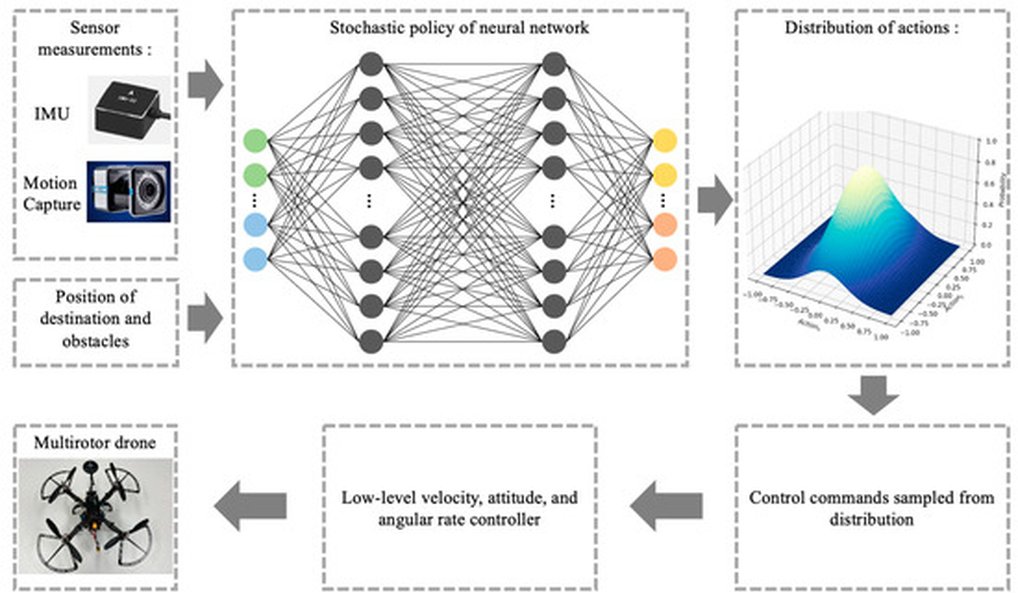
Self-learning enables drones to navigate complex paths and avoid obstacles autonomously.
Boosting Efficiency and Operational Autonomy
Optimized Performance with Minimal Intervention
Self-learning navigation transforms drones into highly efficient autonomous agents capable of executing complex tasks with minimal human oversight. This translates into significant gains in productivity and resource optimization.
Intelligent Path Planning and Execution
Instead of rigidly following pre-set waypoints, self-learning drones dynamically optimize their flight paths. Using RL, they learn routes that minimize flight time and energy consumption based on real-time environmental data (like wind conditions) and mission objectives. This continuous optimization leads to longer flight durations and faster mission completion.
Autonomous Data Management and Task Execution
Drones equipped with self-learning capabilities can autonomously manage data collection for tasks like infrastructure inspection, agricultural monitoring, or surveillance. They can perform repetitive missions at specific intervals, ensuring data consistency and timeliness without requiring constant human setup and monitoring. Some models automate the entire workflow, from takeoff and data acquisition to landing and data uploading.
Reduced Reliance on Human Operators
The high degree of autonomy achieved through self-learning reduces the need for skilled human pilots, especially for large-scale or continuous operations. This allows organizations to deploy drone fleets more effectively, lowering operational costs associated with personnel training and management.
Unmatched Adaptability in Diverse Environments
Thriving in Unpredictable and Challenging Conditions
A defining characteristic of self-learning drones is their exceptional adaptability. They are not limited by pre-existing maps or predictable conditions, enabling operation across a wide spectrum of environments.
- Navigating Unknown Terrains: Self-learning algorithms empower drones to explore and map unfamiliar areas on the fly, whether dense forests, complex urban landscapes, or indoor spaces, using sensor data to build environmental models.
- Responding to Dynamic Changes: These drones can instantly react to sudden changes like unexpected obstacles, adverse weather shifts (e.g., wind gusts), or evolving mission parameters without human intervention or reprogramming. Training models in diverse simulated and real-world environments helps generalize their adaptive capabilities.
- GPS-Independent Operation: As mentioned under safety, the ability to navigate accurately using onboard sensors (visual odometry, sensor fusion) makes them invaluable in environments where GPS is unreliable or completely absent.
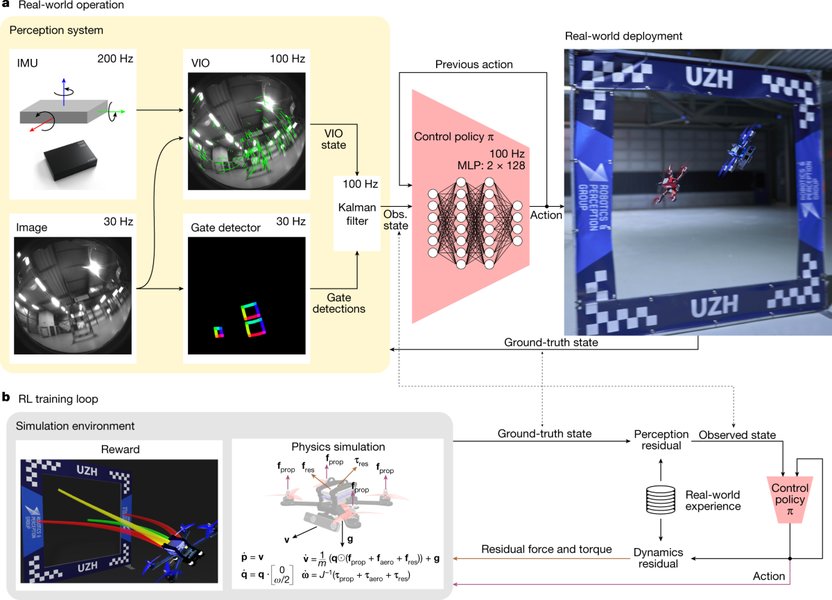
Deep reinforcement learning enables drones to master complex, high-speed navigation tasks like drone racing.
Performance Comparison: Self-Learning vs. Traditional Navigation
Visualizing the Advantages
This chart provides a comparative overview of key performance aspects between drones utilizing self-learning navigation and those relying on traditional (GPS-based, pre-programmed) methods. The scores represent a qualitative assessment of capabilities, highlighting the significant enhancements offered by AI-driven autonomy.
As illustrated, self-learning systems significantly outperform traditional methods, particularly in adaptability, autonomy, safety in complex situations, and operation without GPS reliance. While traditional drones may be efficient for simple, pre-defined tasks in open areas, self-learning unlocks capabilities essential for complex, real-world applications.
Core Benefits Structure
A Mindmap Overview
This mindmap visually summarizes the interconnected benefits stemming from self-learning navigation in drones, showcasing how advancements in core capabilities translate into practical advantages across various operational aspects.
Drone Navigation"] id1["Enhanced Safety"] id1a["Real-Time Obstacle Avoidance"] id1b["Dynamic Hazard Mitigation"] id1c["Reduced Human Risk Exposure"] id1d["Improved Fail-Safe Mechanisms"] id2["Improved Efficiency & Autonomy"] id2a["Optimized Flight Paths
(Time & Energy)"] id2b["Autonomous Task Execution"] id2c["Automated Data Management"] id2d["Reduced Need for Human Pilots"] id3["Superior Adaptability"] id3a["Navigation in Unknown Terrains"] id3b["Response to Dynamic Changes
(Weather, Obstacles)"] id3c["GPS-Denied Environment Operation"] id3d["Versatility Across Missions"] id4["Cost Savings & Optimization"] id4a["Lower Labor Costs"] id4b["Reduced Operational Downtime"] id4c["Optimized Energy Consumption"] id4d["Scalable Fleet Deployment"] id5["Broad Industry Applications"] id5a["Logistics & Delivery"] id5b["Agriculture & Surveying"] id5c["Infrastructure Inspection"] id5d["Security & Surveillance"] id5e["Disaster Response & Rescue"] id5f["Military Operations"] id6["Technological Advancement"] id6a["Integration of AI, CV, RL"] id6b["Continuous Improvement Loop"] id6c["Foundation for Future Autonomy"] id6d["Synergy with Robotics & Self-Driving Tech"]
Cost-Effectiveness and Resource Management
Optimizing Operations and Reducing Expenses
While the initial investment in AI-powered drones might be higher, the long-term operational benefits often lead to significant cost savings.
- Reduced Labor Costs: Automation minimizes the need for trained pilots and ground crews, especially for repetitive or large-scale tasks.
- Lower Maintenance and Repair Costs: Enhanced safety features and collision avoidance reduce the frequency of accidents and associated repair costs.
- Optimized Energy Usage: Intelligent path planning conserves battery life, allowing for longer missions or coverage of larger areas per charge, reducing the number of charge cycles and battery replacements over time.
- Increased Operational Uptime: Drones can operate more continuously and reliably, maximizing the return on investment through increased productivity.
Transforming Industries: Broad Applications
Where Self-Learning Drones Make a Difference
The enhanced capabilities enabled by self-learning navigation unlock a wide range of applications across numerous sectors:
This video provides insights into how AI and Machine Learning are integrated into drone navigation for collision avoidance and enhanced autonomy.
The integration of AI and ML, as discussed in the video, powers the drone's ability to learn and adapt. This is crucial for applications such as:
- Logistics and Delivery: Navigating complex urban environments for faster, autonomous package delivery, avoiding traffic and obstacles.
- Agriculture: Precision farming tasks like crop monitoring, identifying disease or stress, and targeted spraying, optimizing paths over vast fields.
- Infrastructure Inspection: Safely inspecting power lines, pipelines, wind turbines, bridges, and buildings, even in hard-to-reach or hazardous areas.
- Security and Surveillance: Autonomous patrolling of large perimeters, tracking subjects, and responding to incidents in real-time.
- Disaster Management and Search & Rescue: Rapidly mapping affected areas, locating survivors in debris fields or remote locations, and navigating unstable environments.
- Military and Defense: Conducting reconnaissance, surveillance, and target acquisition (RSTA) missions in contested or GPS-denied zones with reduced risk to personnel.
- Environmental Monitoring: Tracking wildlife, monitoring deforestation, or assessing pollution levels autonomously over large areas.
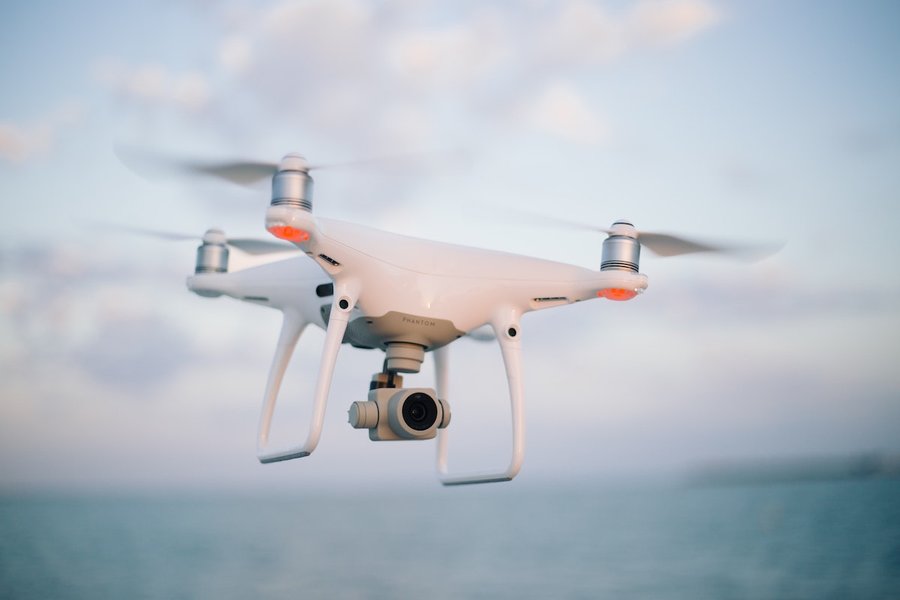
Autonomous drones are poised to revolutionize lightweight delivery services and many other industries.
Comparing Navigation Approaches
Self-Learning vs. Traditional Methods
This table provides a side-by-side comparison of key features between traditional drone navigation systems (primarily GPS-based and pre-programmed) and modern self-learning navigation systems powered by AI.
| Feature | Traditional Navigation | Self-Learning Navigation |
|---|---|---|
| Primary Technology | GPS, Barometer, IMU, Pre-programmed Waypoints | AI (ML, RL, DL), Computer Vision, Sensor Fusion (Lidar, Cameras, IMU, etc.), GPS (often as supplement) |
| Obstacle Avoidance | Basic (often reliant on simple sensors like ultrasonic) or None; Struggles with dynamic or small obstacles. | Advanced, Real-time detection and avoidance of static & dynamic obstacles using AI-powered perception. |
| Path Planning | Follows pre-defined routes; Limited ability to adapt mid-flight. | Dynamic path optimization based on real-time conditions, mission goals, and learned experiences (energy/time efficiency). |
| GPS-Denied Operation | Highly limited or impossible; Relies heavily on GPS signal. | Capable of robust navigation using visual odometry, SLAM, and sensor fusion. |
| Adaptability to Environment | Low; Struggles with unknown terrains, changing weather, or unexpected events. | High; Learns from and adapts to diverse, dynamic, and unknown environments. |
| Level of Autonomy | Low to Medium; Often requires significant human oversight or intervention. | High to Full; Capable of end-to-end mission execution with minimal or no human input. |
| Learning Capability | None; Performance is static based on programming. | Continuous learning from experience and data, leading to performance improvements over time. |
Frequently Asked Questions (FAQ)
Understanding Self-Learning Drone Navigation
What exactly is self-learning navigation for drones?
How does self-learning improve drone safety?
Can drones with self-learning navigation operate without GPS?
What are the main technologies involved in self-learning navigation?
Are self-learning drones significantly more expensive?
Recommended Further Exploration
Dive Deeper into Autonomous Drone Technology
- How does reinforcement learning specifically enable drones to avoid obstacles autonomously?
- What are the main challenges and limitations currently facing self-learning drone navigation systems?
- How do SLAM and Visual-Inertial Odometry compare for navigating drones without GPS?
- What are the future trends for using AI in coordinating swarms of autonomous drones?
References
Sources and Further Reading

Last updated May 5, 2025