
Relationship Between Offset Amount and Length Ratio for C-Shaped Monotone Cubic Bézier Curves
Exploring how offset distances affect the geometry of cubic Bézier curves
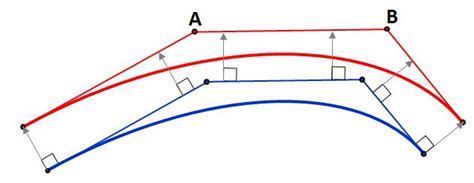
Key Takeaways
- Curvature's Role: The curvature of the original curve significantly influences how the offset amount affects the length ratio.
- Linear Approximation: For small offset distances, the length ratio can be approximated linearly with respect to the offset amount.
- Nonlinear Dynamics: Larger offsets introduce nonlinear relationships, requiring more complex computations for accurate length ratios.
Introduction
Cubic Bézier curves are fundamental in computer graphics, vector graphic design, and various engineering applications. Understanding the relationship between an offset amount—a constant distance from the original curve—and the resulting length of the offset curve is crucial for tasks such as path planning, stroke rendering, and shape manipulation. This comprehensive analysis delves into the mathematical foundations, practical considerations, and approximation methods to establish a relationship between the offset amount and the length ratio of offset curves relative to their original C-shaped monotone cubic Bézier counterparts.
Understanding Cubic Bézier Curves
Definition and Parametrization
A cubic Bézier curve is defined by four control points: P0, P1, P2, and P3. The curve is parametrically represented as:
B(t) = (1 - t)^3 P0 + 3(1 - t)^2 t P1 + 3(1 - t) t^2 P2 + t^3 P3, for t ∈ [0, 1]
Given the monotonic ordering P0 < P1 < P2 < P3, the curve is C-shaped and ensures a single inflection, maintaining monotonicity throughout its domain.
Geometric Properties
- Control Polygon: The polygon formed by connecting the control points influences the curvature and shape of the Bézier curve.
- Monotonicity: Ensures that the curve progresses in a single direction without oscillations.
- Inflection Points: Presence or absence affects the curve's bend and potential behavior under offsetting.
Offset Curves: Definition and Properties
What is an Offset Curve?
An offset curve is a parallel curve that maintains a constant perpendicular distance (offset amount, d) from the original curve at every point. Formally, for each point B(t) on the original curve, the corresponding point on the offset curve Bd(t) is defined as:
B_d(t) = B(t) + d · N(t)
where N(t) is the unit normal vector to the curve at B(t).
Mathematical Representation
- Unit Normal Vector: Calculated using the derivative vectors of the Bézier curve.
- Degree Elevation: Offset curves of cubic Béziers generally result in higher-degree polynomials (degree 10), increasing computational complexity.
- Curvature Dependence: The behavior and validity of offset curves are highly dependent on the original curve's curvature.
Relationship Between Offset Amount and Length Ratio
Fundamental Concepts
The primary goal is to understand how varying the offset amount (d) affects the length of the offset curve (Ld) relative to the original curve length (L). This relationship is deeply intertwined with the curvature (κ) of the original curve.
Small Offset Approximation
For small values of d, the length of the offset curve can be approximated using the integral of curvature along the original curve:
L_d ≈ L + d · ∫₀¹ κ(t) · ||B'(t)|| dt
Here, κ(t) represents the curvature at point B(t), and ||B'(t)|| is the magnitude of the derivative (the speed) of the original curve at t.
This linear approximation holds true under the condition that d is sufficiently small, ensuring that the offset does not introduce significant deviations or complexities such as cusps or self-intersections.
Influence of Curvature Variability
The curvature of the original Bézier curve plays a pivotal role in determining the relationship between d and Ld/L:
- High Curvature Regions: Areas with higher curvature result in greater deviations when offsetting, leading to an increase in the length ratio.
- Low Curvature Regions: Sections with minimal curvature exhibit negligible changes in length ratio upon offsetting.
Therefore, the overall length ratio is a cumulative effect of curvature variations along the entire curve.
Nonlinear Dynamics for Larger Offsets
As the offset amount d increases, the relationship between d and Ld/L becomes nonlinear due to:
- Complex Curvature Interactions: The varying curvature introduces nonlinear contributions to the length ratio.
- Higher-Degree Offset Curves: The offset curve's increased polynomial degree complicates direct analytical relationships.
- Potential Geometric Issues: Large offsets may lead to self-intersections or cusps, invalidating simple length ratio models.
These factors necessitate more sophisticated methods, such as numerical integration or segmentation, to accurately determine the length ratio for larger d.
Mathematical Formulation
Curve Length Calculations
The length of the original Bézier curve (L) is given by:
L = ∫₀¹ ||B'(t)|| dt
Similarly, the length of the offset curve (Ld) is:
L_d = ∫₀¹ ||B'_d(t)|| dt
Where B'_d(t) is the derivative of the offset curve with respect to t.
Curvature Definition
Curvature (κ) at a point t on the curve is defined as:
κ(t) = ||B'(t) × B''(t)|| / ||B'(t)||³
This measures how rapidly the curve is changing direction at t.
Practical Computations and Challenges
Numerical Integration Methods
Exact analytical solutions for Ld are generally unattainable due to the complexity introduced by the offset. Instead, numerical integration techniques are employed:
- Subdivision: Breaking the curve into smaller segments where linear approximations are more accurate.
- Adaptive Quadrature: Adjusting the integration step based on curvature to optimize accuracy.
- Monte Carlo Methods: Utilizing stochastic sampling for integral approximation in highly irregular curves.
Approximation Techniques
For practical purposes, especially when dealing with real-time applications, approximations offer a balance between accuracy and computational efficiency:
- Linear Approximations: Utilizing the small offset approximation for minimal d values.
- Curvature Bounds: Estimating length ratios using maximum curvature values to establish upper or lower bounds.
- Segmented Approaches: Dividing the curve into sections with relatively uniform curvature for localized approximations.
Limitations and Challenges
Several factors complicate the accurate determination of Ld/L:
-
High-Degree Offset Curves: Maintaining computational efficiency while handling degree 10 polynomials.
-
Geometric Complexity: Preventing and managing self-intersections and cusps in offset curves.
-
Curvature Variability: Addressing regions with rapidly changing curvature to maintain approximation accuracy.
Practical Applications and Considerations
Design and Manufacturing
In computer-aided design (CAD) and manufacturing, understanding offset curves is vital for tool path generation, especially in milling and engraving processes.
Graphic Rendering
Offset curves are used in stroke rendering, where the thickness of lines is adjusted by applying offset curves to the original paths.
Path Planning
Robotics and autonomous navigation utilize offset curves for obstacle avoidance and maintaining safe distances from predefined paths.
Conclusion
The relationship between the offset amount and the length ratio of offset curves relative to their original C-shaped monotone cubic Bézier curves is fundamentally influenced by the curve's curvature. For small offsets, a linear approximation based on the integral of curvature provides a reasonable estimate. However, as the offset increases, the relationship becomes nonlinear, requiring more complex computational methods to achieve accurate measurements. Practical applications must balance the need for precision with computational efficiency, often relying on numerical integration and approximation techniques to navigate the inherent complexities of offsetting cubic Bézier curves.
References
Last updated January 19, 2025