
Optimizing Cubic Bézier Curve Approximation for Accuracy, Speed, and GPU Parallelism
A Comprehensive Guide to Efficiently Approximating Cubic Bézier Curves with Straight Line Segments
Key Takeaways
- Adaptive Subdivision with De Casteljau’s Algorithm ensures high accuracy by recursively splitting the curve based on deviation metrics.
- GPU Parallelization significantly enhances computation speed by processing multiple curve segments concurrently.
- Optimized Error Metrics and Forward Differencing maintain uniform chordal distances while minimizing computational overhead.
Introduction
Approximating a cubic Bézier curve with straight line segments is a fundamental task in computer graphics, vector graphics rendering, and real-time applications. The challenge lies in balancing three critical factors: accuracy (ensuring each segment maintains the same chordal distance to the curve), speed (efficient computation), and the feasibility of parallel computation on Graphics Processing Units (GPUs). This guide explores the most effective algorithmic approach to achieve this balance, leveraging adaptive subdivision, GPU parallelization, and optimized error metrics.
Algorithm Overview
1. Adaptive Subdivision with De Casteljau’s Algorithm
The cornerstone of accurate Bézier curve approximation is the De Casteljau’s algorithm, which facilitates adaptive subdivision of the curve into smaller segments. This method dynamically splits the curve based on deviation metrics, ensuring that regions with higher curvature receive more subdivisions to maintain uniform chordal distances.
How It Works
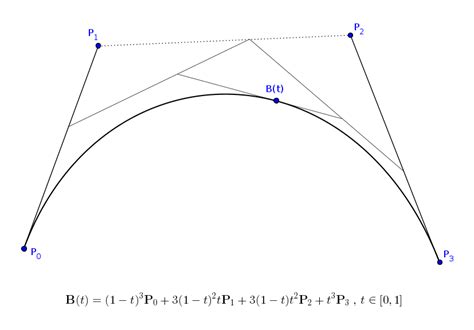
De Casteljau’s algorithm recursively divides the Bézier curve at its midpoint, creating two new sub-curves. This process continues until the deviation between the curve and the straight line segment connecting its endpoints is below a predefined tolerance level (ε). The algorithm guarantees that each resulting segment maintains an approximately equal chordal distance to the original curve.
2. GPU Parallelization
Leveraging the parallel processing capabilities of GPUs can drastically improve the speed of curve approximation. By distributing the workload across multiple GPU threads, each handling independent curve segments, the computation can be performed concurrently, resulting in significant performance gains.
Implementation Strategies
- Initial Segmentation: Divide the original Bézier curve into several initial sub-curves using uniform parameter intervals.
- Parallel Processing: Assign each sub-curve to a separate GPU thread or set of threads, allowing simultaneous processing of multiple segments.
- Error Evaluation and Subdivision: Each thread evaluates the deviation of its assigned sub-curve from the straight line segment and performs further subdivisions if necessary.
- Result Compilation: After processing, combine all the subdivided segments into a final set of straight line approximations.
3. Error Metrics and Optimizations
Error Metrics
Accurate approximation hinges on robust error metrics to quantify the deviation between the Bézier curve and its straight line segments. Two widely used metrics are:
-
Hausdorff Distance: Measures the greatest distance from a point on one curve to the closest point on the other curve.
-
Maximum Perpendicular Distance: Calculates the maximum distance between the curve and the straight line segment, ensuring that all points on the curve lie within a specified tolerance.
Forward Differencing for Speed
To enhance computational speed, the forward differencing technique can be employed. This method iteratively computes successive points on the Bézier curve using difference equations, reducing the need for redundant calculations inherent in adaptive subdivision. By precomputing control points and utilizing incremental calculations, forward differencing minimizes computational overhead, particularly beneficial for GPU-based implementations.
Detailed Steps for Curve Approximation
Step 1: Initial Setup
Begin by defining the cubic Bézier curve using its control points \( P_0, P_1, P_2, P_3 \). Establish a tolerance value \( \epsilon \) that dictates the maximum allowed deviation between the curve and its straight line approximation.
Step 2: Adaptive Subdivision
Utilize De Casteljau’s algorithm to recursively split the curve:
- Compute Deviation: Calculate the deviation between the Bézier curve and the straight line segment connecting \( P_0 \) and \( P_3 \). If the deviation exceeds \( \epsilon \), proceed to subdivide.
- Subdivide the Curve: Apply De Casteljau’s algorithm to split the curve at its midpoint, resulting in two new sub-curves.
- Recursion: Recursively apply the subdivision process to each sub-curve until all segments meet the deviation criterion.
Step 3: GPU Parallel Processing
Implement the adaptive subdivision algorithm on the GPU to exploit parallelism:
- Assign Sub-Curves: Distribute the initial set of sub-curves across multiple GPU threads, allowing simultaneous processing.
- Parallel Deviation Checks: Each thread evaluates the deviation of its assigned segment and performs further subdivisions if necessary.
- Merge Results: After parallel processing, collect and sort all subdivision points to form the final set of straight line segments approximating the original curve.
Step 4: Equal Chordal Distance Adjustment
After the initial subdivision, refine the approximation to ensure that the chordal distances (the straight-line distances between consecutive points) are approximately equal. This can be achieved by:
- Iterative Adjustment: Move the subdivision points along the curve and recompute the chordal distances.
- Optimization: Apply optimization techniques to minimize variations in chordal distances, ensuring uniformity across all segments.
Optimization Techniques
Precomputation of Control Points
Precompute and store necessary control points and intermediate values to reduce redundant calculations during the subdivision process. This optimization is crucial for minimizing processing time, especially when dealing with large datasets.
Efficient Data Structures
Utilize optimized data structures such as contiguous memory blocks and memory pools to store intermediate results. Efficient memory access patterns reduce latency and enhance overall performance, particularly on GPU architectures.
Memory Access Optimization
Reduce memory access latency by leveraging shared memory and caching strategies on the GPU. Minimizing global memory accesses and maximizing data reuse within GPU threads can lead to significant speed improvements.
Implementation Considerations
Choosing the Right Parallel Framework
Implement the subdivision algorithm using parallel computing frameworks such as CUDA or OpenCL. These frameworks allow for efficient parallel execution and resource management on GPUs.
Balancing Workload Across Threads
Ensure an even distribution of workload across GPU threads to prevent bottlenecks. Assigning an appropriate number of curve segments to each thread based on their complexity and required subdivisions can lead to balanced and efficient processing.
Handling High-Curvature Regions
Regions with high curvature require more subdivisions to maintain accuracy. Implement adaptive techniques that dynamically allocate more threads or processing power to these regions, ensuring uniform chordal distances without compromising speed.
Performance Evaluation
Accuracy Assessment
Evaluate the approximation accuracy by measuring the maximum deviation between the original Bézier curve and the straight line segments. Ensure that all deviations are within the specified tolerance \( \epsilon \) to maintain uniform chordal distances.
Speed Benchmarking
Measure the computation time required for the approximation process on both CPU and GPU implementations. Compare the performance gains achieved through GPU parallelization and optimization techniques to validate the efficiency of the chosen approach.
Scalability Analysis
Assess the algorithm’s scalability by testing it with curves of varying complexity and lengths. Ensure that the implementation maintains performance and accuracy across different scenarios, making it suitable for real-time applications.
Conclusion
Approximating cubic Bézier curves with straight line segments requires a delicate balance between accuracy, speed, and parallelizability. The optimal approach leverages Adaptive Subdivision using De Casteljau’s Algorithm for precise curve approximation, enhanced by GPU Parallelization to achieve high computational speed. Additionally, implementing robust error metrics and optimization techniques such as forward differencing and efficient memory management ensures that the approximation maintains uniform chordal distances while maximizing performance. This comprehensive method is well-suited for real-time applications and scenarios demanding high-fidelity curve representations.
References
Last updated January 19, 2025