
Unlock the Secrets of Weak Acid Dissociation: Calculating Hydronium Ion Concentration
A step-by-step guide to finding the [H₃O⁺] in a 0.120 M nitrous acid solution using its Ka value.
Understanding how weak acids behave in solution is fundamental in chemistry. Unlike strong acids that dissociate completely, weak acids like nitrous acid (HNO₂) only partially release their hydrogen ions, establishing an equilibrium in water. This calculation determines the concentration of hydronium ions ([H₃O⁺]), which dictates the acidity of the solution.
Key Insights
- Equilibrium Matters: Calculating [H₃O⁺] for a weak acid requires considering its dissociation equilibrium, defined by the acid dissociation constant (Ka).
- ICE Table Method: The ICE (Initial, Change, Equilibrium) table is a systematic way to track concentration changes as the weak acid reaches equilibrium.
- Approximation vs. Quadratic Formula: While approximation can simplify calculations, its validity must be checked (often using the 5% rule). If the approximation is invalid, the more precise quadratic formula is necessary.
The Chemistry of Nitrous Acid Dissociation
Understanding the Equilibrium Reaction
Nitrous acid (HNO₂) is classified as a weak acid. When dissolved in water, it participates in an equilibrium reaction where it donates a proton (H⁺) to a water molecule (H₂O), forming a hydronium ion (H₃O⁺) and a nitrite ion (NO₂⁻). The reaction is reversible, indicated by the double arrows:
\[ \text{HNO}_2\text{(aq)} + \text{H}_2\text{O(l)} \rightleftharpoons \text{H}_3\text{O}^+\text{(aq)} + \text{NO}_2^-\text{(aq)} \]The extent of this reaction is quantified by the acid dissociation constant, Ka.
The Acid Dissociation Constant (Ka)
The Ka value measures the strength of an acid in solution. It's the equilibrium constant for the acid's dissociation reaction. For nitrous acid, the Ka expression is:
\[ K_a = \frac{[\text{H}_3\text{O}^+][\text{NO}_2^-]}{[\text{HNO}_2]} \]You are given that for nitrous acid, \(K_a = 7.1 \times 10^{-4}\). A smaller Ka value indicates a weaker acid, meaning it dissociates less.
Calculating [H₃O⁺]: The Step-by-Step Process
Step 1: Setting up the ICE Table
To find the equilibrium concentrations needed for the Ka expression, we use an ICE (Initial, Change, Equilibrium) table. We start with an initial concentration of HNO₂ = 0.120 M and assume negligible initial [H₃O⁺] from water autoionization.
ICE Table for HNO₂ Dissociation
| Species | Initial (M) | Change (M) | Equilibrium (M) |
|---|---|---|---|
| HNO₂ | 0.120 | -x | 0.120 - x |
| H₃O⁺ | ≈ 0 | +x | x |
| NO₂⁻ | 0 | +x | x |
Here, 'x' represents the change in concentration due to dissociation, which is equal to the equilibrium concentration of [H₃O⁺] and [NO₂⁻].
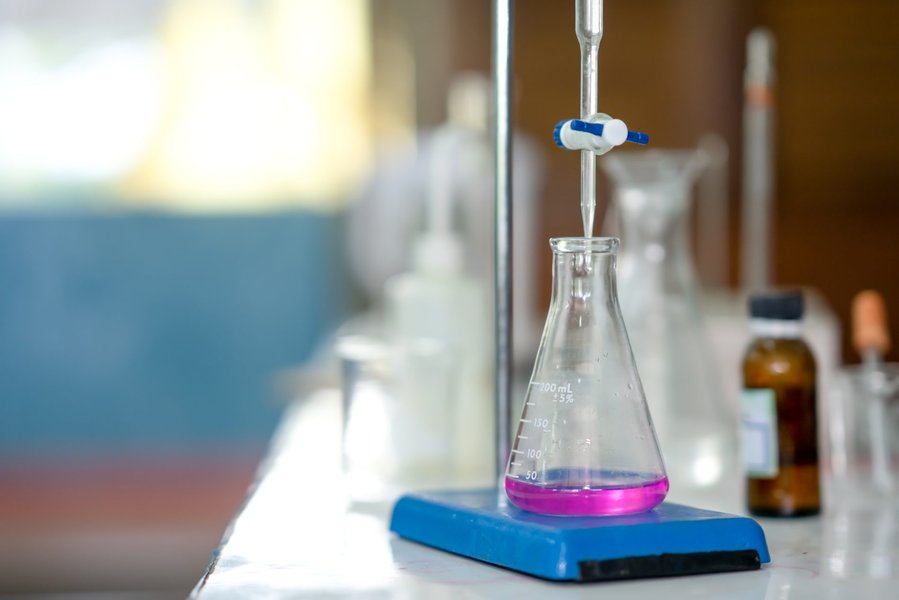
Chemical equilibrium calculations often involve concepts visualized during experiments like titrations.
Step 2: Substitute into the Ka Expression
Now, substitute the equilibrium concentrations from the ICE table into the Ka expression:
\[ K_a = \frac{(x)(x)}{(0.120 - x)} = 7.1 \times 10^{-4} \] \[ \frac{x^2}{0.120 - x} = 7.1 \times 10^{-4} \]Step 3: Solving for x - Approximation Check
We can attempt to simplify the calculation by assuming 'x' is negligible compared to the initial concentration (0.120 M). This is often valid if Ka is very small or the initial concentration is large. The assumption is \(0.120 - x \approx 0.120\).
\[ \frac{x^2}{0.120} \approx 7.1 \times 10^{-4} \] \[ x^2 \approx (7.1 \times 10^{-4}) \times 0.120 = 8.52 \times 10^{-5} \] \[ x \approx \sqrt{8.52 \times 10^{-5}} \approx 0.00923 \, \text{M} \]To check the validity of this approximation, we use the 5% rule: if the calculated 'x' is less than 5% of the initial concentration, the approximation is generally considered valid.
\[ \text{Percent Ionization} = \frac{x}{[\text{HNO}_2]_{\text{initial}}} \times 100\% = \frac{0.00923}{0.120} \times 100\% \approx 7.69\% \]Since 7.69% is greater than 5%, the approximation \(0.120 - x \approx 0.120\) introduces significant error. Therefore, we must solve the full quadratic equation.
Step 4: Solving the Quadratic Equation
We rearrange the original equilibrium expression into the standard quadratic form \(ax^2 + bx + c = 0\):
\[ \frac{x^2}{0.120 - x} = 7.1 \times 10^{-4} \] \[ x^2 = 7.1 \times 10^{-4} (0.120 - x) \] \[ x^2 = (7.1 \times 10^{-4} \times 0.120) - (7.1 \times 10^{-4} \times x) \] \[ x^2 = 8.52 \times 10^{-5} - (7.1 \times 10^{-4})x \] \[ x^2 + (7.1 \times 10^{-4})x - 8.52 \times 10^{-5} = 0 \]Now, we apply the quadratic formula: \(x = \frac{-b \pm \sqrt{b^2 - 4ac}}{2a}\), where a = 1, b = 7.1 × 10⁻⁴, and c = -8.52 × 10⁻⁵.
\[ x = \frac{-(7.1 \times 10^{-4}) \pm \sqrt{(7.1 \times 10^{-4})^2 - 4(1)(-8.52 \times 10^{-5})}}{2(1)} \] \[ x = \frac{-7.1 \times 10^{-4} \pm \sqrt{(5.041 \times 10^{-7}) + (3.408 \times 10^{-4})}}{2} \] \[ x = \frac{-7.1 \times 10^{-4} \pm \sqrt{3.413041 \times 10^{-4}}}{2} \] \[ x = \frac{-7.1 \times 10^{-4} \pm 0.018475}{2} \]This yields two possible values for x:
- \(x_1 = \frac{-0.00071 + 0.018475}{2} = \frac{0.017765}{2} \approx 0.00888 \, \text{M}\)
- \(x_2 = \frac{-0.00071 - 0.018475}{2} = \frac{-0.019185}{2} \approx -0.00959 \, \text{M}\)
Since concentration cannot be negative, the physically meaningful solution is \(x = 0.00888 \, \text{M}\).
Step 5: Final Hydronium Ion Concentration
The value of 'x' represents the equilibrium concentration of hydronium ions, [H₃O⁺].
Therefore, the hydronium ion concentration in a 0.120 M nitrous acid solution is approximately \(8.88 \times 10^{-3}\) M.
Visualizing the Calculation Steps
This mindmap outlines the logical flow of the calculation process, from identifying the problem to reaching the final answer.
HNO₂ + H₂O ⇌ H₃O⁺ + NO₂⁻"] id3["Define Ka Expression:
Ka = [H₃O⁺][NO₂⁻] / [HNO₂]
Ka = 7.1 x 10⁻⁴"] id4["Set up ICE Table"] id5["Initial:
[HNO₂]=0.120
[H₃O⁺]=0
[NO₂⁻]=0"] id6["Change:
-x
+x
+x"] id7["Equilibrium:
0.120-x
x
x"] id8["Substitute into Ka:
7.1x10⁻⁴ = x²/(0.120-x)"] id9["Check Approximation (x << 0.120?)"] id10["Calculate % Ionization:
(x/0.120)*100 ≈ 7.69%"] id11["Result > 5%? -> Use Quadratic"] id12["Solve Quadratic:
x² + (7.1x10⁻⁴)x - 8.52x10⁻⁵ = 0"] id13["Final Result:
x = [H₃O⁺] ≈ 8.88 x 10⁻³ M"]
Comparing Weak vs. Strong Acid Behavior
This chart compares key characteristics of nitrous acid (a weak acid) with hydrochloric acid (a strong acid) on a relative scale (1-10, where 10 indicates maximum expression of the characteristic). It highlights why equilibrium calculations are necessary for weak acids but not for strong acids, which dissociate completely.
As seen in the chart, weak acids like HNO₂ exhibit significantly lower dissociation strength, percent ionization, and hydronium production efficiency compared to strong acids like HCl. This necessitates the equilibrium calculations detailed above.
Exploring Further: Weak Acid Calculations
This video provides further examples and explanations on calculating hydrogen ion concentration ([H⁺], equivalent to [H₃O⁺] in aqueous solutions) for weak acids like nitrous acid, reinforcing the concepts used in this calculation.
The video walks through a similar problem involving nitrous acid, demonstrating the application of the Ka value and equilibrium principles to determine the acidity of the solution.
Frequently Asked Questions (FAQ)
What is an ICE table used for?
An ICE (Initial, Change, Equilibrium) table is a tool used in chemistry to simplify the calculation of equilibrium concentrations of reactants and products in equilibrium reactions. It systematically tracks the initial amounts, the changes that occur as the reaction proceeds towards equilibrium, and the final equilibrium amounts of all species involved.
Why is nitrous acid (HNO₂) considered a weak acid?
Nitrous acid is considered weak because it only partially dissociates or ionizes in water. Unlike strong acids (e.g., HCl, H₂SO₄) that donate nearly all their protons, only a small fraction of HNO₂ molecules release H⁺ ions at equilibrium. This is reflected in its relatively small acid dissociation constant (Ka = 7.1 × 10⁻⁴).
When is the approximation (ignoring 'x' in the denominator) valid?
The approximation \( \text{[HA]}_{\text{initial}} - x \approx \text{[HA]}_{\text{initial}} \) is generally considered valid if the calculated value of 'x' (the equilibrium [H₃O⁺]) is less than 5% of the initial acid concentration \([\text{HA}]_{\text{initial}}\). This typically occurs when the Ka value is small (less than ~10⁻⁵) and/or the initial acid concentration is relatively large. If the percent ionization exceeds 5%, the approximation introduces significant error, and the quadratic formula should be used for greater accuracy.
What does the hydronium ion concentration [H₃O⁺] tell us?
The hydronium ion concentration, [H₃O⁺], is a direct measure of the acidity of an aqueous solution. A higher [H₃O⁺] indicates a more acidic solution. It is also used to calculate the pH of the solution using the formula: \( \text{pH} = -\log_{10}[\text{H}_3\text{O}^+] \).
References
- Calculate the hydronium ion concentration in 0.120 M nitrous acid... - Chegg
- Calculating pH of 0.120 M Nitrous Acid - Brainly
- The hydronium ion concentration of 0.120 M nitrous acid... - Bartleby
- Acid Base Calculations 2 - University of Calgary Chemistry Textbook
- Acid and Base Ionization Constants - University of Calgary Chemistry Textbook
- Finding the [H3O+] and pH of Strong and Weak Acid Solutions - LibreTexts Chemistry
Recommended
Last updated April 24, 2025