
Colombia's Political Trajectory: Dispelling Myths and Understanding Realities
An In-depth Look at Colombia's Governance, Ideologies, and Recent Shifts
Key Insights into Colombia's Political Landscape
- Colombia is not a communist country and has never been a single-party communist state. Its government is a presidential representative democratic republic with a multi-party system, established by the 1991 Constitution.
- The election of Gustavo Petro in 2022 marked a historic shift to the left, being Colombia's first leftist president. This move was a departure from decades of dominance by traditional liberal and conservative parties, and later the right-wing "Uribismo" movement.
- While communist ideologies have historically influenced armed groups like the FARC and ELN, these groups primarily used violence to seek social justice and state power. However, the Colombian government has consistently fought to maintain order and stability against these forces.
The question of whether Colombia is "turning into a communist country" is a recurring one, often fueled by political rhetoric and historical associations with armed conflicts involving groups that espoused communist or socialist ideals. However, a thorough examination of Colombia's political system, its history, and recent developments reveals that such a characterization is inaccurate. Colombia operates as a presidential representative democratic republic with a multi-party system, and while its political landscape has seen significant shifts, it remains firmly within a democratic framework, not a communist one.
Understanding Colombia's Governmental Structure
Colombia has a republican government whose most recent constitution dates to July 5, 1991. This constitution significantly strengthened the administration of justice and introduced reforms such as civil divorce, dual nationality, and the direct election of departmental governors. The political system is decentralized, allowing for a certain degree of autonomy for its territorial entities.
The Pillars of Colombian Democracy
The Colombian government is built upon the principle of separation of powers, dividing authority among executive, legislative, and judicial branches:
Executive Branch: The President and Cabinet
The President of Colombia serves as both head of state and head of government, elected for a single four-year term. The president is supported by the Vice President and a Council of Ministers. Governors of departments and mayors of municipalities are also elected by popular vote, representing the executive branch at regional and local levels. This structure ensures that power is distributed and accountable to the electorate.
Legislative Branch: A Bicameral Congress
Legislative power resides with the Congress of Colombia, which is bicameral, comprising the Senate and the Chamber of Representatives. The Senate has 108 members elected on a nationwide ballot, while the Chamber of Representatives has 172 members elected in multi-member districts within the 32 national departments. Both chambers work together to create and enact laws, reflecting the diverse interests of the Colombian populace.
Judicial Branch: Independent and Multi-tiered
The judiciary in Colombia is independent of the executive and legislative branches. It is composed of four high courts, each with distinct jurisdictions: the Constitutional Court, the Supreme Court of Justice, the Council of State, and the Superior Council of Judicature. This independent judiciary is crucial for upholding the rule of law and ensuring justice.
The Historical Context of Ideologies in Colombia
Colombia has a complex political history marked by prolonged violence and conflict. While the country has maintained one of the longest-standing democracies in Latin America, it has also grappled with serious human rights abuses and the influence of armed groups with ideological leanings.
Traditional Parties and the Rise of "Uribismo"
For 150 years, Colombian political life was dominated by two traditional, largely elitist parties: the Liberal and the Conservative parties. This two-party system made it difficult for other political entities to achieve significant electoral success. However, the 2002 election of Álvaro Uribe Vélez, who established the right-wing Democratic Centre (Centro Democrático) party, disrupted this duopoly. "Uribismo" became the most influential political phenomenon in Colombia for the past three decades, advocating for a strong state, security, and technocratic efficiency.
Communist and Leftist Movements
The history of communism in Colombia dates back to the 1920s, with roots in the ideas of the Russian October Revolution. The Communist Party of Colombia (PCC) was established in 1930 and advocated for improved conditions for laborers and expanded rights for the lower classes. However, the state often met these movements with repression and military violence.
Self-proclaimed communist guerrilla groups, notably the Revolutionary Armed Forces of Colombia (FARC) and the National Liberation Army (ELN), emerged with stated goals of seizing state power through violent means and providing social justice through communism. These groups were deeply involved in the long-running internal conflict, which has been historically rooted in events like "La Violencia" (1948-1958) and anti-communist repression in the 1960s.
Despite the presence and influence of these groups, Colombia has never transitioned into a communist state. The government has consistently viewed these organizations as threats to order and stability, actively engaging in conflict to protect its citizens and democratic institutions. While the FARC, for instance, supported wealth redistribution and opposed foreign influence, their actions were primarily those of an armed insurgency rather than a political party seeking power through democratic means.
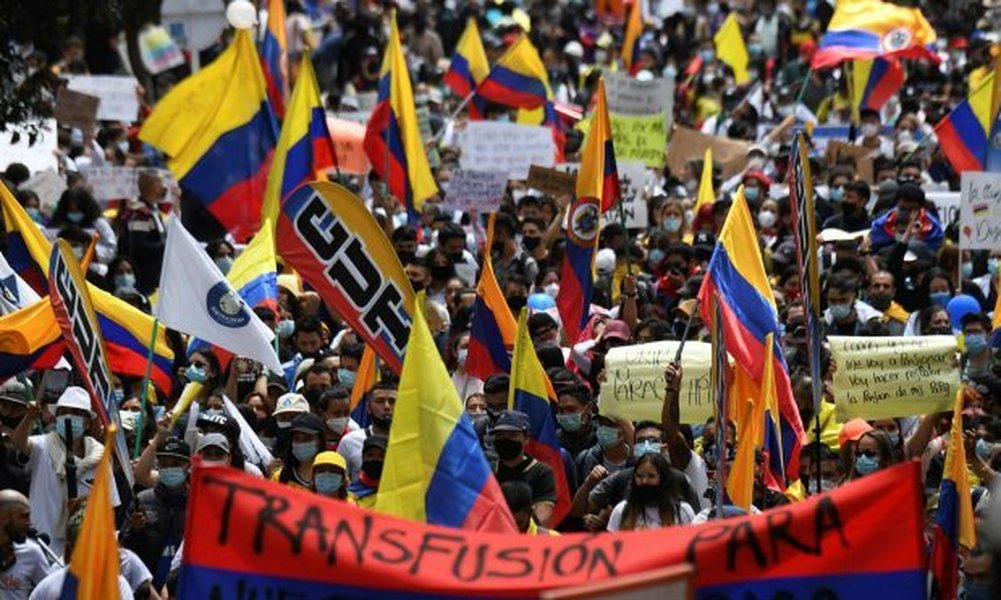
Citizens engaged in public demonstrations, reflecting the dynamic political discourse in Colombia.
The "Left Turn" of 2022 and Its Implications
The election of Gustavo Petro in June 2022 marked an unprecedented opening for the left in Colombia. Petro became the country's first-ever leftist president, promising to fight inequality and heralding a new political chapter. This shift was a culmination of several forces that weakened Colombia's historically strong political establishment, including growing anti-establishment sentiment and internal divisions within centrist and right-wing coalitions.
Petro's Agenda and Challenges
President Petro's government has pursued a radical populist agenda focused on social reforms, including proposed changes to labor and health sectors. He has also embarked on a "total peace" initiative, seeking negotiations with remaining armed groups like the ELN. However, his administration has faced significant challenges, including low approval ratings, political tensions, and resistance to his reforms in Congress. For example, the Senate rejected key labor and health reform proposals, indicating the strong checks and balances within Colombia's democratic system.
Assessment of Colombia's Political Stability and Ideological Leanings under recent administrations.
The radar chart above illustrates a comparative assessment of Colombia's political characteristics during the pre-Petro, predominantly right-leaning era, and the current Petro administration, which is characterized by a significant leftward shift. The "Democratic Institutions Strength" and "Stability Against Insurgency" axes reflect the resilience of Colombia's established democratic framework, which has consistently checked attempts at radical ideological transformation. The "Leftist Influence" axis clearly shows the heightened presence and policy push from the left under Petro, while "Economic Liberalization" indicates a potential shift away from previous market-oriented reforms. "Social Progress" and "Political Polarization" highlight ongoing societal dynamics and the increasing intensity of political divisions.
The Ongoing Debate and Future Outlook
Despite the "left turn," public sentiment can be fluid. Surveys indicate that President Petro is losing support among centrists, leading to a shift in public opinion. The political landscape remains dynamic, with ongoing debates over peace negotiations, security conditions, and economic policies. While the current government is pushing for transformative changes, the strength of Colombia's democratic institutions and its multi-party system means that a complete ideological overhaul towards communism is highly improbable.
Key Elements of Colombia's Political Evolution
To further contextualize Colombia's political trajectory, it's important to understand several key aspects of its governance and the dynamics that have shaped it.
| Aspect of Governance | Description | Relevance to Communism Question |
|---|---|---|
| Form of Government | Presidential representative democratic republic with a multi-party system. | Directly contradicts a single-party communist state model. Power is distributed, not concentrated. |
| Constitution (1991) | Strengthened justice administration, introduced civil liberties, and decentralized government. | Reinforces democratic principles and human rights, which are often curtailed in communist regimes. |
| Historical Political Dominance | Historically by Liberal and Conservative parties, later "Uribismo" (right-wing). | Shows a long history of non-communist, often centrist or right-wing, governance. |
| Leftist Movements/Guerrillas | Communist Party of Colombia (PCC), FARC, ELN, aiming for social justice and state power through various means. | While these groups existed and fought, they never seized control of the state to establish a communist system. The government consistently fought against them. |
| Gustavo Petro's Presidency (2022) | First leftist president, promising social reforms and peace initiatives. | Represents a democratic shift to the left, but within the established democratic framework, not a revolutionary overthrow. Faces institutional checks. |
| Political Polarization | Intense divisions between contending political camps, exacerbated by recent shifts. | A healthy democracy allows for diverse political views and robust debate, preventing a single ideology from dominating without opposition. |
| Media Freedom | Constitution guarantees freedom of expression; opposition views aired in media despite risks to journalists. | A hallmark of democratic societies, contrasting with the state-controlled media typical of communist regimes. |
Checks and Balances on Political Power
Colombia's robust system of checks and balances, enshrined in its 1991 Constitution, is a significant barrier to any single ideological faction, including communism, from unilaterally transforming the state. The independence of the judiciary, the bicameral legislature's ability to challenge executive proposals, and the vibrant multi-party system ensure that no single entity can dictate policy without broad consensus or compromise. The rejection of President Petro's labor and health reforms in the Senate is a clear demonstration of this institutional resilience.
The following video provides context on some of the political challenges and protests related to recent governmental reforms in Colombia:
Colombian President Gustavo Petro rallies supporters for his proposed labor and health reforms.
This video highlights the ongoing political mobilization in Colombia, where President Petro calls upon his supporters to back his reform proposals. Such public rallies and protests, whether in support or opposition, are characteristic of a democratic system where citizens actively participate in political discourse and pressure their elected officials. This engagement underscores the pluralistic nature of Colombian politics, far removed from the monolithic control of a communist state.
Conclusion: A Democratic Nation Navigating Change
In conclusion, Colombia is not, and has never been, a communist country. Its governmental structure is a democratic republic with a strong emphasis on separation of powers and a multi-party system. While the nation has a history of internal conflict involving groups that espoused communist ideologies, the state has consistently fought against them, and these groups never succeeded in establishing a communist regime.
The recent election of Gustavo Petro as Colombia's first leftist president represents a significant shift in the political landscape, reflecting a desire for social change and addressing inequality. However, this shift occurs within the established democratic framework, with robust checks and balances that prevent any singular ideology from transforming the country into a communist state. The ongoing political debates, parliamentary rejections of reforms, and shifting public sentiment all point to a vibrant, albeit at times turbulent, democratic system that continues to evolve.
Frequently Asked Questions (FAQ)
Is Colombia a communist country today?
Has Colombia ever been a communist country?
What is Colombia's current political system?
Who is the current president of Colombia and what is his political alignment?
Do communist groups still exist in Colombia?
Recommended Searches
- Explore Colombia's 1991 Constitution and its impact on democracy.
- Understand Gustavo Petro's political agenda and social reforms in Colombia.
- Delve into the history of armed conflict and peace processes in Colombia.
- Examine the current state of political polarization in Colombia.