
Comprehensive Guide to Energy: Changes, Transfers, and Conservation
Delving into the Dynamics of Energy in Physical Processes
Key Takeaways
- Diverse Energy Forms: Understanding the various forms of energy and their transformations is essential for analyzing physical phenomena.
- Energy Transfer Mechanisms: Energy can be transferred through mechanical work, electrical currents, heating, and waves, each playing a pivotal role in different processes.
- Conservation and Dissipation: The principle of energy conservation ensures that energy remains constant in a closed system, while energy dissipation explains the spread of energy into less useful forms.
Forms of Energy and Their Transformations
1. Kinetic Energy
Kinetic energy is the energy an object possesses due to its motion. It is mathematically expressed as:
KE = ½ mv²
where m is the mass of the object and v is its velocity. For instance, a moving car has kinetic energy that increases with both its mass and speed.
2. Gravitational Potential Energy
Gravitational potential energy is the energy stored in an object as a result of its position in a gravitational field. The formula to calculate it is:
ΔPE = mgh
where m is mass, g is the acceleration due to gravity, and h is the height above a reference point. For example, lifting a book onto a shelf increases its gravitational potential energy.
3. Chemical Energy
Chemical energy is stored in the bonds of chemical compounds and is released or absorbed during chemical reactions. An everyday example is the energy released when gasoline combusts in a vehicle's engine.
4. Elastic (Strain) Energy
Elastic energy is the energy stored in objects that are stretched or compressed. A stretched rubber band or a compressed spring holds elastic energy, which can convert back to kinetic energy when released.
5. Nuclear Energy
Nuclear energy is released during nuclear reactions, such as fission or fusion. A practical example is the energy produced in nuclear power plants through the fission of uranium atoms.
6. Internal Energy
Internal energy encompasses the total energy contained within a system, including the kinetic and potential energies of its particles. Changes in internal energy occur during processes like heating or cooling.
Energy Transfer Mechanisms
1. Mechanical Working
Mechanical working refers to energy transfer through forces acting over a distance. Pushing a shopping cart exerts a force that transfers energy from the person to the cart, causing it to move.
2. Electrical Working
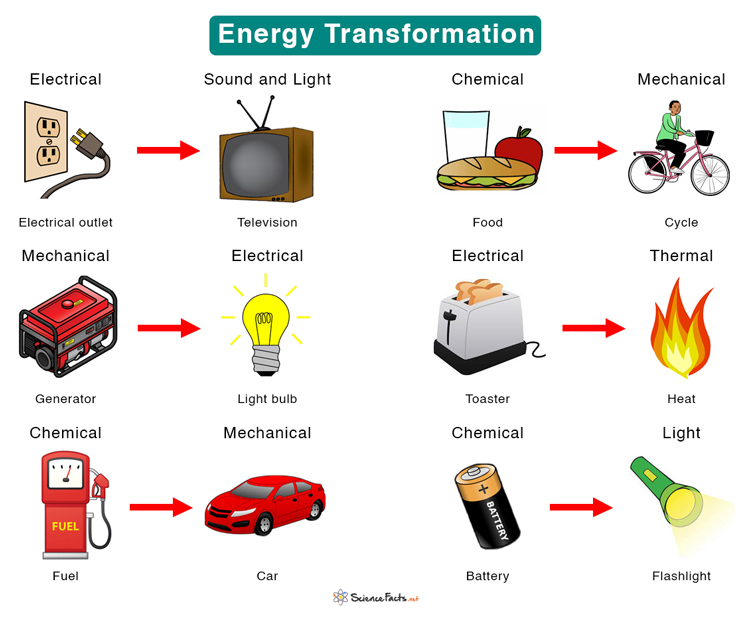
Electrical working involves the transfer of energy via electric currents. For example, a battery converts chemical energy into electrical energy to power a flashlight.
3. Heating
Heating is the transfer of thermal energy due to a temperature difference. Placing a hot cup of coffee on a cooler surface causes heat to transfer from the coffee to the cup, warming the surrounding air.
4. Waves
Waves transfer energy through oscillations without the physical movement of the medium. Sound waves carry energy through air, enabling us to hear, while electromagnetic waves transfer energy through space.
Conservation of Energy
Principle of Conservation of Energy
The principle of conservation of energy states that energy cannot be created or destroyed in an isolated system. Instead, energy transforms from one form to another while the total energy remains constant. This foundational concept allows for the analysis and prediction of energy changes in various processes.
Simple Examples
Pendulum: At the highest point of its swing, a pendulum has maximum gravitational potential energy and minimal kinetic energy. As it descends, potential energy converts to kinetic energy, reaching maximum kinetic energy at the lowest point. The cycle then reverses as it ascends again, illustrating energy conservation.
Roller Coaster: At the peak of a hill, the coaster has high gravitational potential energy. As it descends, this potential energy transforms into kinetic energy, increasing its speed. Throughout the ride, energy shifts between potential and kinetic forms, maintaining the total energy within the system.
Energy Formulas
1. Kinetic Energy Formula
Kinetic energy quantifies the energy of motion and is given by:
KE = ½ mv²
Where m is the mass and v is the velocity of the object. This formula highlights that kinetic energy increases with both mass and the square of velocity, making high-speed objects significantly more energetic.
2. Gravitational Potential Energy Formula
Gravitational potential energy calculates the energy due to an object's height in a gravitational field:
ΔPE = mgh
In this equation, m represents mass, g is the acceleration due to gravity, and h is the height change. This formula is crucial for understanding energy changes in scenarios like lifting objects or objects in free fall.
Conservation of Energy in Multi-Stage Processes
Definition and Explanation
In multi-stage processes, energy undergoes several transformations through different stages while adhering to the conservation principle. Analyzing such processes involves tracking energy conversions and ensuring that the total energy remains constant across all stages.
Example: Coal-Fired Power Plant
In a coal-fired power plant, the process begins with the chemical energy stored in coal. This chemical energy is first converted into thermal energy through combustion. The thermal energy heats water to produce steam, converting it into kinetic energy as the steam spins turbines. Finally, the kinetic energy of the turbines is transformed into electrical energy via generators. Throughout these stages, the total energy is conserved, though some energy is lost as heat due to inefficiencies.
Example: Hydroelectric Dam
A hydroelectric dam uses the gravitational potential energy of stored water. When water is released, its potential energy converts to kinetic energy as it flows downward. The moving water then drives turbines, converting kinetic energy into mechanical energy, which is finally transformed into electrical energy through generators. This multi-stage energy transformation exemplifies the conservation of energy across different forms.
Energy Dissipation
Explanation of Energy Spreading and Dissipation
Energy dissipation refers to the process by which energy spreads out and becomes less concentrated, often resulting in energy being transferred to less useful forms like heat. This phenomenon is a consequence of the second law of thermodynamics, which states that energy tends to disperse and systems move towards greater entropy.
Examples of Energy Dissipation
Bouncing Ball: When a ball bounces, not all its kinetic energy is conserved. Some energy is converted into heat and sound during each impact with the ground, causing the ball to lose height over successive bounces.
Car Engine: In a car engine, chemical energy from fuel is converted into kinetic energy for movement. However, not all energy is efficiently used for motion; a significant portion dissipates as heat due to friction and other inefficiencies.
Table: Energy Transformation and Dissipation Examples
| Process | Energy Transformation | Dissipated Energy |
|---|---|---|
| Pendulum Swing | Gravitational Potential Energy ↔ Kinetic Energy | Minimal energy loss due to air resistance and friction |
| Roller Coaster | Gravitational Potential Energy → Kinetic Energy | Energy lost to friction and air resistance |
| Bouncing Ball | Potential Energy → Kinetic Energy ↔ Elastic Potential Energy | Energy dissipated as heat and sound |
| Car Engine | Chemical Energy → Kinetic Energy | Energy lost as heat due to friction |
| Hydroelectric Dam | Gravitational Potential Energy → Kinetic Energy → Electrical Energy | Minor energy loss as heat through turbines |
Conclusion
Energy, in its various forms, is fundamental to understanding the physical world. Recognizing how energy changes, transfers, and conserves across different processes allows for the analysis and optimization of numerous systems, from simple mechanical devices to complex power plants. While the conservation of energy remains a steadfast principle, acknowledging the inevitability of energy dissipation highlights the importance of efficiency in energy-related applications.
References
Last updated February 12, 2025