
Unlocking the Essence of Nouns: Your Definitive Guide
Explore the foundational building blocks of language and master their diverse forms.
Key Insights into Nouns
- Nouns as Core Identifiers: At their heart, nouns are words that name people, places, things, or ideas, serving as the fundamental identifiers in any sentence.
- Diverse Classification: Nouns are not monolithic; they are categorized into various types like common, proper, concrete, abstract, countable, uncountable, and collective nouns, each with distinct grammatical rules and uses.
- Sentence Functionality: Beyond naming, nouns play crucial roles in sentences, often acting as the subject, object, or complement, and are essential for forming coherent thoughts.
Nouns are the bedrock of language, providing the names for everything we can perceive or conceive. From tangible objects and specific individuals to abstract concepts and groups, nouns give structure and meaning to our communication. Understanding the intricacies of nouns is crucial for both native speakers and those learning English, as they form a significant portion of the English vocabulary and underpin sentence construction.
Defining "Noun": More Than Just a Word
A noun is a word that functions as the name of a specific or general entity. This entity can be a person (e.g., man, Mary, teacher), a place (e.g., home, London, school), a thing (e.g., car, book, PlayStation 5), an animal (e.g., cat, dog, elephant), an event (e.g., birthday, conference), a substance (e.g., water, air), a quality (e.g., beauty, wisdom), a state (e.g., happiness, peace), or an action (e.g., yodeling, play). Essentially, if you can point to it, think about it, or imagine it, there's likely a noun for it.
Nouns are fundamental because they allow us to categorize and refer to the world around us. Without them, it would be impossible to distinguish between different elements in our thoughts or conversations. They are often preceded by articles like "a," "an," or "the," or other determiners such as "your" or "some," although they can also stand alone.
The Broad Spectrum of Noun Categories
Nouns come in many different forms, each with its own characteristics and grammatical rules. Recognizing these types helps in constructing grammatically correct and clear sentences.
Common Nouns: The Everyday Identifiers
Common nouns are general names for people, places, things, or ideas. They do not refer to a specific individual or item and are not capitalized unless they appear at the beginning of a sentence. Examples include city, girl, car, emotion. They are widespread and form the bulk of our daily vocabulary.
For instance, "The dog ran very fast." Here, "dog" is a common noun because it refers to any dog, not a specific one.
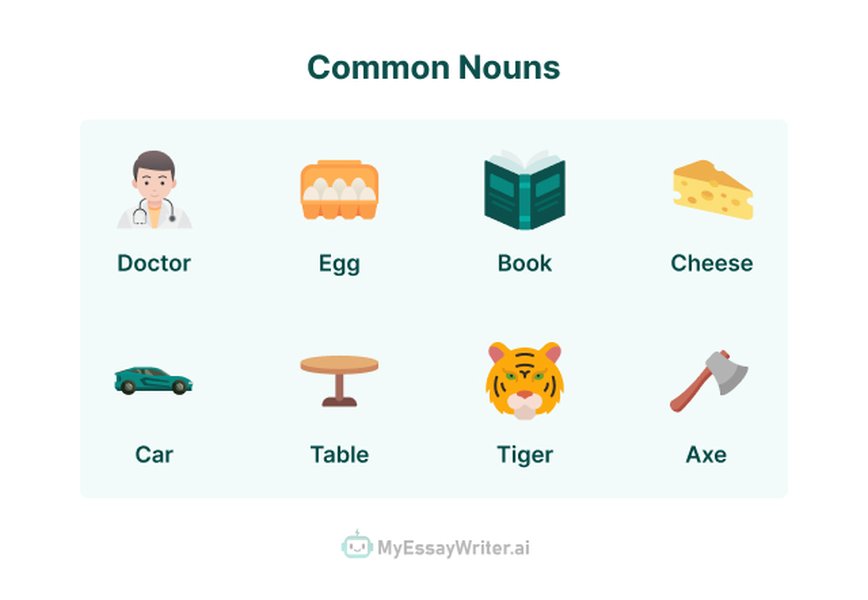
Common nouns name general categories of people, places, or things.
Proper Nouns: Specificity and Capitalization
In contrast to common nouns, proper nouns name specific people, places, organizations, or things. They are always capitalized. Examples include London, Sarah, Google, Mount Everest. Proper nouns allow for precise identification.
Consider the sentence: "Anya is traveling to France by train." Both "Anya" and "France" are proper nouns, indicating specific entities.
Concrete Nouns: Tangible Realities
Concrete nouns refer to things that can be perceived by the five senses: sight, sound, smell, touch, or taste. They have a physical existence. Examples include table, music, perfume, warmth, pizza.
These can be further divided into countable concrete nouns (e.g., suitcase, coin) and uncountable concrete nouns (e.g., luggage, money).
Abstract Nouns: Concepts and Qualities
Abstract nouns refer to ideas, qualities, states, or feelings that cannot be perceived by the senses. They have no physical form. Examples include happiness, freedom, intelligence, honesty, love.
For instance, "Sarah has a lot of intelligence." "Intelligence" is an abstract noun, representing a quality.
Countable and Uncountable Nouns: Quantity in Language
Countable nouns (or count nouns) are nouns that can be counted and have both singular and plural forms (e.g., apple/apples, chair/chairs). They can be preceded by numbers or quantifiers like "many" or "few."
Uncountable nouns (or mass nouns) cannot be counted individually and typically do not have plural forms (e.g., water, information, advice, furniture). They are often referred to using quantifiers like "much" or "some."
A common mistake is treating uncountable nouns as countable, such as saying "a research" instead of "some research" or "a piece of research."
Collective Nouns: Groups as Units
Collective nouns refer to a group of people, animals, or things as a single unit. Examples include team, family, flock, audience, committee. While referring to multiple individuals, they often take singular verbs in American English, treating the group as one entity. In British English, they can sometimes take plural verbs, emphasizing the individuals within the group.
For example, "The team works well together." Here, "team" is a collective noun acting as a singular unit.
The Multifaceted Roles of Nouns in Sentences
Nouns are not just labels; they play vital grammatical roles that dictate sentence structure and meaning. Understanding these functions is key to mastering sentence construction.
Subject of a Verb
The noun often acts as the subject of a verb, indicating who or what is performing the action. This is typically found at the beginning of a sentence.
Example: "The students learn about nouns." (Here, "students" is the subject)
Object of a Verb
Nouns can also function as the direct or indirect object of a verb, receiving the action of the verb or indicating to whom or for whom the action is performed.
Example (direct object): "He likes coffee." ("coffee" is the direct object)
Example (indirect object): "Esmée lends Bente the calculator." ("Bente" is the indirect object, "calculator" is the direct object)
Subject Complement or Object Complement
Nouns can serve as complements, providing more information about the subject or object.
Example (subject complement): "She is a teacher." ("teacher" complements "she")
Key Distinctions and Nuances of Nouns
While the primary definition of a noun is straightforward, there are important distinctions and nuances that enrich the English language.
Possessive Nouns
Possessive nouns show ownership or relationship. They are typically formed by adding an apostrophe and "s" ('s) to singular nouns, and often just an apostrophe (') to plural nouns ending in "s."
Examples: the baby's cries, the dog's bark, the girls' gift.
Compound Nouns
Compound nouns are formed by combining two or more words to create a single noun. These can be written as one word (e.g., sunlight, keyboard), two separate words (e.g., washing machine, living room), or hyphenated (e.g., sister-in-law, well-being).
Nouns Functioning as Other Parts of Speech
One fascinating aspect of English is the flexibility of words. A word that is typically a noun can sometimes function as a verb or an adjective depending on the context. For example, "play" can be a verb ("My kids are going outside to play") or a noun ("I am going to watch a play"). Similarly, "money" is a noun, while "monetary" is its adjective form.
Visualizing Noun Characteristics
To better grasp the multifaceted nature of nouns, let's look at a radar chart comparing different types of nouns based on common linguistic attributes. This chart provides an opinionated analysis to highlight their typical characteristics.
This radar chart illustrates how different noun types score on various attributes. For example, Proper Nouns score high on "Capitalization Required" but low on "Refers to a Group," while Collective Nouns excel in "Refers to a Group" but may have lower "Capitalization Required" unless they are part of a specific name.
Understanding "Site" as a Noun
The word "site" is an excellent example of a common noun that refers to a specific type of place. It denotes the spatial location of an actual or planned structure, or where something happened or is intended to happen. It can refer to a physical location like a construction site or an archaeological site, or a virtual location like a "website."
In its noun form, "site" can be used in various contexts:
- "They visited the site of the ancient ruins." (Physical location)
- "A site has been chosen for the new school." (Planned location)
- "Our company's website provides detailed information." (Virtual location)
The flexibility of "site" as a noun demonstrates how these fundamental words adapt to evolving communication needs, from physical spaces to digital realms.
This video provides an engaging introduction to common and proper nouns, explaining their differences with clear examples for young learners. It visually reinforces the concepts discussed, making it easier to distinguish between general categories and specific names in English grammar.
Common Nouns in English: A Comprehensive Overview
To further solidify understanding, here's a table illustrating some of the most common nouns in English, categorized by their primary function and providing examples of their usage. This table demonstrates the versatility and prevalence of nouns in everyday language.
| Category | Common Noun Example | Usage Example | Proper Noun Equivalent (if applicable) |
|---|---|---|---|
| People | man | The man who found the wallet returned it. | John |
| Places | school | The school is closed today. | Harvard University |
| Things | book | She is reading a good book. | The Great Gatsby |
| Ideas/Concepts | love | Love makes the world go round. | (No direct proper noun equivalent) |
| Time | day | Every day is a new opportunity. | Monday |
| Animals | cat | The cat chased the mouse. | Whiskers |
| Actions | run | The long run was exhausting. | (No direct proper noun equivalent) |
| Qualities | beauty | Her beauty was undeniable. | (No direct proper noun equivalent) |
| Organizations | company | The company announced new policies. | Microsoft |
This table highlights how common nouns provide general descriptions, while proper nouns offer specific identification. The ability to distinguish between these and other noun types is fundamental to grammatical precision.
Frequently Asked Questions About Nouns
What is the simplest definition of a noun?
Do all nouns refer to tangible things?
Why is it important to learn different types of nouns?
Can a word be both a noun and a verb?
Are the names of seasons capitalized?
Conclusion
Nouns are indispensable components of the English language, serving as the primary means by which we name and categorize the world. From the common objects of our daily lives to the abstract concepts that shape our thoughts, nouns provide the linguistic framework for meaningful expression. By understanding their various types—common, proper, concrete, abstract, countable, uncountable, and collective—and their diverse roles within sentences, speakers and writers can achieve greater precision, clarity, and richness in their communication. Mastering nouns is not merely a grammatical exercise; it is a fundamental step toward fluent and effective engagement with the English language.
Recommended Further Exploration
- How are verbs different from nouns?
- What are the rules for pluralizing nouns in English?
- How do adjectives modify nouns?
- Examples of noun phrases in complex sentences