
The Evolution of Computers: From Ancient Counting Tools to Modern Technology
A comprehensive journey through the milestones of computing history
Key Takeaways
- Foundation in Ancient Tools: Early computing began with simple devices like the abacus, laying the groundwork for systematic numerical computation.
- Technological Milestones: Innovations such as the mechanical calculator, transistor, and integrated circuits significantly advanced computing capabilities.
- Modern Advancements: The rise of personal computers, the internet, and artificial intelligence has transformed computing into an integral part of daily life.
1. Ancient Counting Tools
1.1 The Abacus
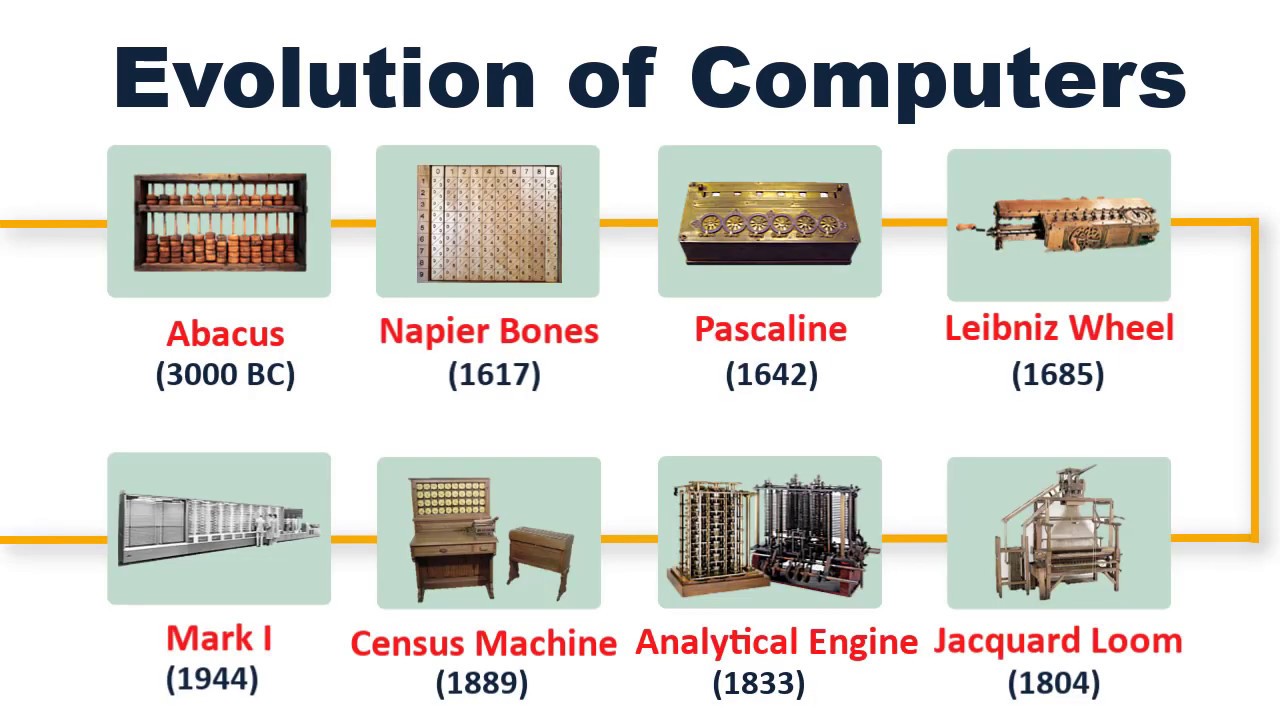
The abacus, originating around 2400 BC in Mesopotamia, is one of the earliest known computing devices. It consists of beads on rods that can perform basic arithmetic operations such as addition, subtraction, multiplication, and division. The abacus was widely used across ancient civilizations, including Mesopotamia, China, and Egypt, enabling efficient numerical calculations and laying the foundational principles for systematic computation.
1.2 Tally Sticks and Counting Rods
Beyond the abacus, other early methods like tally sticks and counting rods were employed for accounting and record-keeping. These simple tools involved marking counts on bones, sticks, or other materials, allowing societies to track resources and transactions effectively. Such innovations were crucial for the development of trade, governance, and societal organization.
2. Mechanical Calculating Devices (17th-19th Centuries)
2.1 Early Mechanical Calculators
The transition from manual to mechanical computation began in the medieval and Renaissance periods. Pioneers like Blaise Pascal and Gottfried Wilhelm Leibniz developed early mechanical calculators. Pascal's Pascaline, introduced in 1642, was capable of performing addition and subtraction. Leibniz's stepped reckoner improved upon this by enabling multiplication and division, pushing the boundaries of mechanical calculation.
2.2 Charles Babbage and the Engines
In the early 19th century, Charles Babbage conceptualized the Difference Engine and the Analytical Engine. The Difference Engine, designed in the 1820s, was intended to automate the calculation and printing of mathematical tables. Although it was never fully realized during Babbage's lifetime, it represented a significant leap towards general-purpose computing. The Analytical Engine, conceived in 1833, is often regarded as the first design for a programmable computer, featuring concepts such as conditional branching and looping.
2.3 Ada Lovelace's Contributions
Ada Lovelace, working alongside Babbage, is credited with writing the first algorithm intended for the Analytical Engine in 1848. Her work laid the foundation for software programming, emphasizing the machine's potential beyond mere calculation, envisioning applications in various fields like music and art.
3. Early Electromechanical and Electronic Computers (Early 20th Century)
3.1 Electromechanical Innovations
The early 20th century saw the advent of electromechanical computers. Herman Hollerith's Tabulating Machine, introduced in 1890, utilized punch cards for processing census data, significantly reducing the time required for data analysis. Similarly, Konrad Zuse developed the Z1 computer in 1941, an early programmable computing device that laid the groundwork for subsequent digital computers.
3.2 The Advent of Electronic Computers
The mid-20th century marked a pivotal shift with the development of electronic computers. ENIAC (Electronic Numerical Integrator and Computer), completed in 1946 by John Mauchly and J. Presper Eckert, was one of the first general-purpose electronic digital computers. Utilizing vacuum tubes, ENIAC was capable of a wide range of calculations, though it was large, power-hungry, and primarily used for military applications during World War II.
3.3 The Role of Vacuum Tubes
Vacuum tubes were essential components in early electronic computers, facilitating the amplification and switching necessary for computation. However, their size, heat generation, and unreliability posed significant challenges, limiting the scalability and performance of early electronic machines.
4. The Transistor and Integrated Circuit Era (1950s-1970s)
4.1 The Invention of the Transistor
In 1947, the invention of the transistor by William Shockley, John Bardeen, and Walter Brattain at Bell Labs revolutionized computing. Transistors replaced bulky vacuum tubes, enabling the creation of smaller, more reliable, and energy-efficient computers. The first transistorized computer, developed at the University of Manchester in 1953, demonstrated the potential for more compact computing systems.
4.2 Development of Integrated Circuits
The introduction of integrated circuits (ICs) in 1958 by Jack Kilby and Robert Noyce further miniaturized computing components by combining multiple transistors and other components onto a single chip. This innovation dramatically reduced the size and cost of computers while significantly increasing their processing power and reliability. Integrated circuits paved the way for the development of more advanced computers and the eventual rise of microelectronics.
4.4 Impact on Computer Design
With transistors and integrated circuits, computers became more accessible and versatile. Mainframe computers became prevalent in businesses and research institutions, enabling complex data processing and scientific calculations. The miniaturization of components also led to the development of minicomputers, which offered more affordable and flexible solutions for smaller organizations.
5. Personal Computer Revolution (1970s-1990s)
5.1 The Rise of Microprocessors
The invention of the microprocessor in the early 1970s, a compact integrated circuit serving as the "brain" of a computer, was a key milestone in the personal computer (PC) revolution. Companies like Intel played a crucial role with their pioneering microprocessors, which enabled the creation of affordable and compact personal computers.
5.2 Iconic Personal Computers
Early personal computers such as the Apple II (1977), the Commodore PET, and the IBM PC (1981) brought computing power into homes and small businesses. These machines featured user-friendly designs, expanding access to computing technology beyond large institutions. The introduction of graphical user interfaces (GUIs) and operating systems like Microsoft Windows and Apple Macintosh further enhanced usability and accessibility.
5.4 Software and User Interface Innovations
Advancements in software, including the development of operating systems and application programs, made computers more practical and user-friendly. GUIs allowed users to interact with computers through visual indicators like windows, icons, and menus, simplifying tasks and making computing more intuitive. This user-centric approach significantly broadened the appeal and adoption of personal computers.
6. The Networked Age and Modern Computing (1990s-Present)
6.1 The Internet and Connectivity
The development of the Internet in the late 20th century transformed computing by enabling global connectivity and information sharing. The Internet facilitated the rise of online services, e-commerce, and social media, making computers essential tools for communication and information access. Networking technologies evolved rapidly, supporting the creation of vast digital ecosystems and interconnected systems.
6.2 Mobile and Ubiquitous Computing
The advent of smartphones, tablets, and wearable devices has made computing devices highly portable and integrated into daily life. Mobile computing allows users to perform a wide range of tasks on the go, from browsing the web and managing schedules to accessing cloud services and multimedia consumption. The Internet of Things (IoT) extends computing capabilities to everyday objects, enabling smart homes, automated systems, and enhanced data collection.
6.3 Advancements in Artificial Intelligence and Quantum Computing
Modern computing is being revolutionized by artificial intelligence (AI) and quantum computing. AI and machine learning algorithms are driving innovations in data analysis, robotics, natural language processing, and autonomous systems. Quantum computing, still in its developmental stages, promises to solve complex problems that are currently intractable for classical computers, potentially transforming fields like cryptography, materials science, and pharmaceuticals.
7. Impact on Society and Future Directions
7.1 Societal Transformation
The evolution of computers has profoundly impacted society by transforming how people work, communicate, and solve problems. Computers have enabled advancements in various fields, including science, medicine, education, and entertainment. They have also reshaped economies, creating new industries and changing job landscapes, while fostering globalization and interconnectedness.
7.2 Future Trends in Computing
Looking ahead, computing is poised to continue evolving with advancements in quantum computing, AI, and augmented reality (AR). These technologies promise to enhance computational capabilities further, enabling breakthroughs in complex problem-solving, immersive experiences, and intelligent systems. Additionally, the continued miniaturization and integration of computing devices will likely result in even more pervasive and seamless technological integration into everyday life.
7.3 Ethical and Societal Considerations
As computing technology advances, it raises important ethical and societal considerations. Issues such as data privacy, cybersecurity, the digital divide, and the ethical use of AI are critical areas that require ongoing attention. Ensuring that technological advancements benefit society as a whole while mitigating potential risks is essential for responsible and sustainable progress in computing.
Conclusion
The evolution of computers from ancient counting tools to the sophisticated devices of today is a testament to human ingenuity and the relentless pursuit of innovation. Starting with the abacus and progressing through mechanical calculators, electromechanical systems, and electronic computers, each technological leap has expanded the capabilities and accessibility of computing. The personal computer revolution democratized computing power, while the internet and mobile technologies have made it an integral part of everyday life. As we venture into the future with AI and quantum computing, the trajectory of computing continues to promise transformative advancements, shaping the way we live, work, and interact with the world.
References
Last updated February 12, 2025