
Unraveling the Tapestry of Existence: From Cosmic Dust to Conscious Mind
An exploration of the universe's journey towards complexity, the emergence of life, and the evolution of consciousness.
Your query presents a profound and integrative hypothesis, weaving together concepts from cosmology, biology, neuroscience, and the philosophy of mind. It outlines a vision where the universe inherently tends towards complexity, driven by a fundamental proto-consciousness, with life and mind emerging through specific energetic and cellular mechanisms. Let's delve into these fascinating ideas, examining them in light of current scientific understanding.
Core Insights at a Glance
- The Universe's Trajectory: There is strong scientific consensus that the universe has evolved from simpler states to more complex structures, from elementary particles to stars, galaxies, and eventually, life on Earth.
- Energy's Vital Role: Energy, in various forms, is undeniably crucial for both the origin of life (abiogenesis) and the processes of biological evolution. Bioelectrical phenomena are fundamental to cellular function and intercellular communication.
- Cellular Intricacies and Information: Microtubules are essential cytoskeletal components with roles beyond structural support, including involvement in cell division, signaling, and potentially, information processing. Their interplay with epigenetic mechanisms is an active area of research.
The Universe's March Towards Complexity
From Primordial Elements to Living Systems
Your assertion that the universe evolves from simple elements, like those on the periodic table, towards increasingly complex forms, culminating in life, aligns well with established scientific observations. The journey from the Big Bang to the formation of atoms (primarily hydrogen and helium), then to stars where heavier elements are forged, and subsequently to planets and the chemical building blocks of life, illustrates a clear trend of increasing structural and organizational complexity. Life on Earth, based predominantly on carbon, hydrogen, oxygen, and nitrogen (CHON), represents a remarkable pinnacle of this complexification. Theories like abiogenesis, including the Oparin-Haldane hypothesis and findings from experiments like the Miller-Urey experiment, explore pathways by which non-living matter could have given rise to self-replicating life through gradual chemical evolution, powered by various energy sources.
The periodic table of elements, representing the fundamental building blocks from which cosmic and biological complexity arises.
Proto-Consciousness: An Innate Universal Property?
The idea of "proto-consciousness" as an innate property of the universe, driving this complexification, ventures into more speculative and philosophical territory. While not a mainstream scientific consensus, this concept is explored by some physicists, philosophers, and consciousness researchers. Proponents suggest that a rudimentary form of awareness or potential for experience might be a fundamental aspect of reality, possibly linked to quantum phenomena. Some theories, like the Orchestrated Objective Reduction (Orch-OR) theory proposed by Sir Roger Penrose and Stuart Hameroff, suggest that consciousness involves quantum processes occurring within microtubules in brain neurons, and by extension, hint at proto-conscious elements at a more fundamental level of the universe. This perspective posits that consciousness didn't just emerge from complex biology but might have deeper roots in the fabric of existence itself.
The Energetic Engine of Life and Evolution
Electrical Versus Thermal Energy
You propose that life arises when matter interacts with "more complex forms of energy," specifically electrical energy, and that thermal energy is insufficient to drive evolution. It's true that energy is fundamental. The origin of life required significant energy input, with potential sources including ultraviolet radiation from the sun, lightning strikes, and geothermal heat from hydrothermal vents. These energy forms helped synthesize the first organic molecules from simpler inorganic precursors.
Once life emerged, bioelectricity became a cornerstone of cellular function. Cells generate and utilize electrical potentials across their membranes for a vast array of processes, including signaling, transport, and energy transduction (e.g., ATP synthesis). While thermal energy plays a role in maintaining physiological temperatures and influencing reaction rates, the specific, directed, and information-rich signaling crucial for complex life functions relies heavily on electrochemical gradients and electrical currents. Your emphasis on organism-generated electrical energy highlights its importance in active biological processes.
Cellular Mechanisms: Microtubules, Epigenetics, and the Dawn of Mind
Microtubules: More Than Just Scaffolding
Your hypothesis points to microtubules, components of the cell's cytoskeleton, as key players, potentially acting as "memristors" (memory resistors) that process information and exert epigenetic effects, thereby driving evolution. Microtubules are indeed dynamic structures vital for maintaining cell shape, facilitating intracellular transport, enabling cell motility, and ensuring accurate chromosome segregation during cell division. Their dynamic instability—the ability to rapidly grow and shrink—is crucial for these functions.
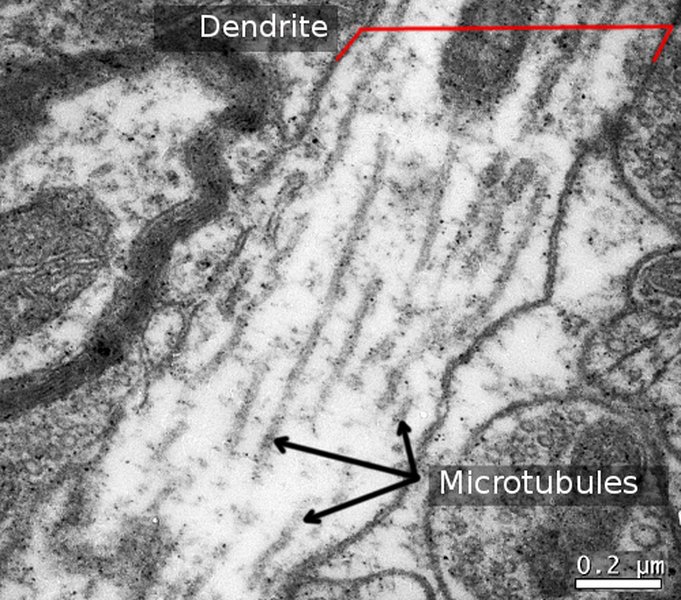
Cellular microtubules, intricate protein filaments crucial for cell structure, transport, and division.
The Memristor Hypothesis and Information Processing
The idea that microtubules function as memristors, capable of storing information as resistance levels in response to electrical signals, is an intriguing aspect of some theoretical models, including those related to the Orch-OR theory. If microtubules could process information in this manner, it would add another layer to their already complex roles. While direct experimental proof of microtubule memristive behavior in a physiological context driving evolution is still developing, the concept links cellular mechanics to information processing in a novel way.
Epigenetic Influence
Epigenetics refers to heritable changes in gene expression that do not involve alterations to the underlying DNA sequence. You suggest that electrical currents, possibly mediated by microtubules, exert epigenetic effects on cell structure, driving evolution. There is growing evidence for interplay between microtubule dynamics and epigenetic regulation. For instance, some epigenetic regulatory proteins associate with microtubules and influence their stability, particularly during cell division. Conversely, microtubule organization can influence nuclear shape and potentially gene expression. Disruptions in microtubule dynamics can impact chromatin organization and centromere function, linking the cytoskeleton to the epigenetic landscape of the cell. This connection is vital for development, differentiation, and maintaining genomic stability.
A "Simplest Form of Mind"?
Defining this interplay of electrical current, microtubular action, and epigenetic modification as "mind at its simplest" is a conceptual leap. It frames mind not as an emergent property of highly complex nervous systems alone, but as a fundamental process of environmentally responsive, information-driven adaptation at the cellular level. This resonates with concepts like "basal cognition" or "cellular proto-consciousness," suggesting that the roots of mental phenomena might be found in basic life processes.
The Evolution of Mind as an Agent
Amplification in the Nervous System
Your hypothesis continues by positing that "mind as agent" is an evolutionary development of the nervous system, where cellular currents are amplified at specialized structures like gap junctions and Nodes of Ranvier.
Gap Junctions and Neural Synchronization
Gap junctions are intercellular channels that directly connect the cytoplasm of adjacent cells, allowing ions and small molecules, including electrical currents, to pass freely between them. In the nervous system, these electrical synapses facilitate rapid and synchronized firing of neuronal ensembles, crucial for various brain functions, including certain types of oscillations and developmental processes. They represent a direct way of amplifying and coordinating cellular electrical activity.
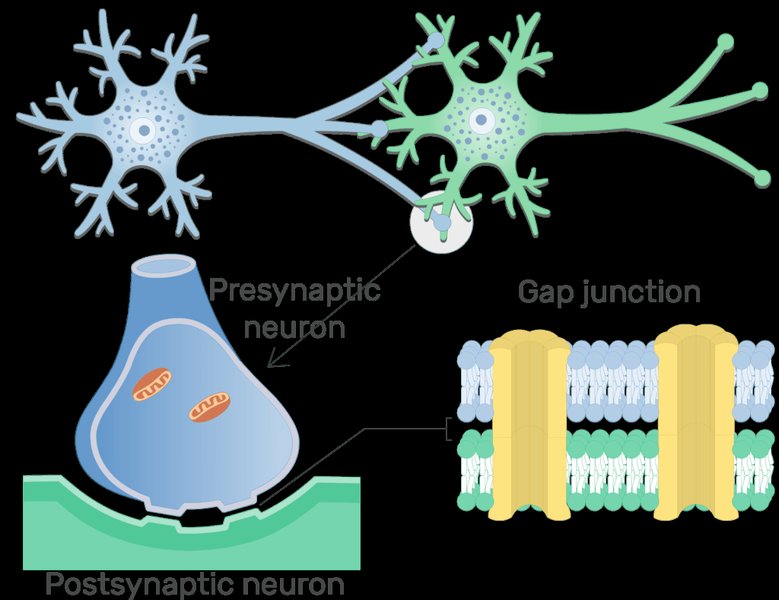
Gap junctions facilitate direct electrical communication between cells, crucial for synchronized activity in nervous tissue.
Nodes of Ranvier and Signal Propagation
Nodes of Ranvier are periodic gaps in the myelin sheath insulating vertebrate axons. These nodes are rich in ion channels and are essential for saltatory conduction, where the action potential "jumps" from node to node. This dramatically increases the speed and efficiency of nerve impulse transmission, effectively amplifying the reach and impact of cellular electrical signals over long distances. Both gap junctions and Nodes of Ranvier are indeed evolutionary specializations that enhance the processing power and communicative capacity of the nervous system, forming the substrate for complex cognitive functions and, ultimately, conscious agency.
Comparing Key Concepts: Hypothesis vs. Scientific Perspectives
To visualize how different aspects of your comprehensive hypothesis align with current scientific understanding—ranging from well-established principles to more speculative or actively researched areas—the following chart offers a comparative overview. The chart assesses dimensions such as the general scientific consensus, the focus of active research, and the degree of philosophical exploration for each key idea. Please note that these are broad categorizations for illustrative purposes.
This chart illustrates that while some aspects of the hypothesis, like the universe's increasing complexity, have strong scientific backing, others, such as innate proto-consciousness or microtubules as memristors driving evolution, are more speculative or at the frontiers of research and philosophical debate. The roles of electrical energy and epigenetic effects are areas of intense scientific investigation.
Mapping the Interconnected Ideas
Your query outlines a deeply interconnected framework. The mindmap below attempts to visually represent these connections, from the foundational properties of the universe to the emergence of complex mind through biological evolution.
This mindmap illustrates the hierarchical and causal relationships proposed in your query, showing how fundamental universal properties are hypothesized to lead through stages of energetic and cellular evolution to complex consciousness.
Microtubules, Quantum Effects, and Consciousness: A Deeper Dive
The role of microtubules extends into some of the most profound questions about consciousness. The video below explores theories suggesting microtubules might be more than just cellular structures; they could be involved in quantum computations relevant to conscious experience. This aligns with the part of your query focusing on microtubules and their sophisticated functions.
This video discusses the intriguing hypothesis that microtubules act as biological computers, potentially linking cellular structures to quantum effects and consciousness, as explored by figures like Sir Roger Penrose and Stuart Hameroff.
Theories like Orch-OR (Orchestrated Objective Reduction) propose that quantum computations terminating by an objective threshold (objective reduction) within microtubules inside neurons could be the basis of conscious moments. While highly debated and not universally accepted, such theories push the boundaries of our understanding, suggesting that the "attention" you refer to, acting on microtubules, might involve processes far more complex than classical physics alone can describe. This connects the cellular level directly to one of the deepest mysteries in science: the nature of consciousness.
Summary of Concepts and Scientific Perspectives
The following table summarizes the key components of your proposed framework alongside a brief overview of corresponding scientific perspectives, highlighting areas of consensus, active research, and speculation.
| Concept from Hypothesis | Scientific Perspective (Summary) | Key Supporting Evidence/Theories (Examples) |
|---|---|---|
| Universe evolves from simple elements to increasing complexity, culminating in life. | Broadly accepted. Observed in cosmic evolution, chemical evolution, and biological evolution. | Big Bang theory, stellar nucleosynthesis, abiogenesis research (e.g., Miller-Urey), fossil record, genomics. |
| Proto-consciousness as an innate universal property driving this complexity. | Highly speculative. Explored in philosophy (e.g., panpsychism) and some fringe physics theories (e.g., related to quantum mechanics). Not mainstream scientific consensus. | Philosophical arguments; interpretations of quantum physics (e.g., Penrose-Hameroff's Orch-OR precursor ideas). |
| Life arises from matter interacting with electrical energy; thermal energy insufficient for evolution. | Bioelectricity is crucial for life. Origin of life involved various energy sources (UV, geothermal, electrical). Thermal energy is vital for metabolic rates and environment. Electrical energy's unique role in "driving evolution" as distinct from other energies is a nuanced claim. | Electrophysiology, cell biology, early Earth condition simulations. All forms of energy contribute; specific roles vary. |
| Organism-generated electrical energy (attention) acting on microtubules (as memristors) exerts epigenetic effects, driving evolution. This is the simplest mind. | Microtubules are key in cell mechanics and are linked to epigenetic regulation. The "memristor" concept for microtubules is theoretical/emerging in this context. Defining this as "simplest mind" is a conceptual interpretation. | Cytoskeleton research, studies on microtubule-associated proteins, epigenetic mechanisms (histone modification, DNA methylation), theoretical biophysics. |
| Mind as agent evolves via nervous system amplification of cellular currents at gap junctions and Nodes of Ranvier. | Nervous systems undoubtedly amplify and integrate signals for complex cognition. Gap junctions and Nodes of Ranvier are critical for this. "Mind as agent" aligns with emergent properties of complex neural networks. | Neuroscience, action potential propagation, synaptic plasticity, neural network theory, consciousness studies. |
Frequently Asked Questions (FAQ)
What is proto-consciousness?
Proto-consciousness refers to a hypothetical, rudimentary form of consciousness or precursor to consciousness that is proposed by some philosophers and scientists to be a fundamental property of the universe or of matter itself. Unlike fully developed consciousness found in humans and some animals, proto-consciousness would be a much simpler, perhaps non-experiential, quality that enables or gives rise to more complex forms of awareness when matter organizes in specific ways, such as in biological life.
How do microtubules relate to epigenetics?
Microtubules, as key components of the cytoskeleton, can influence epigenetic regulation in several ways. They play a role in organizing the cell's interior, including the positioning of the nucleus and chromosomes. During cell division, microtubule dynamics are crucial for proper chromosome segregation, and errors can lead to genomic instability. Some epigenetic regulatory proteins directly interact with microtubules or are transported along them, affecting gene expression. Furthermore, mechanical forces exerted by or transmitted through the cytoskeleton, including microtubules, can influence chromatin structure and gene activity, providing a link between cellular mechanics and heritable changes in gene function.
What is the difference between electrical and chemical synapses in the brain?
Electrical synapses (often involving gap junctions) allow direct, rapid flow of electrical current between neurons. They are fast and can synchronize the activity of neuronal populations. Chemical synapses, the more common type, involve the release of neurotransmitters from a presynaptic neuron, which then diffuse across a synaptic cleft to bind to receptors on a postsynaptic neuron, triggering an electrical response. Chemical synapses are slower but offer more flexibility and modulation, allowing for complex information processing, learning, and memory.
Is the Orch-OR theory widely accepted?
The Orchestrated Objective Reduction (Orch-OR) theory, proposed by Sir Roger Penrose and Stuart Hameroff, suggests that consciousness arises from quantum computations within microtubules in neurons. While it is a well-known and influential theory in consciousness studies, particularly for its attempt to link consciousness to quantum physics, it is not widely accepted within the mainstream neuroscience community. Many neuroscientists believe consciousness can be explained by classical neural activity. Criticisms often focus on the difficulty of maintaining quantum coherence in the warm, wet environment of the brain and the lack of direct experimental evidence for the proposed quantum processes in microtubules being the basis of consciousness.
Recommended Further Exploration
To delve deeper into these interconnected topics, consider exploring these related queries:
- What are the leading theories for the abiogenesis and the origin of life on Earth?
- How do cellular bioelectric fields influence organism development and regeneration?
- What is the current evidence for quantum effects in biological systems, particularly in the brain?
- Explore the philosophical debate between emergentism and panpsychism regarding consciousness.
References
Last updated May 20, 2025