
Unraveling the Mystery: Is "Planet Polo Inversion" a Cosmic Enigma or a Terrestrial Tango?
Delving into the science of Earth's magnetic field flips and what they mean for our planet.
You've asked about "planet polo inversion." While this specific term doesn't appear in established scientific literature, it's highly probable that your query relates to a fascinating and very real phenomenon: geomagnetic reversal, often referred to as a planetary pole inversion. This process involves the dramatic swapping of a planet's magnetic north and south poles. Let's explore what this means, focusing on Earth, where this event is best studied.
Key Insights into Geomagnetic Reversals
- Earth's magnetic poles have flipped many times throughout its history, a natural process driven by dynamics deep within the planet's core.
- During a reversal, the magnetic field significantly weakens but doesn't vanish, leading to increased exposure to solar and cosmic radiation.
- While the magnetic north pole is currently shifting, scientists generally agree that a full reversal is not imminent in the immediate future.
What Exactly is a Geomagnetic Reversal?
Defining the Phenomenon: More Than Just a Compass Confusion
A geomagnetic reversal is a change in a planet's magnetic field such that the positions of magnetic north and magnetic south are interchanged. It's crucial to distinguish these magnetic poles from the geographic poles, which are defined by Earth's axis of rotation. While your compass would point south instead of north (and vice-versa) after a full reversal, the planet itself wouldn't physically flip over. This phenomenon is a fundamental aspect of planetary science, driven by processes deep within Earth.
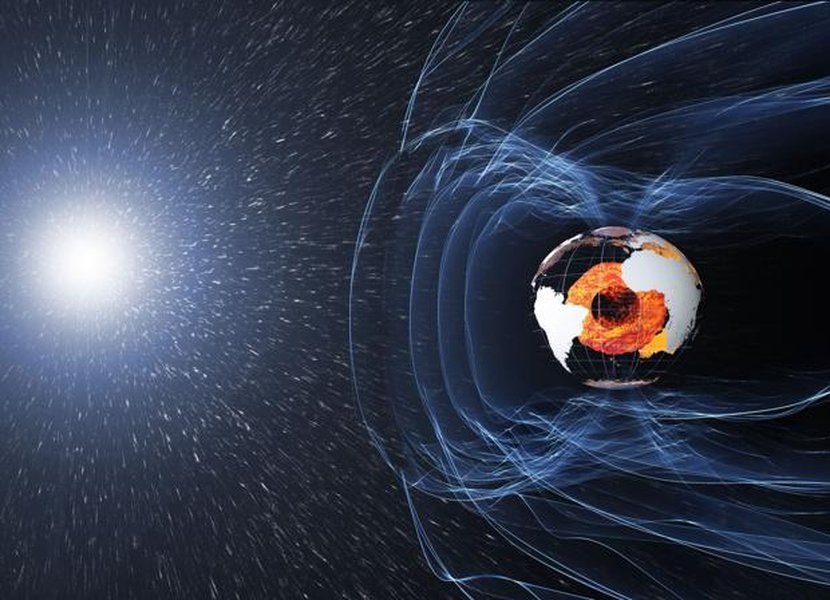
An artist's depiction of Earth's magnetosphere deflecting solar wind, showcasing the protective shield generated by our planet's magnetic field.
The Engine Behind the Flip: Earth's Fiery Outer Core
Earth's magnetic field is generated by the geodynamo, a process involving the convective movement of molten iron and nickel in its outer core. This flow of electrically conductive fluid creates electric currents, which in turn produce the magnetic field. Fluctuations and complex, sometimes chaotic, changes in this flow can cause the magnetic field to weaken, become more complex (with multiple "north" and "south" poles appearing temporarily across the globe), and eventually reorganize itself into the opposite polarity. This isn't a sudden event but a gradual process unfolding over thousands of years.
The Historical Record: Earth's Magnetic Field's Tumultuous Past
A Look Back in Time: Paleomagnetism Reveals Ancient Flips
Scientists know about past reversals by studying paleomagnetism – the record of Earth's magnetic field preserved in rocks, sediments, and archaeological materials. When volcanic rocks cool and solidify, or when sediments settle on the ocean floor, magnetic minerals within them align with the Earth's magnetic field at that time, acting like tiny fossilized compasses. These records show that Earth's magnetic field has reversed its polarity hundreds of times over geological history. The reversals are irregular and unpredictable; while the average interval is around 250,000 years, the actual time between them can vary greatly. The last full reversal, known as the Brunhes-Matuyama reversal, occurred approximately 780,000 years ago.
The Laschamps Excursion: A Recent Case Study
A more recent, though temporary, event was the Laschamps excursion, around 41,000 to 42,000 years ago. During this period, the magnetic field significantly weakened (dropping to as low as 5-28% of its current strength) and the poles briefly swapped before returning to their original configuration. This excursion lasted for about a millennium, with the actual polarity flip phase lasting a few hundred years. Studies of ancient kauri trees from New Zealand that lived through this period suggest significant environmental consequences, including climate disruptions, cooling in many regions, desertification, and advancements of ice sheets. The weakened shield also likely led to increased cosmic radiation reaching the surface, potentially contributing to atmospheric changes and impacting life.
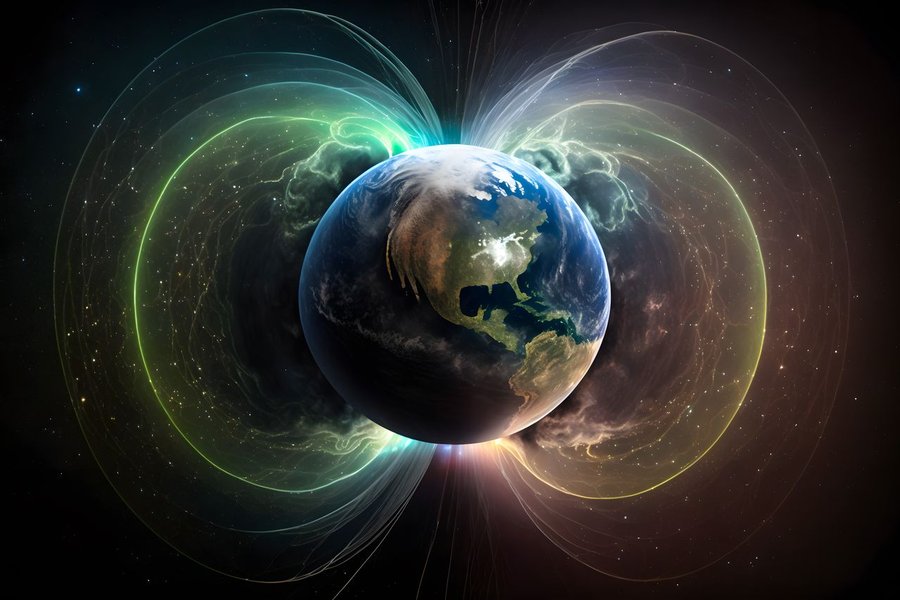
Conceptual art illustrating the dynamic and ever-changing nature of Earth's magnetic field lines.
Visualizing Geomagnetic Field Characteristics
To better understand the dramatic changes during a geomagnetic reversal, the radar chart below compares key planetary conditions during periods of a stable magnetic field, the general process of a reversal, and the specific impacts observed during an event like the Laschamps Excursion. The values are illustrative, representing relative changes rather than precise measurements, on a scale of 1 (low/stable) to 10 (high/unstable/intense).
This chart highlights how a weakening magnetic field (lower 'Magnetic Field Strength') leads to increased 'Cosmic Ray Exposure' and more widespread 'Global Aurora Visibility.' 'Climate Stability' tends to decrease, and for a technologically advanced civilization, 'Technological Risk' significantly increases due to vulnerabilities in satellites and power grids.
Consequences of a Magnetic Field Reversal
Weakening the Shield: Increased Radiation Exposure
The most direct consequence of a weakened magnetic field during a reversal is increased exposure to solar radiation (like solar winds and flares) and high-energy cosmic rays. Earth's magnetosphere acts as a shield, deflecting most of these harmful particles. A weaker shield means more radiation can penetrate the atmosphere and reach the surface. This could lead to increased rates of genetic mutation in organisms and pose risks to astronauts and high-altitude travelers.
Environmental and Climatic Shifts
Past events like the Laschamps excursion suggest that magnetic field changes can correlate with significant environmental shifts. These may include:
- Atmospheric Changes: Increased cosmic rays can alter atmospheric chemistry, potentially affecting ozone concentrations and cloud formation.
- Climate Disruptions: Some studies link magnetic weakening to periods of regional or even global cooling, changes in weather patterns, and glacier advancements.
- Enhanced Auroras: With a weaker and more complex magnetic field, auroras (Northern and Southern Lights) could become visible at much lower latitudes, potentially worldwide.
- Electrical Storms: Increased atmospheric ionization might lead to more frequent and intense electrical storms.
Technological Vulnerabilities in the Modern Era
For our modern, technology-dependent society, a geomagnetic reversal poses unique challenges. Our infrastructure is highly vulnerable to geomagnetic storms, which would likely intensify and become more frequent during a reversal:
- Satellites: GPS, communication, and weather satellites could be damaged or disabled by increased radiation and charged particles.
- Power Grids: Geomagnetically induced currents can overload power grids, leading to widespread blackouts.
- Navigation Systems: Systems relying on magnetic north would need recalibration, and increased space weather could disrupt radio-based navigation.
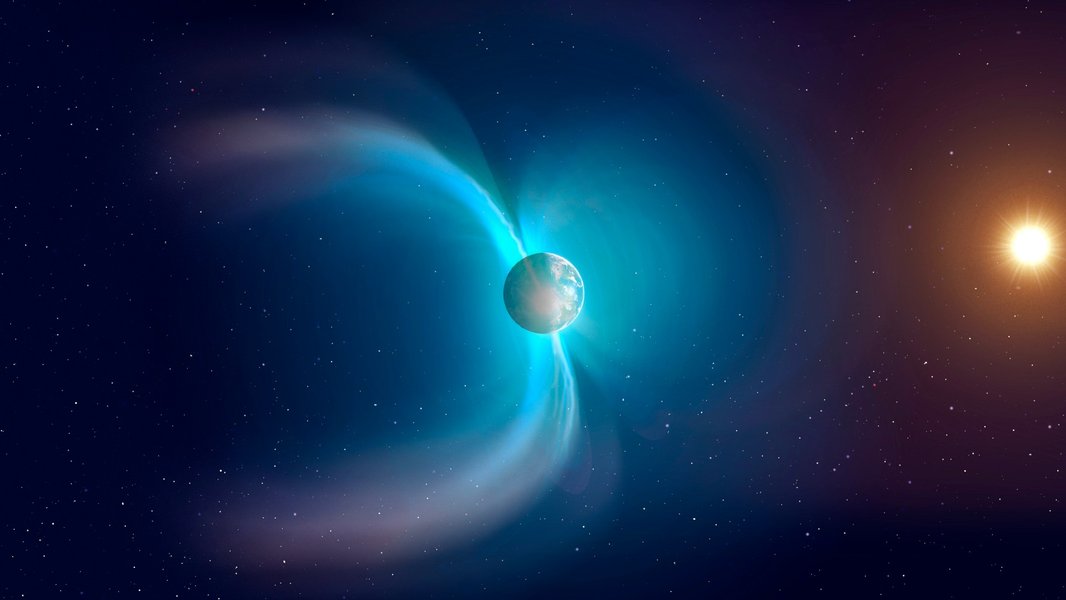
Illustration depicting Earth's magnetic field lines interacting with solar particles, a process that becomes more intense for the planet's surface and atmosphere during field weakening.
Impact on Life on Earth
While a pole reversal wouldn't be an extinction-level event in itself (life has survived many reversals), the associated environmental changes and increased radiation could pose significant stress to ecosystems and species. Some researchers speculate that the Laschamps excursion may have played a role in the extinction of Neanderthals or influenced human migrations, though these links are still debated.
Mapping the Concepts: Understanding Geomagnetic Reversals
The mindmap below provides a structured overview of geomagnetic reversals, connecting their causes, historical evidence, the process itself, the wide-ranging impacts, and the current scientific understanding. It helps to visualize how these different facets interrelate.
This mindmap illustrates the interconnectedness of various aspects of geomagnetic reversals, from the deep Earth processes that cause them to their far-reaching effects on the planet's environment and potentially its inhabitants.
Current Status and Future Outlook
Is a Reversal Imminent? What Scientists Say
As of May 10, 2025, Earth's magnetic north pole is known to be drifting from Canada towards Siberia at an accelerated pace. Additionally, there's a persistent area of magnetic field weakness known as the South Atlantic Anomaly. While these changes are significant and closely monitored, the scientific consensus is that they do not necessarily signal an impending full reversal. The Earth's magnetic field has undergone periods of rapid change and weakening in the past without leading to a complete flip. Scientists emphasize that predicting the exact timing of the next reversal is currently not possible, but it's not expected in the very near future (i.e., within the next few centuries). The current changes are seen as part of the normal, albeit complex, behavior of the geodynamo.
A Closer Look: Key Aspects of Geomagnetic Reversals
The table below summarizes some of the fundamental characteristics of geomagnetic reversals, offering a quick reference to their causes, timescales, and major implications.
| Characteristic | Description | Significance / Example |
|---|---|---|
| Definition | The interchange of a planet's magnetic north and south poles. | Earth's magnetic North pole effectively becomes the South pole, and vice-versa, from a compass perspective. |
| Primary Cause | Convective movements of electrically conductive molten iron and nickel in the planet's outer core. | This "geodynamo" effect generates and maintains the magnetic field; disruptions in flow lead to reversals. |
| Frequency | Irregular; historically, full reversals on Earth average roughly every 250,000 years, but with high variability and no set pattern. | The last full reversal (Brunhes-Matuyama) was approximately 780,000 years ago. Prediction is not currently possible. |
| Duration of Process | Typically spans thousands of years (e.g., from 2,000 to 12,000 years) from onset to completion. Temporary excursions can be shorter. | Involves gradual weakening, a phase of multipolar complexity, then re-establishment with opposite polarity. |
| Field Strength During Reversal | Significant weakening, potentially to 10-25% of normal strength, but not a complete disappearance of the field. | The Laschamps excursion saw Earth's field strength drop to as low as 5-28% of its present strength. |
| Key Consequence: Radiation | Reduced shielding from solar wind, solar flares, and galactic cosmic rays. | Increased radiation levels at Earth's surface and in the upper atmosphere. |
| Key Consequence: Environment | Potential for climate disruptions (e.g., cooling), increased global auroral activity, and more frequent/intense electrical storms. | The Laschamps excursion is linked to regional cooling, ozone layer changes, and atmospheric alterations. |
| Key Consequence: Technology | Modern reliance on technology (satellites for communication/GPS, power grids, navigation systems) makes society vulnerable. | Potential for widespread disruption of essential services and infrastructure. |
Magnetic Field Dynamics: Insights from the North Pole Shift
The behavior of Earth's magnetic field, including the ongoing shift of the magnetic North Pole, is a complex subject. The video below offers further insights into these dynamics, explaining some of the current observations and what they might imply (or not imply) about the future of our planet's magnetic shield. It helps contextualize the discussion around pole shifts and potential reversals.
This video discusses the movement of the magnetic North Pole and what scientists are learning from these observations. While the primary focus isn't solely on a full reversal, understanding these ongoing changes is crucial for comprehending the broader dynamics of Earth's magnetic field, including the very long-term processes that lead to pole flips. It underscores that the field is constantly changing, and phenomena like the polar drift are part of its natural behavior.
Geomagnetic Reversals Beyond Earth
The Sun's Rhythmic Flips
It's interesting to note that Earth isn't the only celestial body with a flipping magnetic field. Our Sun undergoes a magnetic pole reversal approximately every 11 years, coinciding with the peak of its solar activity cycle (solar maximum). This is a much more regular and rapid process than Earth's geomagnetic reversals and is driven by different mechanisms related to the Sun's plasma dynamics.
Magnetic Fields on Other Planets
Other planets in our solar system also have magnetic fields, though they vary greatly in strength and complexity. For example, Jupiter has an incredibly strong magnetic field. Evidence for past magnetic reversals on other planets is harder to obtain than for Earth, but it's an active area of planetary science research. Understanding how magnetic fields are generated and behave on different celestial bodies provides valuable context for studying our own planet's geodynamo.
Frequently Asked Questions (FAQ)
Is "planet polo inversion" a real scientific term?
"Planet polo inversion" is not a recognized term in scientific fields like geophysics or astronomy. It is most likely a misunderstanding or misspelling of "planetary pole inversion" or, more specifically, "geomagnetic reversal," which refers to the process where a planet's magnetic north and south poles switch places. This is a well-documented phenomenon, especially concerning Earth.
How do scientists study Earth's past magnetic field changes?
Scientists study past magnetic field changes primarily through paleomagnetism. This involves analyzing the magnetic properties of rocks, sediments, and archaeological materials. When volcanic lava cools and solidifies, or when fine-grained sediments settle on the ocean floor, magnetic minerals within them align with the Earth's magnetic field at that time, preserving a record of its direction and intensity. By dating these materials, scientists can reconstruct the history of Earth's magnetic field, including past reversals and excursions.
What would be the most significant impacts of a future magnetic pole reversal on humanity?
For modern civilization, the most significant impacts would likely be on our technology. A weakened magnetic field during a reversal would increase our vulnerability to solar storms and cosmic rays. This could:
- Disrupt or damage satellites, affecting GPS, communications, and weather forecasting.
- Induce powerful currents in power grids, leading to widespread blackouts.
- Interfere with navigation systems.
How long does it take for Earth's magnetic poles to flip?
A full geomagnetic reversal is a lengthy process, not an instantaneous event. It typically takes several thousand years from start to finish, with estimates ranging from about 2,000 to 12,000 years. During this time, the main dipole field weakens significantly, the magnetic field can become more complex (with multiple local poles), and eventually, it re-establishes itself with the opposite polarity. Shorter events, known as excursions (like the Laschamps excursion), where the poles temporarily flip or wander significantly before returning, can occur over shorter timescales, perhaps around a thousand years for the entire event, with the actual flip phase being a few centuries.
Given the average time between reversals, are we "overdue" for one?
The last full geomagnetic reversal occurred about 780,000 years ago. Historically, the average interval between reversals has been around 200,000 to 300,000 years. This leads some to suggest we might be "overdue." However, the process of pole reversal is chaotic and not strictly periodic. The intervals between past reversals have varied greatly, from tens of thousands to tens of millions of years. Therefore, while the current period without a reversal is longer than the recent average, it doesn't definitively mean a reversal is imminent. Scientists monitor the field's behavior but cannot predict the next reversal with certainty.
Recommended Further Exploration
If you wish to delve deeper into this topic, consider exploring these related queries:
- What were the detailed environmental and biological effects of the Laschamps excursion on ancient Earth?
- How does the South Atlantic Anomaly relate to the overall behavior and potential future of Earth's magnetic field?
- Explore the complex mechanisms of the geodynamo that powers Earth's magnetic field and causes its reversals.
- Compare Earth's geomagnetic reversals with magnetic field changes observed on other planets in our solar system.
References

Last updated May 10, 2025