
Cosmic Cannibals: Have Scientists Truly Found Stars That Devour Planets?
Unveiling the reality behind stellar engulfment and planetary destruction observed light-years away.
The idea of colossal entities consuming entire worlds often conjures images from science fiction, like the planet-devouring Galactus of comic book fame. However, recent astronomical discoveries have moved this concept from pure fantasy into the realm of observable reality. Scientists have now gathered compelling evidence, including direct observations, confirming that stars can, and do, engulf their own planets. This isn't about mythical beasts, but rather the dramatic, natural life cycles of stars and planetary systems across the cosmos.
Highlights of Planetary Consumption
- Direct Observation Confirmed: Astronomers witnessed a star in the act of swallowing a planet for the first time, providing concrete proof of this long-theorized phenomenon.
- Chemical Fingerprints Reveal History: By analyzing the composition of stars, scientists can detect the "ashes" of consumed planets, suggesting this cosmic cannibalism is more common than previously imagined.
- Implications for Earth's Future: Understanding how other stars consume their planets gives us a glimpse into the potential distant future of our own solar system, including Earth's likely fate billions of years from now.
From Fiction to Fact: The Reality of Planet-Eating Stars
Fictional Inspirations
Science fiction has long explored the theme of planet consumption. Characters like Galactus (Marvel Comics), the Doomsday Machine (*Star Trek*), and various kaiju (*Ultraman*) represent cosmic-scale threats that devour worlds for sustenance or fuel. These narratives often explore themes of immense power, survival, and the scale of the universe, but they remain fictional constructs.
Astronomical Observations: Catching a Star in the Act
The true scientific excitement lies in the observation of actual astronomical events that mirror this fictional concept. The most significant breakthrough came with the first direct detection of a star engulfing one of its planets.
A Landmark Event
Located approximately 12,000 light-years away, astronomers observed a star undergoing a dramatic outburst. Initially detected as a sudden brightening (up to 100 times its normal luminosity) by facilities like the Zwicky Transient Facility (ZTF) around May 2020, follow-up observations using infrared telescopes, including NASA's NEOWISE (Near-Earth Object Wide Field Infrared Survey Explorer), confirmed the cause. The event showed a dying star, likely expanding as it aged, swallowing a planet estimated to be up to 10 times the mass of Jupiter. The process involved a rapid engulfment over about 10 days, followed by the ejection of gas and dust, which produced a distinct infrared signature that faded over months. This observation, published in journals like Nature in 2023, provided the first real-time view of planetary engulfment.
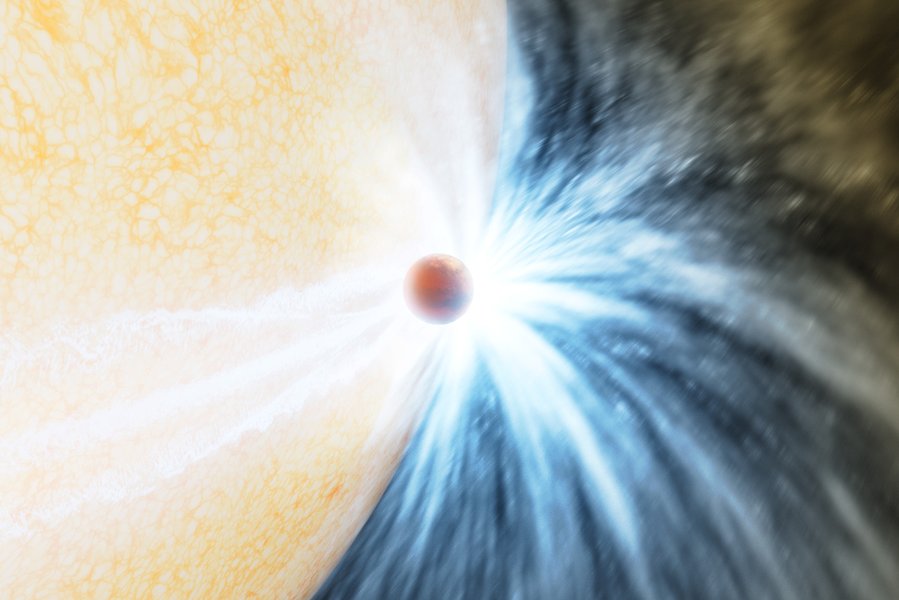
Artist's conception depicting a star swallowing a planet, similar to the event observed 12,000 light-years away.
Interestingly, subsequent analysis using the James Webb Space Telescope (JWST) has added nuance, suggesting the star might not have swollen quite as much as initially thought, prompting further investigation into the precise mechanics of how the planet was drawn in and consumed.
Uncovering Past Events: Chemical Fingerprints
Directly observing a planetary engulfment is rare because the main event is relatively brief on cosmic timescales. However, astronomers have developed ingenious methods to find evidence of past consumption events by analyzing the chemical composition of stars.
Stellar Forensics
Many stars are born in pairs or groups from the same cloud of gas and dust, meaning they should initially have nearly identical chemical compositions. Scientists compare the atmospheric makeup of these "twin" stars (co-natal pairs). If one star in a pair shows an unusually high abundance of heavy, heat-resistant (refractory) elements – such as iron, silicon, aluminum, calcium, and sometimes lithium – compared to its sibling, it strongly suggests that the star has ingested rocky planetary material sometime in its past. These elements are the primary building blocks of terrestrial planets like Earth.
Studies analyzing dozens of binary star systems, using data from instruments like the European Southern Observatory's Very Large Telescope and the Gaia space telescope, have found compelling evidence for this. Research suggests that approximately 8%, or about one in twelve stars in such pairs, show these chemical anomalies indicative of having consumed a planet or significant planetary debris. This implies that planetary engulfment might be a relatively common occurrence throughout the galaxy, a standard, albeit dramatic, part of the evolution of some stellar systems.

Artist's impression illustrating twin stars. Comparing their compositions helps identify stars that may have ingested planets.
Mechanisms of Cosmic Consumption
How exactly does a star "eat" a planet? Several astrophysical processes can lead to this outcome:
- Stellar Expansion: This is the most well-understood mechanism. As stars like our Sun exhaust the hydrogen fuel in their cores, they begin to fuse hydrogen in a surrounding shell. This causes their outer layers to expand enormously, transforming them into red giants. A red giant star can swell to hundreds of times its original size, easily engulfing any planets orbiting too closely. This is the predicted fate for Mercury, Venus, and potentially Earth in about 5-6 billion years when our Sun enters its red giant phase.
- Tidal Disruption: If a planet strays too close to its star (or another massive object like a black hole or neutron star), the immense gravitational forces (tidal forces) can stretch and tear the planet apart. The resulting debris can then rain down onto the star, effectively being consumed.
- Orbital Decay and Migration: Planets can gradually spiral inwards towards their star due to interactions with surrounding gas discs (especially in young systems) or gravitational interactions with other planets, eventually leading to engulfment.
- Gravitational Capture: While less common for star-planet scenarios, it's conceivable that a star could capture a rogue planet gravitationally, with orbits potentially decaying towards consumption over long timescales.
Related Phenomena: Planets Under Siege
Beyond direct engulfment, astronomers have observed other extreme interactions where stars effectively destroy planets, though not necessarily by swallowing them whole immediately.
Rapid Planetary Disintegration
In 2025, astronomers using data from NASA's Transiting Exoplanet Survey Satellite (TESS) reported the discovery of a planet approximately 140 light-years away that is literally falling apart. This Mercury-mass planet orbits its star at an incredibly close distance – about 20 times closer than Mercury orbits our Sun. The intense stellar radiation and powerful tidal forces are vaporizing the planet's rocky surface, stripping away material at an astonishing rate. This process creates a massive, comet-like tail of vaporized rock and dust stretching for millions of kilometers behind the planet. While not immediate engulfment, this represents a form of planetary destruction driven by the host star's proximity and intensity.
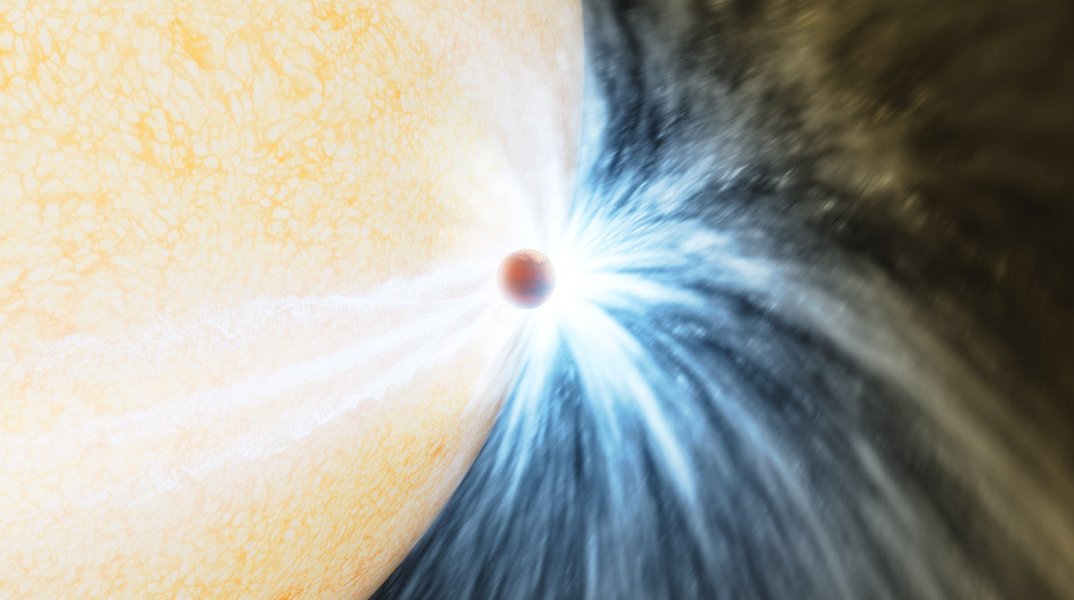
Artist's concept illustrating the destructive power of stars on nearby planets, either through engulfment or disintegration.
Comparing Cosmic Destruction Scenarios
The ways planets meet their demise at the hands of stars vary. The radar chart below provides a comparative overview of the different phenomena discussed, based on current understanding. It contrasts Direct Engulfment (the observed swallowing event), Chemical Signature detection (evidence of past events), and Rapid Disintegration (planets falling apart due to proximity).
This chart visualizes the relative characteristics of these destructive processes. For instance, direct engulfment provides the strongest direct evidence but is considered harder to observe and perhaps rarer than finding the long-lasting chemical signatures. Rapid disintegration also provides strong evidence through observed phenomena like transit dips and comet-like tails.
Mapping the Concepts of Cosmic Consumption
To better visualize the different facets of planet consumption in space, the following mind map outlines the key concepts, differentiating between fictional portrayals and the various real astronomical phenomena observed and studied by scientists.
Doomsday Machine"] id1b["Themes: Cosmic Power,
Existential Threats"] id2["Real Astronomical Phenomena"] id2a["Stellar Engulfment"] id2a1["Direct Observation"] id2a1a["Key Event:
~12,000 ly away,
Jupiter-sized planet"] id2a1b["Detection:
Light Burst (ZTF),
Infrared (NEOWISE)"] id2a1c["Mechanism Refinement:
JWST studies"] id2a2["Chemical Signatures"] id2a2a["Method:
Binary Star Comparison,
Refractory Elements
(Fe, Si, Li, etc.)"] id2a2b["Frequency:
~1 in 12 stars show signs"] id2a2c["Examples:
HIP68468,
HD 20781/20782 studies"] id2a3["Mechanisms"] id2a3a["Stellar Expansion
(Red Giant Phase)"] id2a3b["Tidal Disruption"] id2a3c["Orbital Decay"] id2b["Planetary Disintegration"] id2b1["Key Event:
~140 ly away,
Mercury-mass planet"] id2b2["Cause:
Extreme Proximity,
Intense Stellar Radiation"] id2b3["Observation:
Comet-like Debris Tail,
TESS Detections"] id2c["Scientific Implications"] id2c1["Understanding Stellar
& Planetary Evolution"] id2c2["Predicting Fate of
Inner Solar System (Earth)"] id2c3["Context for
Exoplanet Discoveries"]
This mind map connects the overarching theme to its fictional roots and the scientifically observed realities, detailing the methods, examples, and implications of stars consuming or destroying planets.
Observed Planetary Destruction Events Compared
The table below summarizes and compares the key characteristics of the different types of real planet-destroying phenomena discussed, based on current astronomical observations and studies.
| Phenomenon | Key Example/System | Detection Method | Primary Mechanism | Typical Stellar Stage | Typical Planet Type/Size |
|---|---|---|---|---|---|
| Direct Stellar Engulfment | Star ~12,000 ly away | Luminous outburst (optical/infrared), Dust emission (NEOWISE, ZTF) | Stellar expansion (aging star), Orbital decay/Tidal forces | Late stages (e.g., Red Giant Branch initiation) or specific dynamic interactions | Gas giants (Jupiter-sized observed), potentially rocky planets too |
| Chemical Signature of Past Engulfment | Binary ('twin') stars like HIP68468, HD 20781/2 pairs | Spectroscopic analysis (anomalous abundance of refractory elements like Fe, Si, Li) | Past engulfment event (likely stellar expansion or orbital decay) | Can be detected in main-sequence or later-stage stars (reflecting past events) | Likely rocky planets or significant planetary debris |
| Rapid Planetary Disintegration | Planet ~140 ly away | Irregular transit dips (TESS), Observation of debris tail | Intense stellar radiation, Tidal forces due to extreme proximity | Star doesn't need to be old, depends on planet's orbit (very close-in) | Rocky planets (Mercury-mass observed), potentially small gas planets |
This comparison highlights the diverse ways planets can meet their end in the dynamic environments around stars, detected through different observational techniques and driven by various physical processes.
Witnessing Cosmic Destruction
The following video provides a compelling overview of the discovery where astronomers observed a star in the process of consuming one of its planets, delving into the significance of this groundbreaking observation.
This video discusses the chilling discovery of a star caught in the act of eating its own planet, explaining the event and its implications.
Watching such events unfold, even from light-years away through our telescopes, provides invaluable data. It helps confirm theoretical models of stellar evolution and planetary system dynamics, offering a preview of processes that will eventually reshape our own solar system.
Frequently Asked Questions (FAQ)
Are these planet-eating "entities" like in the movies?
No, the "planet-eating entities" discovered in space are not conscious beings or monsters like Galactus from fiction. They are natural astronomical phenomena involving stars consuming planets due to physical processes like gravity and stellar evolution. The term "planet-eating star" is a descriptive way to refer to stars observed or inferred to have engulfed planetary bodies.
How exactly does a star "eat" a planet?
A star can consume a planet primarily in two ways: 1) Stellar Expansion: When a star ages and runs out of core hydrogen fuel, it swells into a red giant, its outer layers expanding potentially far enough to engulf nearby planets. 2) Tidal Disruption/Orbital Decay: If a planet gets too close to its star due to orbital changes or gravitational interactions, the star's gravity can tear the planet apart (tidal disruption), or the planet's orbit can decay until it spirals into the star.
How common is this phenomenon?
While directly observing the act of engulfment is rare, evidence suggests that planetary consumption might be more common than previously thought. Studies analyzing the chemical compositions of binary stars indicate that about 1 in 12 stars (roughly 8%) may show signs of having consumed a planet at some point in their history. This suggests it's a significant process in the evolution of many planetary systems.
Could our Sun eat the Earth?
Yes, it is predicted that our Sun will eventually consume the Earth. In about 5 to 6 billion years, the Sun will exhaust its core hydrogen fuel and expand into a red giant star. Its outer layers are expected to swell large enough to engulf the orbits of Mercury, Venus, and Earth. While the outer layers of a red giant are tenuous, the drag and heat would vaporize and absorb our planet.
How do scientists find these events?
Scientists use several methods:
- Direct Observation: Monitoring stars for sudden, unusual brightening events (outbursts) followed by infrared emissions from ejected dust (using telescopes like ZTF, NEOWISE, JWST).
- Chemical Analysis: Studying the light spectrum of stars (spectroscopy) to detect abnormal abundances of elements typically found in planets (like iron, silicon, lithium), especially when comparing twin stars in binary systems.
- Transit Light Curves: Looking for unusual dips or variations in a star's brightness caused by disintegrating planets and their debris trails passing in front of the star (using telescopes like TESS and Kepler).
Recommended
- How do astronomers detect the chemical composition of distant stars?
- What is the life cycle of a star like our Sun?
- What happens when a planet gets too close to its star?
- Are there other ways planets can be destroyed in space?
References

Last updated May 5, 2025