
Unveiling the Cosmos: Does a Multiverse Truly Exist?
An exploration into the scientific theories, ongoing debates, and the elusive search for evidence of parallel universes.
The question of whether our universe is unique or merely one among many has captivated scientists and philosophers alike. The concept of a "multiverse" — a vast collection of potentially infinite universes, each with its own set of physical laws and histories — stretches the boundaries of our understanding and imagination. As of May 18, 2025, while the multiverse remains a theoretical construct without definitive proof, it is a notion seriously entertained and investigated within various branches of physics.
Highlights: Key Insights into the Multiverse
- Theoretical Foundations: The idea of a multiverse is primarily supported by prominent theories in physics, including inflationary cosmology, the Many-Worlds Interpretation (MWI) of quantum mechanics, and aspects of string theory.
- Elusive Evidence: Despite compelling theoretical arguments, there is currently no direct, conclusive empirical evidence to confirm the existence of other universes. The search for such evidence is ongoing but faces significant challenges.
- Scientific Debate: The multiverse concept is a subject of intense debate within the scientific community, particularly concerning its testability and falsifiability, which are cornerstones of the scientific method.
Defining the Multiverse: Beyond Our Observable Universe
The multiverse is a hypothetical ensemble of multiple universes, including the universe we inhabit. These constituent universes, often termed "parallel universes" or "alternate universes," could possess fundamentally different physical laws, constants, dimensions, and even timelines. The scope of the multiverse concept is vast, ranging from universes that are spatially remote and causally disconnected from our own to universes that might arise from quantum branching events.
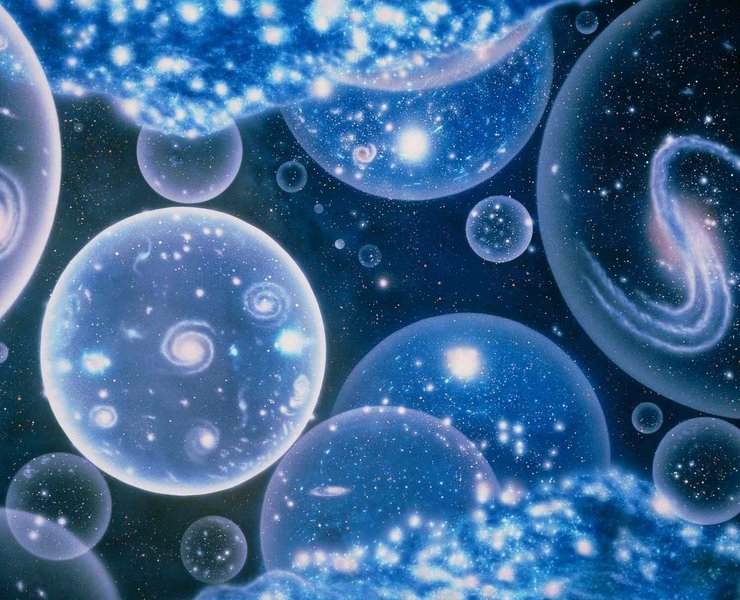
A conceptual representation of the multiverse, depicting multiple bubble-like universes.
Theoretical Pillars: Scientific Postulates of Multiple Universes
Several distinct yet sometimes overlapping theories from physics suggest that a multiverse might be a natural consequence of our current understanding of the cosmos and quantum reality.
Inflationary Cosmology and Bubble Universes
The Ever-Expanding Cosmic Landscape
The theory of cosmic inflation, a widely accepted model describing an extremely rapid expansion of the universe moments after the Big Bang, provides one of the most compelling arguments for a multiverse. Some models of inflation, particularly "eternal inflation," propose that this rapid expansion phase might not have ended everywhere simultaneously. Instead, it could cease in certain regions, forming "bubble universes" (like our own observable universe), while continuing in other regions, spawning an endless array of new bubble universes. Each of these universes could potentially have different physical constants and properties, creating a vast cosmic archipelago.
Quantum Mechanics and the Many-Worlds Interpretation (MWI)
Splitting Realities at the Quantum Level
The Many-Worlds Interpretation (MWI) of quantum mechanics, first proposed by Hugh Everett III in 1957, offers another route to a multiverse. According to MWI, every time a quantum measurement or interaction occurs with multiple possible outcomes, the universe itself splits into a corresponding number of parallel, non-communicating universes. In each of these newly formed universes, one of the possible outcomes is realized. For instance, if a quantum particle can be in state A or state B, the universe branches into one where it's A and another where it's B. This interpretation suggests a constantly branching tree of universes, encompassing every possible quantum history. The Schrödinger equation, a fundamental equation in quantum mechanics, can be interpreted as supporting this continuous evolution and branching of realities without the "collapse" of the wavefunction posited by other interpretations.
String Theory and Higher Dimensions
Vibrating Strings in a Multidimensional Cosmos
String theory, a candidate for a "theory of everything" that aims to reconcile general relativity with quantum mechanics, postulates that fundamental particles are not point-like but are tiny, vibrating "strings." For mathematical consistency, string theory often requires the existence of extra spatial dimensions beyond the three we perceive. Within this framework, our universe might be a "brane" (a multidimensional membrane) existing in a higher-dimensional space called the "bulk." The "string landscape" idea suggests that there could be a vast number of possible configurations for these extra dimensions, each corresponding to a different vacuum state with its own set of physical laws and constants, leading to a multitude of distinct universes.
The Hunt for Evidence: Current Observational Status
Despite the strong theoretical underpinnings, the existence of a multiverse remains unproven by direct empirical evidence. The primary challenge lies in the inherent difficulty, or perhaps impossibility, of observing or interacting with universes that are, by most definitions, causally disconnected from our own.
Whispers from the Cosmic Microwave Background?
Scientists have meticulously analyzed the Cosmic Microwave Background (CMB) – the afterglow radiation from the Big Bang – for any anomalies that might hint at interactions with other universes. One such anomaly is the "CMB Cold Spot," an unusually large and cool region in the CMB. Some researchers have speculated that this could be evidence of a collision between our universe and another bubble universe. However, this interpretation is highly debated, and alternative explanations within standard cosmology, such as statistical flukes or unknown astrophysical phenomena, are generally favored. No statistically significant evidence for such collisions has been found to date.
Quantum Computing and Parallel Realities
Recent advancements in quantum computing have added an intriguing, though controversial, dimension to the multiverse discussion. Hartmut Neven, a leader in Google's Quantum AI lab, suggested that the remarkable performance of quantum processors like the Willow chip – performing tasks in minutes that would take classical supercomputers eons – could be interpreted as evidence for computations occurring across parallel universes, as implied by the MWI. This claim posits that quantum computers tap into these parallel realities to perform many calculations simultaneously. However, this is a highly speculative interpretation, and most physicists believe that the power of quantum computing can be explained by quantum superposition and entanglement within a single universe, without invoking a multiverse.
Visualizing Multiverse Concepts
To better grasp the interconnected ideas surrounding the multiverse, the following mindmap illustrates the main theories, potential (though debated) lines of inquiry, and the challenges associated with this profound concept.
Comparing Multiverse Theories: A Conceptual Overview
Different multiverse theories vary in their foundational assumptions, mathematical consistency, and potential (even if remote) for testability. The radar chart below provides a conceptual comparison of some prominent multiverse frameworks based on several qualitative aspects. These are illustrative scores representing general scientific perception rather than hard data.
This chart illustrates conceptual strengths and weaknesses. 'Falsifiability Challenges' means a lower score indicates greater difficulty in proving the theory false, a key scientific criterion. All depicted theories face significant falsifiability hurdles.
Arguments For and Against the Multiverse
The debate surrounding the multiverse involves compelling arguments from both proponents and skeptics. Here's a summary of the main points:
| Arguments For the Multiverse | Arguments Against the Multiverse |
|---|---|
| Provides a natural extension of existing, well-supported theories like cosmic inflation and quantum mechanics (specifically MWI). | Lack of direct, testable, and falsifiable predictions; currently no statistically significant empirical evidence. |
| Offers a potential explanation for the "fine-tuning" of physical constants in our universe (the anthropic principle suggests we exist in a universe hospitable to life, which might be rare among many). | Raises unresolved metaphysical and philosophical questions (e.g., nature of reality, causality across universes) that may lie beyond the scope of empirical science. |
| Some interpretations of quantum mechanics, like MWI, suggest the multiverse is a necessary consequence of the mathematical formalism (e.g., the Schrödinger equation). | The concept is often criticized as being too speculative, bordering on pseudoscience by some, due to the inability to observe or interact with other universes. |
| String theory and M-theory predict a "landscape" of possible universes with different properties. | Alternative explanations within a single-universe framework (e.g., Copenhagen interpretation of quantum mechanics, pilot-wave theory) can address quantum phenomena without resorting to a multiverse. |
Exploring the Multiverse with Sean Carroll
Renowned physicist Sean Carroll is a prominent voice in discussions about the multiverse, particularly concerning the Many-Worlds Interpretation of quantum mechanics. The video below offers his perspective on what physicists mean when they talk about the multiverse and why it's considered a serious scientific idea, even if it challenges our everyday intuitions.
Sean Carroll discusses the concept of the multiverse, explaining its scientific basis and implications.
Frequently Asked Questions (FAQ)
What exactly is the multiverse?
The multiverse is a hypothetical collection of multiple, potentially infinite, universes (including our own). These universes could differ in their fundamental physical laws, constants, dimensionality, and even the outcomes of events. It's an umbrella term for various scientific theories that predict such a reality.
What are the main scientific theories that suggest a multiverse might exist?
Several theories support the idea:
- Inflationary Cosmology: Suggests that our universe is one of many "bubble" universes created during a period of rapid cosmic expansion.
- Many-Worlds Interpretation (MWI) of Quantum Mechanics: Proposes that every quantum event with multiple outcomes causes the universe to split into parallel universes, each realizing one outcome.
- String Theory/M-Theory: These theories, aiming to unify physics, allow for different vacuum states or "branes," each potentially representing a distinct universe with unique physical laws.
Is there any concrete proof that the multiverse is real?
As of May 2025, there is no direct, conclusive empirical evidence that proves the existence of a multiverse. While some observations (like the CMB Cold Spot or certain quantum computing results) have led to speculative interpretations, these are not widely accepted as proof and have alternative explanations within standard, single-universe physics.
Why is the multiverse idea so controversial among scientists?
The primary controversy stems from the apparent lack of testability and falsifiability. Science relies on hypotheses that can be tested and potentially proven wrong. Since other universes are, by most definitions, causally disconnected from ours, it's extremely difficult (perhaps impossible) to design experiments to detect them or verify their properties. This leads some scientists to argue that the multiverse is more of a philosophical or metaphysical concept than a strictly scientific one.
If other universes exist, could we ever travel to them or communicate with them?
Based on current understanding, travel or communication between universes, especially those proposed by inflationary cosmology or the MWI, is considered highly improbable, if not impossible. These universes are generally thought to be causally disconnected from ours, meaning no information or matter could pass between them. While science fiction often explores such concepts, there is no known physics that would permit inter-universal travel or communication at this time.
Recommended Further Exploration
- What are the different levels of multiverse proposed by Max Tegmark?
- How does the Many-Worlds Interpretation of quantum mechanics compare to the Copenhagen interpretation?
- What is eternal inflation and how does it lead to bubble universes?
- Can string theory ever be experimentally verified, and what are its implications for the multiverse?
References
Last updated May 18, 2025