
Unraveling the Everyday Math Mystery: A Picture Book Adventure!
Discover how ordinary days transform into extraordinary mathematical challenges in a world where numbers come alive.
Key Insights into "The Everyday Math Mystery"
- Whimsical Narrative: The book adopts a playful and engaging storytelling style, similar to "The Math Curse," where a curious protagonist named Alex encounters math problems in everyday situations.
- Integrated Math Challenges: It seamlessly weaves in at least 2 decimal problems, 2 fraction problems, and 4 multi-step real-world word problems, ensuring a comprehensive learning experience.
- Relatable Scenarios: Each math problem is presented within a familiar context—from breakfast calculations to shopping trips—making abstract mathematical concepts tangible and fun for young readers.
Step into the intriguing world of "The Everyday Math Mystery," a picture book designed to captivate young minds and transform the perception of mathematics. Inspired by the whimsical genius of Jon Scieszka and Lane Smith's "The Math Curse," this book follows Alex, a curious 10-year-old, whose ordinary day takes a delightful turn when everything around them becomes a numerical puzzle. The book's charm lies in its ability to humanize mathematics, illustrating that numbers aren't just confined to textbooks but are vibrant threads woven into the fabric of daily life. Through engaging scenarios and a touch of humor, readers will embark on a journey of discovery, realizing that math isn't a "curse" but a powerful tool for understanding and navigating the world.
This comprehensive concept integrates a variety of problem types as requested: dedicated sections for decimals and fractions, alongside more complex multi-step real-world challenges that combine these concepts. Each problem is crafted to be relatable and progressively challenging, fostering critical thinking and problem-solving skills. Visual elements, such as quirky illustrations and conceptual diagrams, are integral to the book's appeal, making abstract mathematical ideas accessible and exciting for young learners.

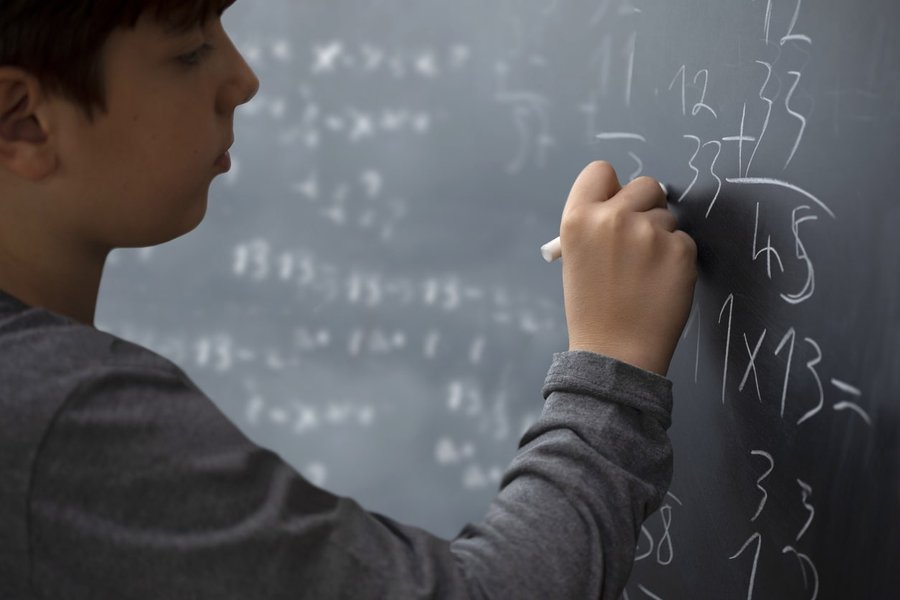
Alex, pondering a perplexing problem that has just appeared in their mind.
The Curious Case of Everyday Arithmetic
Our story begins with Alex, a typical 10-year-old, waking up to a world that suddenly seems to speak in numbers. It all started after their math teacher, Ms. Fibonacci, declared, "You know, you can think of almost everything as a math problem!" And just like that, Alex's perfectly normal Tuesday morphed into a fascinating mathematical adventure, turning routine tasks into engaging puzzles.
Breakfast Blunders: Decimals in the Morning Rush
The first challenge emerged at breakfast. Alex reached for the milk carton, and a question mark seemed to hover over it, followed by numbers. The simple act of pouring milk became a decimal dilemma.
Problem 1: The Disappearing Milk
The milk carton contained 0.945 liters of milk. Alex used 0.18 liters for their cereal, and their younger sibling, Leo, used 0.25 liters. How much milk was left after Alex and Leo had their portions? If their dad then used 0.3 liters for his coffee, what was the final amount of milk remaining in the carton?
Solution:
First, combine the milk used by Alex and Leo:
\[ \text{Milk used by Alex and Leo} = 0.18 \, \text{liters} + 0.25 \, \text{liters} = 0.43 \, \text{liters} \]Next, subtract this amount from the original volume:
\[ \text{Milk remaining after Alex and Leo} = 0.945 \, \text{liters} - 0.43 \, \text{liters} = 0.515 \, \text{liters} \]Finally, subtract the milk used by Dad:
\[ \text{Final milk remaining} = 0.515 \, \text{liters} - 0.3 \, \text{liters} = 0.215 \, \text{liters} \]So, 0.215 liters of milk were left for tomorrow. It was a lot of milk math before 8 AM!
Problem 2: Sticker Shock at the Store
Later, Alex headed to the store to pick up some art supplies. The sticker packs looked appealing, but their price turned into another decimal puzzle. Alex wanted 4 packs of stickers, each costing $1.99. How much would they spend in total? If they had a $5.00 coupon, how much money would they still owe?
Solution:
First, calculate the total cost of the stickers:
\[ \text{Total sticker cost} = 4 \times \$1.99 = \$7.96 \]Next, apply the coupon:
\[ \text{Amount owed} = \$7.96 - \$5.00 = \$2.96 \]Alex owed $2.96. Math was definitely everywhere!
Fraction Fun: Slicing Up the Day
Even a delicious pizza became a fraction challenge for Alex. Sharing was caring, but it also involved knowing how to divide accurately.
Problem 3: The Pizza Predicament
Alex had 1/4 of a pizza left from dinner, and their sibling generously offered them another 1/8 of a pizza. How much pizza did Alex have in total now?
Solution:
To add fractions, they need a common denominator. The least common multiple of 4 and 8 is 8.
\[ \frac{1}{4} = \frac{1 \times 2}{4 \times 2} = \frac{2}{8} \]Now, add the fractions:
\[ \text{Total pizza} = \frac{2}{8} + \frac{1}{8} = \frac{3}{8} \]Alex now had 3/8 of a pizza. Perfect for a hungry mathematician!
Problem 4: Sharing Crayons in Art Class
Art class was no escape from the numbers. Alex needed to share 3/4 of a bag of crayons with two friends. If each friend received 1/4 of the bag, how much of the crayon bag was left for Alex?
Solution:
First, calculate the total amount of crayons given to the friends:
\[ \text{Crayons for friends} = \frac{1}{4} + \frac{1}{4} = \frac{2}{4} \]Then, subtract this amount from the original share:
\[ \text{Crayons left for Alex} = \frac{3}{4} - \frac{2}{4} = \frac{1}{4} \]Alex had 1/4 of the crayon bag left. It was a good thing they were good at sharing!
Multi-Step Mysteries: Real-World Adventures
As the day progressed, Alex realized that some problems weren't as straightforward as just adding or subtracting. The real world presented multi-step challenges that required careful planning and several calculations.
This radar chart illustrates the perceived complexity and relevance of different problem types within "The Everyday Math Mystery." It highlights how multi-step problems, while more complex, offer the highest real-world applicability and integrate both decimal and fraction concepts effectively, making them the most comprehensive challenges for young learners.
Problem 5: The Grand Party Planning
Alex decided to throw a party for their friends. They needed to buy supplies: cups, plates, and napkins. Each pack of cups contained 12 cups and cost $2. Each pack of plates contained 10 plates and cost $1.50. Each pack of napkins contained 20 napkins and cost $1. If Alex had 16 friends coming and wanted to buy enough supplies for each guest to have 2 cups, 2 plates, and 2 napkins, how much would they spend in total?
Solution:
First, calculate total supplies needed (including Alex, so 17 people):
- Cups: \(17 \, \text{people} \times 2 \, \text{cups/person} = 34 \, \text{cups}\)
- Plates: \(17 \, \text{people} \times 2 \, \text{plates/person} = 34 \, \text{plates}\)
- Napkins: \(17 \, \text{people} \times 2 \, \text{napkins/person} = 34 \, \text{napkins}\)
Next, calculate packs needed:
- Cups: \(\lceil 34 \, \text{cups} / 12 \, \text{cups/pack} \rceil = 3 \, \text{packs}\)
- Plates: \(\lceil 34 \, \text{plates} / 10 \, \text{plates/pack} \rceil = 4 \, \text{packs}\)
- Napkins: \(\lceil 34 \, \text{napkins} / 20 \, \text{napkins/pack} \rceil = 2 \, \text{packs}\)
Then, calculate the cost for each item:
- Cups cost: \(3 \, \text{packs} \times \$2/\text{pack} = \$6\)
- Plates cost: \(4 \, \text{packs} \times \$1.50/\text{pack} = \$6\)
- Napkins cost: \(2 \, \text{packs} \times \$1/\text{pack} = \$2\)
Finally, calculate the total cost:
\[ \text{Total cost} = \$6 + \$6 + \$2 = \$14 \]Alex would spend $14 on party supplies. Party planning was serious business!
Problem 6: The Treehouse Dream
Alex had a grand dream of building a treehouse. It would need 15 feet of lumber for the frame and 30 feet for the roof. If lumber cost $3 per foot, how much would Alex spend on lumber in total?
Solution:
First, calculate the total length of lumber needed:
\[ \text{Total lumber} = 15 \, \text{feet} + 30 \, \text{feet} = 45 \, \text{feet} \]Next, calculate the total cost:
\[ \text{Total cost} = 45 \, \text{feet} \times \$3/\text{foot} = \$135 \]The treehouse lumber would cost $135. A lofty goal, indeed!
Alex learned that organizing information, much like this table, was key to solving multi-step problems.
Problem 7: The Floury Forecast
Alex decided to bake cookies, a recipe that required 2.5 cups of flour. They had a bag of flour that weighed 2 pounds. If 1 pound of flour was approximately 3.5 cups, how much of the bag would Alex use for the recipe?
Solution:
First, convert the total weight of flour in the bag to cups:
\[ \text{Total cups in bag} = 2 \, \text{pounds} \times 3.5 \, \text{cups/pound} = 7 \, \text{cups} \]Next, determine the fraction of the bag used:
\[ \text{Fraction used} = \frac{2.5 \, \text{cups needed}}{7 \, \text{total cups}} = \frac{25}{70} = \frac{5}{14} \]Alex would use 5/14 of the flour bag. Baking was surprisingly mathematical!
Problem 8: Garden Planning Quandary
Alex wanted to plant a garden with two types of flowers. The first type needed 2 square feet of space per plant, and they wanted to plant 8 of them. The second type required 3 square feet per plant, and Alex wanted to plant 5 of those. If the garden bed was 10 feet by 10 feet, would there be enough space for all the plants?
Solution:
First, calculate the space needed for the first type of flower:
\[ \text{Space for Type 1} = 8 \, \text{plants} \times 2 \, \text{sq ft/plant} = 16 \, \text{sq ft} \]Next, calculate the space needed for the second type of flower:
\[ \text{Space for Type 2} = 5 \, \text{plants} \times 3 \, \text{sq ft/plant} = 15 \, \text{sq ft} \]Then, find the total space required:
\[ \text{Total space needed} = 16 \, \text{sq ft} + 15 \, \text{sq ft} = 31 \, \text{sq ft} \]Finally, calculate the available space in the garden bed:
\[ \text{Available space} = 10 \, \text{feet} \times 10 \, \text{feet} = 100 \, \text{sq ft} \]Since 100 sq ft is greater than 31 sq ft, Alex would have enough space for all the plants. Gardening was a breeze when you knew your math!
Understanding Math in a New Light
By the end of the day, Alex realized that math wasn't a "curse" but a fascinating way to understand and interact with the world. Every problem, big or small, presented an opportunity to think, calculate, and discover. The numbers that once seemed daunting now felt like friendly guides, leading Alex through the mysteries of daily life.
This mindmap illustrates the thematic and problem-solving structure of "The Everyday Math Mystery." It branches out from the central concept, detailing the protagonist's journey through various daily scenarios that become mathematical challenges, ultimately leading to a realization that math is an integral and enjoyable part of life.
The Journey Continues: Learning Math Through Storytelling
Here's a summary table that outlines the key mathematical concepts covered in "The Everyday Math Mystery" and their real-world applications, demonstrating how the book addresses the user's requirements.
| Problem Type | Concept Covered | Real-World Application | Complexity (Steps) |
|---|---|---|---|
| Decimal Problem 1 | Addition and Subtraction of Decimals | Managing quantities (e.g., milk, liquids) | 2-step |
| Decimal Problem 2 | Multiplication and Subtraction of Decimals | Calculating costs and change (e.g., shopping) | 2-step |
| Fraction Problem 1 | Addition of Fractions (common denominator) | Combining portions (e.g., food sharing) | 1-step |
| Fraction Problem 2 | Subtraction of Fractions (common denominator) | Dividing resources (e.g., sharing supplies) | 2-step |
| Multi-Step Problem 5 | Multiplication, Addition, and Division (Whole Numbers/Decimals) | Budgeting and purchasing for events | Multiple steps |
| Multi-Step Problem 6 | Addition and Multiplication (Whole Numbers) | Calculating material costs for projects | 2-step |
| Multi-Step Problem 7 | Multiplication and Division (Decimals/Fractions) | Converting units and determining proportions (e.g., baking) | 2-step |
| Multi-Step Problem 8 | Multiplication and Addition (Whole Numbers) | Area calculation and space planning (e.g., gardening) | 3-step |
This table provides a concise overview of each problem, highlighting the core mathematical concept, its practical application, and the number of steps involved in solving it. This structure ensures that "The Everyday Math Mystery" comprehensively addresses the user's requirements for decimal, fraction, and multi-step real-world problems.
Discovering the Magic of Math: A Visual Guide
The journey of solving decimal word problems, such as those encountered by Alex, can be made much clearer and more engaging with visual aids. The following video delves into how to approach such problems, mirroring the process Alex undertakes in "The Everyday Math Mystery."
This video, "Decimal Word Problems (Simplifying Math)," explains how word problems involving decimals can be simplified and solved. It demonstrates various operations, such as addition, subtraction, multiplication, and division, using clear examples, much like the challenges Alex faces in the book. This visual explanation helps bridge the gap between abstract decimal concepts and their practical applications in everyday life.
Frequently Asked Questions (FAQ)
Why is "The Math Curse" a good inspiration for a math picture book?
How does "The Everyday Math Mystery" incorporate real-world scenarios?
What age group is this picture book concept designed for?
Will the book provide solutions to the problems?
Conclusion
Creating a picture book inspired by "The Math Curse" provides a unique opportunity to make mathematics approachable and exciting for young readers. "The Everyday Math Mystery" aims to demystify numbers by embedding them within relatable, humorous, and multi-step real-world scenarios. By combining decimal, fraction, and complex word problems, the book not only enhances mathematical literacy but also fosters a sense of curiosity and confidence in children, transforming the perceived "curse" of math into a delightful adventure of discovery. This comprehensive approach ensures that every page is a learning opportunity, making math a fun and integral part of understanding the world around us.
Recommended Further Exploration
- How to make math fun for elementary students?
- Creative ways to teach fractions and decimals?
- Benefits of storytelling in math education?
- Designing engaging word problems for children?
Referenced Search Results
 therouttymathteacher.blogspot.com
