
Unlock Personalized Math Learning: How Swarm Intelligence Reinvents Recommendations
Discover how algorithms inspired by nature can create dynamic learning paths without relying on traditional user or content matching.
Imagine a mathematics learning platform that doesn't just suggest the next lesson based on what others liked or what seems similar to past topics. Instead, picture a system that dynamically crafts the optimal learning journey for each individual student, adapting in real-time based on their unique progress, engagement, and learning style. This is the potential offered by swarm intelligence algorithms, a fascinating branch of artificial intelligence inspired by the collective behavior of social animals like ants, bees, and birds.
This approach moves beyond the limitations of traditional content-based filtering (recommending items similar to what a user liked before) and collaborative filtering (recommending items liked by similar users). By harnessing swarm intelligence, particularly algorithms like Particle Swarm Optimization (PSO), we can build a recommendation service that focuses on optimizing the learning experience itself.
Key Highlights
- Optimization Over Filtering: Swarm intelligence reframes recommendation as an optimization problem, seeking the best sequence or set of learning resources rather than matching users or content.
- Dynamic Adaptation: Recommendations evolve in real-time based on individual learner performance and engagement data, creating truly personalized and adaptive learning paths.
- Data-Driven Emergence: Recommendations emerge from the collective exploration of possibilities by algorithmic "agents," leveraging interaction data (time spent, accuracy, progression) instead of explicit ratings or content tags.
Why Choose Swarm Intelligence for Math Recommendations?
Moving Beyond Traditional Boundaries
Traditional recommendation systems in education often face challenges:
- Content-Based Filtering: Struggles with recommending novel content and requires detailed feature analysis of every learning resource.
- Collaborative Filtering: Suffers from the "cold start" problem (difficulty recommending to new users or new content) and data sparsity, often needing large amounts of user interaction data. It can also lead to "filter bubbles," limiting exposure to diverse learning materials.
Swarm intelligence offers compelling advantages:
- No Need for Direct Similarity: Recommendations emerge from optimizing a learning path based on performance metrics, not direct user-user or item-item comparisons.
- Inherent Adaptability: Swarm algorithms are designed to dynamically adjust to changing environments (i.e., the learner's evolving knowledge state).
- Exploration and Diversity: These algorithms naturally balance exploring new possibilities (finding potentially novel beneficial paths) and exploiting known good solutions, helping avoid local optima and filter bubbles.
- Robustness: They can often function effectively even with less dense interaction data compared to collaborative methods.
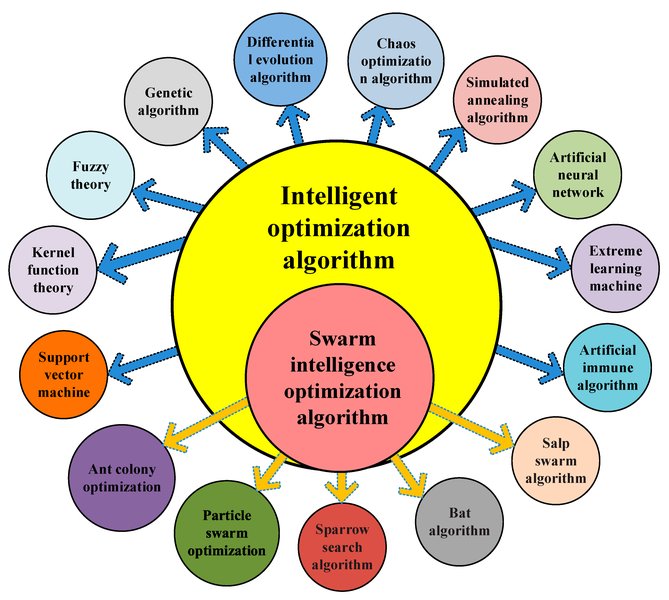
General scheme of Swarm Intelligence algorithms, showing the iterative process of exploration and information sharing.
Reframing Recommendation: The Optimization Approach
Finding the Best Learning Path
Instead of asking "What content is similar?" or "What did similar users like?", a swarm-based system asks: "What is the optimal sequence or set of learning resources for this specific student right now, given their current knowledge, goals, and observed interactions?"
Defining the Objective
The primary goal is to find the best possible learning trajectory. This could mean:
- The sequence of topics/problems that maximizes knowledge gain.
- The set of resources that best balances challenge and engagement.
- The path that minimizes time to mastery for a specific concept.
The Crucial Role of the Fitness Function
At the heart of this optimization process is the fitness function. This function quantitatively evaluates how "good" a potential recommendation (a learning path or resource set) is for the student. It combines various metrics, such as:
- Performance Data: Accuracy rates on exercises, quiz scores, concept mastery speed.
- Engagement Metrics: Time spent on resources, interaction frequency, problem completion rates.
- Learning Progress: Advancement through curriculum topics, reduction in skill gaps.
- Resource Characteristics (Optional): Difficulty level, estimated cognitive load (used for evaluation, not filtering).
The swarm algorithm works to find the recommendations that maximize (or minimize, depending on the formulation) this fitness score.
How Swarm Algorithms Generate Recommendations (Focus: PSO)
Harnessing Collective Exploration with Particle Swarm Optimization
Particle Swarm Optimization (PSO) is a popular and effective swarm intelligence algorithm well-suited for this task. Here's how it could work in a math learning platform:
1. Particles as Potential Solutions
Imagine a swarm of "particles." Each particle represents a potential solution – for instance, a specific sequence of math lessons or problems (e.g., [Algebra Basics -> Linear Equations -> Practice Set 1 -> Quadratic Functions]).
2. The Search Space
The "space" these particles explore is the vast landscape of all possible combinations and sequences of learning resources available on the platform.
3. Iterative Optimization Process
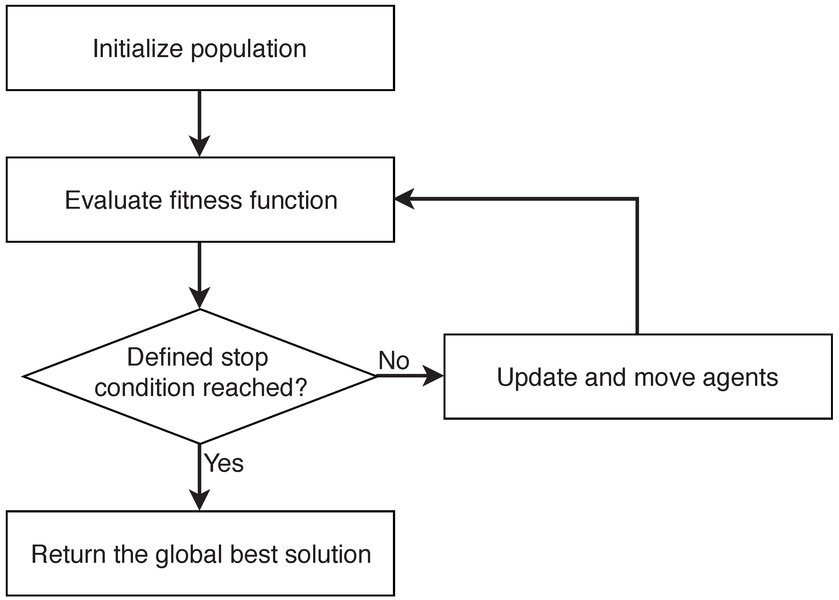
- Initialization: A swarm of particles is randomly initialized with different potential learning paths. Domain knowledge (like prerequisites) can guide this initialization.
- Evaluation: Each particle's current position (its proposed learning path) is evaluated using the fitness function based on the target student's data.
- Memory: Each particle remembers the best position (highest fitness score) it has personally discovered so far (its
pbest). - Information Sharing: The swarm identifies the best position found by any particle in the swarm (the
gbest). - Movement (Update): Each particle adjusts its "velocity" and "position" (modifies its proposed learning path) based on a combination of:
- Its current direction of movement.
- Its attraction towards its personal best position (
pbest). - Its attraction towards the global best position (
gbest).
- Convergence: Through repeated iterations of evaluation and movement, the swarm tends to converge towards regions of the search space containing high-fitness solutions (optimal or near-optimal learning paths).
4. Recommendation Output
The learning path represented by the particle with the best fitness score (gbest) after a sufficient number of iterations becomes the recommendation provided to the student.
Conceptual flowchart of the Particle Swarm Optimization (PSO) algorithm.
Exploring PSO Concepts Visually
The following video provides a concise explanation of the core concepts behind Particle Swarm Optimization, illustrating how particles explore a search space to find optimal solutions.
Understanding PSO helps visualize how multiple potential learning paths ("particles") can be evaluated and refined simultaneously based on learner data, converging on effective recommendations without needing direct content or user comparisons.
Other Swarm Algorithms
While PSO is a strong candidate, other swarm algorithms could also be adapted:
- Ant Colony Optimization (ACO): Inspired by ants finding the shortest path via pheromone trails. This could model learning progression as navigating a graph of concepts, where "pheromones" reinforce successful learning transitions. Useful for finding optimal sequences.
- Artificial Bee Colony (ABC): Mimics the foraging behavior of honey bees. It could be used for clustering problems or concepts based on how students naturally group them during learning, identifying related topics mastered together.
Building the Swarm-Powered Recommendation Engine
Key Implementation Steps
Data Requirements
The system relies on non-filtering data reflecting learner interaction and progress:
- Individual performance metrics (accuracy, scores, errors).
- Time spent on problems, lessons, or videos.
- Progression through curriculum modules or topics.
- Mastery levels achieved for different concepts.
- Implicit feedback (e.g., re-watching videos, skipping exercises).
Particle Representation (Encoding)
How do you represent a learning path as a "particle"? This depends on the specific implementation, but could involve:
- A vector of resource IDs representing a sequence.
- A set of parameters defining the characteristics of recommended content (e.g., difficulty range, topic focus, media type preference).
- A hybrid representation combining sequence and parameters.
For instance, a particle's "position" might encode aspects like current topic focus and preferred learning pace, while its "velocity" represents how quickly it adapts these elements:
# Conceptual representation of a particle
particle = {
    'position': [topic_focus_vector, difficulty_preference, pace_factor],
    'velocity': [rate_of_topic_change, rate_of_difficulty_adjustment],
    'pbest_position': [best_historical_topic_focus, ...], # Best state found by this particle
    'pbest_fitness': highest_personal_fitness_score
}
# Note: Actual implementation would use numerical arrays/vectors.
Designing the Fitness Function
This is a critical step. The function needs to accurately capture what constitutes a "good" recommendation for learning. It might involve weighting and combining different factors:
# Conceptual fitness function
def calculate_fitness(particle_position, student_data):
    # Predict outcomes based on particle's proposed path/parameters
    predicted_mastery_gain = predict_mastery(particle_position, student_data)
    predicted_engagement = predict_engagement(particle_position, student_data)
    # Penalize paths violating constraints (e.g., prerequisites)
    constraint_penalty = calculate_penalty(particle_position, student_data.prerequisites)

    # Combine metrics (example: maximize mastery and engagement, minimize penalty)
    fitness_score = (weight_mastery * predicted_mastery_gain +
                     weight_engagement * predicted_engagement -
                     weight_penalty * constraint_penalty)
    return fitness_score
Incorporating Pedagogical Constraints
Mathematical learning often follows logical sequences (e.g., arithmetic before algebra). These prerequisite rules must be incorporated:
- Hard Constraints: Disallow particles from representing invalid sequences.
- Soft Constraints (Penalties): Reduce the fitness score of particles that violate pedagogical rules, guiding the swarm away from invalid paths.
The Adaptation Loop
The system isn't static. It needs to adapt:
- Recommend resources based on the current best solution (
gbest). - Collect data on the student's interaction with the recommended resources.
- Update the student's profile/state model (mastery levels, engagement patterns).
- Re-run the swarm optimization process (or continue iterating) with the updated student data to refine future recommendations.
This creates a continuous feedback loop, making the recommendations dynamically responsive to the learner's progress.
AI is increasingly influencing recommendations in educational technology.
Visualizing the Approach: System Structure
A Mindmap Overview
This mindmap illustrates the key components and relationships within a swarm intelligence-based recommendation system for mathematics learning, highlighting its departure from traditional filtering methods.
Comparing Recommendation Approaches
Swarm Intelligence vs. Traditional Methods
This radar chart provides a visual comparison between Swarm Intelligence (SI)-based recommenders and traditional Content-Based (CB) and Collaborative Filtering (CF) methods across several key dimensions relevant to educational platforms. The scores are conceptual estimates.
The chart suggests that swarm intelligence excels in adaptability, handling new users/items (cold start), and potentially offering deeper personalization and diversity by focusing on optimizing the learning path itself using interaction data, rather than relying heavily on historical ratings or pre-defined content features.
Feature Comparison Table
This table summarizes the key differences between the approaches:
| Feature | Content-Based Filtering (CB) | Collaborative Filtering (CF) | Swarm Intelligence (SI - e.g., PSO) |
|---|---|---|---|
| Basic Principle | Recommend items similar to those liked previously. | Recommend items liked by similar users or items similar to liked items. | Optimize a sequence/set of resources based on learner performance/engagement. |
| Primary Data Used | Item features/attributes, user profile (liked features). | User-item interactions (ratings, clicks, purchases). | Learner interaction logs (time, accuracy, progress), performance metrics. |
| Personalization Basis | User's historical preference for specific content features. | Similarity to other users' behavior or item co-occurrence. | Optimization of individual learner's objective function (e.g., maximize mastery gain). |
| Handling New Items/Users (Cold Start) | Good for new items (if features available), poor for new users. | Poor for both new items and new users. | Relatively good for both; optimization can start with minimal data, adapts quickly. |
| Recommendation Diversity | Low (recommends similar items). | Moderate (can be limited by popular items/filter bubbles). | Potentially High (exploration inherent in swarm behavior). |
| Main Strength | User independence, recommends specific/niche items. | Can find unexpected items (serendipity), requires no content analysis. | High adaptability, deep personalization based on learning dynamics, robustness to data sparsity. |
| Main Weakness | Overspecialization, needs feature engineering. | Cold start, data sparsity, popularity bias. | Computational cost, complexity of fitness function design, potential need for tuning. |
| Example Application | Recommending math problems based on topic tags. | Recommending lessons popular among students with similar grades. | Recommending the next sequence of problems to optimize learning speed for a specific student. |
Practical Considerations and Challenges
While promising, implementing a swarm-based recommendation system involves challenges:
- Computational Complexity: Swarm algorithms can be computationally intensive, especially with large swarms or complex fitness functions. Optimization is needed for real-time performance on a busy platform.
- Parameter Tuning: Algorithms like PSO have parameters (e.g., inertia weight, cognitive/social factors) that may need tuning for optimal performance in the specific educational context.
- Fitness Function Design: Crafting an effective fitness function that accurately reflects desired learning outcomes is non-trivial and critical to success.
- Scalability: Ensuring the system scales effectively as the number of users and learning resources grows requires careful architectural design.
- Hybrid Approaches: It might be beneficial to combine swarm intelligence with other techniques (like knowledge graphs or simpler rule-based systems) to leverage the strengths of each.

Integrating advanced AI like swarm intelligence requires careful planning within the educational context.
Frequently Asked Questions (FAQ)
What specific data does a swarm intelligence recommender need?
It primarily needs data reflecting individual learner interactions and performance within the platform. This includes time spent on specific problems or lessons, accuracy rates, scores on quizzes or assessments, progression through defined learning paths or concepts, and potentially implicit feedback like skipping content or re-watching videos. It does *not* require explicit user ratings (like stars) or pre-defined content tags in the way traditional methods do.
How is this fundamentally different from collaborative or content filtering?
The core difference lies in the objective. Content filtering matches item features to user profiles. Collaborative filtering matches users based on past behavior or items based on co-occurrence. Swarm intelligence, in this context, doesn't match users or content features directly. Instead, it treats recommendation as an optimization problem: it searches for the sequence or set of learning resources that best optimizes a defined goal (like learning speed or engagement) for the individual student, based on their dynamic interaction data. The recommendation emerges from this optimization process.
Is using swarm intelligence computationally expensive?
It can be, depending on the complexity of the search space (number of resources), the size of the swarm (number of particles/agents), the number of iterations required for convergence, and the complexity of the fitness function evaluation. Real-time recommendation might require efficient implementations, optimized algorithms, or approximations. However, they can sometimes be more efficient than methods requiring massive matrix factorizations (common in CF) for certain problem structures, especially when dealing with dynamic data.
Can swarm intelligence handle prerequisites in math?
Yes. Pedagogical constraints like prerequisites can be incorporated directly into the optimization process. This can be done either by restricting the search space so that particles can only represent valid sequences (hard constraints) or by adding a penalty term to the fitness function that significantly lowers the score of any proposed path violating prerequisite rules (soft constraints). This guides the swarm towards educationally sound recommendations.
Recommended Reading
Explore further insights into related topics:
- What are practical applications of Particle Swarm Optimization in adaptive learning systems?
- How can one design effective fitness functions for educational recommender systems using optimization algorithms?
- What are the differences and trade-offs between various swarm intelligence algorithms like PSO, ACO, and ABC for optimization tasks?
- What are the main challenges in implementing real-time AI-driven recommendations in online education platforms?
References
Last updated May 4, 2025