
Unlocking NMDA Receptor Function: How DAO Inhibitors Play a Key Role
Exploring the Mechanism Behind DAO Inhibitors and Their Impact on NMDAR Activity
Key Highlights of DAO Inhibitors and NMDAR Function
- DAO inhibitors increase D-serine levels: By blocking the activity of D-amino acid oxidase (DAO), these inhibitors prevent the breakdown of D-serine, a crucial co-agonist of the N-methyl-D-aspartate receptor (NMDAR).
- Enhanced NMDAR activation: Elevated D-serine levels lead to enhanced activation of NMDARs, which play a critical role in synaptic plasticity, learning, and memory.
- Potential therapeutic applications: This modulation of NMDAR function has implications for treating conditions like schizophrenia and other neuropsychiatric disorders characterized by NMDAR hypofunction.
Understanding NMDA Receptors and Their Activation
N-methyl-D-aspartate receptors (NMDARs) are glutamate-gated ion channels that play a crucial role in synaptic transmission, plasticity, learning, and memory. They are unique among ligand-gated ion channels because their activation requires the binding of two co-agonists: glutamate and either glycine or D-serine. The NMDAR complex is essential for various brain functions, including neurotoxicity regulation and dopamine neuron activity.
The activation of NMDARs involves several key steps:
- Glutamate Binding: Glutamate, a primary excitatory neurotransmitter, binds to the glutamate-binding site on the NMDAR.
- Co-agonist Binding: Either glycine or D-serine must bind to the glycine-binding site on the receptor. Glycine is generally considered to be ubiquitously available, making D-serine a critical regulator of NMDAR activity.
- Membrane Depolarization: The postsynaptic membrane must be depolarized to remove the magnesium (Mg2+) block that prevents ion flow through the channel at resting membrane potentials.
- Ion Channel Opening: Once these conditions are met, the NMDAR ion channel opens, allowing the influx of calcium (Ca2+) and sodium (Na+) ions, and the efflux of potassium (K+) ions.
The Role of D-Amino Acid Oxidase (DAO)
D-amino acid oxidase (DAO, also known as DAAO) is an enzyme that degrades D-amino acids, particularly D-serine. DAO modulates D-serine levels, and consequently, NMDA receptor function. The activity of DAO is therefore a critical factor in regulating NMDAR activity.
DAO is expressed in various brain regions, including the ventral tegmental area (VTA). By controlling the levels of D-serine, DAO influences the extent to which NMDARs are activated. This regulation is essential for maintaining balanced glutamatergic neurotransmission. Dysfunction of DAO has been linked to neuropsychiatric disorders, highlighting its importance in mental health.
How DAO Inhibitors Facilitate NMDAR Function
DAO inhibitors work by blocking the enzymatic activity of DAO, which prevents the breakdown of D-serine. This leads to an increase in synaptic D-serine levels, enhancing the co-agonist availability at the NMDAR glycine-binding site.
The fundamental role of D-serine as a co-agonist at the NMDAR means that increasing its levels can enhance both physiological and pathological actions of glutamate. By inhibiting DAO, more D-serine is available to bind to NMDARs, promoting their activation. This increased NMDAR activation can improve synaptic plasticity and neurotransmission, which are critical for cognitive functions.
In essence, DAO inhibitors facilitate NMDAR function by ensuring that the receptor has sufficient D-serine available to bind and activate the receptor when glutamate is also present.
The Link Between NMDAR Activation and DAO Inhibitors
DAO inhibitors do not directly activate NMDARs. Instead, they modulate the environment around the NMDAR by increasing the concentration of D-serine. NMDAR activation still depends on the presence of glutamate and sufficient membrane depolarization to relieve the Mg2+ block.
Several studies suggest that the effects of DAO inhibitors are consistent with enhanced NMDAR function. For example, blocking DAO activity increases synaptic D-serine levels, which in turn enhances NMDAR function. This enhancement can be particularly beneficial in conditions where NMDAR hypofunction is a contributing factor, such as schizophrenia.
The connection can be summarized as follows:
- DAO inhibitors prevent the degradation of D-serine.
- Increased D-serine levels enhance the availability of a co-agonist for NMDARs.
- With more D-serine available, NMDARs are more likely to be activated when glutamate is present.
Therapeutic Implications and Research
The modulation of NMDAR function by DAO inhibitors has significant therapeutic implications, especially for neuropsychiatric disorders. Deficits in NMDAR function have been increasingly linked to persistent negative symptoms and cognitive deficits in schizophrenia.
Research has shown that add-on treatment with weak DAO inhibitors can improve NMDAR function. For example, studies using the DAO inhibitor luvadaxistat have shown promising results in enhancing NMDAR activity and improving cognitive functions.
Furthermore, the proinflammatory environment can promote the release of D-serine, which in turn promotes excessive glutamatergic-NMDAR-mediated transmission. This suggests that DAO inhibitors could also play a role in managing conditions characterized by excessive NMDAR activity.
Visualizing NMDA Receptor Activation
The following image illustrates the process of NMDA receptor activation, highlighting the roles of glutamate, glycine/D-serine, and the magnesium block.
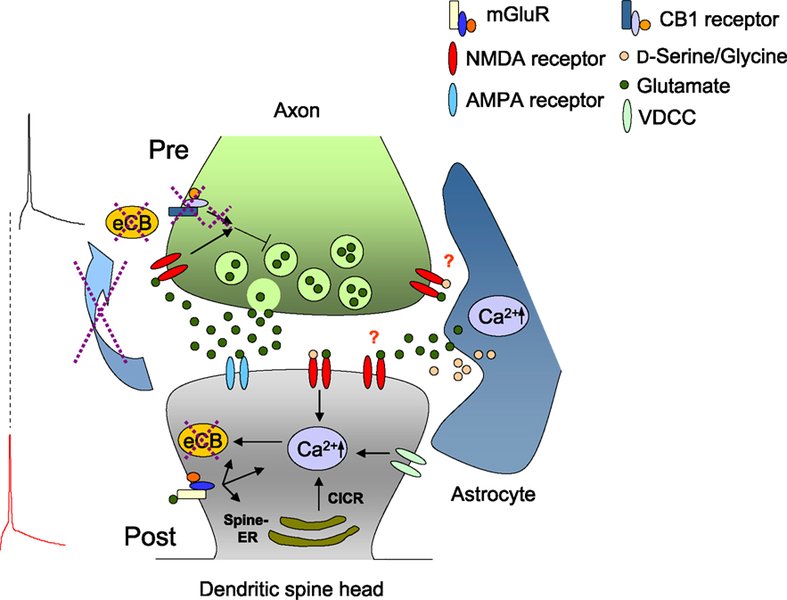
Illustration of NMDA Receptor Activation
The Interplay Between DAO, D-Serine, and NMDAR: A Summary Table
To consolidate the information, here is a table summarizing the interplay between DAO, D-serine, and NMDAR:
| Component | Function | Effect on NMDAR |
|---|---|---|
| DAO (D-Amino Acid Oxidase) | Enzyme that degrades D-serine | Reduces D-serine levels, decreasing NMDAR activation |
| D-Serine | Co-agonist at the NMDAR glycine-binding site | Enhances NMDAR activation when glutamate is present |
| DAO Inhibitor | Blocks DAO activity | Increases D-serine levels, enhancing NMDAR activation |
The Broader Impact of NMDA Receptor Modulation
Modulating NMDA receptor function has far-reaching implications due to the receptor's central role in various neurological processes. NMDARs are involved in synaptic plasticity, which is the ability of synapses to strengthen or weaken over time in response to increases or decreases in their activity. This plasticity is fundamental to learning and memory.
Furthermore, NMDARs play a critical role in long-term potentiation (LTP), a process where synaptic connections become stronger with repeated activation. This is a key mechanism for memory formation. By enhancing NMDAR function through DAO inhibitors, it may be possible to improve cognitive functions related to memory and learning.
However, it is crucial to note that excessive NMDAR activation can lead to excitotoxicity, a process where neurons are damaged or killed by overstimulation. Therefore, the use of DAO inhibitors must be carefully managed to avoid overstimulating NMDARs and causing potential harm.
NMDA Receptors Explained
This video by CSHL Professor Hiro Furukawa elucidates how the NMDA receptor opens and closes its ion channel. It offers a detailed visualization of the structural changes and molecular interactions that facilitate ion flow upon receptor activation, which is critical for understanding how DAO inhibitors can modulate NMDAR function by influencing co-agonist availability.
Frequently Asked Questions
What exactly is a DAO inhibitor?
A DAO (D-amino acid oxidase) inhibitor is a substance that blocks the activity of the enzyme D-amino acid oxidase. This enzyme breaks down D-amino acids, particularly D-serine, which is a co-agonist of the NMDA receptor. By inhibiting DAO, these inhibitors increase the levels of D-serine available in the synapse.
How do DAO inhibitors affect NMDA receptors?
DAO inhibitors increase the concentration of D-serine, a co-agonist required for NMDA receptor activation. When glutamate binds to the NMDA receptor, D-serine must also be present for the receptor to open its ion channel and allow ions to flow through. By increasing D-serine levels, DAO inhibitors enhance the likelihood of NMDA receptor activation.
Are DAO inhibitors a direct activator of NMDAR?
No, DAO inhibitors are not direct activators of NMDA receptors. They work indirectly by increasing the availability of D-serine, a co-agonist. The NMDA receptor still requires glutamate binding and sufficient membrane depolarization to relieve the magnesium block for activation to occur.
What conditions might benefit from DAO inhibitors?
DAO inhibitors may be beneficial in conditions characterized by NMDA receptor hypofunction, such as schizophrenia. By enhancing NMDA receptor activity, these inhibitors may help improve cognitive deficits and negative symptoms associated with these conditions.
What are the potential risks of using DAO inhibitors?
While DAO inhibitors can enhance NMDA receptor function, excessive activation of NMDA receptors can lead to excitotoxicity, where neurons are damaged or killed by overstimulation. Therefore, the use of DAO inhibitors must be carefully managed to avoid potential harm.
References
Last updated April 12, 2025