
Analyzing the Impact of Depreciation Methods on Financial Statements and Business Strategy
A Deep Dive into How Depreciation Shapes Financial Health and Decision-Making
Key Insights
- Depreciation is a Non-Cash Expense: While depreciation reduces reported net income, it does not involve an actual outflow of cash. This distinction is crucial for understanding its impact on cash flow.
- Method Choice Influences Financial Metrics: Different depreciation methods allocate the asset's cost over time differently, leading to variations in reported net income, asset values, and ultimately impacting key financial ratios.
- Tax Implications and Cash Flow: Depreciation provides a tax shield by reducing taxable income. Accelerated methods offer greater tax benefits in the early years, indirectly increasing cash flow, though the total tax benefit over the asset's life remains the same.
The Multifaceted Impact of Depreciation on Financial Statements
Depreciation is a fundamental accounting concept that reflects the gradual decrease in the value of tangible assets over their useful life due to wear and tear, obsolescence, or usage. While it is a non-cash expense, its impact on a company's financial statements is significant and far-reaching, influencing everything from reported profitability to asset valuation and financial ratios. Understanding how depreciation works and the implications of choosing different depreciation methods is essential for accurate financial reporting, effective tax planning, and informed decision-making.
The primary role of depreciation is to systematically allocate the cost of a fixed asset over the periods in which it is expected to provide economic benefits. This allocation principle adheres to the matching principle in accounting, which requires that expenses be recognized in the same period as the revenues they help generate. By spreading the cost of a long-term asset over its useful life, depreciation provides a more accurate representation of the cost of using that asset to generate revenue in a given period.
Impact on the Income Statement
On the income statement, depreciation is recorded as an operating expense. An increase in depreciation expense directly leads to a decrease in operating income (Earnings Before Interest and Taxes - EBIT) and, consequently, net income. This reduction in net income is a key reason why depreciation is often discussed in the context of profitability. While it reduces reported profit, it's important to remember that this is a book entry and doesn't represent a cash outflow in the period the depreciation expense is recorded.
The choice of depreciation method significantly impacts the pattern of expense recognition on the income statement. For example, accelerated depreciation methods recognize higher depreciation expense in the early years of an asset's life and lower expense in later years, compared to the straight-line method which recognizes a constant expense each year. This difference in expense recognition directly affects the reported net income in each period, influencing perceptions of a company's profitability over time.
Impact on the Balance Sheet
Depreciation also has a direct impact on the balance sheet. Fixed assets are reported on the balance sheet at their net book value, which is the original cost of the asset minus accumulated depreciation. Accumulated depreciation is a contra-asset account that accumulates the total depreciation expense recorded for an asset since it was placed in service. As depreciation expense is recognized each period, the accumulated depreciation balance increases, and the net book value of the asset decreases.
The reduction in the net book value of assets on the balance sheet affects the total asset value of the company. This, in turn, can influence financial ratios that use total assets in their calculation, such as the return on assets (ROA). Furthermore, since retained earnings (a component of shareholders' equity) are affected by net income, depreciation's impact on net income also indirectly affects the equity section of the balance sheet.
Impact on the Cash Flow Statement
Depreciation's impact on the cash flow statement is indirect. As a non-cash expense, it does not involve an actual cash outflow. When preparing the cash flow statement using the indirect method (which is common), net income is the starting point for the operating activities section. Since depreciation expense reduces net income but does not reduce cash, it is added back to net income to arrive at the cash flow from operating activities. This adjustment is necessary to reconcile net income to the actual cash generated or used by operations.
While depreciation doesn't directly affect cash flow in the period it's expensed, its tax implications do have a cash flow effect. Depreciation is a tax-deductible expense, which reduces a company's taxable income and, consequently, its income tax liability. A lower tax liability means less cash outflow for taxes, thus indirectly increasing the company's cash flow. This effect is often referred to as the "depreciation tax shield."
Comparing Depreciation Methods and Their Influence on Financial Ratios
The choice of depreciation method is a critical decision for companies as it impacts the timing of expense recognition and asset valuation, which in turn affects various financial ratios. Common depreciation methods include:
Straight-Line Method
The straight-line method is the simplest and most commonly used depreciation method. It allocates an equal amount of depreciation expense to each period over the asset's useful life. The formula is:
\[ \text{Annual Depreciation Expense} = \frac{\text{Cost of Asset} - \text{Salvage Value}}{\text{Useful Life}} \]This method results in a stable depreciation expense and a gradual decline in the asset's book value. It is often preferred by companies seeking to report consistent earnings.
Declining Balance Methods (e.g., Double-Declining Balance)
Declining balance methods are accelerated depreciation methods that recognize a higher depreciation expense in the early years of an asset's life and lower expense in later years. The double-declining balance method, a common form, depreciates assets at twice the straight-line rate. The formula for the depreciation rate is:
\[ \text{Declining Balance Rate} = \frac{1}{\text{Useful Life}} \times 2 \]The depreciation expense each year is calculated by multiplying the declining balance rate by the asset's book value at the beginning of the year. This method is often used for assets that are more productive or lose value more quickly in their early years.
Units of Production Method
The units of production method depreciates an asset based on its usage rather than the passage of time. The depreciation expense varies each period depending on how much the asset was used (e.g., machine hours, units produced). The formula for the depreciation rate per unit is:
\[ \text{Depreciation Rate Per Unit} = \frac{\text{Cost of Asset} - \text{Salvage Value}}{\text{Total Estimated Production Units}} \]The depreciation expense for a period is then calculated by multiplying the depreciation rate per unit by the number of units produced or hours used in that period. This method is suitable for assets whose wear and tear is directly related to their activity level.
The choice of depreciation method significantly impacts key financial ratios:
Return on Assets (ROA)
ROA measures how efficiently a company uses its assets to generate profit. The formula is:
\[ \text{Return on Assets (ROA)} = \frac{\text{Net Income}}{\text{Total Assets}} \]Accelerated depreciation methods result in lower net income (due to higher depreciation expense) and lower total assets (due to higher accumulated depreciation) in the early years. The net effect on ROA can vary depending on the magnitude of these changes. In later years, as depreciation expense decreases and asset book value is lower, ROA may appear higher compared to the straight-line method.
Net Profit Margin
Net profit margin measures the percentage of revenue that remains after all expenses, including depreciation, have been deducted. The formula is:
\[ \text{Net Profit Margin} = \frac{\text{Net Income}}{\text{Revenue}} \]Since depreciation expense directly reduces net income, methods that result in higher depreciation expense in a period will lead to a lower net profit margin in that period. Accelerated depreciation methods will therefore result in lower net profit margins in the early years compared to the straight-line method.
Debt-to-Equity Ratio
The debt-to-equity ratio measures a company's financial leverage. The formula is:
\[ \text{Debt-to-Equity Ratio} = \frac{\text{Total Debt}}{\text{Total Equity}} \]As depreciation expense reduces net income, it also reduces retained earnings, which is a component of total equity. Therefore, higher depreciation expense can lead to lower total equity, potentially increasing the debt-to-equity ratio. Accelerated depreciation methods, with their higher early-year expenses, can result in a higher debt-to-equity ratio in the initial years compared to the straight-line method.
Here is a table summarizing the general impact of different depreciation methods on financial statements and key ratios in the early years of an asset's life:
| Financial Statement/Ratio | Straight-Line Method | Accelerated Methods | Units of Production Method |
|---|---|---|---|
| Depreciation Expense (Income Statement) | Consistent | Higher | Varies with Usage |
| Net Income (Income Statement) | Consistent | Lower | Varies with Usage |
| Accumulated Depreciation (Balance Sheet) | Increases Steadily | Increases More Rapidly | Increases with Usage |
| Net Book Value of Asset (Balance Sheet) | Decreases Steadily | Decreases More Rapidly | Decreases with Usage |
| Total Assets (Balance Sheet) | Decreases Steadily | Decreases More Rapidly | Decreases with Usage |
| Total Equity (Balance Sheet) | Consistent with Net Income | Lower due to Lower Net Income | Varies with Usage/Net Income |
| Cash Flow from Operations (Indirect Method) | Higher than Net Income (depreciation added back) | Higher than Net Income (depreciation added back) | Higher than Net Income (depreciation added back) |
| Return on Assets (ROA) | More Stable | Potentially Lower (early years) | Varies with Usage/Net Income/Assets |
| Net Profit Margin | More Stable | Lower (early years) | Varies with Usage/Net Income |
| Debt-to-Equity Ratio | More Stable | Potentially Higher (early years) | Varies with Usage/Equity |
The units of production method's impact on ratios is dependent on the actual usage of the asset, making it less predictable than time-based methods if usage fluctuates significantly.
Tax Implications and Cash Flow Effects
One of the most significant benefits of depreciation is its impact on a company's tax liability. Since depreciation is a tax-deductible expense, it reduces the amount of taxable income, leading to lower income taxes. This reduction in taxes results in a lower cash outflow for tax payments, effectively increasing the company's cash flow. This is known as the depreciation tax shield.
Accelerated depreciation methods provide a larger tax shield in the early years of an asset's life compared to the straight-line method. By recognizing more depreciation expense upfront, companies can reduce their taxable income and tax payments more significantly in those early years. This can be particularly beneficial for companies looking to free up cash for reinvestment or reduce their tax burden in periods of high profitability.
However, it's important to note that accelerated depreciation methods do not change the total amount of depreciation that can be claimed over the asset's life, nor do they change the total tax benefit. They merely shift the timing of the tax benefit to earlier periods. While this can provide a short-term cash flow advantage, it means less depreciation will be available in later years, potentially leading to higher tax payments in those periods.
The choice of depreciation method for tax purposes is often influenced by tax regulations in a specific jurisdiction. For instance, in the United States, the Modified Accelerated Cost Recovery System (MACRS) is the standard depreciation system for tax purposes and often allows for accelerated depreciation. Understanding and utilizing these tax regulations can significantly impact a company's cash flow and overall financial health.
Consistency, Predictability, and Usefulness in Decision-Making
The choice of depreciation method also affects the consistency and predictability of a company's financial reporting. The straight-line method provides a consistent depreciation expense each year, leading to more stable reported net income, assuming other factors remain constant. This consistency can be beneficial for companies that want to present a steady earnings trend to investors and stakeholders.
Accelerated depreciation methods, on the other hand, result in more volatile depreciation expense and net income figures, with higher expenses and lower profits in the early years, followed by lower expenses and potentially higher profits in later years. This can make it more challenging to predict future earnings based on historical trends. The units of production method's predictability depends on the predictability of asset usage; if usage fluctuates significantly, so will the depreciation expense and reported income.
From a decision-making perspective, the chosen depreciation method impacts various aspects of business strategy:
Investment Decisions
When evaluating potential capital investments, companies consider the expected cash flows and profitability associated with the asset. The depreciation method used will impact the projected net income and the depreciation tax shield, which are crucial inputs in financial modeling and investment appraisal techniques like Net Present Value (NPV) and Internal Rate of Return (IRR).
Asset Management and Replacement
Depreciation provides a systematic way to account for the cost of using assets and helps in planning for their eventual replacement. By tracking accumulated depreciation and the remaining book value, companies can gain insights into the age and remaining economic life of their assets, informing decisions about maintenance, upgrades, and replacement cycles.
Financial Performance Evaluation
Financial ratios influenced by depreciation are used by management, investors, and creditors to evaluate a company's performance and financial health. Consistency in applying a chosen depreciation method over time is important for comparability of financial statements across periods. However, it's also crucial for analysts to understand the depreciation methods used by different companies when comparing their financial performance.
Earnings Management
While not always the primary driver, the choice of depreciation method can sometimes be influenced by a company's desire to manage reported earnings. For instance, choosing an accelerated method can lower reported profits in the short term, which might be desirable for tax purposes or during periods of high profitability to smooth out earnings over time. Conversely, the straight-line method can help present a picture of more stable earnings.
Strategic Asset Management and Long-Term Financial Planning
Informed depreciation policy choices are integral to strategic asset management and long-term financial planning. The selection of a depreciation method should align with the company's business strategy, the nature of its assets, and its financial goals. Considerations include the expected pattern of asset usage, the rate at which assets are expected to lose value, tax planning objectives, and the desired financial reporting outcomes.
Companies need to consider the trade-offs between different methods. Accelerated methods offer tax benefits and potentially higher cash flow in the early years, which can be advantageous for growth-oriented companies or those with significant capital expenditures. However, they also result in lower reported profits and higher debt-to-equity ratios in those early periods, which might impact investor perception and borrowing capacity.
The straight-line method provides stability and predictability in financial reporting, which can be favored by mature companies or those aiming for consistent earnings growth. However, it may not fully reflect the economic reality of assets that lose value more rapidly in their early years and provides less immediate tax relief compared to accelerated methods.
The units of production method is most suitable when the decline in an asset's value is directly linked to its usage. This method provides a better matching of expenses with revenues for assets where activity level is the primary driver of wear and tear. However, it requires reliable tracking of asset usage.
Beyond the standard depreciation methods, companies also need to consider factors like salvage value and useful life when calculating depreciation. The estimation of these factors requires careful judgment and can significantly impact the annual depreciation expense. Overestimating the salvage value or useful life will result in lower annual depreciation, while underestimating them will lead to higher annual depreciation.
Furthermore, tax regulations may offer additional options for accelerating depreciation, such as Section 179 expensing or bonus depreciation in the U.S., which allow businesses to deduct a significant portion or even the full cost of eligible assets in the year they are placed in service. Utilizing these provisions can provide substantial tax savings and improve cash flow in the short term.
Here is a relevant video discussing the impact of depreciation on the three financial statements:
Understanding Depreciation's Effect on Financial Statements
Data Analysis for Manucorp Industries Ltd. (Illustrative Example)
To illustrate the impact of different depreciation methods, let's consider a hypothetical example for Manucorp Industries Ltd. Assume Manucorp purchases a piece of machinery for $500,000 with an estimated useful life of 5 years and a salvage value of $50,000. We will analyze the impact of the straight-line method and the double-declining balance method over the asset's life on the income statement, balance sheet, and cash flow (indirect method). For simplicity, assume a tax rate of 25% and no other changes in the company's financials.
Straight-Line Method Calculation:
\[ \text{Annual Depreciation} = \frac{\$500,000 - \$50,000}{5 \text{ years}} = \frac{\$450,000}{5 \text{ years}} = \$90,000 \]Annual depreciation expense is $90,000 for each of the 5 years.
Double-Declining Balance Method Calculation:
The straight-line rate is \(1 / 5 = 20\%\). The double-declining balance rate is \(20\% \times 2 = 40\%\).
-
Year 1 Depreciation: \(40\% \times \$500,000 = \$200,000\)
-
Year 2 Depreciation: \(40\% \times (\$500,000 - \$200,000) = 40\% \times \$300,000 = \$120,000\)
-
Year 3 Depreciation: \(40\% \times (\$300,000 - \$120,000) = 40\% \times \$180,000 = \$72,000\)
-
Year 4 Depreciation: \(40\% \times (\$180,000 - \$72,000) = 40\% \times \$108,000 = \$43,200\)
-
Year 5 Depreciation: Book value at beginning of year 5 is \( \$108,000 - \$43,200 = \$64,800 \). The remaining depreciable amount to reach the salvage value of $50,000 is \( \$64,800 - \$50,000 = \$14,800 \). Depreciation expense is limited to this amount. Year 5 Depreciation: $14,800.
Let's assume Manucorp's earnings before depreciation and taxes (EBDT) is $300,000 each year. We can see the impact on net income and cash flow from operations.
Impact on Income Statement and Cash Flow (Illustrative)
| Year | Straight-Line Method | Double-Declining Balance Method | ||
|---|---|---|---|---|
| Depreciation Expense | Net Income (EBDT - Dep - Taxes) | Depreciation Expense | Net Income (EBDT - Dep - Taxes) | |
| 1 | $90,000 | $(\$300,000 - \$90,000) \times (1-0.25) = \$157,500$ | $200,000 | $(\$300,000 - \$200,000) \times (1-0.25) = \$75,000$ |
| 2 | $90,000 | $\$157,500$ | $120,000 | $(\$300,000 - \$120,000) \times (1-0.25) = \$135,000$ |
| 3 | $90,000 | $\$157,500$ | $72,000 | $(\$300,000 - \$72,000) \times (1-0.25) = \$171,000$ |
| 4 | $90,000 | $\$157,500$ | $43,200 | $(\$300,000 - \$43,200) \times (1-0.25) = \$192,600$ |
| 5 | $90,000 | $\$157,500$ | $14,800 | $(\$300,000 - \$14,800) \times (1-0.25) = \$213,900$ |
| Cash Flow from Operations (Net Income + Depreciation) | Cash Flow from Operations (Net Income + Depreciation) | |||
| 1 | $\$157,500 + \$90,000 = \$247,500$ | $\$75,000 + \$200,000 = \$275,000$ | ||
| 2 | $\$157,500 + \$90,000 = \$247,500$ | $\$135,000 + \$120,000 = \$255,000$ | ||
| 3 | $\$157,500 + \$90,000 = \$247,500$ | $\$171,000 + \$72,000 = \$243,000$ | ||
| 4 | $\$157,500 + \$90,000 = \$247,500$ | $\$192,600 + \$43,200 = \$235,800$ | ||
| 5 | $\$157,500 + \$90,000 = \$247,500$ | $\$213,900 + \$14,800 = \$228,700$ | ||
This illustrative example for Manucorp Industries Ltd. demonstrates that the double-declining balance method results in lower net income in the early years but higher cash flow from operations due to the larger depreciation tax shield. In later years, the straight-line method shows higher net income and more stable cash flow from operations compared to the double-declining balance method.
Analyzing financial ratios based on these numbers would show the impact on ROA, Net Profit Margin, and Debt-to-Equity Ratio as discussed earlier, with accelerated depreciation generally leading to lower profitability ratios in the early years but potentially better cash flow.
Visualizing Depreciation Impact (Illustrative Chart Concept)
While we cannot generate interactive charts, here is a conceptual representation of how depreciation expense and net book value would compare between straight-line and accelerated methods over time:
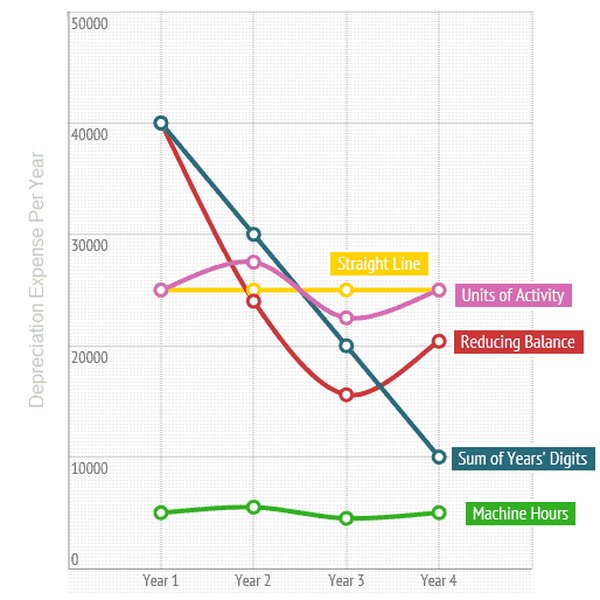
Illustrative Comparison of Depreciation Methods Over Time
This image conceptually shows how accelerated depreciation (like double-declining balance) results in higher expense and lower book value in the initial years compared to the straight-line method.
Frequently Asked Questions (FAQ)
Does depreciation affect cash flow directly?
No, depreciation is a non-cash expense and does not involve a direct outflow of cash in the period it is recorded. However, it indirectly affects cash flow through its impact on income tax liability.
How does depreciation reduce taxable income?
Depreciation expense is tax-deductible. By including depreciation as an expense on the income statement, a company reduces its reported taxable income, which in turn lowers the amount of income tax it owes.
Which depreciation method is best?
There is no single "best" depreciation method. The most appropriate method depends on the nature of the asset, its expected usage pattern, the company's business strategy, and tax objectives. Companies often choose a method that best reflects the pattern in which the asset's economic benefits are consumed.
How does depreciation impact financial ratios like ROA?
Depreciation affects both the numerator (Net Income) and the denominator (Total Assets) of the ROA ratio. Accelerated depreciation methods, by reducing net income more in early years and lowering asset book value faster, can lead to a different ROA trend compared to the straight-line method.
Can a company change its depreciation method?
Yes, a company can change its depreciation method, but this is considered a change in accounting estimate or principle depending on the circumstances and accounting standards (GAAP or IFRS). Such changes require proper disclosure and justification.
References
Last updated May 5, 2025