
A Comprehensive Analysis of Depreciation Methods and Their Impact on Financial Performance
Exploring Key Accounting Concepts and Their Effects
This document presents a comprehensive study examining various depreciation methods and their significant impact on a company's financial performance. Depreciation is a fundamental accounting concept that allocates the cost of tangible assets over their useful lives. The choice of depreciation method can have profound implications for a company's financial statements, tax obligations, and overall financial health. Understanding these methods is crucial for accurate financial reporting, informed decision-making, and effective asset management.
Key Highlights of Depreciation Methods and Their Impact
- Multiple Depreciation Methods Exist: Generally Accepted Accounting Principles (GAAP) and other accounting standards allow for several depreciation methods, each with distinct characteristics and impacts on financial reporting. The most common include straight-line, declining balance, units of production, and sum-of-the-years' digits.
- Impact on Financial Statements: The chosen depreciation method directly affects a company's income statement (through depreciation expense), balance sheet (through the carrying value of assets and accumulated depreciation), and potentially the cash flow statement (indirectly through net income). Accelerated methods result in higher expenses and lower asset values in earlier years compared to the straight-line method.
- Tax and Strategic Implications: Different depreciation methods can have varying tax implications, particularly with accelerated depreciation methods that allow for larger deductions in the initial years of an asset's life. The choice of method can also influence financial ratios and the perception of a company's financial performance and asset management effectiveness.
Introduction to Depreciation
Understanding the Core Concept
Depreciation is an accounting mechanism used to spread the cost of a tangible asset over its estimated useful life. This process recognizes that assets lose value over time due to wear and tear, obsolescence, or usage. Instead of expensing the entire cost of a significant asset in the year of purchase, depreciation allows businesses to match the expense with the revenue generated by the asset over its service life. This provides a more accurate representation of a company's profitability over time.
The concept of depreciation is vital for both financial reporting and tax purposes. For financial reporting, it ensures compliance with accounting standards like GAAP or IFRS, providing stakeholders with a realistic view of the asset's diminishing value. For tax purposes, depreciation allows businesses to deduct a portion of the asset's cost each year, reducing taxable income.

Illustration representing fixed asset depreciation.
Need of Study
Why a Comparative Analysis is Essential
The existence of multiple permissible depreciation methods highlights the need for a comparative study. Each method allocates the asset's cost differently across its useful life, leading to variations in reported net income, asset values, and financial ratios. Businesses need to understand these differences to make informed decisions about which method best suits their assets, industry, and financial objectives. A comparative study helps to illuminate:
- The distinct impact of each method on financial statements over an asset's life.
- How different methods influence a company's tax liability.
- The potential effects on financial ratios and their interpretation by investors and creditors.
- The strategic implications of choosing one method over another, particularly in industries with significant capital assets.
Furthermore, tax regulations, such as those under the Modified Accelerated Cost Recovery System (MACRS) in the U.S., often have their own sets of rules and allowable methods, which may differ from those used for financial reporting. Understanding these discrepancies is crucial for compliance and effective tax planning.
Objective of Study
Defining the Goals of the Analysis
The primary objective of this comparative study is to provide a detailed analysis of the most common depreciation methods and quantify their impact on key financial metrics. Specific objectives include:
- To describe and illustrate the mechanics of the major depreciation methods: straight-line, declining balance, units of production, and sum-of-the-years' digits.
- To compare the annual depreciation expense and resulting book value of an asset under each method over its useful life using practical examples.
- To analyze how the choice of depreciation method affects a company's income statement, balance sheet, and cash flow statement.
- To discuss the implications of different depreciation methods for financial ratios such as return on assets and profit margins.
- To explore the tax advantages and disadvantages associated with each depreciation method.
- To provide insights into factors businesses should consider when selecting an appropriate depreciation method for their assets.
Scope of Study
Defining the Boundaries of the Research
This study focuses on the most widely recognized and applied depreciation methods under generally accepted accounting principles (GAAP). While other specialized or industry-specific methods may exist, the core analysis will center on:
- Straight-Line Method
- Declining Balance Methods (specifically focusing on Double Declining Balance)
- Units of Production Method
- Sum-of-the-Years' Digits Method
The analysis will involve hypothetical case studies and examples to illustrate the calculations and financial statement impacts. The study will primarily consider the implications for financial reporting and U.S. income tax regulations (specifically MACRS where relevant), acknowledging that international accounting standards (like IFRS) may have variations in application.
The study will not delve into the detailed historical evolution of depreciation accounting or explore highly specialized depreciation treatments for specific asset types unless they serve as clear illustrative examples for the core methods.
Literature Survey
Reviewing Existing Knowledge
A review of existing literature reveals a substantial body of knowledge on depreciation accounting. Academic texts, accounting standards pronouncements, and financial articles consistently highlight the importance of depreciation in financial reporting and analysis. The literature emphasizes that depreciation is a non-cash expense that allocates the cost of an asset over its useful life, reflecting the asset's consumption or decline in value.
Key themes emerging from the literature include:
- The four primary depreciation methods (straight-line, declining balance, units of production, and sum-of-the-years' digits) are consistently presented as the fundamental approaches.
- Accelerated depreciation methods (declining balance and sum-of-the-years' digits) are often favored for tax purposes as they result in larger deductions in the early years, deferring tax liabilities.
- The straight-line method is widely acknowledged as the simplest and most commonly used method due to its ease of calculation and consistent expense allocation.
- The units of production method is considered most appropriate for assets whose wear and tear are directly related to usage rather than the passage of time.
- The impact of depreciation on financial statements, particularly the income statement and balance sheet, is a recurring topic, with emphasis on how different methods influence reported profitability and asset carrying values.
- Comparisons between GAAP and IFRS depreciation treatments are also discussed, noting some differences in flexibility and preferred methods depending on the asset's usage pattern.
Several sources provide formulas and examples for calculating depreciation under each method, reinforcing the practical application of these concepts.
Research Methodology
Approach to the Study
This comparative study will employ a descriptive and analytical research methodology. The approach involves:
- Literature Review: Gathering information from accounting textbooks, academic journals, professional accounting standards (GAAP), and reputable financial websites to understand the theoretical foundations and practical applications of various depreciation methods.
- Method Description and Formulae: Clearly defining each depreciation method and presenting the relevant formulas for calculating annual depreciation expense, accumulated depreciation, and the asset's book value.
- Case Studies and Examples: Developing hypothetical scenarios involving the purchase and depreciation of a tangible asset. Applying each depreciation method to these scenarios to calculate and compare the depreciation expense and book value over the asset's useful life.
- Financial Statement Impact Analysis: Analyzing how the depreciation expense calculated under each method would affect key line items on the income statement (e.g., operating income, net income) and the balance sheet (e.g., carrying value of assets, accumulated depreciation).
- Tax Implications Analysis: Discussing the general tax implications of using different depreciation methods, particularly in the context of accelerated depreciation and its effect on taxable income.
- Comparison and Synthesis: Comparing the results obtained from the case studies and synthesizing the findings to highlight the advantages and disadvantages of each method from financial reporting, tax, and strategic perspectives.
The focus will be on providing clear, step-by-step calculations and explanations to enhance understanding of the differences between the methods.
Data Analysis
Illustrating Depreciation Through Examples
To effectively analyze the impact of different depreciation methods, we will use a consistent example. Let's assume a company purchases a machine for $100,000 with an estimated useful life of 5 years and a salvage value of $10,000. The depreciable cost is $100,000 - $10,000 = $90,000.
Straight-Line Method
The straight-line method allocates the depreciable cost evenly over the asset's useful life.
\[ \text{Annual Depreciation Expense} = \frac{\text{Asset Cost} - \text{Salvage Value}}{\text{Useful Life}} \] \[ \text{Annual Depreciation Expense} = \frac{\$100,000 - \$10,000}{5 \text{ years}} = \frac{\$90,000}{5 \text{ years}} = \$18,000 \]The depreciation expense is $18,000 each year for 5 years.
Double Declining Balance Method
The double declining balance method is an accelerated method that depreciates a larger portion of the asset's cost in the early years. The depreciation rate is double the straight-line rate. The straight-line rate is \(1 / \text{Useful Life}\), so in this case, \(1/5 = 20\%\). The double declining balance rate is \(2 \times 20\% = 40\%\).
\[ \text{Annual Depreciation Expense} = \text{Beginning Book Value} \times \text{Depreciation Rate} \]Note that salvage value is not subtracted when calculating the annual depreciation expense with this method, but the asset is not depreciated below its salvage value.
- Year 1: \( \$100,000 \times 40\% = \$40,000 \)
- Year 2: \( (\$100,000 - \$40,000) \times 40\% = \$60,000 \times 40\% = \$24,000 \)
- Year 3: \( (\$60,000 - \$24,000) \times 40\% = \$36,000 \times 40\% = \$14,400 \)
- Year 4: \( (\$36,000 - \$14,400) \times 40\% = \$21,600 \times 40\% = \$8,640 \)
- Year 5: The remaining book value before depreciation is \( \$21,600 - \$8,640 = \$12,960 \). To reach the salvage value of $10,000, the depreciation expense is \( \$12,960 - \$10,000 = \$2,960 \).
Units of Production Method
This method depreciates the asset based on its usage. Assume the machine is expected to produce 100,000 units over its life, and in Year 1 it produced 25,000 units, Year 2 produced 30,000 units, Year 3 produced 20,000 units, Year 4 produced 15,000 units, and Year 5 produced 10,000 units.
\[ \text{Depreciation per Unit} = \frac{\text{Asset Cost} - \text{Salvage Value}}{\text{Total Estimated Production}} \] \[ \text{Depreciation per Unit} = \frac{\$100,000 - \$10,000}{100,000 \text{ units}} = \frac{\$90,000}{100,000 \text{ units}} = \$0.90 \text{ per unit} \] \[ \text{Annual Depreciation Expense} = \text{Depreciation per Unit} \times \text{Units Produced in the Year} \]- Year 1: \( \$0.90 \times 25,000 \text{ units} = \$22,500 \)
- Year 2: \( \$0.90 \times 30,000 \text{ units} = \$27,000 \)
- Year 3: \( \$0.90 \times 20,000 \text{ units} = \$18,000 \)
- Year 4: \( \$0.90 \times 15,000 \text{ units} = \$13,500 \)
- Year 5: \( \$0.90 \times 10,000 \text{ units} = \$9,000 \)
Sum-of-the-Years' Digits (SYD) Method
The SYD method is another accelerated method. It calculates a depreciation fraction based on the sum of the years of the asset's useful life. For a 5-year life, the sum of the years' digits is \(5 + 4 + 3 + 2 + 1 = 15\).
\[ \text{Annual Depreciation Expense} = (\text{Depreciable Cost}) \times \frac{\text{Remaining Useful Life}}{\text{Sum of the Years' Digits}} \]- Year 1: \( \$90,000 \times (5/15) = \$30,000 \)
- Year 2: \( \$90,000 \times (4/15) = \$24,000 \)
- Year 3: \( \$90,000 \times (3/15) = \$18,000 \)
- Year 4: \( \$90,000 \times (2/15) = \$12,000 \)
- Year 5: \( \$90,000 \times (1/15) = \$6,000 \)
Comparison of Depreciation Expenses and Book Values
The following table summarizes the annual depreciation expense and the ending book value of the asset under each method for each year.
| Year | Straight-Line Depreciation | Straight-Line Book Value | Double Declining Balance Depreciation | Double Declining Balance Book Value | Units of Production Depreciation | Units of Production Book Value | SYD Depreciation | SYD Book Value |
|---|---|---|---|---|---|---|---|---|
| 0 (Beginning) | - | $100,000 | - | $100,000 | - | $100,000 | - | $100,000 |
| 1 | $18,000 | $82,000 | $40,000 | $60,000 | $22,500 | $77,500 | $30,000 | $70,000 |
| 2 | $18,000 | $64,000 | $24,000 | $36,000 | $27,000 | $50,500 | $24,000 | $46,000 |
| 3 | $18,000 | $46,000 | $14,400 | $21,600 | $18,000 | $32,500 | $18,000 | $28,000 |
| 4 | $18,000 | $28,000 | $8,640 | $12,960 | $13,500 | $19,000 | $12,000 | $16,000 |
| 5 | $18,000 | $10,000 | $2,960 | $10,000 | $9,000 | $10,000 | $6,000 | $10,000 |
This table clearly shows the differing patterns of depreciation expense and book value under each method. Straight-line results in a constant expense, while the accelerated methods (Double Declining Balance and SYD) have higher expenses in earlier years and lower expenses in later years. The Units of Production method's expense fluctuates based on usage.
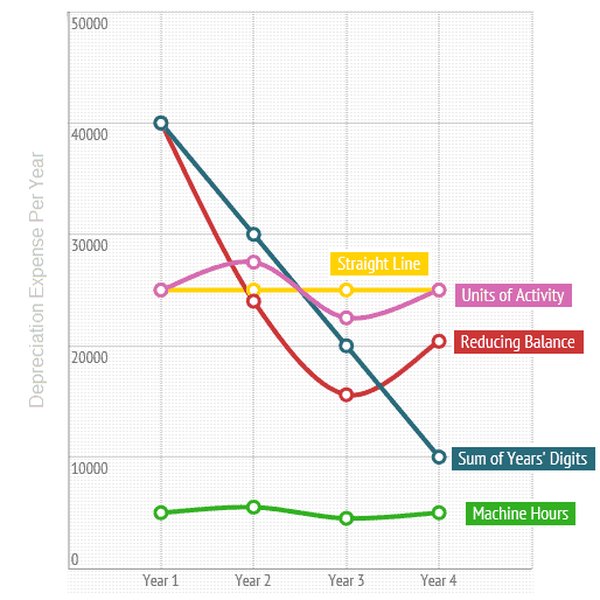
Graph illustrating the depreciation expense patterns of different methods over an asset's life.
Applications
Where Depreciation Methods are Applied
Depreciation methods are applied across various aspects of business and finance:
- Financial Reporting: Companies use depreciation to prepare financial statements (Income Statement, Balance Sheet, Cash Flow Statement) in accordance with GAAP or IFRS. The chosen method impacts reported profitability and asset values, which are crucial for investors, creditors, and other stakeholders.
- Taxation: Depreciation is a significant tax deduction for businesses. Tax regulations often prescribe specific methods (like MACRS in the U.S.) and recovery periods, which may differ from financial reporting methods. Strategic tax planning involves understanding how different depreciation methods can affect taxable income and tax liabilities.
- Asset Management: Understanding depreciation helps businesses track the diminishing value of their assets and make informed decisions about asset replacement, disposal, or upgrades.
- Financial Analysis: Analysts use depreciation figures to evaluate a company's profitability, asset utilization, and financial health. The choice of depreciation method can influence key financial ratios used in this analysis.
- Decision Making: Depreciation is considered in capital budgeting decisions when evaluating the profitability of potential investments in long-term assets.
Findings
Key Observations from the Analysis
Based on the data analysis and comparison of depreciation methods, several key findings emerge:
- The straight-line method provides a consistent annual depreciation expense, resulting in a gradual decrease in the asset's book value. This simplicity makes it easy to understand and apply.
- Accelerated depreciation methods (Double Declining Balance and SYD) result in higher depreciation expenses in the early years of an asset's life and lower expenses in later years. This leads to a more rapid decline in the asset's book value compared to the straight-line method.
- The units of production method aligns depreciation expense with the asset's actual usage. This method is particularly suitable for assets whose decline in value is primarily driven by how much they are used, rather than just the passage of time.
- The choice of depreciation method significantly impacts reported net income. Accelerated methods lead to lower net income in the early years (due to higher depreciation expense) and higher net income in later years compared to the straight-line method.
- The accumulated depreciation on the balance sheet grows faster under accelerated methods in the early years, resulting in a lower net book value of assets.
- While depreciation is a non-cash expense and doesn't directly affect cash flow from operations, the choice of depreciation method can indirectly influence cash flow through its impact on taxable income and thus the amount of income taxes paid. Accelerated depreciation can lead to lower taxable income and tax payments in the early years, improving cash flow during that period.
Suggestions
Recommendations for Depreciation Method Selection
Selecting the appropriate depreciation method is a crucial decision for businesses. The following suggestions should be considered:
-
Consider the Asset's Usage Pattern: If an asset's value declines more rapidly in its early years or its usage is expected to be higher initially, accelerated methods like double declining balance or SYD might be more appropriate for financial reporting to better match expenses with revenue generation. If the asset's wear and tear are directly tied to production or usage, the units of production method is likely the most suitable.
-
Evaluate Tax Implications: For tax purposes, businesses should explore accelerated depreciation methods allowed by tax regulations (like MACRS) to potentially reduce taxable income and defer tax payments, thereby improving cash flow.
-
Maintain Consistency: Once a depreciation method is chosen for a particular class of assets, it should be applied consistently over the asset's life to ensure comparability of financial statements across periods. Changes in depreciation methods are permissible under accounting standards but require proper justification and disclosure.
-
Consider Simplicity: For businesses with limited accounting resources or assets that depreciate evenly over time, the straight-line method offers simplicity and ease of application.
-
Align with Financial Reporting Objectives: The chosen method should align with the company's overall financial reporting objectives and provide a fair representation of the asset's diminishing value and its contribution to revenue.
-
Seek Professional Advice: Businesses should consult with accounting professionals to determine the most appropriate depreciation methods based on their specific circumstances, asset types, industry practices, and tax considerations.
Conclusion
Summarizing the Findings and Implications
In conclusion, depreciation is a fundamental accounting principle with a significant impact on a company's financial statements and overall financial health. The choice of depreciation method is not merely an accounting formality but a strategic decision that influences reported profitability, asset values, tax liabilities, and key financial ratios.
This comparative study has illustrated that while the straight-line method provides a consistent allocation of cost, accelerated methods front-load depreciation expense, leading to different patterns of reported income and asset values. The units of production method offers an alternative that aligns depreciation with asset usage.
Businesses must carefully consider the characteristics of their assets, their financial reporting objectives, and the relevant tax regulations when selecting a depreciation method. Understanding the implications of each method is essential for accurate financial reporting, effective tax planning, and informed decision-making regarding asset management and capital investments. The impact on financial ratios and the perception of financial performance further underscore the importance of a thoughtful approach to depreciation.
Frequently Asked Questions
What is depreciation?
Depreciation is an accounting method used to allocate the cost of a tangible asset over its useful life. It represents the gradual decrease in the asset's value due to wear and tear, obsolescence, or usage.
What are the main types of depreciation methods?
The most common depreciation methods include straight-line, double declining balance, units of production, and sum-of-the-years' digits.
How does depreciation affect the income statement?
Depreciation is recorded as an expense on the income statement, which reduces operating income and net income.
How does depreciation affect the balance sheet?
Depreciation affects the balance sheet by reducing the book value of the asset (cost minus accumulated depreciation). Accumulated depreciation is a contra-asset account that appears on the balance sheet.
Is depreciation a cash expense?
No, depreciation is a non-cash expense. It is an accounting allocation of a past cash outflow (the purchase of the asset) over time.
How does depreciation impact cash flow?
Although depreciation is a non-cash expense, it affects cash flow indirectly by reducing taxable income, which in turn reduces the amount of income taxes a company pays. This can lead to increased cash flow from operations compared to a scenario with no depreciation expense.
Can a company change its depreciation method?
Yes, a company can change its depreciation method, but it is considered a change in accounting estimate effected by a change in accounting principle. Such a change requires justification that the new method is preferable and must be disclosed in the financial statements.
References
Last updated May 6, 2025