
A Comprehensive Study of Depreciation Methods and Their Impact on Financial Performance: A Focus on ManuCorp Industries Ltd.
Analyzing the Allocation of Asset Costs and Financial Reporting Implications
Key Insights
- Depreciation's Fundamental Role: Depreciation is a non-cash expense that systematically allocates the cost of a tangible asset over its useful life, reflecting the asset's gradual loss of value due to wear and tear, obsolescence, or usage.
- Impact on Financial Statements: Depreciation significantly affects a company's income statement (reducing net income and thus taxable income), balance sheet (decreasing the book value of assets and equity), and cash flow statement (added back to net income as it is a non-cash expense).
- Diverse Methods, Varying Impacts: Different depreciation methods (Straight-Line, Declining Balance, Units of Production, Sum-of-the-Years' Digits) result in different depreciation expense patterns over an asset's life, influencing reported profitability, asset values, and tax obligations.
Introduction
Depreciation is a critical concept in accounting and finance, representing the systematic allocation of the cost of a tangible asset over its estimated useful life. This process acknowledges that assets like machinery, buildings, and equipment lose value over time due to various factors, including wear and tear, technological obsolescence, and market conditions. Rather than expensing the entire cost of a long-term asset in the year of purchase, depreciation allows businesses to spread this cost over the periods the asset is expected to generate revenue. This aligns with the matching principle of accounting, which requires expenses to be recognized in the same period as the revenues they help generate.
The choice of depreciation method can have a notable impact on a company's financial statements, influencing reported profitability, asset valuation, and tax liabilities. Understanding the different methods and their effects is crucial for accurate financial reporting, informed decision-making, and effective financial analysis.
Need of Study
The need for a comprehensive study on depreciation methods and their impact on financial performance stems from several factors:
- Accurate Financial Reporting: Businesses must accurately reflect the diminishing value of their assets to provide stakeholders with a true and fair view of their financial position and performance. Different depreciation methods can lead to variations in reported profits and asset values, making a comparative study essential for understanding these differences.
- Informed Decision-Making: The depreciation method used impacts key financial ratios and metrics, which are vital for internal decision-making regarding pricing, investment, and resource allocation. A study helps in understanding how these metrics are influenced.
- Tax Planning and Compliance: Depreciation is a significant tax deduction, reducing taxable income. The choice of method can accelerate or decelerate these deductions, impacting a company's tax burden over time. Understanding the tax implications of different methods is crucial for effective tax planning and compliance with regulations like those from the IRS (e.g., under MACRS).
- Comparability Across Companies: Companies within the same industry may use different depreciation methods, making direct comparisons of financial performance challenging. A study can highlight these differences and their potential impact on comparative analysis.
- Asset Management: Depreciation is linked to asset management, as it helps in tracking the remaining value of assets and planning for their eventual replacement. The method used can influence the perceived efficiency of asset utilization.
Objective of Study
The primary objectives of this comparative study are to:
- Identify and describe the most common depreciation methods used by businesses.
- Explain the calculation methodology for each depreciation method.
- Analyze and compare the impact of different depreciation methods on the three primary financial statements: the Income Statement, the Balance Sheet, and the Cash Flow Statement.
- Evaluate how the choice of depreciation method affects key financial metrics and ratios.
- Examine the tax implications associated with different depreciation methods.
- Illustrate the application of these depreciation methods using a case study of ManuCorp Industries Ltd.
Scope of Study
This study will focus on the most widely used depreciation methods under Generally Accepted Accounting Principles (GAAP) and relevant tax regulations. The analysis will primarily cover the impact of depreciation on financial reporting and tax obligations. The case study of ManuCorp Industries Ltd. will provide a practical illustration of the concepts discussed, focusing on a specific asset or class of assets relevant to their manufacturing operations. While other factors influencing asset value (like impairment) are acknowledged, the core focus will remain on depreciation.
Literature Survey
The concept of depreciation is well-established in accounting literature and practice. Early accounting principles recognized the need to account for the diminishing value of assets used in generating income. The literature highlights that depreciation is a non-cash expense, meaning it does not involve an outflow of cash. Its primary purpose is cost allocation, not asset valuation in terms of market value.
Various depreciation methods have been developed to reflect different patterns of asset usage and value decline. The Straight-Line method is often considered the simplest and is widely used, allocating the cost evenly over the asset's life. Accelerated methods, such as the Declining Balance method and Sum-of-the-Years' Digits method, recognize higher depreciation expense in the earlier years of an asset's life, aligning with the idea that assets may be more productive or lose value more quickly when they are new. The Units of Production method ties depreciation to the asset's usage rather than the passage of time, which is particularly relevant for assets whose wear and tear is directly related to their output.
Research consistently shows that the choice of depreciation method impacts reported net income, asset values on the balance sheet (through accumulated depreciation), and profitability ratios. While depreciation itself is a non-cash expense, it affects cash flow indirectly through its impact on taxable income. Lower taxable income due to higher depreciation expense results in lower income tax payments, thereby increasing cash flow.
Tax regulations, such as the Modified Accelerated Cost Recovery System (MACRS) in the United States, often prescribe specific depreciation methods and recovery periods for different classes of assets, sometimes allowing for accelerated depreciation or bonus depreciation as tax incentives. These regulations can influence a company's choice of depreciation method for tax purposes, which may differ from the method used for financial reporting.
Studies on specific industries, such as manufacturing, emphasize the significance of depreciation for capital-intensive businesses that rely heavily on machinery and equipment. The accurate tracking and depreciation of these assets are crucial for determining the true cost of production and evaluating financial performance.
Research Methodology
This study employs a descriptive and analytical research methodology. The research will involve:
- Literature Review: Gathering information on depreciation methods from accounting textbooks, academic journals, industry publications, and regulatory guidelines (e.g., GAAP, IRS publications).
- Method Calculation and Illustration: Detailing the formulas and step-by-step calculations for the primary depreciation methods.
- Impact Analysis: Analyzing the theoretical impact of each depreciation method on the income statement, balance sheet, and cash flow statement.
- Case Study Application: Applying the different depreciation methods to a hypothetical scenario involving ManuCorp Industries Ltd. This will involve making assumptions about the cost, useful life, and salvage value of a representative asset.
- Comparative Analysis: Comparing the results obtained from applying different depreciation methods in the ManuCorp case study to highlight the variations in financial reporting outcomes.
- Discussion of Implications: Discussing the implications of these variations for financial performance analysis, decision-making, and tax planning.
Data Analysis
To illustrate the impact of different depreciation methods, let's consider a hypothetical asset purchased by ManuCorp Industries Ltd. Assume ManuCorp purchases a new manufacturing machine with the following details:
- Initial Cost: $205,000
- Estimated Useful Life: 5 years
- Estimated Salvage Value: $5,000
We will calculate the annual depreciation expense and the book value of the asset over its useful life using three common methods: Straight-Line, Double Declining Balance, and Sum-of-the-Years' Digits.
Straight-Line Method
The straight-line method allocates the depreciable cost evenly over the asset's useful life.
\[ \text{Annual Depreciation} = \frac{\text{Cost} - \text{Salvage Value}}{\text{Useful Life}} \] \[ \text{Annual Depreciation} = \frac{\$205,000 - \$5,000}{5 \text{ years}} = \frac{\$200,000}{5 \text{ years}} = \$40,000 \]Double Declining Balance Method
The double declining balance method is an accelerated method that depreciates assets at twice the straight-line rate. The depreciation rate is applied to the book value of the asset at the beginning of each year. Salvage value is not subtracted initially but the depreciation stops when the book value reaches the salvage value.
Straight-Line Rate = \( \frac{1}{\text{Useful Life}} = \frac{1}{5} = 20\% \)
Double Declining Balance Rate = \( 2 \times 20\% = 40\% \)
Sum-of-the-Years' Digits Method
The sum-of-the-years' digits method is another accelerated method. The depreciation rate changes each year and is applied to the depreciable cost (Cost - Salvage Value).
Sum of the years' digits for a 5-year life = \( 5 + 4 + 3 + 2 + 1 = 15 \)
Here's a table comparing the depreciation expense and book value under each method for ManuCorp's asset:
| Year | Straight-Line Depreciation | Straight-Line Book Value | Double Declining Balance Depreciation | Double Declining Balance Book Value | Sum-of-the-Years' Digits Depreciation | Sum-of-the-Years' Digits Book Value |
|---|---|---|---|---|---|---|
| Beginning | - | $205,000 | - | $205,000 | - | $205,000 |
| 1 | $40,000 | $165,000 | $205,000 * 40% = $82,000 | $123,000 | ((\( \frac{5}{15} \))) * $200,000 = $66,667 | $138,333 |
| 2 | $40,000 | $125,000 | $123,000 * 40% = $49,200 | $73,800 | ((\( \frac{4}{15} \))) * $200,000 = $53,333 | $85,000 |
| 3 | $40,000 | $85,000 | $73,800 * 40% = $29,520 | $44,280 | ((\( \frac{3}{15} \))) * $200,000 = $40,000 | $45,000 |
| 4 | $40,000 | $45,000 | $44,280 * 40% = $17,712 | $26,568 | ((\( \frac{2}{15} \))) * $200,000 = $26,667 | $18,333 |
| 5 | $40,000 | $5,000 | $26,568 - $5,000 = $21,568 (limited by salvage value) | $5,000 | ((\( \frac{1}{15} \))) * $200,000 = $13,333 | $5,000 |
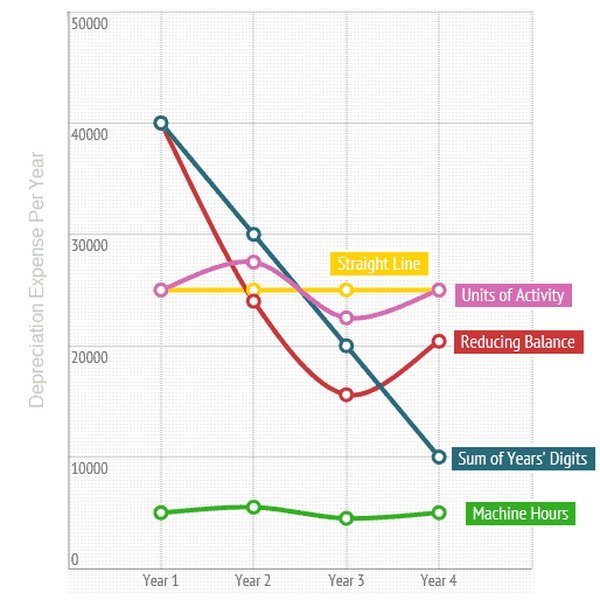
As the table demonstrates, the straight-line method results in a consistent depreciation expense each year. The accelerated methods (Double Declining Balance and Sum-of-the-Years' Digits) show higher depreciation in the earlier years and lower depreciation in later years. This difference in expense patterns directly impacts the reported financial performance.
Here is a visual representation comparing the depreciation expense over the years for these methods:
Comparison of Depreciation Expense Methods
Impact on Financial Statements (Using ManuCorp Example - Year 1)
Income Statement:
Assuming pre-depreciation operating income of $100,000 and a tax rate of 30%:
- Straight-Line: Operating Income decreases by $40,000 to $60,000. Net Income decreases by $40,000 * (1 - 30%) = $28,000.
- Double Declining Balance: Operating Income decreases by $82,000 to $18,000. Net Income decreases by $82,000 * (1 - 30%) = $57,400.
- Sum-of-the-Years' Digits: Operating Income decreases by $66,667 to $33,333. Net Income decreases by $66,667 * (1 - 30%) = $46,667.
Accelerated methods result in lower reported net income in the early years compared to the straight-line method.
Balance Sheet:
Depreciation reduces the book value of the asset and the equity section (through retained earnings). Accumulated depreciation is a contra-asset account.
- Straight-Line: Asset Book Value is $205,000 - $40,000 = $165,000.
- Double Declining Balance: Asset Book Value is $205,000 - $82,000 = $123,000.
- Sum-of-the-Years' Digits: Asset Book Value is $205,000 - $66,667 = $138,333.
Accelerated methods lead to a lower reported asset book value and lower equity in the early years.
Cash Flow Statement:
Depreciation is a non-cash expense, so it is added back to net income in the operating activities section when using the indirect method.
- Straight-Line: Net Income is reduced by $28,000 (as calculated above), but $40,000 in depreciation is added back. The net impact on cash flow from operations is an increase of $40,000 - $28,000 = $12,000 (due to lower taxes).
- Double Declining Balance: Net Income is reduced by $57,400, but $82,000 in depreciation is added back. The net impact on cash flow from operations is an increase of $82,000 - $57,400 = $24,600.
- Sum-of-the-Years' Digits: Net Income is reduced by $46,667, but $66,667 in depreciation is added back. The net impact on cash flow from operations is an increase of $66,667 - $46,667 = $20,000.
Accelerated methods result in higher cash flow from operations in the early years due to the larger tax shield provided by the higher depreciation expense.
Applications
Understanding depreciation methods and their impact is crucial for various applications within a business like ManuCorp Industries Ltd.:
- Financial Reporting: Ensuring compliance with accounting standards (GAAP) and providing accurate financial statements to investors, creditors, and other stakeholders.
- Tax Compliance and Planning: Calculating the correct depreciation deduction for tax purposes and strategically choosing methods (where options exist) to optimize tax liabilities and improve cash flow.
- Internal Performance Evaluation: Assessing the profitability of different business segments or product lines by accurately allocating asset costs.
- Capital Budgeting: Evaluating potential investments in new assets by considering the impact of depreciation on future profitability and cash flows. Depreciation is a key input in calculating metrics like Net Present Value (NPV) and Internal Rate of Return (IRR).
- Asset Management and Replacement: Tracking the book value of assets helps in making decisions about maintenance, upgrades, and eventual replacement.
- Loan and Credit Applications: Financial statements, influenced by depreciation, are reviewed by lenders to assess a company's financial health and repayment capacity.
Findings
Based on the analysis and illustration with ManuCorp Industries Ltd., several key findings emerge:
- Different depreciation methods lead to significantly different patterns of depreciation expense over an asset's useful life.
- Accelerated depreciation methods (Double Declining Balance and Sum-of-the-Years' Digits) result in higher depreciation expense in the early years and lower expense in later years compared to the Straight-Line method.
- The choice of depreciation method directly impacts reported net income, with accelerated methods resulting in lower net income in the early years.
- The book value of assets on the balance sheet is also affected, with accelerated methods leading to a lower book value in the early years.
- While depreciation is a non-cash expense, it influences cash flow through its impact on income taxes. Accelerated methods provide a larger tax shield in the early years, resulting in higher cash flow from operations during that period.
- There is no single "best" depreciation method; the most appropriate method depends on the nature of the asset, industry practices, and a company's financial reporting and tax objectives.
Suggestions
For ManuCorp Industries Ltd. and other businesses, the following suggestions are relevant regarding depreciation:
-
Carefully consider the nature of the asset and its expected pattern of use and value decline when selecting a depreciation method.
-
Understand the implications of the chosen method on financial statements and key financial ratios.
-
Evaluate the tax implications of different methods and leverage accelerated depreciation or bonus depreciation where permissible and beneficial for cash flow.
-
Maintain detailed records of fixed assets, including their cost, useful life, salvage value, and accumulated depreciation for each asset.
-
Regularly review depreciation policies and estimates (useful life, salvage value) to ensure they remain appropriate. Changes in estimates may be necessary over time.
-
Utilize accounting software or specialized depreciation software to accurately track and calculate depreciation, especially for companies with a large number of fixed assets.
-
For internal analysis, consider the impact of different depreciation methods on performance metrics and ensure consistency in reporting.
Conclusion
Depreciation is a fundamental accounting practice that reflects the economic reality of asset usage and decline in value. The choice of depreciation method has a profound impact on a company's financial statements, influencing reported profitability, asset values, and cash flows. Straight-Line depreciation offers simplicity and consistent expense, while accelerated methods provide larger tax deductions and higher cash flow in the early years, which can be advantageous for businesses seeking to reinvest. By understanding the mechanics and implications of different depreciation methods, companies like ManuCorp Industries Ltd. can make more informed financial reporting decisions, optimize tax strategies, and enhance their overall financial management.
FAQ
What is the main purpose of depreciation?
The main purpose of depreciation is to allocate the cost of a tangible asset over its estimated useful life, matching the expense to the periods in which the asset is used to generate revenue. It reflects the gradual loss of the asset's value due to wear and tear, obsolescence, or usage.
How does depreciation affect net income?
Depreciation is an expense on the income statement. An increase in depreciation expense reduces operating income and, consequently, net income. Accelerated depreciation methods result in lower net income in the earlier years compared to the straight-line method.
Is depreciation a cash expense?
No, depreciation is a non-cash expense. It is an accounting entry that allocates a portion of an asset's historical cost. While it reduces net income, it does not involve an outflow of cash in the period it is recorded.
How does depreciation impact the balance sheet?
Depreciation reduces the book value of a tangible asset on the balance sheet. This is done through accumulated depreciation, which is a contra-asset account that is subtracted from the asset's original cost. The reduction in asset value also reduces the equity section of the balance sheet (specifically, retained earnings) due to the lower net income.
Which depreciation method is best?
There is no universally "best" depreciation method. The most appropriate method depends on factors such as the asset's usage pattern, industry norms, and the company's financial reporting and tax objectives. The Straight-Line method is simple and widely used, while accelerated methods can offer tax advantages in the early years.
References
Last updated May 6, 2025