
Unlock Precision: Refining Your DFT Gauge Procurement Request
Enhancing your Material Request with essential details about Dry Film Thickness measurement technology.
Requesting equipment like a Dry Film Thickness (DFT) gauge requires clarity and context for efficient processing. Below is a refined version of your email to the Procurement Team, followed by a comprehensive guide to DFT gauges to support your request and ensure the right tool is acquired for your needs.
Improved Email Draft for Procurement
This revised email provides a professional tone, clearly states the purpose, and offers context for the request.
Subject: Request for Processing: Approved Material Request (MAR) for DFT Gauge (Dry Film Thickness)
Dear Procurement Team,
Please find attached the Approved Material Request (MAR) for a Dry Film Thickness (DFT) Gauge, submitted for your review and further processing.
The DFT Gauge is a crucial instrument for our quality control processes, used to accurately measure the thickness of coatings applied to various materials. Ensuring correct coating thickness is vital for product durability, performance, and compliance with industry standards.
We appreciate your prompt attention to this request. Please let me know if any additional information or clarification is required from my end to facilitate the procurement process.
Thank you for your support.
Best Regards,
[Your Full Name]
[Your Title/Position]
[Your Department]
[Your Contact Information]
Key Insights into DFT Gauges
- Critical for Quality: DFT measurement ensures coatings meet specifications, impacting durability, corrosion resistance, and performance.
- Technology Matters: Different gauge types (Magnetic, Eddy Current, Ultrasonic) suit specific substrate materials (ferrous metals, non-ferrous metals, wood, concrete).
- Accuracy is Paramount: Proper selection, usage, and regular calibration are essential for reliable and repeatable measurements, adhering to standards like SSPC-PA 2.
Understanding Dry Film Thickness (DFT) Gauges
What is a DFT Gauge and Why is it Essential?
A Dry Film Thickness (DFT) gauge is a precision instrument designed to measure the thickness of a coating after it has dried or cured on a substrate (the underlying material). Common coatings include paint, powder coating, galvanizing, enamel, and other protective layers. The substrates can range from metals (steel, aluminum) to non-metals like wood, plastic, or concrete.
The importance of measuring DFT cannot be overstated in industries such as manufacturing, automotive, aerospace, construction, marine, and oil & gas. Accurate DFT measurement is fundamental for:
- Quality Control: Verifying that the coating thickness meets the required specifications set by manufacturers, clients, or industry standards.
- Process Control: Monitoring the application process to ensure consistency and efficiency.
- Performance & Durability: Ensuring the coating provides the intended level of protection against corrosion, abrasion, environmental factors, etc. Incorrect thickness (too thin or too thick) can lead to premature failure.
- Cost Management: Avoiding the waste of coating material due to over-application and preventing costly rework or warranty claims due to under-application.
- Compliance: Adhering to industry standards and regulations (e.g., SSPC, ISO, ASTM) which often mandate specific DFT ranges.

Overview of various coating thickness gauges, highlighting their role in quality assurance.
Types of DFT Gauges and Measurement Principles
Matching the Gauge to the Substrate
DFT gauges operate using different physical principles, primarily non-destructive, meaning they measure thickness without damaging the coating or substrate. The choice of gauge depends mainly on the substrate material.
Magnetic Induction Gauges
These gauges are used for measuring non-magnetic coatings (e.g., paint, powder coating, plastic, zinc, chrome, enamel) on ferrous (magnetic) substrates like steel and iron. They work by generating a magnetic field using a probe. The proximity of the magnetic substrate affects the density of the magnetic flux lines. The gauge measures this effect, which is related to the distance (i.e., the coating thickness) between the probe and the ferrous substrate.
- Principle: Magnetic Induction
- Coatings: Non-magnetic
- Substrates: Ferrous (Steel, Iron)
- Examples: DeFelsko PosiTest DFT Ferrous, Elcometer 456 F models.
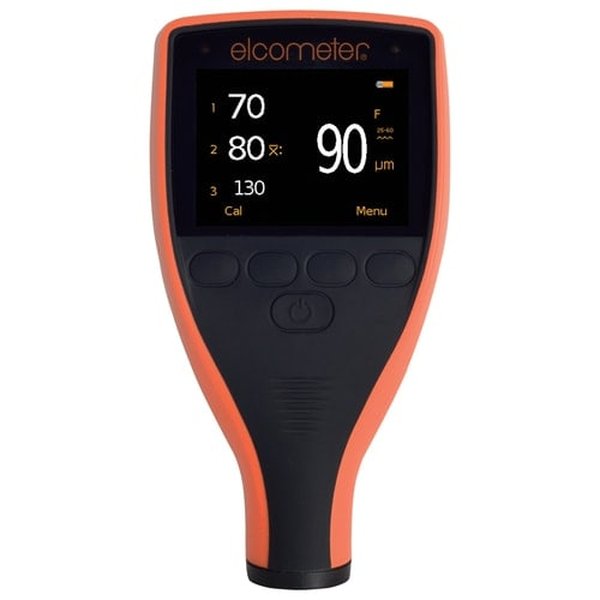
The Elcometer 456 is a popular digital DFT gauge available in models for ferrous, non-ferrous, or dual substrates.
Eddy Current Gauges
Eddy current gauges are designed for measuring non-conductive coatings (e.g., paint, powder coating, anodizing, plastic, enamel) on non-ferrous metal substrates (e.g., aluminum, copper, brass, stainless steel - non-magnetic grades). These gauges use a probe that induces alternating electrical currents (eddy currents) within the conductive metal substrate. The characteristics of these eddy currents (magnitude and phase) are influenced by the distance between the probe and the substrate, which corresponds to the coating thickness.
- Principle: Eddy Current
- Coatings: Non-conductive
- Substrates: Non-ferrous Metals (Aluminum, Copper, Brass, Austenitic Stainless Steel)
- Examples: DeFelsko PosiTest DFT Non-Ferrous, Elcometer 456 N models.
Many modern gauges are "dual" or "combination" types (often designated FNF), incorporating both magnetic induction and eddy current principles, automatically detecting the substrate type and selecting the appropriate method.

The Fischer MMS Inspection DFT utilizes both magnetic induction and eddy current principles for versatility.
Ultrasonic Gauges
Ultrasonic gauges are used primarily for measuring coating thickness on non-metal substrates such as wood, concrete, plastic, composites, and glass. They can also measure individual layers in multi-layer coating systems. These gauges emit an ultrasonic pulse that travels through the coating, reflects off the substrate (or the interface between layers), and returns to the transducer. The gauge measures the time taken for the pulse's round trip, which is converted into a thickness measurement based on the coating's sound velocity.
- Principle: Ultrasound Pulse-Echo
- Coatings: Various (paint, varnish, polymers)
- Substrates: Non-metals (Wood, Concrete, Plastic, Composites, Glass), and sometimes metals
- Special Feature: Can measure multiple layers individually.
- Examples: DeFelsko PosiTector 200.
Comparing DFT Gauge Technologies
This chart provides a comparative overview of the key characteristics of the main DFT gauge technologies. The scores (ranging conceptually from 1 to 10, with 10 being most advantageous) reflect typical performance attributes and suitability for different needs. Note that specific model performance can vary.
This visualization helps compare the strengths of each technology. Magnetic and Eddy Current gauges excel in ease of use and cost-effectiveness for metal substrates, while Ultrasonic gauges offer unparalleled versatility for non-metals and multi-layer analysis, albeit typically at a higher cost and complexity.
Key Features and Selection Criteria
Choosing the Right Gauge for Your Application
When selecting a DFT gauge through procurement, consider the following factors:
- Substrate Compatibility: Ensure the gauge principle matches your primary substrate materials (ferrous, non-ferrous, non-metal). Dual gauges offer flexibility if working with multiple metal types.
- Measurement Range & Accuracy: Verify the gauge covers the expected thickness range of your coatings and meets the required accuracy tolerance (often ±1-3%).
- Probe Type: Gauges come with built-in (integral) probes or separate (cable) probes. Integral probes are convenient for flat surfaces and one-handed use, while separate probes offer flexibility for reaching difficult areas or measuring on small/curved parts.
- Ease of Use & Features: Look for intuitive interfaces, clear displays, statistical functions (average, min/max, standard deviation), memory/data logging, and software connectivity if needed for reporting.
- Durability: Consider the working environment. Rugged gauges designed for field or industrial use are often required.
- Calibration & Standards: Ensure the gauge can be easily calibrated using certified shims or standards. Compliance with standards like ASTM D7091, ISO 2808, or SSPC-PA 2 is often necessary.
Summary of Gauge Types and Applications
The following table summarizes the primary DFT gauge types and their typical applications:
| Gauge Type | Measurement Principle | Suitable Substrates | Suitable Coatings | Common Applications |
|---|---|---|---|---|
| Magnetic Induction | Magnetic Flux | Ferrous Metals (Steel, Iron) | Non-magnetic (Paint, Powder, Plastic, Zinc, Chrome) | Steel structures, Automotive (steel panels), Industrial equipment |
| Eddy Current | Induced Electrical Currents | Non-ferrous Metals (Aluminum, Copper, Brass, Austenitic SS) | Non-conductive (Paint, Powder, Anodizing, Plastic) | Aerospace (aluminum), Automotive (aluminum panels), Architectural aluminum |
| Ultrasonic | Ultrasound Pulse-Echo | Non-metals (Wood, Concrete, Plastic, Composites, Glass), sometimes Metals | Various (Paint, Varnish, Polymers) | Wood finishing, Concrete coatings, Plastic parts, Multi-layer analysis |
| Dual (FNF) | Magnetic Induction & Eddy Current | Ferrous & Non-ferrous Metals | Non-magnetic on Ferrous / Non-conductive on Non-ferrous | General coating inspection on various metal substrates |
Visualizing DFT Gauge Concepts
Mindmap Overview
This mindmap illustrates the interconnected concepts surrounding Dry Film Thickness measurement, from its fundamental importance to the practical aspects of gauge selection and usage.
(SSPC, ISO, ASTM)"] id2["Gauge Types & Principles"] id2a["Magnetic Induction"] id2a1["Ferrous Substrates
(Steel, Iron)"] id2a2["Non-Magnetic Coatings"] id2b["Eddy Current"] id2b1["Non-Ferrous Metals
(Al, Cu, Brass)"] id2b2["Non-Conductive Coatings"] id2c["Ultrasonic"] id2c1["Non-Metal Substrates
(Wood, Concrete, Plastic)"] id2c2["Multi-Layer Measurement"] id2d["Dual (FNF)"] id2d1["Combines Magnetic & Eddy Current"] id3["Key Selection Factors"] id3a["Substrate Compatibility"] id3b["Accuracy & Range"] id3c["Probe Type (Integral/Separate)"] id3d["Ease of Use & Features"] id3e["Durability"] id3f["Calibration Needs"] id4["Applications"] id4a["Manufacturing"] id4b["Automotive"] id4c["Aerospace"] id4d["Construction & Infrastructure"] id4e["Marine & Offshore"] id4f["Oil & Gas"] id5["Best Practices"] id5a["Proper Calibration (Shims)"] id5b["Correct Usage Technique"] id5c["Understanding Standards (e.g., SSPC-PA 2)"] id5d["Surface Condition Awareness"]
DFT Gauge Selection Guidance Video
Expert Insights on Choosing the Right Tool
Selecting the appropriate DFT gauge involves considering various factors beyond just the substrate type. This video from KTA Gage, a reputable supplier, features an expert discussing different types of DFT gauges, their features, and considerations for choosing the right one for specific inspection needs. Understanding these nuances can be beneficial during the procurement process to ensure the selected gauge aligns perfectly with your operational requirements and industry standards.
The video covers aspects like gauge types (mechanical vs. electronic), probe configurations, statistical capabilities, and compliance with standards such as SSPC-PA 2, providing valuable context for making an informed procurement decision.
Frequently Asked Questions (FAQ)
What does DFT stand for?
DFT stands for Dry Film Thickness. It refers to the thickness of a coating (like paint or powder coating) after it has fully dried or cured on a surface (substrate).
Why is calibrating a DFT gauge important?
Calibration is crucial for ensuring the accuracy of DFT measurements. It involves adjusting the gauge using known thickness standards (certified shims or coating standards) on the specific uncoated substrate being measured, or a similar one. Environmental factors, substrate properties (like roughness or geometry), and gauge wear can affect readings, making regular calibration checks and adjustments essential for reliable results and compliance with standards like SSPC-PA 2 or ASTM D7091.
Are DFT measurements destructive?
Most common DFT measurement methods (Magnetic Induction, Eddy Current, Ultrasonic) are non-destructive, meaning they do not damage the coating or the substrate. This allows for repeated measurements and inspection of finished products. Destructive methods, like cutting a cross-section and viewing it under a microscope, exist but are typically used for verification, calibration, or when non-destructive methods are unsuitable.
What is SSPC-PA 2?
SSPC-PA 2, "Procedure for Determining Conformance to Dry Coating Thickness Requirements," is a widely recognized industry standard developed by the Society for Protective Coatings (SSPC), now part of AMPP (Association for Materials Protection and Performance). It provides a standardized method for measuring DFT on coated steel surfaces, including instructions on gauge calibration, measurement frequency, and acceptance criteria based on spot and area readings. Compliance with SSPC-PA 2 is often required in coating specifications for bridges, tanks, ships, and other steel structures.
References
- Coating Thickness Gauges | Dry Film Thickness (DFT) - DeFelsko
- Elcometer Digital Coating Thickness Gauges - Elcometer
- Guide to Dry Film Thickness (DFT) Measurement - voliro.com
- Dry Film Coating Thickness (SSPC-PA 2) - KTA University
- Dry Film Thickness Gauges - KTA Gage
- How To Ensure Accurate Dry Film Thickness Readings - DeFelsko
Recommended Reading
Last updated April 16, 2025