
Unlock the Secret: How Many Coffee Beans Are *Really* in Your Container?
Discover simple, human-friendly methods to estimate your bean count without tedious counting!
Ever looked at a jar brimming with coffee beans and wondered just how many tiny treasures it holds? Counting them one by one is impractical, but curiosity persists! Fortunately, you don't need superhuman patience or a laboratory. There are several straightforward ways a human can estimate the number of coffee beans in a container and get surprisingly close to the actual count. These methods rely on basic measurements and simple calculations.
Quick Estimation Highlights
Key takeaways for estimating your bean count:
- Volume Estimation: Measure your container's volume and use average bean size plus a 'packing density' factor to estimate the total count. No scale needed!
- Weight Estimation: If you have a kitchen scale, weigh your beans and divide by the average weight of a single bean for a quick calculation. Requires a scale.
- Sample Counting: Count the beans in a small, measured sample (like a scoop or measuring cup) and scale up based on the container's total volume. Intuitive and avoids guesswork on average bean size.
Method 1: The Volume Virtuoso - Estimating with Volume and Packing Density
Estimate beans using measurements, no scale required.
This is often considered one of the easiest methods as it doesn't require a scale, just some simple measurements and estimates. It works on the principle that you can calculate the total space beans occupy by knowing the container size, the average size of a bean, and accounting for the empty space between them.
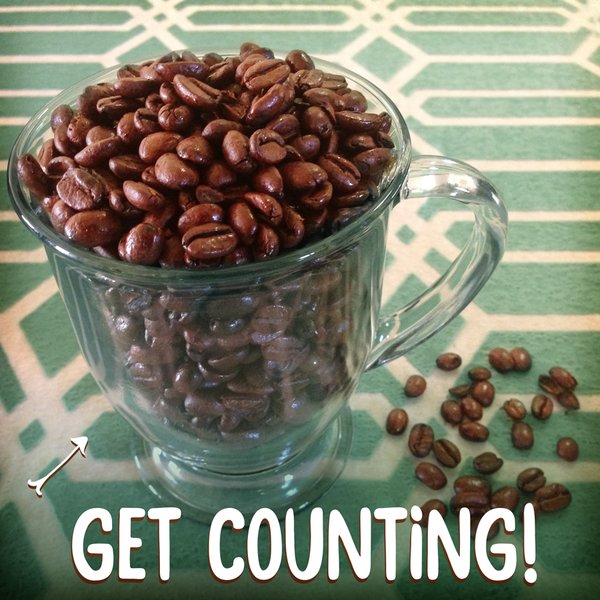
Estimating beans in a jar often involves volume calculations.
Step 1: Measure Your Container's Internal Volume
First, determine how much your container can hold. Use cubic centimeters (cm³) or milliliters (ml), where 1 ml = 1 cm³.
- Regular Shapes (Cylinders, Boxes): Measure dimensions (length, width, height, radius) with a ruler.
- Cylinder Volume = \( \pi \times \text{radius}^2 \times \text{height} \)
- Box Volume = \( \text{length} \times \text{width} \times \text{height} \)
- Irregular Shapes: Fill the container with water, then pour the water into a measuring cup or beaker to read the volume directly.
Step 2: Use an Average Coffee Bean Volume
Coffee beans vary, but we can use an average. Most sources suggest a single roasted coffee bean occupies approximately 0.13 to 0.15 cubic centimeters (cm³). Using 0.14 cm³ is a reasonable average for estimation.
Step 3: Account for Packing Density
Beans don't fit together perfectly; there are air gaps. This is called packing density. Coffee beans typically fill about 60% to 70% of the container's volume. Use a packing density factor of 0.65 (or 65%) as a good general estimate.
Step 4: Calculate Your Estimate
Use this formula:
\[ \text{Estimated Number of Beans} = \frac{(\text{Container Volume in cm}^3) \times (\text{Packing Density Factor})}{(\text{Average Volume per Bean in cm}^3)} \]Example:
- Your container holds 1500 ml (which is 1500 cm³).
- Average bean volume = 0.14 cm³.
- Packing density factor = 0.65.
This gives you a solid estimate without needing any specialized equipment beyond a measuring cup or ruler.
Method 2: The Weight Wizard - Estimating with a Scale
Use a kitchen scale for a straightforward calculation.
If you have a kitchen scale, estimating by weight can be very simple and quite accurate, provided you use a reasonable average weight per bean.
Step 1: Weigh Your Coffee Beans
- Place the container with beans on the scale and note the total weight.
- Empty the container and weigh the empty container.
- Subtract the empty container's weight from the total weight to get the net weight of the beans only. Ensure your scale is set to grams (g).
Step 2: Use an Average Coffee Bean Weight
The weight of a single coffee bean varies by origin, varietal, and roast level. However, a commonly cited average for a roasted coffee bean is around 0.13 to 0.15 grams (g). Lighter roasts tend to be slightly heavier (denser) than darker roasts. Using 0.14 g per bean is a practical average.
Step 3: Calculate Your Estimate
The formula is simple:
\[ \text{Estimated Number of Beans} = \frac{\text{Total Weight of Beans (g)}}{\text{Average Weight per Bean (g/bean)}} \]Example:
- Your beans weigh 450 grams.
- Average bean weight = 0.14 g/bean.
This method is quick and easy if a scale is available.
Method 3: The Sample Scaler - Estimating by Counting a Small Batch
Count beans in a small volume and scale up proportionally.
This method is highly intuitive and bypasses the need for average bean size or weight estimates, relying instead on a direct count from a representative sample.
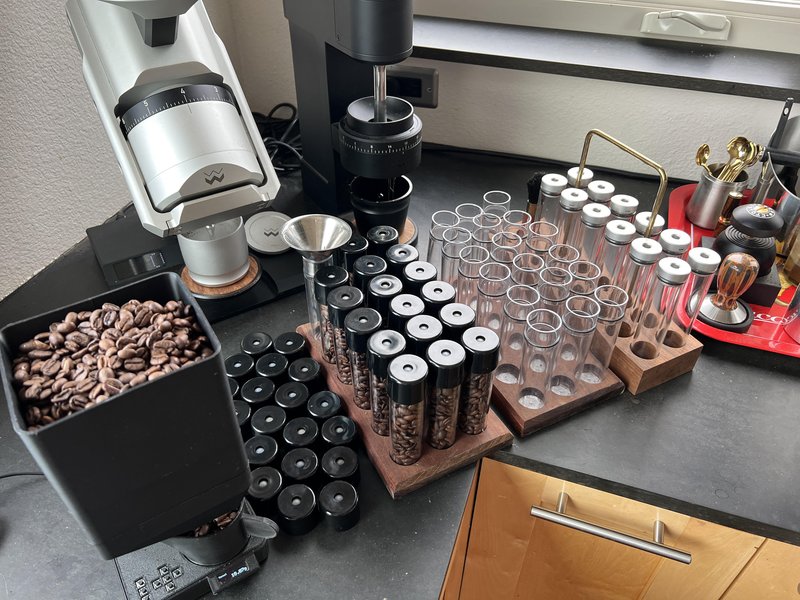
Counting a small sample is a practical way to estimate the total.
Step 1: Measure Your Container's Total Volume
As in Method 1, determine the total internal volume of your main container (in ml or cm³).
Step 2: Take and Measure a Small Sample Volume
Use a small measuring cup (e.g., 1/4 cup, which is about 59 ml) or a measuring spoon (e.g., a tablespoon, about 15 ml). Fill it level with beans from your container. Note the volume of this sample cup/spoon.
Step 3: Count the Beans in Your Sample
Carefully count the exact number of beans in the sample volume you just measured.
Step 4: Scale Up Your Count
Use ratios to estimate the total number of beans:
\[ \text{Estimated Total Beans} = \frac{(\text{Number of Beans in Sample})}{(\text{Volume of Sample})} \times (\text{Total Container Volume}) \]Make sure the sample volume and total container volume are in the same units (e.g., both in ml or both in cm³).
Example:
- Your container's total volume = 1500 ml.
- You took a 1/4 cup sample (approx. 59 ml).
- You counted 410 beans in the sample.
This method directly reflects the characteristics of *your specific beans* and how they pack, potentially offering good accuracy if the sample is representative.
Comparing the Estimation Methods
Which method is best for you?
Each estimation method has its pros and cons regarding ease of use, required tools, and potential accuracy. The radar chart below provides a visual comparison based on key factors. Higher scores indicate better performance for that factor (e.g., a higher score for 'Ease' means the method is easier).
As the chart suggests, the Volume & Packing Density method and the Sample Counting method are generally easier if you don't have a scale and require fewer specialized tools. The Sample Counting method might offer better accuracy as it uses your specific beans, reducing sensitivity to variations in type or roast. The Weight-Based method is simple and potentially accurate *if* you have a reliable scale and a good estimate for the average bean weight.
Mindmap of Estimation Approaches
Visualizing the paths to your bean count estimate.
This mindmap illustrates the different strategies discussed for estimating the number of coffee beans in your container.
(~0.13-0.15 cm³)"] M1_3["Apply Packing Density
(~0.6-0.7)"] M1_4["Calculate:
(Vol * Density) / Bean Vol"] M1_5["Pros: No scale needed"] M1_6["Cons: Relies on averages"] M2["Weight-Based"] M2_1["Weigh Net Beans (Requires Scale)"] M2_2["Use Avg. Bean Weight
(~0.13-0.15 g)"] M2_3["Calculate:
Total Weight / Avg. Weight"] M2_4["Pros: Simple calculation"] M2_5["Cons: Needs scale, relies on avg."] M3["Sample Counting"] M3_1["Measure Container Volume"] M3_2["Measure Sample Volume"] M3_3["Count Beans in Sample"] M3_4["Calculate:
(Sample Count / Sample Vol) * Total Vol"] M3_5["Pros: Uses actual beans, no avg. needed"] M3_6["Cons: Requires careful counting"] FACTORS["Factors Affecting Accuracy"] F1["Bean Type & Size"] F2["Roast Level"] F3["Packing Method"] F4["Measurement Precision"]
Key Parameters for Calculations
Reference values for your estimates.
While using data specific to your beans is best, these typical values can be used for the estimation methods:
| Parameter | Typical Range / Value | Unit | Notes |
|---|---|---|---|
| Average Roasted Bean Weight | 0.13 - 0.15 | grams (g) | Darker roasts are generally lighter per bean. |
| Average Roasted Bean Volume | 0.13 - 0.15 | cubic centimeters (cm³) | Larger beans (e.g., Maragogipe) will have higher volume. |
| Packing Density Factor | 0.60 - 0.70 (use ~0.65) | dimensionless | Represents the fraction of space occupied by beans (vs. air). |
| Bulk Density (Roasted Beans) | 0.32 - 0.48 | grams per milliliter (g/ml) | Varies significantly with roast level (Dark: ~0.32-0.38, Light: ~0.45-0.48 g/ml). Used in some alternative methods (Answer D). |
Factors Influencing Accuracy
What can affect your estimate?
Keep in mind that these are estimations. Several factors can introduce variability:
- Bean Variety and Origin: Beans come in different sizes and shapes (e.g., small Ethiopian beans vs. larger Colombian Supremo).
- Roast Level: Darker roasts expand more and are less dense than lighter roasts, meaning fewer dark roast beans occupy the same volume or weight.
- Bean Uniformity: If your beans vary significantly in size within the batch, averages become less reliable.
- How Beans are Settled: Tapping or shaking the container causes beans to settle, increasing packing density and thus the total number of beans that fit.
- Measurement Precision: Accuracy in measuring volume or weight is crucial.
While perfect accuracy isn't the goal, being aware of these factors helps understand potential margins of error, which could be around ±10-15%.
Watch: Counting Beans by Weight
See an example of relating weight to bean count.
This video discusses the number of coffee beans found in a standard 250-gram bag. While it doesn't demonstrate the estimation techniques directly on a container, it provides a real-world example of bean counts relative to weight, which is the core idea behind the weight-based estimation method. It helps visualize the scale involved – thousands of beans in a typical retail bag.
Video discussing bean counts in a 250g bag.
Frequently Asked Questions (FAQ)
Quick answers to common queries.
How accurate are these estimation methods?
Which method is truly the *easiest*?
Does the type of coffee bean or roast level significantly change the estimate?
What if my container is an unusual shape?
Recommended Further Exploration
Dive deeper into related coffee topics.
- How does coffee bean density vary by roast level?
- What is the best way to store coffee beans to maintain freshness?
- How many grams of coffee beans are needed per cup?
- Calculate volume of irregular shapes using water displacement
References
Sources used for this information.
 amazon.com
Last updated May 4, 2025