
Unveiling the EU ETS Engine: How the Linear Reduction Factor Shrinks Emissions
Delving into the calculation of the LRF and the crucial reference level that underpins Europe's ambitious climate goals.
The European Union Emissions Trading System (EU ETS) is a cornerstone of the EU's policy to combat climate change. It operates on a "cap and trade" principle, limiting greenhouse gas emissions from over 10,000 installations in the power sector, manufacturing industry, and airlines operating within Europe. A key instrument in progressively lowering this cap is the Linear Reduction Factor (LRF). Understanding how the LRF is calculated and the significance of its reference level is crucial to grasping the EU's strategy for decarbonization.
Key Insights at a Glance
- The Linear Reduction Factor (LRF) dictates the fixed annual percentage by which the total EU ETS emissions cap is reduced, ensuring a steady decline in permissible emissions.
- The Reference Level for LRF calculations is the average total volume of emission allowances issued annually during the 2008-2012 period, serving as a stable baseline for reductions.
- LRF rates have significantly increased over time, from 1.74% (2013-2020) to 2.2% (2021-2023), and are set to 4.3% (2024-2027) and 4.4% (2028 onwards) to meet more ambitious climate targets, aiming for a 62% emissions reduction in ETS sectors by 2030 compared to 2005 levels.
What is the Linear Reduction Factor (LRF)?
The Linear Reduction Factor (LRF) is a pivotal mechanism within the EU ETS designed to ensure a consistent and predictable decrease in the total number of emission allowances (EUAs) available in the market each year. Each allowance grants the holder the right to emit one tonne of carbon dioxide equivalent (CO2e). By systematically reducing the supply of these allowances, the LRF drives scarcity, which in turn encourages investment in cleaner technologies and more efficient processes, thereby contributing to the EU's overall greenhouse gas emission reduction targets.
The LRF essentially sets the pace for decarbonisation within the sectors covered by the EU ETS. Its consistent application provides a clear long-term signal to businesses about the increasing stringency of emissions limits, fostering strategic planning for a low-carbon future.
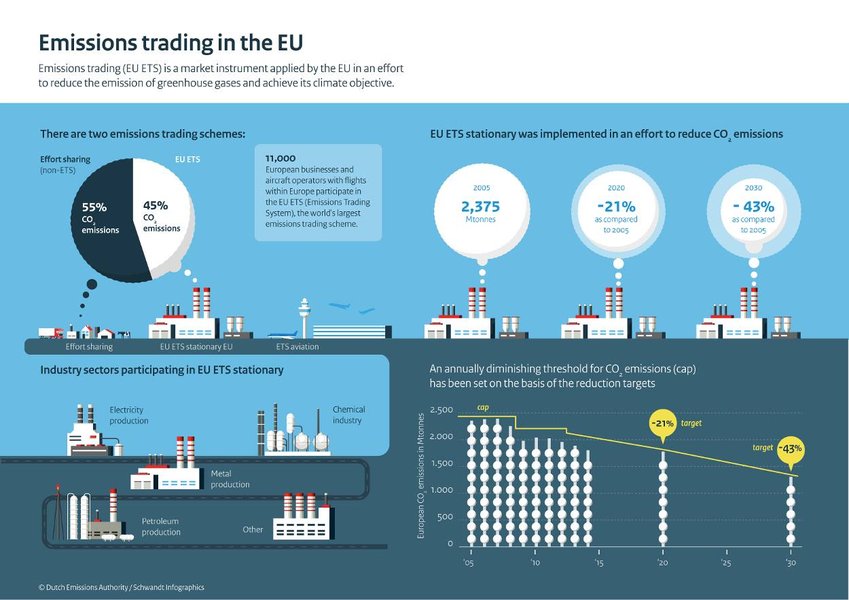
An overview of how the EU Emissions Trading System functions.
Calculating the Linear Reduction Factor
The calculation of the LRF's impact on the emissions cap involves two primary components: the reference level (or baseline cap) and the annually applied reduction percentage.
The Reference Level: A Fixed Anchor
The reference level is the starting point from which the annual reductions are calculated. It is defined as the average total volume of allowances issued annually under the EU ETS during the period 2008 to 2012. This period was chosen to represent a relatively stable historical emissions baseline before more significant reduction measures took hold.
Precisely, this reference level is approximately 1,867 million tonnes of CO2 equivalent (MtCO2e). It's important to note that this baseline remains fixed; the LRF percentage is applied to this original figure each year, rather than to the previous year's reduced cap. This ensures a consistent absolute reduction in allowances annually.
For example, the annual reduction in allowances is determined by the formula:
\[ \text{Annual Cap Reduction (in MtCO2e)} = \text{LRF Rate} \times \text{Reference Level (approx. 1,867 MtCO2e)} \]This fixed reduction amount is then subtracted from the cap of the preceding year to determine the new, lower cap for the current year.
Evolution of the LRF Percentage
The LRF percentage itself is not static; it has been revised upwards over the different trading phases of the EU ETS to align with the EU's increasingly ambitious climate targets, particularly under the "Fit for 55" package, which aims for at least a 55% net reduction in EU-wide greenhouse gas emissions by 2030 compared to 1990 levels. For the ETS sectors specifically, the goal is a 62% reduction by 2030 compared to 2005 levels.
The LRF has evolved as follows:
- Phase 3 (2013-2020): The LRF was set at 1.74% per year. This corresponded to an annual reduction of approximately 38 million allowances.
- Phase 4 (2021-2030) - Initial: From 2021 to 2023, the LRF was increased to 2.2% per year.
- Phase 4 (2021-2030) - Revised (Fit for 55): Following the 2023 revision of the ETS Directive, the LRF has been significantly strengthened:
- From 2024 to 2027, the LRF is 4.3% per year.
- From 2028 onwards (until at least 2030), the LRF will be 4.4% per year.
These escalating LRF values mean that the emissions cap is decreasing at a much faster rate in the current decade, pushing industries to accelerate their decarbonization efforts.
One-Off Cap Reductions (Rebasing)
In addition to the annual linear reduction, the cap has also been subject to "rebasing" – one-off reductions to bring it more swiftly in line with actual emission levels and reduction goals. For instance:
- In 2024, the cap was reduced by an additional 90 million allowances.
- In 2026, a further reduction of 27 million allowances is scheduled.
These rebasing events work in tandem with the LRF to tighten the cap effectively.
The EU ETS Cap Trajectory and LRF Values
The following table summarizes the evolution of the Linear Reduction Factor and its impact on the emissions cap within the EU ETS framework:
| Trading Phase | Period | Linear Reduction Factor (LRF) | Key Implication for Emissions Cap |
|---|---|---|---|
| Phase 3 | 2013-2020 | 1.74% per year | Moderate annual decrease, leading to a cap of approx. 1,816 MtCO2e in 2020. |
| Phase 4 | 2021-2023 | 2.2% per year | Increased pace of reduction compared to Phase 3. |
| 2024-2027 | 4.3% per year | Significant acceleration in cap reduction due to "Fit for 55" reforms. Includes a one-off reduction of 90 million allowances in 2024. | |
| 2028-2030 (and beyond) | 4.4% per year | Continued steep reduction path. Includes a one-off reduction of 27 million allowances in 2026. Aims for a 62% ETS emissions cut by 2030 (vs. 2005). |
This structured decrease in available allowances is designed to ensure that the EU ETS contributes effectively to achieving the Union's climate neutrality objective by 2050.
Visualizing Key EU ETS Drivers
The effectiveness of the EU ETS is influenced by several interconnected factors. The radar chart below illustrates some of these key drivers, with the Linear Reduction Factor's stringency being a central element. A higher value indicates a stronger positive influence on achieving emission reduction goals.
This chart compares the perceived strength of these drivers in the current, more ambitious phase of the EU ETS (post "Fit for 55" reforms) against a previous phase. The increased LRF stringency is clearly a major factor in the enhanced potential of the current system.
Understanding the EU ETS Ecosystem
The Linear Reduction Factor and its reference level are integral parts of a larger, complex system. The mindmap below illustrates the core mechanisms of the EU Emissions Trading System and how the LRF fits into the broader picture of achieving climate targets.
4.3% (2024-27)
4.4% (2028+)"] id3["Reference Level"] id3a["Avg. Emissions 2008-2012"] id3b["Approx. 1,867 MtCO2e"] id3c["Fixed Baseline for Calculations"] id4["Emission Allowances (EUAs)"] id4a["1 EUA = 1 tonne CO2e"] id4b["Auctioned or Freely Allocated"] id4c["Traded on Carbon Market"] id5["System Goals & Impacts"] id5a["Reduce Greenhouse Gas Emissions"] id5b["Meet EU Climate Targets (-62% by 2030 vs 2005 for ETS sectors)"] id5c["Incentivize Low-Carbon Investment"] id5d["Generate Revenue for Climate Action"] id6["Key Supporting Mechanisms"] id6a["Market Stability Reserve (MSR)"] id6b["Innovation Fund & Modernisation Fund"] id6c["Carbon Border Adjustment Mechanism (CBAM)"]
This mindmap highlights how the LRF, by acting on the reference level to shrink the cap, creates the scarcity of allowances that underpins the entire market-based approach of the EU ETS, pushing sectors towards decarbonization and fulfilling EU climate objectives.
The EU ETS Explained Visually
For a concise overview of how the EU Emissions Trading System operates and its role in reducing industrial greenhouse gas emissions, the following video provides a helpful explanation. It touches upon the core principles of the system, including the emissions cap which is directly influenced by the Linear Reduction Factor discussed.
This video from the European Commission offers a foundational understanding of the EU ETS, contextualizing the importance of mechanisms like the LRF in achieving cost-effective emissions reductions across the European Union.
Frequently Asked Questions (FAQ)
What is the main purpose of the Linear Reduction Factor (LRF)?
The main purpose of the LRF is to ensure a steady and predictable annual reduction in the total EU ETS emissions cap. This drives down the overall greenhouse gas emissions from covered sectors, helping the EU meet its climate targets by making emission allowances scarcer and thus more valuable over time, incentivizing companies to reduce their emissions.
Why was the 2008-2012 period chosen for the reference level?
The 2008-2012 period was chosen as the reference for establishing the baseline cap because it represented a period of relatively stable, verified emissions data across the EU ETS sectors before more substantial reduction measures and market reforms (like the introduction of auctioning as the primary allocation method in Phase 3) took full effect. This provides a consistent historical benchmark for calculating reductions.
How does the LRF affect the price of carbon allowances?
By reducing the supply of allowances each year, the LRF contributes to their scarcity. Assuming demand for allowances remains stable or increases, this reduction in supply generally puts upward pressure on the price of carbon allowances (EUAs). A higher carbon price makes polluting more expensive, thereby strengthening the incentive for companies to invest in emissions reduction technologies and practices.
Are all sectors in the EU ETS subject to the same LRF?
The LRF applies to the overall EU-wide cap for stationary installations. While the general LRF has been harmonized, specific considerations or timelines can apply to newly included sectors. For example, the aviation sector, included in 2012, has its cap reduced by the LRF. Maritime transport, included from 2024, will see its emissions gradually phased into the ETS, and the overall cap was adjusted to reflect this expansion, with the LRF then applying to this new, larger cap.
What happens if the EU decides to adopt even more ambitious climate targets in the future?
If the EU adopts more ambitious climate targets, it is highly likely that the LRF would be reviewed and potentially increased further to ensure the EU ETS contributes its share to these new goals. The EU ETS is designed to be a flexible instrument, and its parameters, including the LRF and cap, are subject to periodic reviews and revisions (as seen with the "Fit for 55" package) to align with evolving climate policy.
Recommended Further Exploration
- What are the implications of the EU ETS 'Fit for 55' reforms for specific industries?
- How does the Market Stability Reserve interact with the Linear Reduction Factor in the EU ETS?
- What is the role of carbon allowance auctioning revenue in funding climate action in EU member states?
- How is the EU ETS being expanded to cover new sectors like maritime transport and buildings & road transport (ETS2)?
References
Last updated May 13, 2025