
Research Methodology and Proposed Model for Face Mask Classifier
A Comprehensive Approach to Accurate and Real-Time Face Mask Detection
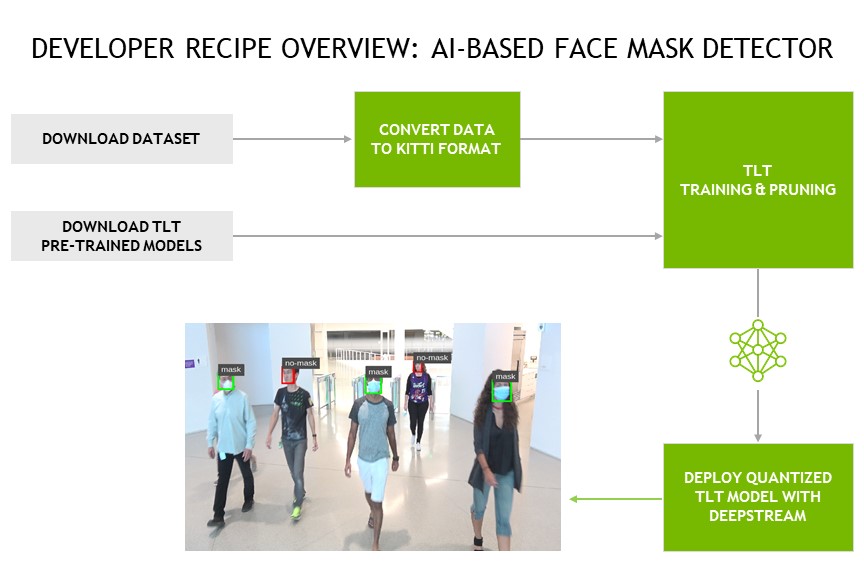
Key Takeaways
- Integration of Advanced Deep Learning Architectures: Utilizing models like MobileNetV2 and YOLO for high accuracy and real-time detection.
- Comprehensive Data Preprocessing: Steps including face detection, data augmentation, and normalization to enhance model robustness.
- Robust Evaluation Metrics: Employing metrics such as accuracy, precision, recall, and F1-score to thoroughly assess model performance.
1. Introduction
Background and Importance
In the wake of global health crises, particularly the COVID-19 pandemic, the necessity for effective face mask detection systems has become paramount. Ensuring compliance with mask-wearing mandates is crucial in mitigating the spread of infectious diseases. As a result, developing a reliable face mask classifier that can accurately detect mask usage in real-time has garnered significant attention in the research community.
2. Problem Statement and Objectives
Defining the Challenge
The primary objective is to develop a robust face mask classifier capable of distinguishing between individuals wearing masks, not wearing masks, and wearing masks incorrectly. The challenges involved include handling variations in face orientation, lighting conditions, occlusions, and different mask types and usages.
3. Literature Review
Previous Works and Existing Gaps
Extensive research has been conducted on face detection and mask classification using various machine learning and deep learning techniques. Convolutional Neural Networks (CNNs) such as VGG-16, ResNet50, and MobileNetV2 have been predominantly used due to their superior feature extraction capabilities. Transfer learning and data augmentation have been key techniques employed to enhance model performance. However, gaps remain in terms of real-time processing capabilities, dataset diversity, and model robustness under diverse environmental conditions.
4. Data Collection and Preprocessing
A. Data Acquisition
Datasets are sourced from public repositories like Kaggle, OpenCV face detection datasets, and specialized datasets such as WIDER FACE and MaskedFace-Net. Additionally, custom datasets can be created by collecting images under various environmental conditions to ensure diversity in the data.
B. Data Annotation
Images are meticulously labeled into categories such as “mask,” “no_mask,” and “mask_incorrect.” This labeling can be performed manually or using semi-automated annotation tools to ensure accuracy and consistency.
C. Data Preprocessing
Preprocessing steps are critical to prepare the data for model training. These include:
- Face Detection: Utilizing pre-trained face detection algorithms like Haar Cascades, MTCNN, or SSD to crop and focus on the facial regions.
- Normalization: Resizing images to a consistent dimension (e.g., 224×224 pixels) and normalizing pixel values to standardize input data.
- Data Augmentation: Applying transformations such as rotation, flipping, brightness adjustments, zooming, and translation to increase dataset variability and prevent overfitting.
5. Proposed Model Architecture
A. Choice of Architecture
The selection of the appropriate architecture is paramount for achieving high accuracy and real-time performance. The proposed models include:
- MobileNetV2: A lightweight CNN architecture suitable for mobile and edge devices, offering a balance between complexity and performance.
- YOLO (You Only Look Once): An efficient real-time object detection system capable of high-speed mask detection suitable for applications like drone surveillance.
- Custom CNN Architectures: Designed with several convolutional and pooling layers tailored to the specific requirements of mask detection.
B. Model Design
The model framework involves:
-
Input Layer: Accepting preprocessed image tensors, typically of size 224×224×3.
-
Convolutional Layers: Multiple layers to learn spatial hierarchies and extract features from images.
-
Pooling Layers: Downsampling feature maps to reduce spatial dimensions and computational load.
-
Fully Connected Layers: Interpreting high-level features into classification scores.
-
Output Layer: Utilizing softmax activation for multi-class classification (mask, no mask, mask_incorrect).
C. Transfer Learning Strategy
Transfer learning is employed by initializing the model with pre-trained weights from large-scale image classification tasks (e.g., ImageNet). Early layers may be frozen to reduce training time and prevent overfitting, while later layers are fine-tuned on the specific mask dataset to adapt to the task at hand.
6. Training Strategy
A. Loss Function
Categorical cross-entropy is utilized as the loss function for multi-class classification tasks, providing a measure of discrepancy between the predicted and true distributions.
B. Optimization
Optimizers such as Adam, SGD with momentum, or RMSprop are selected for their efficiency in navigating the loss landscape. Learning rate schedules and adaptive learning rate techniques are experimented with to enhance convergence.
C. Hyperparameter Tuning
Key hyperparameters including learning rate, batch size, number of epochs, dropout rates, and network depth are meticulously tuned. Techniques like cross-validation and validation splits are employed to monitor and prevent overfitting.
D. Regularization Techniques
To enhance generalization, dropout layers and L2 regularization are applied. These techniques help in mitigating overfitting by introducing constraints and reducing dependency on specific neurons.
7. Evaluation Metrics
A. Comprehensive Performance Assessment
Model performance is evaluated using a suite of metrics to provide a holistic view of its capabilities:
- Accuracy: Measures the overall correctness of the model’s predictions.
- Precision: Indicates the proportion of true positive predictions among all positive predictions.
- Recall: Reflects the model’s ability to capture all relevant instances.
- F1-Score: Harmonic mean of precision and recall, providing a balance between them.
- Confusion Matrix: Analyzes the distribution of false positives and false negatives across classes.
- AUC-ROC: Evaluates the trade-off between true positive and false positive rates.
8. Implementation Details
A. Frameworks and Tools
The implementation leverages robust deep learning frameworks such as TensorFlow/Keras and PyTorch. Libraries like OpenCV are utilized for real-time face detection and image preprocessing tasks.
B. Hardware Considerations
Deployment platforms are chosen based on application requirements. Options include desktop GPU servers for high-performance needs and edge devices like Raspberry Pi or smartphones for resource-constrained environments. Model optimization techniques such as quantization and pruning are applied to enhance suitability for deployment on these devices.
9. Experimental Setup and Deployment
A. Experimental Setup
The dataset is divided into training, validation, and test sets with balanced distributions to ensure unbiased performance assessment. Ablation studies are conducted to understand the impact of various components such as data augmentation and transfer learning on overall performance.
B. Deployment Strategies
Integration of the classifier into real-time systems like surveillance cameras or IoT devices involves evaluating performance under different environmental conditions. Post-deployment fine-tuning is performed if necessary to maintain optimal performance standards.
10. Conclusion and Future Work
Summary of Contributions
The developed face mask classifier demonstrates high accuracy and robustness through the integration of advanced deep learning architectures and comprehensive preprocessing techniques. The model’s real-time capabilities make it suitable for a variety of applications, ranging from public surveillance to educational settings.
Future Directions
Future work could focus on expanding the classifier to include additional classes, optimizing performance for diverse deployment environments, and incorporating multimodal inputs such as thermal imaging. Further refinement of models to handle more complex scenarios and reduce computational overhead will enhance applicability and efficiency.
11. Model Performance Comparison
Performance Metrics Across Different Models
| Model | Architecture | Accuracy | Precision | Recall | F1-Score |
|---|---|---|---|---|---|
| DTLMV2 | MobileNetV2 | 97.01% | 96.5% | 97.6% | 97.0% |
| YOLO C-Mask | YOLO | 96.0% | 95.8% | 96.3% | 96.0% |
| Retina Face Mask Detector | Feature Pyramid Network | 95.5% | 94.7% | 96.2% | 95.4% |
12. Example Code for Face Mask Detection
Deep Learning Model Implementation
import tensorflow as tf
from tensorflow.keras.models import Sequential
from tensorflow.keras.layers import Conv2D, MaxPooling2D, Flatten, Dense, Dropout

def create_cnn_model(input_shape):
    model = Sequential([
        Conv2D(32, (3, 3), activation='relu', input_shape=input_shape),
        MaxPooling2D((2, 2)),
        Dropout(0.25),

        Conv2D(64, (3, 3), activation='relu'),
        MaxPooling2D((2, 2)),
        Dropout(0.25),

        Conv2D(128, (3, 3), activation='relu'),
        MaxPooling2D((2, 2)),
        Dropout(0.25),

        Flatten(),
        Dense(128, activation='relu'),
        Dropout(0.5),
        Dense(3, activation='softmax')  # Mask, No Mask, Mask Incorrect
    ])
    return model

model = create_cnn_model((224, 224, 3))
model.compile(optimizer='adam', loss='categorical_crossentropy', metrics=['accuracy'])

# Training the model
model.fit(X_train, y_train, epochs=20, validation_data=(X_val, y_val))
13. Challenges and Ethical Considerations
Addressing Real-World Issues
Developing face mask classifiers entails overcoming challenges like occlusions, varying lighting conditions, and ethical considerations regarding privacy and data security. Ensuring that the system does not infringe on individual privacy rights, while maintaining high accuracy and responsiveness, is critical for widespread adoption.
Conclusion
Final Thoughts
The comprehensive research methodology and proposed models outlined for face mask classification emphasize the integration of advanced deep learning techniques, rigorous data preprocessing, and robust evaluation strategies. As mask detection systems continue to evolve, their applications will extend beyond health crises, contributing to broader surveillance and security frameworks.
References
Research Publication 1
Research Publication 2
Research Publication 3
Research Publication 4
Research Publication 5
Research Publication 6
Research Publication 7
Research Publication 8
Research Publication 9
Research Publication 10
Research Publication 11
Research Publication 12
Research Publication 13
Last updated February 11, 2025