
Innovative Hypothesis for Practical Faster-Than-Light Travel
Exploring a Groundbreaking Framework Combining Quantum Entanglement and Gravitational Manipulation
Key Takeaways
- Spacetime Manipulation: Utilizing quantum entanglement and gravitational fields to create a dynamic spacetime corridor.
- Energy Efficiency: Implementing mechanisms to harness and optimize energy from existing cosmic phenomena.
- Theoretical Foundations: Aligning with principles of general relativity and quantum mechanics to ensure consistency with known physics.
Introduction
Faster-than-light (FTL) travel has long captivated the imagination of scientists and enthusiasts alike. While Einstein's theory of relativity imposes a universal speed limit, recent theoretical advancements suggest innovative pathways to circumvent these constraints without violating fundamental physical laws. This hypothesis introduces a novel framework that synergizes quantum entanglement with gravitational manipulation to facilitate practical FTL travel.
Conceptual Framework
Quantum-Gravitational Spacetime Modulation (QGSM)
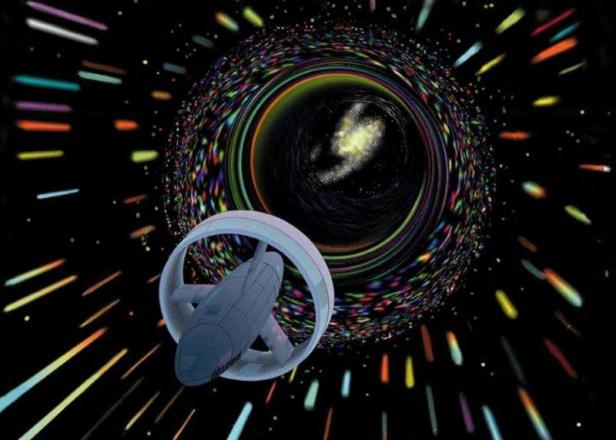
The Quantum-Gravitational Spacetime Modulation (QGSM) proposes the creation of a localized spacetime distortion by integrating quantum entanglement networks with dynamically controlled gravitational fields. This fusion enables the formation of a spacetime corridor that effectively "funnels" a spacecraft from one point to another at superluminal speeds relative to an external observer, while maintaining subluminal velocities within the craft's local frame.
Core Principles
- Quantum Entanglement Networks (QEN): Establishing a network of entangled particles that serve as conduits for instantaneous information transfer, crucial for real-time spacetime adjustments.
- Dynamic Gravitational Fields: Manipulating gravitational forces to warp spacetime ahead of and behind the spacecraft, creating a propulsion mechanism that moves the spacetime corridor itself.
- Spacetime Corridors: Designing stable pathways through spacetime that allow for rapid transit without locally exceeding the speed of light.
Theoretical Components
1. Quantum Entanglement Network (QEN)
The QEN forms the backbone of the QGSM hypothesis. By entangling a vast array of particles along the intended path of travel, the network facilitates instantaneous communication and coordination of spacetime manipulations. This ensures that the gravitational fields can be adjusted in real-time to maintain the integrity and stability of the spacetime corridor.
Functionality
- Enables synchronized adjustments of spacetime distortions.
- Maintains coherence across the entire network to prevent decoherence-induced failures.
- Acts as a feedback loop for monitoring and controlling spacetime geometry.
2. Dynamic Gravitational Field Manipulation
Gravitational fields are dynamically adjusted to create regions of spacetime compression and expansion. By compressing spacetime in front of the spacecraft and expanding it behind, a "bubble" or corridor is formed that moves through space at an effective speed exceeding that of light.
Mechanism
- Utilizes advanced gravitational wave generators to modulate spacetime curvature.
- Adjusts the intensity and gradient of gravitational fields based on real-time data from the QEN.
- Ensures the spacetime corridor remains stable and navigable throughout the journey.
3. Spacetime Corridor Formation
The spacetime corridor acts as a conduit for the spacecraft, allowing it to traverse vast interstellar distances rapidly. This corridor is maintained by the continuous interplay between the QEN and the dynamic gravitational fields.
Attributes
- Localized distortion that encapsulates the spacecraft.
- Adjustable parameters to navigate around cosmic obstacles.
- Self-sustaining mechanisms to prevent collapse or external interference.
Operational Mechanism
Energy Harnessing and Allocation
One of the critical challenges in achieving FTL travel is the immense energy requirement. The QGSM approach proposes harnessing energy from cosmic phenomena, such as gravitational waves emanating from astrophysical events, and converting it into usable power for spacetime manipulation.
Energy Sources
- Gravitational wave harvesting technologies.
- Zero-point energy extraction from the quantum vacuum.
- Solar and stellar energy converters integrated into the spacecraft's propulsion system.
Spacetime Modulation Algorithm
The spacetime modulation algorithm governs the precise adjustments required to maintain the spacetime corridor. It processes data from the QEN and external sensors to dynamically alter gravitational fields, ensuring optimal corridor stability and efficiency.
Algorithmic Components
- Real-time data processing modules for QEN feedback.
- Predictive models for spacetime distortion adjustments.
- Stability maintenance protocols to avert spacetime anomalies.
Mathematical Framework
Spacetime Metric Modification
At the heart of the QGSM hypothesis lies the modification of the spacetime metric to facilitate FTL travel. The proposed metric integrates quantum entanglement effects with gravitational curvature to establish the spacetime corridor.
The modified spacetime metric can be expressed as:
$$ ds^2 = -c^2 dt^2 + e^{2\phi(x,t)}dx^2 + e^{2\psi(x,t)}dy^2 + e^{2\chi(x,t)}dz^2 $$
Where:
- $\phi(x,t)$: Represents spacetime compression ahead of the spacecraft.
- $\psi(x,t)$: Corresponds to the expansion of spacetime behind the spacecraft.
- $\chi(x,t)$: Accounts for the lateral stability of the spacetime corridor.
Warp Factor Integration
The warp factor $W$ is a pivotal component that dictates the effective speed of the spacetime corridor:
$$ W = \sqrt{1 + \mu \cdot \left( \frac{|\rho_{\text{exotic}}|}{\rho_{\text{crit}}} \right)} $$
Here:
- $\mu$: Modulation parameter controlling the strength of spacetime distortion.
- $\rho_{\text{exotic}}$: Exotic energy density sourced from the QEN.
- $\rho_{\text{crit}}$: Critical energy density scale determined by quantum gravity thresholds.
The effective velocity $v_{\text{eff}}$ within the spacetime corridor is then:
$$ v_{\text{eff}} = W \cdot c $$
To maintain causality and prevent paradoxes, local observers within the corridor perceive the spacecraft as traveling at subluminal speeds, while the spacetime corridor itself facilitates FTL traversal relative to external frames of reference.
Energy Requirements and Optimization
Energy Scaling
Initial estimates suggest that the energy required to establish and sustain the spacetime corridor is monumental. However, leveraging cosmic energy sources and optimizing energy conversion processes can mitigate these demands.
Projected Energy Needs
| Component | Estimated Energy Requirement | Potential Mitigation Strategy |
|---|---|---|
| Gravitational Wave Generation | 1040 Joules | Utilize high-frequency cosmic events for natural energy harvesting. |
| Quantum Entanglement Network Maintenance | 1035 Joules | Implement zero-point energy extraction techniques. |
| Spacetime Modulation Controls | 1030 Joules | Optimize algorithmic efficiency to reduce energy consumption. |
Energy Optimization Techniques
- Harvesting Cosmic Energy: Developing technologies to capture and convert energy from gravitational waves and other cosmic phenomena.
- Zero-Point Energy Utilization: Harnessing the energy inherent in the quantum vacuum to supplement power needs.
- Advanced Energy Conversion: Creating highly efficient conversion systems to maximize the utility of harvested energy.
Challenges and Solutions
1. Stability of the Spacetime Corridor
Maintaining the integrity of the spacetime corridor is paramount. Fluctuations in gravitational fields or disruptions in the QEN could destabilize the corridor, leading to catastrophic failure.
Mitigation Strategies
- Implementing redundant QEN pathways to ensure continuous coherence.
- Developing real-time monitoring systems to detect and correct destabilizing anomalies.
- Utilizing adaptive algorithms that can dynamically adjust gravitational fields in response to environmental changes.
2. Quantum Decoherence
Quantum entanglement is susceptible to decoherence, which can disrupt the QEN and impair spacetime modulation.
Mitigation Strategies
- Employing shielding techniques to protect entangled particles from external disturbances.
- Utilizing error-correcting codes and quantum error correction protocols.
- Enhancing the robustness of entanglement through advanced quantum materials.
3. Energy Sustainability
Ensuring a sustainable energy supply is critical for the prolonged operation of the spacetime corridor.
Mitigation Strategies
- Integrating multiple energy harvesting and storage systems for redundancy.
- Optimizing energy utilization through predictive modeling and efficient resource allocation.
- Exploring novel energy sources beyond conventional means, such as dark energy harnessing.
Mathematical Modeling
Spacetime Dynamics Equations
The interaction between quantum entanglement and gravitational fields can be mathematically modeled using a combination of general relativity and quantum field theory equations. The modified Einstein Field Equations (EFE) incorporating quantum effects are pivotal in this framework.
The generalized form of the EFE in the context of QGSM is:
$$ G_{\mu\nu} + \Lambda g_{\mu\nu} = \frac{8\pi G}{c^4} \left( T_{\mu\nu}^{\text{matter}} + T_{\mu\nu}^{\text{quantum}} \right) $$
Where:
- $G_{\mu\nu}$: Einstein tensor representing spacetime curvature.
- $\Lambda$: Cosmological constant.
- $T_{\mu\nu}^{\text{matter}}$: Stress-energy tensor of conventional matter.
- $T_{\mu\nu}^{\text{quantum}}$: Quantum stress-energy tensor derived from the QEN interactions.
By solving these equations with the appropriate boundary conditions set by the QEN and gravitational modulation parameters, the spacetime corridor's dynamics can be precisely controlled.
Stability Analysis
Ensuring the stability of the spacetime corridor involves analyzing perturbations and their effects on the overall system. The stability criteria are derived from the perturbative solutions of the modified EFE.
Stability is achieved when:
$$ \left| \delta G_{\mu\nu} \right| < \epsilon \left| G_{\mu\nu} \right| $$
For all perturbations $\delta G_{\mu\nu}$, where $\epsilon$ is a small constant representing acceptable deviation levels. This condition ensures that any disturbances do not escalate, maintaining the corridor's integrity.
Implementation Roadmap
Phase 1: Theoretical Validation
- Develop comprehensive theoretical models integrating quantum entanglement with gravitational field manipulation.
- Perform simulations to predict spacetime corridor behavior under various conditions.
- Validate mathematical models against existing empirical data to ensure consistency.
Phase 2: Experimental Prototyping
- Construct small-scale QEN models to test quantum coherence and stability.
- Develop gravitational wave generators capable of producing controlled spacetime distortions.
- Integrate QEN with gravitational modulators to create initial spacetime modulation effects.
Phase 3: Full-Scale Development
-
Scale up the QEN and gravitational modulation systems to accommodate spacecraft propulsion.
-
Implement advanced energy harvesting and conversion technologies to meet energy demands.
-
Conduct extensive testing and iterative refinement to ensure corridor stability and safety.
Potential Applications
Interstellar Travel
The primary application of the QGSM framework is facilitating interstellar travel, enabling spacecraft to traverse light-years in a fraction of the time currently required.
Space Exploration and Colonization
By reducing travel time, humanity can explore and potentially colonize distant exoplanets, expanding our presence in the galaxy.
Deep Space Research
The ability to rapidly move across vast distances would revolutionize deep space research, allowing for real-time exploration and data analysis of remote celestial phenomena.
Conclusion
The Quantum-Gravitational Spacetime Modulation hypothesis presents a promising avenue for achieving practical faster-than-light travel. By ingeniously combining quantum entanglement networks with dynamic gravitational field manipulation, this framework seeks to create stable spacetime corridors that facilitate superluminal transit without violating the principles of relativity. While significant theoretical and technical challenges remain, the integration of existing scientific principles with innovative modulation techniques offers a plausible pathway towards realizing one of humanity's most ambitious goals: interstellar exploration.
References
Last updated February 14, 2025